Web3 Inside and Outside the Great Wall: The Triple Impact and Solutions for Chinese Entrepreneurs

marsbitОпубликовано 2025-12-17Обновлено 2025-12-17

Введение

Chinese Web3 entrepreneurs, once dominant in the crypto industry with leading exchanges and mining ventures, have seen their global influence decline significantly since the DeFi Summer of 2020. This shift stems from three major challenges: stringent regulatory crackdowns in China, which dismantled local ecosystems and forced migration overseas; a structural bias in venture capital favoring Western projects due to compliance advantages and better exit opportunities; and a mismatch in skill sets, as many Chinese developers excel in B2C applications rather than the infrastructure-focused B2B nature of recent Web3 development. While culturally diverse founders like Hyperliquid’s Jeff Yan show that Chinese-background innovators can still succeed, they often do so by integrating into Western cultural and operational frameworks. The future of crypto entrepreneurship will depend less on geographic origin and more on cross-cultural collaboration, long-term technical commitment, and adaptive resilience in a rapidly evolving regulatory landscape.

Original Author: Hu Tao, ChainCatcher

As the encryption industry becomes increasingly mainstream, Chinese entrepreneurs seem to be moving further away from the center stage.

There was a time when projects founded by Chinese people accounted for half of the industry, including well-known cryptocurrency exchanges such as Binance, OKX, Bybit, Bitget, Gate, HTX, and Bitmart. This was even more true in the mining sector, where projects like Bitmain, Canaan, and Spark Pool held significant positions in the industry. Their commonality is that they were all established in 2017-2018 or even earlier.

Although Changpeng Zhao, Mingxing Xu, Jihan Wu, and Justin Sun are still actively working on the front lines of the industry, after the DeFi Summer boom in 2020, a general consensus has gradually formed: the visibility and influence of the new generation of Chinese entrepreneurs in the global encryption industry have declined, and so far, no leaders comparable to the previous generation of industry figures have emerged. Given this gap, what has happened to the ecosystem of Chinese entrepreneurs? Where are the future opportunities?

Regulatory and Geopolitical Reshaping: The First Impact of Ecological Disruption

The most significant factor over the past five years has been the drastic changes in regulatory and geopolitical environments.

Starting in 2021, China significantly increased its governance efforts on cryptocurrency-related activities, swiftly shutting down previously gray-area scenarios such as trading and mining. In recent market hotspots, almost any popular concept has been flagged by regulators, from earlier ICOs, NFTs, and digital collectibles to recent payment and real-world asset topics. This undoubtedly limits the inflow and support of high-quality resources into the Chinese encryption ecosystem to some extent.

These crackdowns not only accelerated the relocation of mining and exchange businesses but, more importantly, deprived Chinese entrepreneurs of a native market with natural network effects, high talent density, and capital concentration, forcing them to develop in unfamiliar overseas environments.

In the early encryption ecosystem, many explosively growing Chinese projects rapidly accumulated users through the mobilization mechanisms of Chinese internet communities: WeChat group fission, KOL networks, media matrices, offline gatherings... These channels were once one of the most efficient systems for spreading encryption narratives. However, changes in regulatory policies have largely invalidated this system.

What followed was the rapid shift of the industry's power center to Europe and America—the dominance of U.S. compliance, the influx of institutional capital, and the increasing maturity of regulatory frameworks began to shape an industry order vastly different from that of 2017–2018. New narratives, new regulatory landscapes, and new capital structures naturally favor English-speaking markets and compliance-oriented entrepreneurial teams. For example, prediction markets, which have a certain gambling nature, are unlikely to emerge in the Chinese-speaking market environment where gambling is strictly regulated.

In such an industry environment, the new generation of Chinese entrepreneurs also finds it harder to gain "default trust" from global media, regulators, capital, and users, requiring more trial and error costs in areas like marketing and compliance compared to similar European and American projects.

Shift in Capital Preferences: The Second Impact of Ecological Disruption

If the institutional barriers created by regulatory and geopolitical environments are the first impact, then the "structural shift in preferences" from the capital market side further exacerbates the marginalization trend of Chinese entrepreneurs in the new cycle.

In today's industry environment, without strong VC funding and resource support, projects are at a disadvantage in user acquisition, token listings, and narrative building. Chinese entrepreneurs are already at a disadvantage on the funding front.

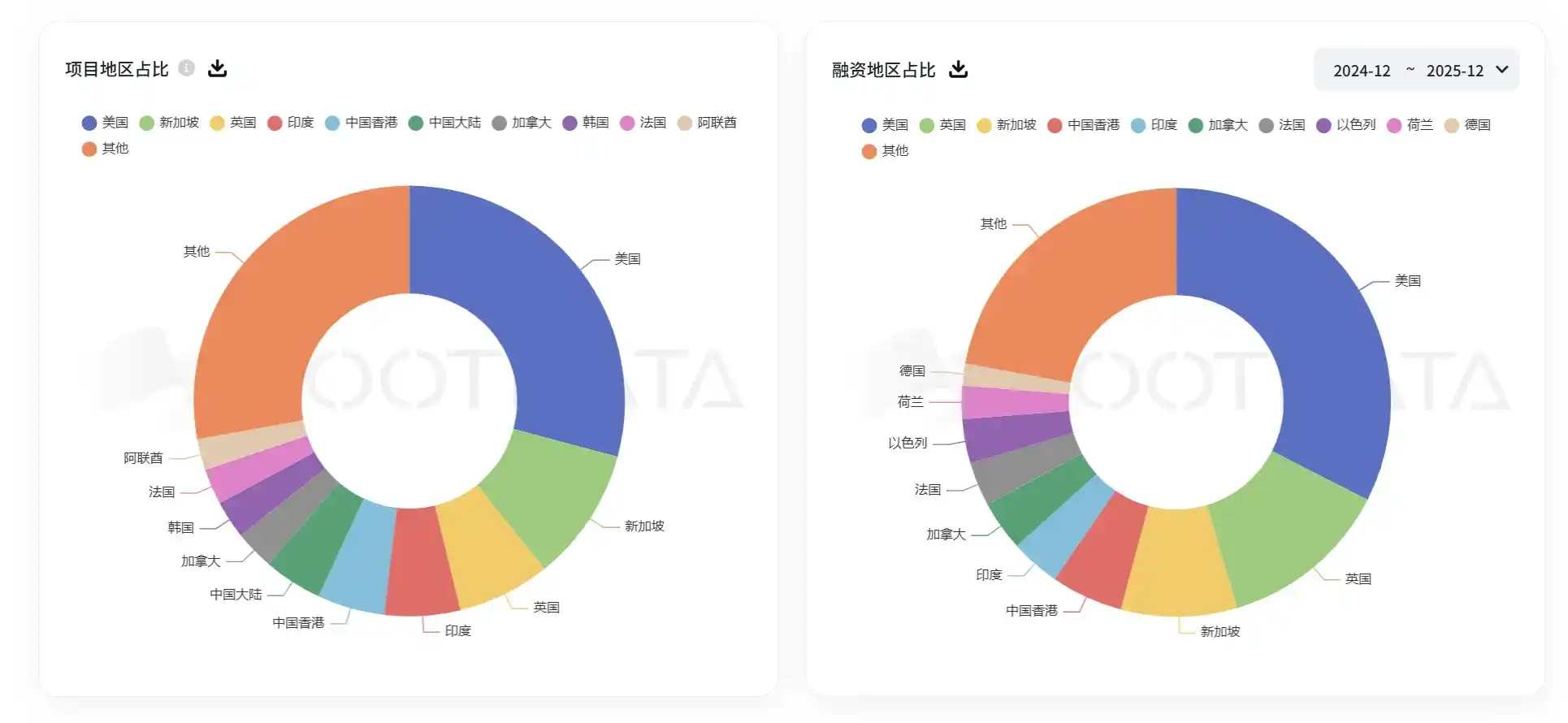
Due to the poor performance of altcoins and a significant decline in investment returns, Chinese-background VCs have largely reduced their investment frequency or even stopped entirely over the past 2-3 years. Chinese entrepreneurs face significant constraints in both financing and exit paths. When dealing with VCs dominated by Europe and America, Chinese projects struggle to gain an advantage due to language and cultural differences. As a result, the amount and number of financings secured by Chinese projects have been declining in recent years.

Industry share of the number and financing amount of projects from mainland China Source: RootData

This year, the encryption industry has seen a wave of IPOs and mergers and acquisitions, with companies like Circle and Gemini successfully listing on U.S. stock exchanges, and Coinbase and Ripple frequently making acquisitions. This has significantly boosted confidence among entrepreneurs and VCs, but these developments have largely bypassed Chinese projects. It can be said that European and American projects are enjoying the institutional dividends of the mainstreaming of the encryption industry.

In the eyes of mainstream capital, European and American projects have inherent advantages in compliance, cultural recognition, and exits. Unless Chinese projects have exceptional team composition and technical background, they are unlikely to win the favor of European and American capital.

Mismatch Between Capability Structure and Industry Maturity: The Third Impact of Ecological Disruption

Over the past decade, the main theme of the encryption industry has been in the infrastructure and tool sectors. Although new concepts like DeFi, NFTs, gaming, and inscriptions have emerged, most have failed to become mainstream projects.

In a previous interview with ChainCatcher, Jason Kam, founder of Folius Ventures, stated that over the past 5 to 10 years, Web3 development has been about laying the foundation, focusing more on product categories and states. This has been a decade biased towards ecology, infrastructure, tools, and consensus-building. In other words, it has been a decade of B2B products.

Europe and America have three generations of extremely talented engineers who are very good at building this B2B ecosystem. In contrast, the Asia-Pacific region mainly has young engineers from the 80s and 90s generations, whose career paths developed alongside the boom of China's B2C industry starting in 2005. In other words, their engineering experience lies in B2C and applications, which is at odds with the development trajectory of blockchain. Therefore, they may not excel in public chains and infrastructure.

"If Asia-Pacific entrepreneurs compete with European and American entrepreneurs on the To C level, I believe Asia-Pacific entrepreneurs have no disadvantages; in fact, they may have advantages. Their advantages lie in their rich product experience and their highly aggressive tactics for capturing market share."

Although Chinese entrepreneurs have proven this in the more Web2-like exchange sector, and in on-chain C-end products, the fleeting success of Stepn demonstrated the talent of Chinese entrepreneurs in C-end products. However, the overall market explosion for consumer-grade products has been slow to arrive, which is closely related to the maturity of industry infrastructure. The market has not yet reached the "comfort zone" of Chinese entrepreneurs.

Entrepreneurs with Multicultural Backgrounds Are Becoming Industry Leaders

Strictly speaking, there have been no new cases of representative Chinese entrepreneurs in recent years. Jeff Yan, the founder of Hyperliquid, is of Chinese descent. His parents are Chinese immigrants, and he was born and raised in Palo Alto, California. He later attended Harvard University, majoring in mathematics and computer science. After graduation, Jeff joined the high-frequency trading giant Hudson River Trading as a quantitative trader. In 2022, Jeff founded Hyperliquid and, with the philosophy of "small but refined," no VC, and user-driven growth, built it into one of the fastest-growing giants in the encryption industry in recent years.

However, although Hyperliquid is one of the most successful projects in this cycle with "Chinese bloodline" participation, it is difficult to see it as a continuation of the influence of Chinese entrepreneurs. Jeff is almost never active in the Chinese ecosystem, projects almost entirely European and American values in the outside world, and has never expressed himself in Chinese. The rise of Jeff and Hyperliquid highlights a fact: in the new cycle, Chinese ancestry can still produce global influence, but it must integrate into the mainstream cultural system rather than rely on the old path of Chinese entrepreneurship. If you rely solely on one cultural system, you can only become a regional leader and cannot achieve excellent results in the globalization process.

In fact, the founders of many well-known Chinese projects that have become sector leaders in this cycle mostly have multicultural backgrounds, having studied in Europe or America at least during their university years. Examples include Sean Ren, founder of Sahara; Yu Hu, founder of Kaito; and Erick Zhang, founder of BuidlPad. Their long-term experiences in Europe and America play an important role in their development paths.

In fact, entrepreneurs with multicultural backgrounds are indeed more popular in the encryption industry. For example, the founders of Ethereum, Solana, and Binance's Changpeng Zhao all immigrated from China and Russia to North American countries during their childhood. The collision of different political systems and cultures allowed these entrepreneurs to recognize the value of blockchain in empowering individual sovereignty earlier and quickly take action. They prioritize cultural inclusivity in team building, resource对接, and daily operations, ultimately making it easier to gain the favor of users from different regional cultural backgrounds.

The inherently borderless nature of encryption and the regulatory and interest demands of various countries will dominate the development trends of the encryption industry for a long time through conflict and磨合. Against the backdrop of multiple conflicts between China and the U.S. and the mainstreaming of the encryption industry, Chinese entrepreneurs indeed face increasing challenges. However, as the encryption industry recently faces skepticism about gambling tendencies, nihilism, and the disproval of more and more project concepts, the development trend of Chinese entrepreneurs may no longer be an important industry question. What truly deserves attention is: as speculative growth and narrative泡沫 gradually recede, who can continue to invest in the long-term value of decentralized technology and redefine the industry's direction through real products and verifiable innovation.

The core competitiveness of the future industry landscape will depend more on whether founding teams possess cross-cultural collaboration capabilities, long-term technological investment capabilities, and institutional understanding and organizational resilience in the face of regulatory uncertainty. Regardless of cultural or national background, those who can persistently excel in these dimensions may become the true beneficiaries of the next cycle. In other words, the path to success in the encryption industry has never depended on "where they come from" but on "what they can achieve."

Связанные с этим вопросы

QWhat are the three major challenges faced by Chinese entrepreneurs in the Web3 industry according to the article?

AThe three major challenges are: 1. Reshaped regulatory and geopolitical environment, 2. Shift in capital preferences, and 3. Mismatch between capability structure and industry maturity.

QHow did the change in China's regulatory policy around 2021 impact the Chinese crypto entrepreneurial ecosystem?

AIt led to the rapid shutdown of previously gray-area scenarios like trading and mining, causing an accelerated migration of mining and exchange businesses overseas. Crucially, it deprived Chinese entrepreneurs of their native market, which had natural network effects, talent density, and capital aggregation advantages, forcing them to develop in unfamiliar overseas environments.

QWhy does the article suggest that capital markets' 'structural preference shift' has marginalized Chinese entrepreneurs?

ABecause powerful VC support is crucial for user acquisition, exchange listings, and narrative building. Chinese-background VCs significantly reduced investment frequency due to poor altcoin performance and low ROI. Facing language and cultural barriers, Chinese projects find it difficult to gain favor with dominant Western VCs, leading to a continued decline in the amount and number of financings they secure.

QWhat is the 'mismatch' between the capability structure of Chinese engineers and the maturity of the Web3 industry?

AThe past decade of Web3 focused on infrastructure and tools (B2B products), which aligns with the strengths of Western engineers. However, primarily '80s and '90s generation Chinese engineers developed their skills during China's B2C industry boom post-2005, giving them more experience in consumer applications, creating a mismatch with the industry's earlier infrastructure-building phase.

QAccording to the article, what is a key characteristic of successful founders in the current cycle, as exemplified by Hyperliquid's Jeff Yan?

AA key characteristic is having a multicultural background and integrating into the mainstream cultural system, rather than relying on old Chinese entrepreneurial paths. Founders with long-term experience in the West (e.g., studying there from university) show greater cultural inclusivity in team building, resource对接, and operations, making it easier to gain favor with users from different cultural backgrounds.

Похожее

Gensyn AI: Don't Let AI Repeat the Mistakes of the Internet

In recent months, the rapid growth of the AI industry has attracted significant talent from the crypto sector. A persistent question among researchers intersecting both fields is whether blockchain can become a foundational part of AI infrastructure. While many previous AI and Crypto projects focused on application layers (like AI Agents, on-chain reasoning, data markets, and compute rentals), few achieved viable commercial models. Gensyn differentiates itself by targeting the most critical and expensive layer of AI: model training. Gensyn aims to organize globally distributed GPU resources into an open AI training network. Developers can submit training tasks, nodes provide computational power, and the network verifies results while distributing incentives. The core issue addressed is not decentralization for its own sake, but the increasing centralization of compute power among tech giants. In the era of large models, access to GPUs (like the H100) has become a decisive bottleneck, dictating the pace of AI development. Major AI companies are heavily dependent on large cloud providers for compute resources. Gensyn's approach is significant for several reasons: 1) It operates at the core infrastructure layer (model training), the most resource-intensive and technically demanding part of the AI value chain. 2) It proposes a more open, collaborative model for compute, potentially increasing resource utilization by dynamically pooling idle GPUs, similar to early cloud computing logic. 3) Its technical moat lies in solving complex challenges like verifying training results, ensuring node honesty, and maintaining reliability in a distributed environment—making it more of a deep-tech infrastructure company. 4) It targets a validated, high-growth market with genuine demand, rather than pursuing blockchain integration without purpose. Ultimately, the boundaries between Crypto and AI are blurring. AI requires global resource coordination, incentive mechanisms, and collaborative systems—areas where crypto-native solutions excel. Gensyn represents a step toward making advanced training capabilities more accessible and collaborative, moving beyond a niche controlled by a few giants. If successful, it could evolve into a fundamental piece of AI infrastructure, where the most enduring value in the AI era is often created.

marsbit11 ч. назад

Gensyn AI: Don't Let AI Repeat the Mistakes of the Internet

marsbit11 ч. назад

Why is China's AI Developing So Fast? The Answer Lies Inside the Labs

A US researcher's visit to China's top AI labs reveals distinct cultural and organizational factors driving China's rapid AI development. While talent, data, and compute are similar to the West, Chinese labs excel through a pragmatic, execution-focused culture: less emphasis on individual stardom and conceptual debate, and more on teamwork, engineering optimization, and mastering the full tech stack. A key advantage is the integration of young students and researchers who approach model-building with fresh perspectives and low ego, prioritizing collective progress over personal credit. This contrasts with the US culture of self-promotion and "star scientist" narratives. Chinese labs also exhibit a strong "build, don't buy" mentality, preferring to develop core capabilities—like data pipelines and environments—in-house rather than relying on external services. The ecosystem feels more collaborative than tribal, with mutual respect among labs. While government support exists, its scale is unclear, and technical decisions appear driven by labs, not state mandates. Chinese companies across sectors, from platforms to consumer tech, are building their own foundational models to control their tech destiny, reflecting a broader cultural drive for technological sovereignty. Demand for AI is emerging, with spending patterns potentially mirroring cloud infrastructure more than traditional SaaS. Despite challenges like a less mature data industry and GPU shortages, Chinese labs are propelled by vast talent, rapid iteration, and deep integration with the open-source community. The competition is evolving beyond a pure model race into a contest of organizational execution, developer ecosystems, and industrial pragmatism.

marsbit13 ч. назад

Why is China's AI Developing So Fast? The Answer Lies Inside the Labs

marsbit13 ч. назад

3 Years, 5 Times: The Rebirth of a Century-Old Glass Factory

Corning, a 175-year-old glass company, is experiencing a dramatic revival as a key player in AI infrastructure, driven by surging demand for high-performance optical fiber in data centers. AI data centers require vastly more fiber than traditional ones—5 to 10 times as much per rack—to handle high-speed data transmission between GPUs. This structural demand shift, coupled with supply constraints from the lengthy expansion cycle for fiber preforms, has created a significant supply-demand gap. Nvidia has invested in Corning, along with Lumentum and Coherent, in a $4.5 billion total commitment to secure the optical supply chain for AI. Corning's competitive edge lies in its expertise in producing ultra-low-loss, high-density, and bend-resistant specialty fiber, which is critical for 800G+ and future 1.6T data rates. Its deep involvement in co-packaged optics (CPO) with partners like Nvidia further solidifies its position. While not the largest fiber manufacturer globally, Corning's revenue from enterprise/data center clients now exceeds 40% of its optical communications sales, and it has secured multi-year supply agreements with major hyperscalers including Meta and Nvidia. Financially, Corning's optical communications revenue has surged, doubling from $1.3 billion in 2023 to over $3 billion in 2025. Its stock price has risen nearly 6-fold since late 2023. Key future catalysts include the rollout of Nvidia's CPO products and the scale of undisclosed customer agreements. However, risks include high current valuations and potential disruption from next-generation technologies like hollow-core fiber. The company's long-term bet on light over electricity, maintained even through the telecom bubble crash, is now being validated by the AI boom.

marsbit13 ч. назад

3 Years, 5 Times: The Rebirth of a Century-Old Glass Factory

marsbit13 ч. назад

Торговля

Спот
Фьючерсы
活动图片