Wall Street’s bid on crypto dominated 2025 but what’s the demand outlook for 2026?

cointelegraphОпубликовано 2025-12-22Обновлено 2025-12-22

Введение

Wall Street's embrace of crypto dominated 2025, with massive institutional inflows into spot Bitcoin ETFs reaching $57 billion. However, the market faced a correction late in the year, raising questions about 2026's demand outlook. Key factors include the continuation of institutional adoption, the impact of AI industry growth on risk assets, and potential regulatory clarity from the Clarity Act. Federal Reserve policy shifts and rate cuts are viewed as bullish, but may collide with a softening job market and rising consumer costs. The performance of tech equities and the monetization of AI investments will also significantly influence crypto markets. Overall, 2026 presents a bullish macro backdrop, but its trajectory hinges on these complex, interconnected narratives.

2025 was a blockbuster year for Bitcoin (BTC) and the wider crypto market as crypto-friendly legislators platformed growth-focused regulation and Wall Street finally accepted Bitcoin, Ether (ETH), and numerous altcoins as a valid asset class worthy of inclusion in an investment portfolio.

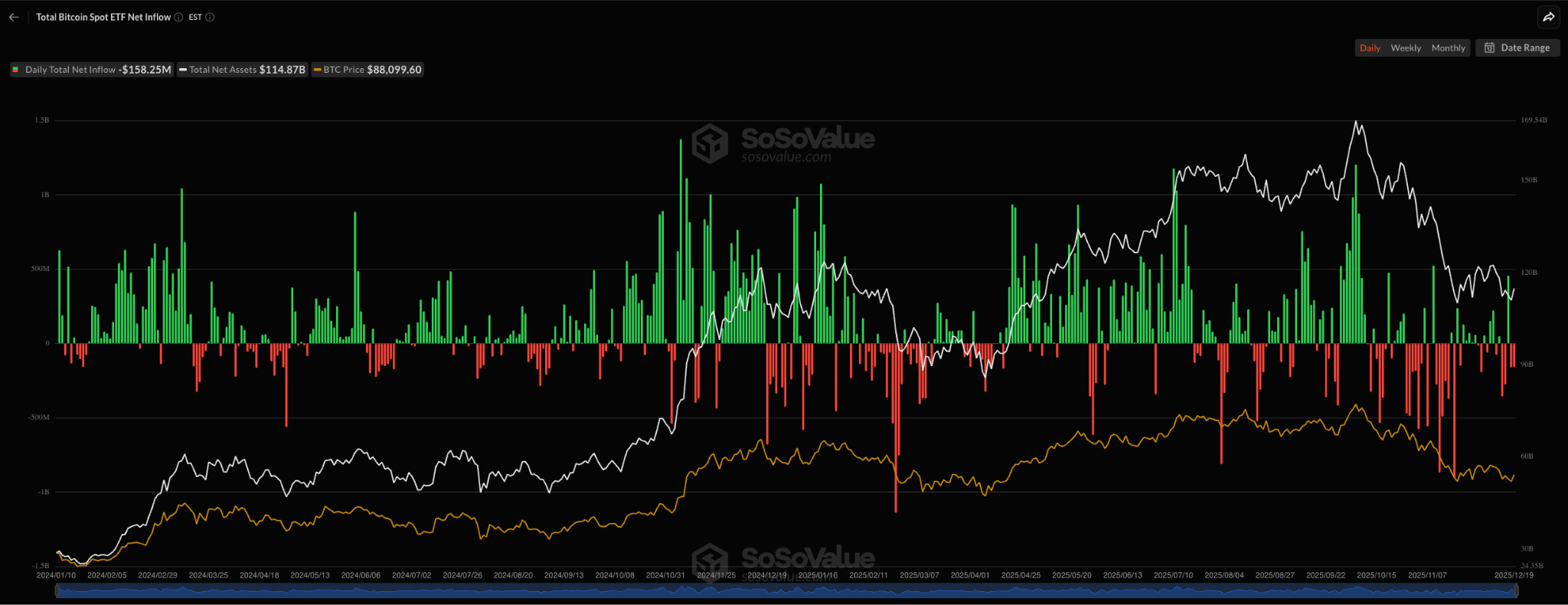
The global bid on Bitcoin, Ether and Solana’s SOL (SOL) token was near immeasurable, with total net flows into the spot Bitcoin ETFs reaching $57 billion and the total net assets across the ETFs reaching $114.8 billion.

Spot Bitcoin ETF netflows in 2025. Source: SoSoValue.com

Going into 2026, the real question is, will the pace of institutional, corporate and government-level adoption, which were critical price drivers in 2025, continue? Since October, the robust inflows to the spot Bitcoin ETF tapered off and, in some cases, turned into a sellers' market for weeks on end, and this was followed by a 30% correction in BTC and 50% in Ether.

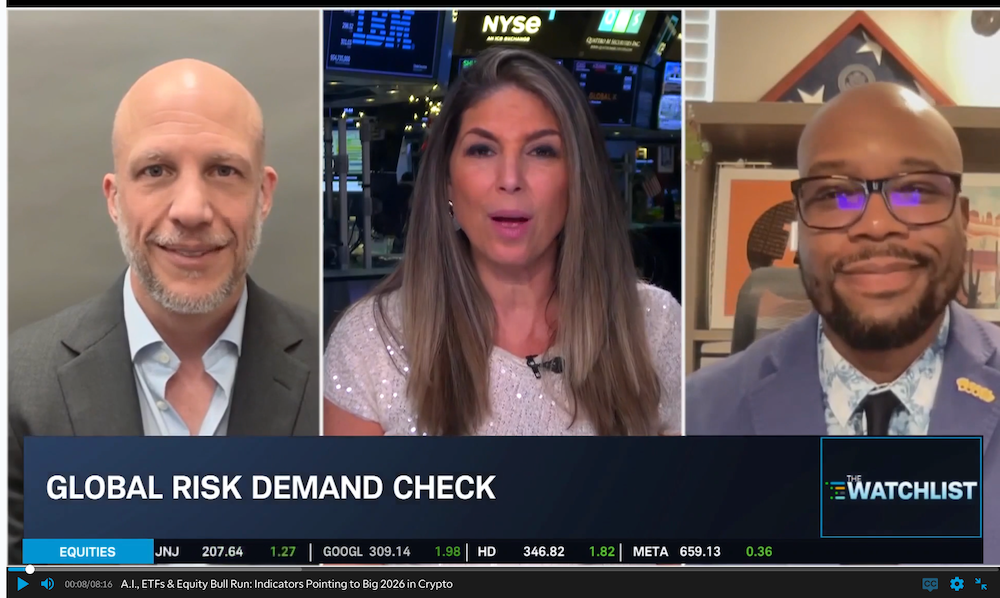
In an interview with Schwab Network’s Nicole Petallides, Cointelegraph Head of Markets Ray Salmond said that the crypto market’s performance in early 2026 will depend on a range of factors.

Given how the narratives surrounding AI, Fed rate cuts, a strategic Bitcoin reserve and ETF flows drove the market, I’m curious to see if the same narratives catalyze price upside in 2026 or will a new narrative need to emerge to bring buyers back into the markets?”

Beyond the ETF flows and demand across spot markets like Binance and Coinbase, investor sentiment regarding the immense size of the AI industry buildout and the performance of the tech-heavy S&P 500 is likely to have a direct impact on crypto markets.

The AI buildout, company valuations, fundraising, IPO performance, and whether datacenter hyperscalers continue to propel the equities markets alongside MAG7 will remain at the forefront of everyone’s mind.

In the interview, Salmond explained that rapid balance sheet expansion was a strategy that supercharged tech-related equities in 2025 as hyperscalers spent double-digit billions on data centers, compute, Nvidia GPUs and energy. At some point in 2026, the expectation will be that these companies demonstrate that they can monetize their investments, or at least finance the expansions from their internal cash flow.

In the latter half of 2025, Oracle, Meta and Nvidia saw their stock prices fall as the market questioned whether there was a chance that some of these companies’ free cash flow could go negative. If investors smell smoke related to debt-heavy, cash-poor AI and quantum computing companies in 2026, there’s likely to be some negative reaction. How these shockwaves carry over to the SPX, DOW, and, by proxy, crypto is something investors will need to keep on the watch list.

Will passing the Clarity Act supercharge altcoins, DeFi and large caps?

A bullish event worth watching in the early part of 2026 will be whether or not the Clarity Act becomes law. The crypto lobby aimed to have this act passed into law before the end of the year, but the lengthy government shutdown delayed progress on hammering it out.

If passed, the Clarity Act will provide clearer rules and the necessary environment for FinTech innovators to sandbox in the US, and the hope is that more offshored crypto businesses will headquarter back in the United States.

It will define which regulatory bodies (SEC and CFTC) have jurisdiction over various crypto assets, depending on whether they are classified as securities or commodities. There’s also a strong emphasis on consumer protections, and a better framework in this area could provide the necessary transparency that businesses and consumers need to confidently invest in crypto assets.

Will a Trump-aligned Fed chair and easy money policy turbocharge markets?

The Federal Reserve’s policy shift is expected to further morph into an easy money regime, and President Trump’s early 2026 Fed chair selection is anticipated to bring up to 100 basis points in rate cuts.

According to Salmond,

“Crypto investors view Fed rate cuts as bullish for risk assets, but we’ve got a Tale of Two Cities scenario where the data collides with the most bullish perspectives.”
AI, ETFs and Equities Bull Run in 2026. Source: Schwab Network

Salmond explained that” the job market is softening and this cooling trend is predicted to carry on in 2026. The 'transitory' impact of the Trump tariffs has resulted in elevated goods and services costs, health insurance premiums will rise, and retail investor confidence may drop as layoffs are announced, consumer debt rises, and disposable income falls.”

At the same time, “investors expect Fed rate cuts to result in lower mortgage rates, compel banks to loosen the purse strings for lending, and lure consumers to go buy more stuff. But, the potential return of easy money policy and big government spending essentially confirms that the US is kicking the debt bomb further down the road.”

Related: JPMorgan explores crypto trading for institutional clients: Report

In Q1 2026, the dilemma investors will have to contend with is whether there are signals that prove that the Fed's easy money trade is being front-run and possibly sold on confirmation, or will the evolving Fed policy also reinvigorate the bull market seen across equities in 2025 and extend to crypto?

Investors who prioritize optionality and a nimble footprint should be able to avoid some of the pitfalls of a narrative and speculation-driven market, where the MAG7 and AI markets could prove to be overvalued.

On paper, the big picture view for 2026 is bullish, especially when considering the Trump economic mandate, Fed policy, and crypto-friendly regulation, but it’s the unknown outcomes of the AI buildout and the actual impact of rate cuts on the consumer and economy that are going to determine the direction markets take in Q1 and Q2.

This article does not contain investment advice or recommendations. Every investment and trading move involves risk, and readers should conduct their own research when making a decision. While we strive to provide accurate and timely information, Cointelegraph does not guarantee the accuracy, completeness, or reliability of any information in this article. This article may contain forward-looking statements that are subject to risks and uncertainties. Cointelegraph will not be liable for any loss or damage arising from your reliance on this information.


Похожее

OpenAI's Largest Internal Wealth Creation: 600 People Cash Out a Total of $6.6 Billion, 75 Take Home the Maximum $30 Million Each

A Wall Street Journal report reveals OpenAI's unprecedented pre-IPO wealth creation. In a single employee stock sale last October, over 600 current and former employees sold shares, collectively cashing out approximately $6.6 billion. Due to high investor demand, the company tripled the individual sale cap to $30 million, with about 75 employees selling the maximum amount. This event represents the largest such transaction in tech industry history for a private company. OpenAI's valuation was $500 billion for this tender offer. Employees with over two years of tenure were eligible, allowing many post-ChatGPT hires their first liquidity event. The company's stock has reportedly grown over 100-fold in seven years. Following a restructuring, employees collectively hold about 26% of OpenAI. The scale of executive wealth is also staggering. In court testimony related to Elon Musk's lawsuit, President and co-founder Greg Brockman confirmed his OpenAI stake is worth around $30 billion. Analysis indicates about 165 current and former employees hold a combined ~$164.9 billion in equity, averaging nearly $1 billion per person in paper wealth. OpenAI's per-employee stock-based compensation is estimated to be 34 times the average of major tech firms before their IPOs. OpenAI continues its rapid ascent, closing a $122 billion funding round at an $852 billion valuation in March. With monthly revenue hitting $2 billion, over 900 million weekly ChatGPT users, and plans for a potential trillion-dollar IPO in late 2026, this wealth-creation engine shows no signs of stopping.

链捕手19 мин. назад

OpenAI's Largest Internal Wealth Creation: 600 People Cash Out a Total of $6.6 Billion, 75 Take Home the Maximum $30 Million Each

链捕手19 мин. назад

Understanding CPO (Co-Packaged Optics) in One Article: Why Nvidia Is Willing to Spend $3.2 Billion on a Fiber?

NVIDIA and Corning announced a multi-year strategic partnership on May 6, 2026, with NVIDIA committing up to $3.2 billion to support Corning's U.S. expansion. This investment will triple Corning's manufacturing plants and significantly boost its optical fiber and communications production capacity. The core driver behind this massive investment is the fundamental shift from copper to optical interconnect technology within AI data centers. As GPU clusters scale, copper wires face critical limitations: severe signal attenuation over distance, high energy consumption for signal integrity, and excessive heat generation. Optical fiber, transmitting light instead of electrical signals, solves these issues with minimal loss, near-light speed, and lower power needs. The article outlines a three-stage evolution of data center interconnect: 1. **Traditional Copper Interconnects:** The mainstream solution of the 2010s, now being phased out due to scaling bottlenecks. 2. **Pluggable Optical Modules:** The current mainstream, where modules convert electrical signals to light externally. This process still introduces energy loss and latency. 3. **CPO (Co-Packaged Optics):** The next-generation technology where the optical engine is integrated directly with the GPU chip package. This drastically reduces the electrical signal travel distance to mere millimeters, slashing power consumption and latency while boosting data density. NVIDIA CEO Jensen Huang has identified CPO as an essential core technology for AI infrastructure. NVIDIA's investment signifies a strategic shift from being a buyer to actively controlling its supply chain for critical components. With demand for specialized optical fiber far outstripping supply—evidenced by soaring prices—securing long-term manufacturing capacity has become a competitive necessity. While Corning's expansion may pressure some suppliers, a projected global fiber supply gap of 5-15% over the next few years creates a significant opportunity window, particularly for Chinese manufacturers competitive in optical preforms, chips, and modules. Ultimately, NVIDIA's move is not about chasing a trend but an engineering imperative. The transition to light-based interconnects like CPO is driven by the physical limits of copper, marking a definitive step in the ongoing AI computing revolution.

marsbit44 мин. назад

Understanding CPO (Co-Packaged Optics) in One Article: Why Nvidia Is Willing to Spend $3.2 Billion on a Fiber?

marsbit44 мин. назад

KOL's Perspective: Why Is SOL Set to Rise from This Point?

**Summary: Why SOL is Positioned for Growth at This Level** The article argues that SOL is poised for an upward move from its current price point, citing several key factors. Primarily, SOL has just broken out of a 4-month consolidation phase. This breakout signals a return of risk appetite to the broader crypto market, as SOL is seen as a key indicator of overall crypto health. The token's ownership has reportedly shifted from short-term traders and tourists to long-term accumulators, leading to low volume. Any meaningful increase in trading activity could thus trigger significant upward momentum. Fundamental strengths include strong institutional adoption, integration with DeFi and RWAs (Real-World Assets), and the potential benefits from the Clarity Act. Despite its high volatility—having dropped 70% from its all-time high but still up 12x from its bear market low—SOL is highlighted as one of the few tokens from the last cycle to reach new highs. It boasts a robust ecosystem of applications, users, and protocols. Future catalysts include the expected influx of AI developers following the Miami Accelerate conference, which focused on AI on Solana. Furthermore, Solana is positioned as the premier chain for memecoin activity, a trend expected to continue and drive network usage and fees. The article concludes that recent price action reflects a healthy transfer to long-term holders, setting the stage for growth.

marsbit1 ч. назад

KOL's Perspective: Why Is SOL Set to Rise from This Point?

marsbit1 ч. назад

Торговля

Спот
Фьючерсы

Популярные статьи

Как купить S

Добро пожаловать на HTX.com! Мы сделали приобретение Sonic (S) простым и удобным. Следуйте нашему пошаговому руководству и отправляйтесь в свое крипто-путешествие.Шаг 1: Создайте аккаунт на HTXИспользуйте свой адрес электронной почты или номер телефона, чтобы зарегистрироваться и бесплатно создать аккаунт на HTX. Пройдите удобную регистрацию и откройте для себя весь функционал.Создать аккаунтШаг 2: Перейдите в Купить криптовалюту и выберите свой способ оплатыКредитная/Дебетовая Карта: Используйте свою карту Visa или Mastercard для мгновенной покупки Sonic (S).Баланс: Используйте средства с баланса вашего аккаунта HTX для простой торговли.Третьи Лица: Мы добавили популярные способы оплаты, такие как Google Pay и Apple Pay, для повышения удобства.P2P: Торгуйте напрямую с другими пользователями на HTX.Внебиржевая Торговля (OTC): Мы предлагаем индивидуальные услуги и конкурентоспособные обменные курсы для трейдеров.Шаг 3: Хранение Sonic (S)После приобретения вами Sonic (S) храните их в своем аккаунте на HTX. В качестве альтернативы вы можете отправить их куда-либо с помощью перевода в блокчейне или использовать для торговли с другими криптовалютами.Шаг 4: Торговля Sonic (S)С легкостью торгуйте Sonic (S) на спотовом рынке HTX. Просто зайдите в свой аккаунт, выберите торговую пару, совершайте сделки и следите за ними в режиме реального времени. Мы предлагаем удобный интерфейс как для начинающих, так и для опытных трейдеров.

1.3k просмотров всегоОпубликовано 2025.01.15Обновлено 2025.03.21

Как купить S

Sonic: Обновления под руководством Андре Кронье – новая звезда Layer-1 на фоне спада рынка

Он решает проблемы масштабируемости, совместимости между блокчейнами и стимулов для разработчиков с помощью технологических инноваций.

2.2k просмотров всегоОпубликовано 2025.04.09Обновлено 2025.04.09

Sonic: Обновления под руководством Андре Кронье – новая звезда Layer-1 на фоне спада рынка

HTX Learn: Пройдите обучение по "Sonic" и разделите 1000 USDT

HTX Learn — ваш проводник в мир перспективных проектов, и мы запускаем специальное мероприятие "Учитесь и Зарабатывайте", посвящённое этим проектам. Наше новое направление .

1.8k просмотров всегоОпубликовано 2025.04.10Обновлено 2025.04.10

HTX Learn: Пройдите обучение по "Sonic" и разделите 1000 USDT

Обсуждения

Добро пожаловать в Сообщество HTX. Здесь вы сможете быть в курсе последних новостей о развитии платформы и получить доступ к профессиональной аналитической информации о рынке. Мнения пользователей о цене на S (S) представлены ниже.

活动图片