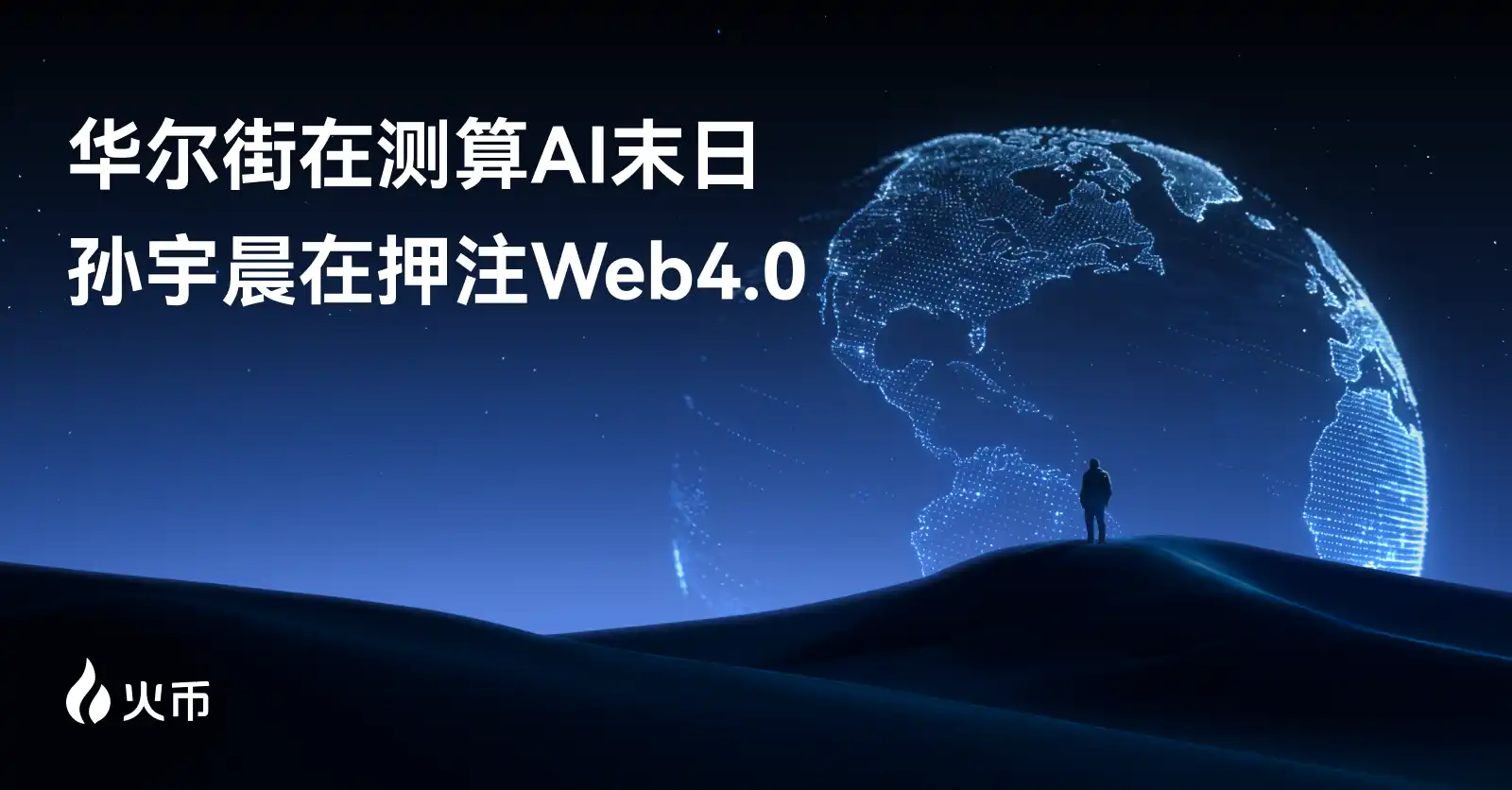
Wall Street Is Calculating the 'AI Apocalypse', While Justin Sun Is Betting on Web4.0

marsbitОпубликовано 2026-03-04Обновлено 2026-03-04

Введение

Wall Street research firm Citrini Research released a thought experiment report, "2028 Global Intelligence Crisis," predicting that AI agents will eliminate friction in human interactions, destroying traditional business models built on information asymmetry and intermediation. Meanwhile, Justin Sun, a prominent Web3 figure, declared 2026 as a "year of miracles" and urged people to embrace AI-driven futures, framing it as the dawn of Web4.0. The report argues that AI agents will enable near-zero-cost, instant service delivery and transaction execution, dismantling industries reliant on human cognitive limitations—such as finance, advertising, law, and consulting. This aligns with blockchain’s core mission of decentralization but takes it further by reducing the need for trust intermediaries altogether. Both AI and crypto are fundamentally rooted in physical resources: compute power and electricity. AI inference consumes computational energy, while blockchain transactions rely on energy-intensive mining or validation. Tokens, whether AI-generated or crypto-based, are digital representations of energy consumption. A critical challenge for AI agents is financial interoperability. Traditional payment systems are designed for humans, not machines. At Level 5 automation, AI agents will transact autonomously, requiring programmable, near-instant, low-cost settlement—conditions that blockchain networks like Solana or Ethereum L2s, with stablecoins, are uniquely suited to provide. ...

Recently, Wall Street research firm Citrini Research released a thought experiment report titled "2028 Global Intelligence Crisis," which has sparked widespread discussion in the market. The core deduction of the report points to an extremely冷酷的商业洗牌 logic: AI Agents will completely eliminate the "friction" in human interactions, thereby destroying all old商业 empires built on information asymmetry and intermediary models.

Coincidentally, just as this Wall Street "apocalypse report" went viral online, Justin Sun, a iconic figure in the Web3 industry, also made quite eye-catching remarks on social media. He declared 2026 as the "time for miracles to happen" and even urged young people: "If you can chat with AI, don't chat with humans... fully embrace the future!"

In the eyes of the general public, this may be yet another highly personal-style "traffic狂欢" by Justin Sun. However, if we strip away the emotional surface and compare these remarks with the macro deductions of the "2028 Global Intelligence Crisis," we discover a thought-provoking truth: the "collapse of the old order" that Wall Street fears in its macro models is precisely the "Web4.0 new era" that Justin Sun极力推崇 in his micro actions and attempts to加速拥抱.

Facing the same future, pessimists see an abyss, while Justin Sun sees a ladder to the singularity.

Computing Power, Electricity, and Token: The Inevitable Convergence of AI and Crypto

The scene of "friction消亡" depicted in the "2028 Global Intelligence Crisis" is essentially an极其冷酷的去中介化 revolution driven by AI.

The report sharply points out that when omniscient and omnipotent AI Agents can complete supply-demand matching, execute transactions, and provide services instantly at near-zero cost, the moats upon which modern business survival depends will be彻底击穿.

For a long time, countless business models, from traditional financial intermediaries and advertising distribution platforms to law firms and consulting agencies that charge high fees, have essentially been寄生於人类的认知局限、决策延迟与信息盲区. Once AI erases these artificially created "frictions," these old empires will inevitably collapse like dominoes.

This trend恰恰与区块链自诞生之初便高举的“去中心化”旗帜,形成了惊人的历史共振.

If the Web3 movement that emerged over a decade ago attempted to瓦解中心化机构的“信任垄断” from the underlying architecture through cryptography and distributed ledgers; then the rise of AI Agents today is a more thorough and efficient way to directly erase the necessity of "trust" itself in many scenarios—because智能体不仅能自动验证事实,还能自主完成价值交换.

The deeper契合 lies in the fact that the material foundation supporting this dual revolution is完全同源的.

Whether it's the推理 Token generated by AI or the加密 Token in the blockchain network, they all hide a long-underestimated yet incredibly坚硬 physical truth: they are both digital incarnations of electricity.

Every inference of an AI large model consumes real computing power; the confirmation of every on-chain transaction, the execution of every smart contract, also relies on the continuous energy consumption burned by miners or validator nodes. Token is not magic; it is a credential of energy conversion, the value projection of electricity穿越芯片、算法与协议后 in the digital world. In this view, this forms a perfect闭环 with Justin Sun's previous assertion that "short-term lack of chips, long-term lack of energy,永远缺存储."

Thus, we see two seemingly opposing yet同源 forces converging: on one side, capital elites foresee the collapse of their own power structures in model deductions; on the other side, crypto natives actively welcome a new文明协议 of no intermediaries, no friction, and no redundancy in code and slogans. This "post-intermediary era" narrative jointly written by AI and blockchain has perhaps just begun.

Why is AI Destined to Choose Crypto for Settlement?

However, this grand historical convergence is not仅仅停留在哲学与物理层面的共鸣. When the narrative lands on specific business operations, an极其现实的问题横亘在了 AI 面前: in this new world about to be taken over by machine execution, who will provide financial services for these incorporeal "silicon-based life forms"?

Centralized payment networks are designed for "humans."

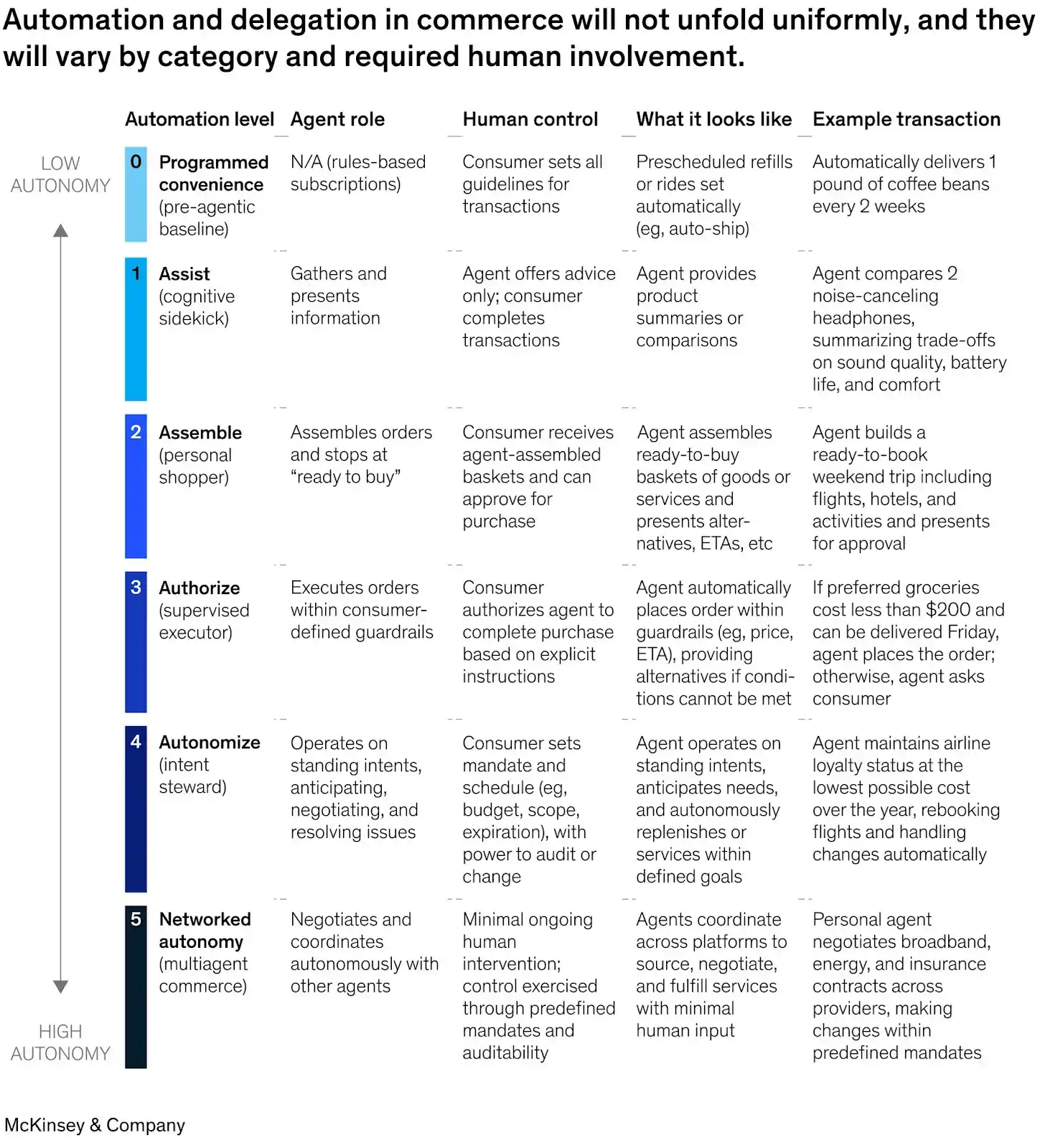
McKinsey divides AI-driven business automation into six levels. Among them, levels 0 to 4 can still operate within the existing financial system because transactions are always associated with human identities. But at level 5,智能体 begin to transact directly with other智能体 without human instruction. At this point, there is no "human identity" to inherit, nor can they rely on traditional KYC processes; payments must be programmatic, condition-triggered, settled in milliseconds, and the reputation of智能体 must be portable across platforms. Blockchain thus becomes indispensable.

AI has no physical entity, let alone the ability to hold an ID card and queue for KYC. For them, a string of asymmetric encrypted private key is an account; a blockchain that can achieve second-level arrival, near-zero fees, and supports programmable smart contracts is the perfect清算中心.

There is a very realistic deduction in the "2028 Global Intelligence Crisis": The space for price matching and information aggregation is ultimately limited. When智能体 start trading with each other, the most direct and effective path is to eliminate various handling fees. They begin to寻找比信用卡更快、更低成本的支付方式. Most eventually choose to use stablecoins for settlement through Solana or Ethereum Layer 2 networks, where transactions are almost instant, with fees as low as a fraction of a cent.

Because of this, crypto wallets are destined to become the "native bank" of AI Agents.

This also彻底打破了外界长期以来对 Crypto 的刻板认知: issuing Token is not just for secondary market speculation and circulation. In an AI-dominated future,加密 Token and peer-to-peer payments will truly settle as the underlying financial infrastructure for high-frequency collaboration between智能体.

Justin Sun's All-in Conspiracy: Where Does the Confidence and Ambition Come From?

Justin Sun's choice to bet on Web4.0 is backed by极其缜密的商业逻辑和战略诉求.

First, Tron's "stablecoin hegemony" is the natural settlement layer for Web 4.0.
As is well known, the Tron TRON network carries the largest circulation of USDT globally. As mentioned earlier, the core of Web4.0 is payment interaction between machines and machines. AI needs a payment network that is fast, has low fees, and has enormous liquidity. Tron's USDT payment network perfectly meets the underlying financial needs of AI Agents. Justin Sun only needs to build a set of payment APIs on the Tron network for AI to seamlessly call, and he can continue to躺赚 in the Web 4.0 era.

Second,寻找“后 Web3 时代”的破局点.
Traditional Web 3.0 has entered存量博弈, lacking new破圈 stories. AI has become the most certain and largest incremental track in the world today. Justin Sun极其敏锐地意识到 that the fate of Crypto must be bound to AI. By "All in Web4.0," he can divert the AI funds and attention from the traditional tech circle back to the加密 market. Tron previously set up an AI development fund as high as 100 million US dollars, which is already a clear signal of布局 for Web 4.0.

Third,建立“去中心化网络”的闭环.
Justin Sun holds BitTorrent (decentralized storage/transmission), the Tron public chain (underlying settlement), and Huobi's massive number of加密 users. If he further integrates decentralized computing power and AI models, he has the opportunity to build a full-stack Web4.0 infrastructure that does not rely on Amazon AWS or Google Cloud.

The诡谲 of history often lies in the fact that the night watchmen of the old order are still calculating the losses of the城墙倒塌, while the barbarians of the new world have already laid the foundation on the废墟.

This transformation jointly written by AI and encryption is not yet complete, but the direction is clear. The real question is no longer whether AI will reshape business, but who can提前占据基础设施的核心位置 in this restructuring.

Связанные с этим вопросы

QWhat is the core argument of Citrini Research's '2028 Global Intelligence Crisis' thought experiment report?

AThe report argues that AI Agents will eliminate 'friction' in human interactions, destroying old business empires built on information asymmetry and intermediary models.

QHow does Sun Yuchen view the year 2026 in relation to AI and the future?

ASun Yuchen defines 2026 as 'a time for miracles to happen' and encourages young people to 'embrace the future fully by chatting with AI instead of humans.'

QWhy does the article suggest that AI is destined to choose Crypto for settlement?

AAI lacks human identity and cannot use traditional KYC processes. Crypto offers programmable, near-instant, low-cost settlements with cross-platform reputation portability, making it ideal for AI-to-AI transactions.

QWhat are the three strategic reasons behind Sun Yuchen's all-in bet on Web4.0?

A1) Tron's 'stablecoin hegemony' provides a natural settlement layer for Web4.0; 2) AI is a massive growth sector to attract capital and attention back to crypto; 3) To build a closed-loop decentralized network integrating storage, settlement, and compute without relying on centralized cloud providers.

QWhat fundamental physical truth underlies both AI inference tokens and blockchain crypto tokens according to the article?

ABoth are digital manifestations of electricity, representing value transformed through energy consumption in chips, algorithms, and protocols.

Похожее

AI Relay Stations Spark Heated Debate on Zhihu: Behind Cheap Tokens, What Are Users Really Worried About?

A discussion on Zhihu about "AI relay stations" shifted the niche developer topic of "cheap tokens" into broader user awareness. Users moved beyond simply questioning the legitimacy of these services to focus on practical concerns: Where do cheap tokens truly come from? Is the model being accessed the real one? Can relay stations see prompts, code, and API keys? For occasional users, are the risks worth it? The core debate centered less on price and more on trust. A primary worry is model authenticity—the risk of "model swapping," where users paying for a premium model might be routed to a cheaper one, creating an information asymmetry. Others argued that cost comparisons matter; while cheaper than official pay-as-you-go APIs, relay stations may not be the lowest-cost option versus subscriptions, domestic models, or free tiers, making user needs assessment crucial. Speculation about token sources ranged from legitimate bulk discounts to gray-area methods like account sharing or exploiting regional pricing. This opacity makes risk assessment difficult for users. Data security emerged as a critical concern, especially for enterprise use. When processing sensitive information like code, contracts, or client data, the inability to verify a relay station's data handling, retention, or access policies poses significant compliance and confidentiality risks. The evolving consensus suggests relay stations can be used cautiously for low-sensitivity, disposable tasks (e.g., summarizing public info, simple translation). However, they should not be the default for sensitive, professional, or production workflows involving proprietary data, Agents, or automated systems. Recommendations include avoiding large prepayments, not relying on a single service, using test prompts to monitor quality, anonymizing data where possible, and keeping official channels as backups. Ultimately, the discussion framed tokens not just as a billing unit but as a measure of real cost encompassing price, model integrity, data security, and service stability. The popularity of relay stations highlights user demand for affordable access, but the debate underscores a key trade-off: the savings from cheap tokens may come at the price of trust, transparency, and control over one's data and AI experience.

marsbit11 мин. назад

AI Relay Stations Spark Heated Debate on Zhihu: Behind Cheap Tokens, What Are Users Really Worried About?

marsbit11 мин. назад

In-Depth Research Report on TradFi: The Convergence Wave of Crypto and Traditional Finance

In 2026, the crypto industry is undergoing a profound infrastructure-level transformation—TradFi assets are migrating on-chain at an unprecedented pace. According to CoinGecko's Q1 2026 report, the total value locked (TVL) of tokenized real-world assets (RWA) has surpassed $31 billion, a nearly 4x increase from $7.8 billion at the beginning of 2025, with the sector’s aggregate market capitalization reaching $19.3 billion. Among these, the market cap of tokenized stocks surged from $2 million to $486 million, with Q1 spot trading volume reaching $15.1 billion—a single quarter already surpassing the entire second half of 2025. RWA perpetual contract Q1 trading volume reached a staggering $524.8 billion, far exceeding the $313 billion for all of 2025. Meanwhile, BlackRock's BUIDL fund has reached $2.3 billion in scale and has filed for two new tokenized funds, signaling that the world's largest asset manager's tokenization strategy is evolving from pilot to product suite expansion. HTX, as a core participant in the crypto exchange sector, officially launched TradFi perpetual futures products including NVDA, AAPL, MSFT, META, and SPY in 2026, enabling crypto users to gain 24/7 trading access to core U.S. equities. Boston Consulting Group predicts that global tokenized asset scale could reach $16 trillion by 2030, while McKinsey offers a conservative estimate of approximately $2 trillion. The on-chain migration of TradFi assets is no longer a "future narrative" but a structural transformation unfolding in real time, as crypto exchanges evolve from single crypto asset trading platforms toward "multi-asset-class trading infrastructure."

HTX Learn14 мин. назад

In-Depth Research Report on TradFi: The Convergence Wave of Crypto and Traditional Finance

HTX Learn14 мин. назад

Blocked Its Own Treasure, WeChat AI Steps Up

Tencent's stock surged over 10% on June 2nd amid reports that WeChat, with 1.43 billion monthly users, is finalizing tests for a native AI Agent. The reported feature, accessible by swiping right from the main interface, allows users to issue commands in natural language. The AI then decomposes tasks and automatically calls upon relevant Mini Programs within WeChat to complete actions like ordering food, booking tickets, or making payments, creating a closed-loop service execution system. This strategic shift follows the internal conflict and subsequent "blocking" of Tencent's standalone AI app, Yuanbao, by WeChat for violating sharing rules during a 2026 Spring Festival promotion. The incident highlighted a lack of internal consensus and exposed the weakness of competing in the standalone AI assistant arena against rivals like ByteDance's Doubao (345M MAU) and Alibaba's Qianwen. The new WeChat AI Agent aims to leverage WeChat's unique assets—its massive user base, standardized Mini Program APIs, WeChat Pay, and identity system—to move from simple content generation to actual task execution. Analysts note this changes the competitive landscape from model benchmarks to which AI can connect to more real-world services. However, success depends on key variables: the capability of Tencent's underlying Hunyuan model, managing massive inference costs, and redesigning incentives for Mini Program developers whose traffic might be bypassed. The move is seen as an attempt to keep user service intent within WeChat's ecosystem as AI begins to redefine how users access services.

marsbit1 ч. назад

Blocked Its Own Treasure, WeChat AI Steps Up

marsbit1 ч. назад

ByteDance Adopts Arm CPUs, Jensen Huang: So Sad I Didn't Buy Arm

**Summary:** At Computex 2026, Arm CEO Rene Haas announced that ByteDance and Oracle have adopted Arm's self-designed Arm AGI data center CPU. The company expects significant revenue growth from this product, projecting $20 billion in demand for the 2027/2028 fiscal years. Haas noted that restricting AI-capable CPUs from the US to China is nearly impossible due to their widespread applications. Arm's stock has surged dramatically this year, notably rising 16% after NVIDIA's Arm-based Vera CPU and RTX Spark announcements. A highlight was the informal, humorous on-stage conversation between Haas and NVIDIA CEO Jensen Huang. Huang joked about NVIDIA's failed attempt to acquire Arm and playfully lamented selling his Arm shares. Both executives showed a clear sense of camaraderie and shared regret over the missed merger. Key technical topics were discussed: 1. **AI PC Design:** Huang explained NVIDIA's RTX Spark superchip (with a 20-core Arm CPU) is designed for future AI agents that will autonomously run and use tools on PCs, blending local and cloud processing. 2. **Agent vs. OS:** Huang emphasized the operating system remains crucial, as AI agents rely on its APIs and tools to function. 3. **Growth Constraints:** He identified the shift to "useful AI" that generates profitable tokens as a primary driver for immense, almost limitless, computational demand. Haas outlined Arm's strategy across PC and data centers. For PCs, Arm collaborates with partners like NVIDIA and MediaTek, offering its compute subsystem (CSS) for custom SoCs. In data centers, its Arm AGI CPU (built on TSMC's 3nm process) has gained major partners including OpenAI, Meta, and now ByteDance and Oracle. Arm presented a multi-year roadmap for its in-house CPU line. The article concludes that while GPUs dominated the AI training race, the explosion of AI agents is shifting significant focus to CPUs for inference, state management, and tool orchestration. The industry is trending towards vertical integration, with companies like cloud providers designing chips and chip/IP firms offering full solutions, all competing to deliver more efficient computing per watt.

marsbit1 ч. назад

ByteDance Adopts Arm CPUs, Jensen Huang: So Sad I Didn't Buy Arm

marsbit1 ч. назад

Торговля

Спот
Фьючерсы

Популярные статьи

Как купить SUN

Добро пожаловать на HTX.com! Мы сделали приобретение SUN (SUN) простым и удобным. Следуйте нашему пошаговому руководству и отправляйтесь в свое крипто-путешествие.Шаг 1: Создайте аккаунт на HTXИспользуйте свой адрес электронной почты или номер телефона, чтобы зарегистрироваться и бесплатно создать аккаунт на HTX. Пройдите удобную регистрацию и откройте для себя весь функционал.Создать аккаунтШаг 2: Перейдите в Купить криптовалюту и выберите свой способ оплатыКредитная/Дебетовая Карта: Используйте свою карту Visa или Mastercard для мгновенной покупки SUN (SUN).Баланс: Используйте средства с баланса вашего аккаунта HTX для простой торговли.Третьи Лица: Мы добавили популярные способы оплаты, такие как Google Pay и Apple Pay, для повышения удобства.P2P: Торгуйте напрямую с другими пользователями на HTX.Внебиржевая Торговля (OTC): Мы предлагаем индивидуальные услуги и конкурентоспособные обменные курсы для трейдеров.Шаг 3: Хранение SUN (SUN)После приобретения вами SUN (SUN) храните их в своем аккаунте на HTX. В качестве альтернативы вы можете отправить их куда-либо с помощью перевода в блокчейне или использовать для торговли с другими криптовалютами.Шаг 4: Торговля SUN (SUN)С легкостью торгуйте SUN (SUN) на спотовом рынке HTX. Просто зайдите в свой аккаунт, выберите торговую пару, совершайте сделки и следите за ними в режиме реального времени. Мы предлагаем удобный интерфейс как для начинающих, так и для опытных трейдеров.

985 просмотров всегоОпубликовано 2024.04.18Обновлено 2026.06.02

Как купить SUN

Обсуждения

Добро пожаловать в Сообщество HTX. Здесь вы сможете быть в курсе последних новостей о развитии платформы и получить доступ к профессиональной аналитической информации о рынке. Мнения пользователей о цене на SUN (SUN) представлены ниже.

活动图片