Vitalik Buterin is trying to fix crypto’s biggest blind spot: ‘The goal is to…’

ambcryptoОпубликовано 2026-02-23Обновлено 2026-02-23

Введение

Vitalik Buterin, co-founder of Ethereum, is shifting the focus of crypto conversations from price and performance to a more fundamental issue: the gap between user intent and a system's actual behavior. He argues that true security is about minimizing this divergence, as even simple actions involve complex human assumptions that are difficult to encode. Buterin extends this concern to the broader internet and AI, noting that the core challenge is not the ability to generate content or execute code, but the need for quality, judgment, and context. He envisions Ethereum evolving into a neutral coordination layer where AI agents can transact, prove actions, and build verifiable trust on-chain. This framework aims to create systems that don't just execute commands blindly but safely interpret human intent, making trustless and private interactions possible in an increasingly automated world.

Most conversations in crypto focus on price, performance, and security. The common belief is that once the technology becomes secure enough, everything else will fall into place.

But recently, Ethereum co-founder Vitalik Buterin has been bringing the discussion back to a more basic question.

Are these systems actually working in the user’s best interest?

Security is about intent

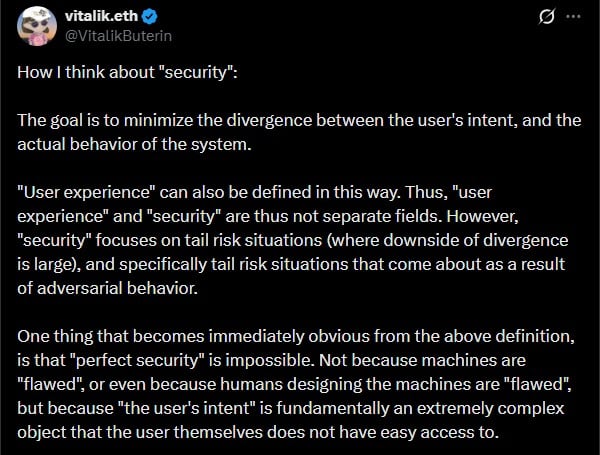
In his latest X post, Buterin noted that security is about reducing the gap between what users want and what the system actually does.

As he puts it,

“The goal is to minimize the divergence between the user’s intent, and the actual behavior of the system.”
Source: X

That sounds obvious, but it also moves the conversation in an important way. Security today is about understanding that human intent is often impossible to fully encode.

Even a simple action like sending an Ether [ETH] involves hidden assumptions. Is the address correct? Is it really controlled by the right person? If there’s a fork, which version of ETH is the “real” one?

Much of what we rely on falls under common sense. That’s not so easily done by machines, is it? However, there are limits too.

Buterin made sure to note that,

“‘Perfect security’ is impossible… because ‘the user’s intent’ is fundamentally an extremely complex object.”

The internet has the same problem

Buterin sees a similar issue in today’s creator economy. AI can generate unlimited content. Publishing is easy. Execution is easy. The bottleneck is judgment.

“The problem is quality. And so your goal is not incentivizing content, it’s surfacing good content.”

This is the same problem he identified in crypto security. The internet publishes everything; crypto executes everything. Neither inherently understands context.

This is why platforms like Substack stand out to him. Their value comes from elevating the right content through curation, judgment, and alignment.

Increasingly, the challenge is building systems that understand what is worth working on.

This question of intent…

…becomes far more serious in the age of AI. It acts, decides, and interacts on its own.

Buterin recently mentioned that the real issue is not how powerful AI becomes, but who controls it and how its behavior is verified. The goal is to shape its direction.

Warning against systems that concentrate power or operate beyond human oversight, he wrote,

“I want an AI future where we foster human freedom and empowerment…”
Source: X

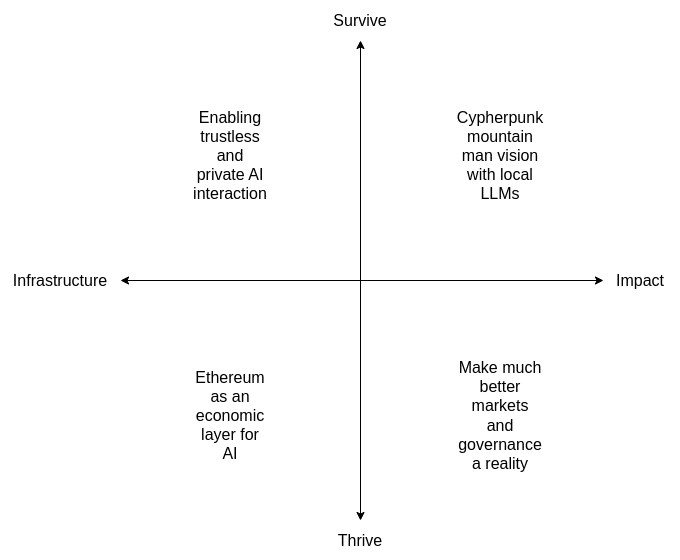
This is where Ethereum fits in, as infrastructure around it. A neutral layer where AI systems can make payments, prove actions, and build reputation transparently.

Think of this.  AI agents could pay for services, interact with other agents, or post security deposits on-chain. These actions create accountability, the behavior of which, becomes traceable. Trust, in turn, becomes verifiable.

As Buterin explained, the goal is to make “trustless and/or private interaction with AIs possible.”

AMBCrypto previously reported that Buterin has proposed personal AI agents to address DAO voting fatigue.

Instead of users manually voting on every proposal, private AI models trained on their preferences could vote on their behalf.

He noted that “the usual solution, delegation, is disempowering,” especially when participation drops and power concentrates with large holders.

As AI expands what machines can do, who ensures they act the way users actually would?

When systems optimize the wrong things

Here’s a different example of the same vein.

Prediction markets were supposed to solve a very specific problem. They were designed to aggregate collective intelligence and help make better decisions. But Buterin now worries they are drifting away from that purpose.

Instead of helping people manage real-world risk, many prediction markets are dominated by short-term bets on crypto prices, sports, and viral events. These markets generate activity, but not necessarily insight.

As he put it, 

“(teams often) capitulate to these things because they bring in large revenue during a bear market where people are desperate.”

The system is working… but towards the wrong goal.

This is the same problem in crypto and the internet. Systems focus on what they can easily measure and not on what actually matters, like accuracy or real usefulness.

Buterin is of the belief that prediction markets could help. He suggests using them to track real-world costs like housing, food, or healthcare. AI tools could then help people automatically protect themselves against those rising costs.

“You have price indices on all major categories of goods and services… and prediction markets on each category…”

In that model, prediction markets become a tool for protection. The difference, again, comes down to intent.

From executing code to protecting intent

All of Buterin’s recent ideas describe a blueprint for how the future internet itself may work.

His core principle is that no single signal should be trusted completely. Not a signature, an AI agent, or even a user’s click. Systems should rely on multiple overlapping checks to approximate what a person actually meant to do.

This is how humans already build trust.

Crypto, in its early days, focused on “trustless” execution. But Buterin seems to recognize that code can execute perfectly and still produce the wrong outcome if intent is misunderstood.

The next phase is trust-minimized interpretation. Systems that don’t blindly execute commands, but interpret them safely. In that world, Ethereum could ideally be a coordination layer.

In an internet run increasingly by machines, the scarcest resource will be the certainty that systems do what humans actually mean.


Final Summary

  • Vitalik Buterin says crypto’s biggest risk is the growing gap between what users intend and what systems actually execute.
  • Ethereum could evolve into a coordination layer where AI agents vote, transact, and act.
Next: Dollar stablecoin for Gaza? Trump advisers’ proposal draws scrutiny
Share
  • Share
  • Tweet

Трендовые криптовалюты

Связанные с этим вопросы

QWhat is the core issue that Vitalik Buterin is trying to address in crypto systems according to the article?

AHe is addressing the growing gap between what users intend to do and what the system actually executes, moving the focus beyond just price, performance, and security.

QHow does Buterin define the goal of security in his X post?

AHe defines it as 'to minimize the divergence between the user's intent, and the actual behavior of the system.'

QWhat role does Buterin propose for Ethereum in the future of AI, as mentioned in the article?

AHe proposes Ethereum as a neutral coordination layer where AI agents can make payments, prove actions, build reputation transparently, and enable trustless and/or private interactions.

QWhat problem does Buterin identify with current prediction markets, and what alternative does he suggest?

AHe identifies that they have drifted from their purpose of aggregating collective intelligence and are dominated by short-term bets. He suggests using them to track real-world costs like housing and food, so AI tools can help people automatically protect themselves against rising costs.

QWhat does the article state is the 'scarcest resource' in an internet increasingly run by machines?

AThe scarcest resource is the certainty that systems do what humans actually mean.

Похожее

Паркер Льюис ответил, почему биткоин остаётся лучшими деньгами

Известный биткоин-аналитик Паркер Льюис раскритиковал стратегии публичных компаний, позиционирующих себя как криптовалютные казначейства. Он заявил, что продажа ими «цифрового кредита» в виде бессрочных привилегированных акций искажает суть биткоина, который не генерирует фиатный доход на алгоритмическом уровне. Льюис подчеркнул, что выплата дивидендов в этой модели часто зависит от притока новых инвесторов, что несёт высокие риски, наглядно демонстрируемые скромным размером рынка таких акций ($1 трлн) на фоне глобального кредитного рынка ($300 трлн). Эксперт также опроверг тезис о чрезмерной волатильности биткоина, объяснив её как естественное следствие массового принятия актива с жёстко ограниченным предложением. Он призвал инвесторов покупать биткоины напрямую, а не акции компаний вроде MicroStrategy, что математически безопаснее. Льюис указал на главную угрозу — инфляцию фиатных денег, проиллюстрировав её личным «Индексом рибая», показывающим рост цен на 12–13% годовых. В итоге, наиболее надёжной стратегией защиты сбережений он назвал прямое владение биткоином и контроль над приватными ключами, предостерегая от скрытых рисков погони за корпоративной доходностью через деривативы.

cryptonews.ru36 мин. назад

Паркер Льюис ответил, почему биткоин остаётся лучшими деньгами

cryptonews.ru36 мин. назад

Почему биткоин удерживает $64 000 после жесткой паузы ФРС

Федеральная резервная система США оставила ключевую ставку без изменений, но жесткая риторика и голосование (9 против 3) показали готовность к дальнейшему ужесточению, что ограничивает аппетит к рисковым активам. Несмотря на это, биткоин демонстрирует устойчивость, удерживаясь около уровня $64 000 после волатильной реакции на заявление ФРС. Ключевая поддержка находится в зоне $63 000–63 500, сопротивление — около $66 000. На рынке наблюдается ротация капитала: спотовые Bitcoin-ETF после серии оттоков показали чистый приток в $32,1 млн, тогда как фонды на Ethereum продолжили терять средства. Интерес институциональных инвесторов сместился в сторону биткоина как основного актива, хотя отдельные альткоины, такие как Solana, также привлекают капитал. Рыночная доля Ethereum снижается, несмотря на сильные фундаментальные показатели сети, включая растущую очередь на стейкинг. Законодательная инициатива CLARITY Act была отложена Сенатом США до осени, что снизило рыночные ожидания относительно её принятия в 2026 году. В последний день июля внимание инвесторов будет приковано к макроэкономической статистике из США. Устойчивость биткоина выше $63 000, закрепление Ethereum над $1 860 и продолжение притоков в ETF могут стать сигналами для формирования базы восстановления во второй половине года.

cryptonews.ru37 мин. назад

Почему биткоин удерживает $64 000 после жесткой паузы ФРС

cryptonews.ru37 мин. назад

Компания ARK Invest Кэти Вуд купила 109,129 акций Circle на $6,83 млн

Компания ARK Invest Кэти Вуд приобрела 109 129 акций компании Circle на сумму около 6,83 млн долларов США. Покупка была осуществлена через три ее биржевых фонда: ARK Innovation, ARK Next Generation Internet и ARK Fintech Innovation. Эта сделка произошла вскоре после того, как Circle получила лицензию на доверительное управление от Департамента финансовых услуг штата Нью-Йорк для своей дочерней компании Circle New York Trust. Генеральный директор Circle Джереми Аллер назвал получение лицензии долгосрочной целью компании. Однако, несмотря на это регулирующее одобрение, акции Circle (CRCL) 31 июля снизились на 2,54%, что, вероятно, указывает на сдержанную реакцию инвесторов на данную новость. Параллельно ARK Invest также совершила крупные покупки акций Tesla, SpaceX и Nvidia на общую сумму около 40,2 млн долларов, одновременно сократив свои доли в таких компаниях, как Shopify, Cloudflare и CrowdStrike.

cryptonews.ru38 мин. назад

Компания ARK Invest Кэти Вуд купила 109,129 акций Circle на $6,83 млн

cryptonews.ru38 мин. назад

Арестованы участники мошеннической схемы с XRP, похитившие 9 млн долларов у 71 инвестора

Полиция Сеула арестовала трех участников мошеннической инвестиционной платформы, похитивших примерно 3,4 млн XRP (около 9 млн долларов) у 71 инвестора. Группа продвигала сайт Fxrpntwork.com через блоги и YouTube, обещая гарантированную сохранность вкладов и ежемесячный доход до 1,8%, после чего исчезла с деньгами. Мошенники использовали названия и брендинг легитимных проектов Flare Network и FXRP для создания видимости надежности. Полиция предупреждает инвесторов о необходимости проверять официальные источники и не доверять непроверенной информации в интернете. Дело передано прокуратуре, ведется розыск еще одного подозреваемого за рубежом с помощью Интерпола. В ходе расследования были заморожены активы на крупную сумму и выявлены дополнительные транзакции, что указывает на возможных новых потерпевших и соучастников. Этот случай иллюстрирует распространенность мошеннических схем с гарантированной доходностью в криптосфере.

cryptonews.ru40 мин. назад

Арестованы участники мошеннической схемы с XRP, похитившие 9 млн долларов у 71 инвестора

cryptonews.ru40 мин. назад

Торговля

Спот

Популярные статьи

Как купить S

Добро пожаловать на HTX.com! Мы сделали приобретение Sonic (S) простым и удобным. Следуйте нашему пошаговому руководству и отправляйтесь в свое крипто-путешествие.Шаг 1: Создайте аккаунт на HTXИспользуйте свой адрес электронной почты или номер телефона, чтобы зарегистрироваться и бесплатно создать аккаунт на HTX. Пройдите удобную регистрацию и откройте для себя весь функционал.Создать аккаунтШаг 2: Перейдите в Купить криптовалюту и выберите свой способ оплатыКредитная/Дебетовая Карта: Используйте свою карту Visa или Mastercard для мгновенной покупки Sonic (S).Баланс: Используйте средства с баланса вашего аккаунта HTX для простой торговли.Третьи Лица: Мы добавили популярные способы оплаты, такие как Google Pay и Apple Pay, для повышения удобства.P2P: Торгуйте напрямую с другими пользователями на HTX.Внебиржевая Торговля (OTC): Мы предлагаем индивидуальные услуги и конкурентоспособные обменные курсы для трейдеров.Шаг 3: Хранение Sonic (S)После приобретения вами Sonic (S) храните их в своем аккаунте на HTX. В качестве альтернативы вы можете отправить их куда-либо с помощью перевода в блокчейне или использовать для торговли с другими криптовалютами.Шаг 4: Торговля Sonic (S)С легкостью торгуйте Sonic (S) на спотовом рынке HTX. Просто зайдите в свой аккаунт, выберите торговую пару, совершайте сделки и следите за ними в режиме реального времени. Мы предлагаем удобный интерфейс как для начинающих, так и для опытных трейдеров.

1.8k просмотров всегоОпубликовано 2025.01.15Обновлено 2026.06.02

Как купить S

Sonic: Обновления под руководством Андре Кронье – новая звезда Layer-1 на фоне спада рынка

Он решает проблемы масштабируемости, совместимости между блокчейнами и стимулов для разработчиков с помощью технологических инноваций.

2.4k просмотров всегоОпубликовано 2025.04.09Обновлено 2025.04.09

Sonic: Обновления под руководством Андре Кронье – новая звезда Layer-1 на фоне спада рынка

HTX Learn: Пройдите обучение по "Sonic" и разделите 1000 USDT

HTX Learn — ваш проводник в мир перспективных проектов, и мы запускаем специальное мероприятие "Учитесь и Зарабатывайте", посвящённое этим проектам. Наше новое направление .

1.9k просмотров всегоОпубликовано 2025.04.10Обновлено 2025.04.10

HTX Learn: Пройдите обучение по "Sonic" и разделите 1000 USDT

Обсуждения

Добро пожаловать в Сообщество HTX. Здесь вы сможете быть в курсе последних новостей о развитии платформы и получить доступ к профессиональной аналитической информации о рынке. Мнения пользователей о цене на S (S) представлены ниже.

活动图片















