Veteran Chinese Public Chain NEO's Two Founders in a Feud, Financial Opacity as the Core Reason

marsbitОпубликовано 2026-01-01Обновлено 2026-01-01

Введение

Summary: A public conflict has erupted between Erik Zhang (Zhang Zhengwen) and Da Hongfei, the two co-founders of the Chinese-origin blockchain project NEO. The core issue is a lack of financial transparency within the NEO Foundation. Zhang, who had left NEO years ago and officially returned in September, accused Da of maintaining a "black box" of assets. He claims Da has sole control over the Foundation's non-token assets and lacks a proper audit mechanism. Zhang also alleged that Da was using NEO's resources to develop a separate project, EON, which prompted his return. The dispute escalated in December when Zhang publicly demanded financial disclosures and unilaterally announced that Da would be removed from NEO mainnet affairs to focus on sidechain and new project development starting January 1, 2026. In response, Da countered that Zhang actually controls the majority of the ecosystem's funds (NEO/GAS tokens) and consensus node voting power. He accused Zhang of delaying the transfer of these funds to a multi-signature wallet for years. Da committed to releasing a financial report for 2025 by Q1 2026.

It's unexpected that a veteran domestic public chain could come to such a day. What's even more lamentable is that top domestic AI projects like Manus, Kimi, and Minimax have had major news for two consecutive days—either being acquired for billions of dollars or raising hundreds of millions in funding—while this old-school public chain has started a feud.

As it stands, the two co-founders of the NEO public chain, founded in 2014, Zhang Zhengwen (Erik Zhang) and Da Hongfei, have essentially completely fallen out, continuing to trade barbs on X. Based on their statements and publicly available information online, let's try to figure out what exactly happened between the two founders of this veteran public chain.

Financial Black Box

Actually, Zhang Zhengwen had left NEO a few years ago, which he confirmed on his own Twitter, and then officially returned in September this year. The trigger for this feud was in November. According to community news and public information, Zhang Zhengwen, as the technical core, encountered obstacles when seeking to obtain the detailed financial report and fund flow of the Neo Foundation.
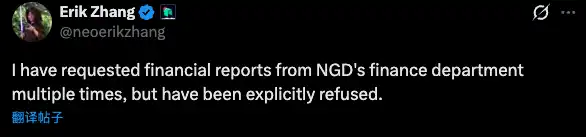
Subsequently, Zhang Zhengwen accused the Neo Foundation of long-term opaque operations, with its financial status resembling a "black box." He pointed out that Da Hongfei has long solely controlled the foundation's assets other than NEO/GAS tokens, and there is a lack of a complete, auditable disclosure mechanism.

In today's exchange of accusations, we also discovered the reason for Zhang Zhengwen's previous departure. He said that Da Hongfei approached him alone, stating that it was inefficient for the two of them to be responsible for NEO, so he chose to temporarily withdraw from management to "improve efficiency." However, he found that Da Hongfei was using NEO's resources to develop an independent public chain project, EON. This prompted him to return and intervene in the foundation's governance.

In community discussions in November, Zhang Zhengwen stated that NEO had previously relied on hackathons to create "false prosperity," with no real users, and many hackathon projects disappeared after receiving awards.

Escalation of Conflict

In December, Zhang Zhengwen publicly issued a statement demanding that Da Hongfei fulfill the financial disclosure obligations promised since December 9th. More explosively, Zhang Zhengwen unilaterally announced that, according to a previous phone agreement between them, starting January 1, 2026, Da Hongfei will no longer participate in NEO mainnet affairs and will instead focus on the development and operation of the sidechain NeoX and the new project SpoonOS.

Da Hongfei (Da Shu) responded immediately, stating that Zhang Zhengwen actually controls the vast majority of the funds in the NEO ecosystem (including the core assets NEO and GAS tokens) and dominates the voting rights of consensus nodes. He also accused Zhang Zhengwen of delaying the transfer of funds to the foundation's multi-signature address (Multisig) for years under various pretexts (such as waiting for the completion of the N3 migration).

Da Hongfei承诺将在 2026 年第一季度发布 2025 年末的财务报告,并会提前分享初步数据。

Связанные с этим вопросы

QWhat is the core reason for the public conflict between the two co-founders of NEO, as mentioned in the article?

AThe core reason is financial opacity, with Erik Zhang accusing Da Hongfei of controlling the foundation's assets (excluding NEO/GAS tokens) in a 'black box' manner without a complete, auditable disclosure mechanism.

QAccording to the article, why did Erik Zhang initially leave NEO's management?

AHe left because Da Hongfei told him that having two people in charge was inefficient. Zhang agreed to step back temporarily to 'improve efficiency'.

QWhat specific event prompted Erik Zhang to return and get involved in the NEO Foundation's governance?

AHe returned after discovering that Da Hongfei was using NEO's resources to develop an independent public chain project called EON.

QWhat did Erik Zhang unilaterally announce regarding Da Hongfei's role starting January 1, 2026?

AHe announced that, based on a prior phone agreement, Da Hongfei would no longer be involved in NEO mainnet affairs and would instead focus on developing and operating the sidechain NeoX and a new project called SpoonOS.

QHow did Da Hongfei counter Erik Zhang's accusations about financial control?

ADa Hongfei stated that Zhang actually controls the vast majority of the funds in the NEO ecosystem (including the core NEO and GAS tokens) and the consensus node voting power. He also accused Zhang of delaying the transfer of funds to the foundation's multi-signature address for years.

Похожее

Understanding Hash in One Article: The "Browser Miner" on Ethereum

Hash is an Ethereum-based ERC-20 token described as a "browser-minable post-quantum token." Its key features include enabling browser-based GPU mining without specialized hardware, a fixed supply cap of 21 million tokens, immutable and permissionless smart contracts with no team allocation or pre-mining, and an emphasis on post-quantum security using Keccak256 hashing. The mining mechanism is a simplified on-chain proof-of-work where miners solve unique challenges tied to their wallet address. Key design elements prevent answer theft, with epochs resetting every 100 blocks (~20 minutes) and a per-block minting limit. Emission follows a Bitcoin-like halving schedule every 100,000 mints, starting at 100 tokens per mint. Projections suggest all tokens could be mined within approximately 294 days if a target rate of one mint per minute is sustained. Hash emphasizes "post-quantum" security by leveraging hash-based primitives like Keccak256, which are considered more resistant to quantum attacks compared to elliptic-curve cryptography. While not a fully post-quantum asset, it aligns with Ethereum's broader post-quantum research narrative. The project completed its Genesis sale at $0.03 and began trading on Uniswap, with its price reaching around $0.19. The initial circulating supply is small, with 5% sold in Genesis and 5% allocated to liquidity. The majority (47.6% of total supply) is allocated to early-stage mining, leading to a front-loaded emission schedule. This structure, combined with low initial liquidity, makes Hash a high-volatility, high-risk project dependent on sustained miner participation and market demand to absorb new supply.

marsbit9 мин. назад

Understanding Hash in One Article: The "Browser Miner" on Ethereum

marsbit9 мин. назад

OpenAI's Largest Internal Wealth Creation: 600 People Cash Out a Total of $6.6 Billion, 75 Take Home the Maximum $30 Million Each

A Wall Street Journal report reveals OpenAI's unprecedented pre-IPO wealth creation. In a single employee stock sale last October, over 600 current and former employees sold shares, collectively cashing out approximately $6.6 billion. Due to high investor demand, the company tripled the individual sale cap to $30 million, with about 75 employees selling the maximum amount. This event represents the largest such transaction in tech industry history for a private company. OpenAI's valuation was $500 billion for this tender offer. Employees with over two years of tenure were eligible, allowing many post-ChatGPT hires their first liquidity event. The company's stock has reportedly grown over 100-fold in seven years. Following a restructuring, employees collectively hold about 26% of OpenAI. The scale of executive wealth is also staggering. In court testimony related to Elon Musk's lawsuit, President and co-founder Greg Brockman confirmed his OpenAI stake is worth around $30 billion. Analysis indicates about 165 current and former employees hold a combined ~$164.9 billion in equity, averaging nearly $1 billion per person in paper wealth. OpenAI's per-employee stock-based compensation is estimated to be 34 times the average of major tech firms before their IPOs. OpenAI continues its rapid ascent, closing a $122 billion funding round at an $852 billion valuation in March. With monthly revenue hitting $2 billion, over 900 million weekly ChatGPT users, and plans for a potential trillion-dollar IPO in late 2026, this wealth-creation engine shows no signs of stopping.

链捕手31 мин. назад

OpenAI's Largest Internal Wealth Creation: 600 People Cash Out a Total of $6.6 Billion, 75 Take Home the Maximum $30 Million Each

链捕手31 мин. назад

Торговля

Спот
Фьючерсы

Популярные статьи

Как купить CORE

Добро пожаловать на HTX.com! Мы сделали приобретение CORE (CORE) простым и удобным. Следуйте нашему пошаговому руководству и отправляйтесь в свое крипто-путешествие.Шаг 1: Создайте аккаунт на HTXИспользуйте свой адрес электронной почты или номер телефона, чтобы зарегистрироваться и бесплатно создать аккаунт на HTX. Пройдите удобную регистрацию и откройте для себя весь функционал.Создать аккаунтШаг 2: Перейдите в Купить криптовалюту и выберите свой способ оплатыКредитная/Дебетовая Карта: Используйте свою карту Visa или Mastercard для мгновенной покупки CORE (CORE).Баланс: Используйте средства с баланса вашего аккаунта HTX для простой торговли.Третьи Лица: Мы добавили популярные способы оплаты, такие как Google Pay и Apple Pay, для повышения удобства.P2P: Торгуйте напрямую с другими пользователями на HTX.Внебиржевая Торговля (OTC): Мы предлагаем индивидуальные услуги и конкурентоспособные обменные курсы для трейдеров.Шаг 3: Хранение CORE (CORE)После приобретения вами CORE (CORE) храните их в своем аккаунте на HTX. В качестве альтернативы вы можете отправить их куда-либо с помощью перевода в блокчейне или использовать для торговли с другими криптовалютами.Шаг 4: Торговля CORE (CORE)С легкостью торгуйте CORE (CORE) на спотовом рынке HTX. Просто зайдите в свой аккаунт, выберите торговую пару, совершайте сделки и следите за ними в режиме реального времени. Мы предлагаем удобный интерфейс как для начинающих, так и для опытных трейдеров.

535 просмотров всегоОпубликовано 2024.03.29Обновлено 2025.03.21

Как купить CORE

Обсуждения

Добро пожаловать в Сообщество HTX. Здесь вы сможете быть в курсе последних новостей о развитии платформы и получить доступ к профессиональной аналитической информации о рынке. Мнения пользователей о цене на CORE (CORE) представлены ниже.

活动图片