Valued at 600 Billion, NVIDIA Invests 10 Billion! How Nokia, After Selling Its Phones, Is Making a Comeback

marsbitОпубликовано 2026-05-29Обновлено 2026-05-29

Введение

Once known as its mobile phones were sold in 2013, Nokia has staged a remarkable commercial comeback, now standing as a "patent giant" and "AI infrastructure builder." In Q1 2026, its net profit surged over 200% year-over-year. Nokia retains a vast portfolio of over 26,000 patent families, including over 7,000 essential 5G patents. This creates a high-margin "licensing" business, generating €1.5 billion in 2025 with over 70% operating margin, from smartphone makers to automotive and streaming media companies. Beyond patents, Nokia is a key player in AI infrastructure. Its acquisition of Infinera made it a top supplier of high-speed optical modules for AI data centers. Its AI-RAN technology allows 5G base stations to utilize idle computing power for AI inference tasks. A strategic $1 billion investment from NVIDIA in 2025 aims to unlock this distributed edge compute potential, with their joint AI Aerial platform already in trials. Looking ahead, Nokia is actively shaping 6G standards with AI-native architecture and is transitioning toward a recurring revenue model through network automation and SaaS offerings. With strong free cash flow and dividends, Nokia has transformed from a faded mobile brand into a core technology player poised for the AI and 6G era.

If we talk about the most unexpected winner in the AI track in 2026, Nokia definitely counts as one.

Most people's memory of it still lingers on the lonely背影 of selling its mobile phone business in 2013 and the definitive conclusion of "being淘汰 by the times."

But the reality is that this company, misunderstood as having "disappeared," has quietly completed a textbook-level business rebirth.

In the first quarter of 2026, Nokia's net profit skyrocketed by over 200% year-on-year. Holding 5G Standard Essential Patents ranking among the top six globally, it received a strategic investment endorsement of $10 billion from NVIDIA. Orders for its optical networking business are in such high demand that delivery schedules are already booked until the second half of the year.

The former "King of Mobile Phones" now stands at the core track of the global technology industry once again with the dual identity of a "Patent Giant + AI Infrastructure Provider."

PART 01

The "Lying Down" Business of Nokia After the Phone Curtain Call

The public's misunderstanding about Nokia essentially equates the "failure of the mobile phone business" with "corporate failure."

Many people overlook the fact that Microsoft only bought the brand usage rights and manufacturing business of Nokia's mobile phones back then, leaving the most valuable communication technology patents, of which Nokia didn't sell a single one.

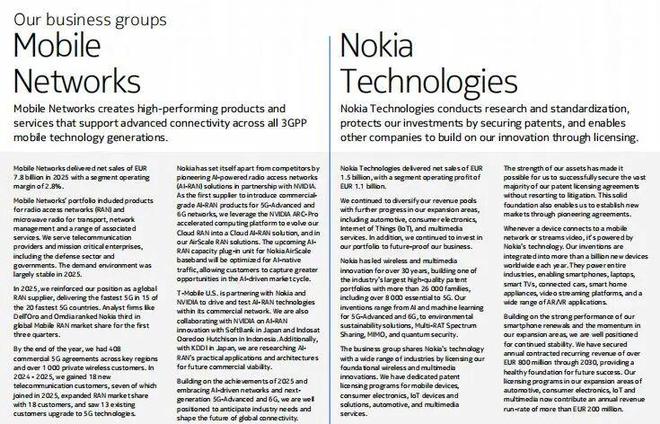
As of 2025, Nokia holds over 26,000 patent families, including more than 7,000 5G Standard Essential Patents (SEPs), with about 70% of the patent families having a remaining validity period of over ten years.

What do these patents mean?

All global mobile phone manufacturers, whether Apple, Samsung, Huawei, or Xiaomi, as long as their devices support 4G or 5G communication, cannot bypass Nokia's technical barriers and must pay it patent licensing fees.

Nokia's royalty rate for 5G phones is no more than 3 euros per unit. Although the unit price seems low, the profit margin on this revenue is extremely high, almost akin to a "rent collection" model.

The 2025 financial report shows that Nokia's patent licensing business generated annual net sales of 1.5 billion euros, with an operating profit margin exceeding 70%, of which over 800 million euros in core cellular patent revenue has been locked in until 2030.

Source: 2025 Financial Report

More notably, Nokia is systematically replicating this "patent royalty" model from the traditional mobile phone field to multiple high-growth sectors.

Riding the wave of automotive intelligence, in 2025, Nokia reached 4G/5G patent licensing agreements with automakers like Mercedes-Benz and at least four Chinese automakers. Through the Avanci patent pool, its 5G automotive patent fee is set at $32 per vehicle, and $20 per vehicle for 4G.

Furthermore, Nokia has also reached into the video streaming sector. In 2025, it completed the acquisition of 298 core video codec patents from LG Electronics. By the end of the year, it had signed licensing agreements with seven streaming platforms including Amazon and Starz.

Simultaneously, it initiated patent lawsuits against giants like Paramount and Warner Bros. in the US, Germany, and other places, accelerating the implementation of a "playback tax" across the industry.

From handheld terminals to smart cars, and further to digital content and the Internet of Things, by the end of 2025, Nokia had signed patent licensing agreements with over 250 enterprises worldwide, building a patent royalty network covering all scenarios.

PART 02


Nokia's New "Optical-Compute Integration" Engine After the AI Computing Boom

If patents are Nokia's "cash cow," then optical networks and AI-RAN are its true engines charging into the AI era.

Relying on these two core technologies, this underestimated company has long been deeply embedded in the core of AI computing infrastructure, becoming a key partner for giants like NVIDIA, Google, and Microsoft.

In June 2024, Nokia acquired the US optical communications company Infinera for $2.3 billion, thereby gaining full-chain technology from optical chips, optical modules to transmission systems, boosting its market share to second globally, only behind Huawei.

The real value of this acquisition lies in: there are very few companies worldwide capable of independently designing and manufacturing high-end optical semiconductor chips, and Infinera is one of them.

This means Nokia can directly supply high-speed optical modules of 800G and 1.6T to AI data centers, with a single optical fiber transmission rate as high as 1.6 Tbps and latency reduced to microseconds.

Performance is the most direct proof: its optical networking revenue grew 19% in 2025, and rose another 20% in Q1 2026, with an operating profit margin exceeding 15%, over five times that of its mobile networking business. The book-to-bill ratio is far greater than 1, with customers queuing for goods. Among the top ten global cloud service providers, nine use Nokia's optical networking technology.

If optical networking brings stable hardware orders for Nokia, AI-RAN earns it long-term, sustainable service revenue.

Traditional 5G base stations typically have baseband computing utilization rates below 10% during nighttime traffic troughs. Nokia's AI-RAN technology allows base stations to run AI inference tasks using idle computing power while ensuring communication quality, enabling localized processing for smart security, autonomous driving edge computing, lightweight large model inference, etc.

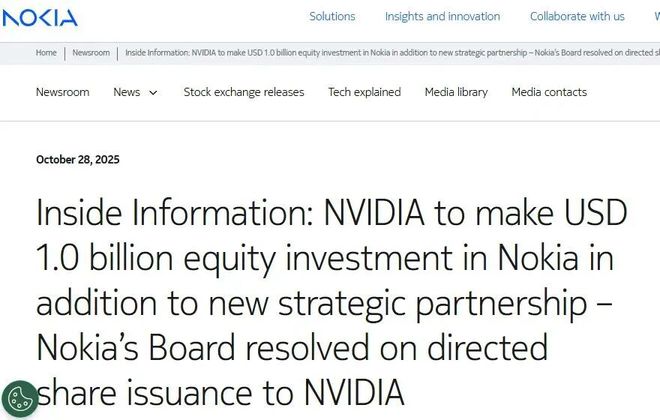
In October 2025, NVIDIA invested a whopping $10 billion in strategic funding, precisely eyeing the dormant computing power within Nokia's global millions of base stations.

Source: Company Website

The jointly launched AI Aerial platform deeply integrates NVIDIA GPUs with Nokia's base station network. It has already been piloted in Indonesia, completing Southeast Asia's first AI-driven 5G call.

Currently, AI-RAN is undergoing pilot verification with over 10 leading global operators. In Q1 2026, revenue from AI and cloud customers grew 49% year-on-year, with quarterly orders reaching about one billion euros, becoming Nokia's fastest-growing emerging business.

PART 03

Nokia's "Positioning + Subscription" Dual Springboard Before 6G Standardization

For a long time, the capital market has priced Nokia using traditional telecom equipment vendor valuation standards, resulting in a significantly lower price-to-earnings ratio compared to peers like Ericsson and Cisco.

However, this valuation discount will be completely broken with the advent of the 6G era. 2026 is a crucial year for 6G standard setting, with formal commercialization expected by 2030.

Relying on its industry-leading AI-native architecture, Nokia is expected to achieve an overtaking in the 6G era and become a core global standard-setter.

Its advantages are mainly concentrated in: being able to embed AI capabilities directly into the network's physical layer and data link layer, enabling smooth evolution on existing AirScale base stations without additional hardware; the intelligent resource optimization technology jointly tested with KDDI, which reduces base station power consumption by 40% and increases throughput fourfold, has already been verified; promoting the inclusion of non-terrestrial networks in the 6G standard to achieve global coverage.

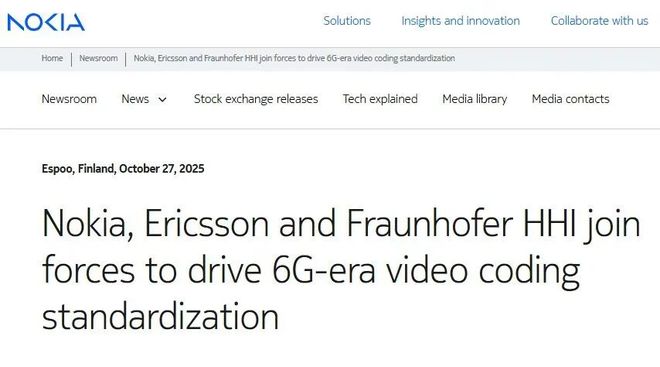
More crucially, in October 2025, Nokia and Ericsson joined hands with Germany's Fraunhofer HHI in a historic tripartite cooperation, jointly promoting the formulation of 6G video codec standards, further enhancing Nokia's influence in this field.

Source: Company Website


Simultaneously, Nokia is breaking the traditional telecom equipment vendor model of one-time sales, transitioning towards a persistent revenue technology service provider through network automation and subscription-based services.

Currently, Nokia has launched 9 SaaS products, with an addressable market size projected to reach $2.6 billion in 2026. Its MantaRay SON self-organizing network solution has been deployed and validated in the networks of over 120 global customers. The entire MantaRay product portfolio supports the TM Forum's Level 4 Autonomous Network level, significantly reducing manual intervention.

Additionally, the 2025 financial report shows that its full-year free cash flow reached 1.5 billion euros, with an FCF conversion rate of 72%, and a free cash flow yield of approximately 4.4%. The company's stable and continuous dividend payouts also provide investors with a certain level of cash return assurance.

Today's Nokia has long shed its old label of a "nostalgia brand" and transformed into a hidden giant holding core technologies, binding with the AI红利, and positioning for the future of 6G.

Market perception always lags behind industrial transformation, but as more capital begins to re-examine Nokia's true value, the curtain on a long-overdue value re-rating is just beginning to rise.

Связанные с этим вопросы

QWhat is the core reason behind Nokia's dramatic financial turnaround in 2026, as described in the article?

ANokia's dramatic turnaround is attributed to its transformation into a 'patent giant + AI infrastructure provider.' It leverages a massive patent portfolio (particularly 5G SEPs) for high-margin licensing revenue and has become a key player in AI infrastructure through its optical network business and AI-RAN technology.

QHow does Nokia's patent licensing business generate revenue, and what new markets is it expanding into beyond smartphones?

ANokia's patent licensing business generates revenue by charging fees to all manufacturers of 4G/5G devices. It is expanding into new markets like smart vehicles (charging per-car fees through the Avanci pool) and video streaming platforms (through acquired video codec patents and lawsuits to enforce 'streaming taxes').

QWhat strategic acquisition did Nokia make in 2024 to strengthen its position in the AI infrastructure market, and what key capability did it gain?

AIn 2024, Nokia acquired the US optical communications company Infinera for $2.3 billion. This gave it the crucial capability to design and manufacture high-end optical semiconductor chips, allowing it to supply high-speed optical modules (like 800G and 1.6T) directly to AI data centers.

QWhat is AI-RAN, and why did NVIDIA invest $1 billion in a strategic partnership with Nokia in this area?

AAI-RAN is Nokia's technology that allows 5G base stations to use their idle computing power during low-traffic periods to run AI inference tasks locally. NVIDIA invested $1 billion to partner with Nokia to tap into the vast, underutilized compute power within Nokia's global network of millions of base stations, integrating its GPUs with Nokia's network through the AI Aerial platform.

QHow is Nokia positioning itself for the 6G era, according to the article, and what business model shift is it undergoing?

AFor the 6G era, Nokia is positioning itself as a core standard-setter by leveraging its AI-native architecture and participating in key alliances (e.g., with Ericsson and Fraunhofer HHI). It is also shifting its business model from a traditional one-time telecom equipment seller to a technology service provider with recurring revenue through SaaS products and subscription-based network automation services.

Похожее

SpaceX, OpenAI, Anthropic: The Three AI Giants Racing for IPO, Which One Is Worth Betting On?

SpaceX, OpenAI, and Anthropic are poised for historic IPOs within weeks, potentially raising a combined $180 billion—a sum exceeding the entire internet bubble's fundraising. The hosts of the Limitless Podcast argue this isn't just individual company financing but an unprecedented capital concentration for AI infrastructure, driven by an insatiable need for compute, data centers, power, and chips. SpaceX's IPO is notable for reportedly changing market index rules to allow faster inclusion, potentially funneling trillions in passive retirement funds into its stock, despite its unproven space-based data center business model. In contrast, Anthropic demonstrates explosive growth, with ARR reportedly hitting $45 billion and approaching profitability, fueled by strong enterprise adoption of products like Claude Code. Google's separate $80 billion raise highlights the immense capital pressure, even for giants. The discussion acknowledges bubble risks but leans optimistic. The hosts contend the massive spending is building essential physical infrastructure for the next technological era. A key bottleneck isn't capital but the real-world limits of chip manufacturing and construction speed. As long as demand for AI compute outstrips supply, this investment cycle represents a foundational build-out rather than a purely financial bubble. All three companies are seen as foundational bets on the future, with Anthropic often cited as the most immediately compelling due to its proven revenue trajectory.

marsbit1 ч. назад

SpaceX, OpenAI, Anthropic: The Three AI Giants Racing for IPO, Which One Is Worth Betting On?

marsbit1 ч. назад

From 'Old Guys' to 'New Favorites': How AI Is Revaluing Old Infrastructure from Dell to Nokia?

From "Vintage Tech" to "New AI Darlings": How AI Revalues Old Infrastructure One year ago, tech giants like Dell, Nokia, Cisco, and Western Data were seen as slow-growth, low-valuation stories, far from the AI spotlight dominated by players like Nvidia. Now, these legacy tech stocks are gaining market attention, sparking debate on whether this is genuine industry revaluation or a temporary narrative. As AI moves from model parameters to real-world data centers, the market is recognizing companies with proven delivery and infrastructure capabilities. This shift marks a change in the AI investment thesis: from pure model and GPU focus to the complex systems engineering required for deployment. Companies like Dell, HPE, and Corning are being revalued not for being "sexy" AI innovators, but for their decades of accumulated expertise in supply chains, enterprise delivery, and infrastructure—assets that have become critical in the AI buildout phase. The revaluation is unfolding across three key infrastructure lines: 1. **Servers & System Integration:** Dell and HPE are emerging as crucial system integrators or "general contractors" for AI data centers, translating GPU orders into complete, deployable server racks integrated with power, cooling, and networking. 2. **Networking & Connectivity:** AI's scale demands robust high-speed connections. Corning (fiber optics), Nokia (AI-RAN, 6G), and Cisco (data center switches) are gaining importance for enabling efficient data transfer within and between AI clusters. 3. **Storage:** Beyond high-speed memory (HBM/DRAM), the AI data explosion is driving demand for high-capacity hard drives (HDDs) from companies like Western Digital and Seagate to handle training data, logs, and cold storage cost-effectively. For this revaluation to be substantive and not just a narrative, three criteria are key: 1) Concrete AI-related order and revenue growth (e.g., Dell's AI server sales), 2) Upward revisions to company financial guidance, and 3) Sustainable improvements in profit quality, not just top-line revenue spikes. In essence, AI's transition to a real construction phase is re-pricing "old assets" against "new demand." The opportunity, however, is selective. Only those legacy firms that are demonstrably integrated into the capital expenditure chains of data center and enterprise AI deployment are likely to experience a true "logic re-rating" rather than just a temporary valuation bounce.

marsbit1 ч. назад

From 'Old Guys' to 'New Favorites': How AI Is Revaluing Old Infrastructure from Dell to Nokia?

marsbit1 ч. назад

The Merger of Codex and ChatGPT Marks the Beginning of a Major Reshuffle in Programming Tools

OpenAI is shifting its strategic focus from ChatGPT to Codex, merging them along with the browser tool Atlas into a unified desktop super-app. This move signals an internal belief that Codex, originally a programming tool, represents the next evolution of AI more than conversational models like ChatGPT. Over the past year, Codex's weekly active users have surged past 5 million. The key distinction is that while ChatGPT answers questions, Codex executes tasks. Enterprises increasingly value this ability to get work done over simply receiving advice. Consequently, Codex is attracting professionals beyond developers, including analysts, bankers, marketers, and product managers. OpenAI's reorganization and increased investment in Codex stem from recognizing that the future of AI competition lies in execution capabilities, not just conversation. The company is launching role-specific plugins (e.g., for data analysis, sales, design) to transform Codex into a broad knowledge work platform that automates and redefines white-collar workflows. Beyond being a tool, Codex reflects OpenAI's ambition to redefine software. New features like "Sites"—which generates interactive websites from documents—and collaborative "Annotations" aim to create a paradigm where the AI understands the goal and handles the tools and steps, functioning more like a digital colleague than traditional software. The ultimate goal is a unified experience where the user cares only about the completed task.

marsbit1 ч. назад

The Merger of Codex and ChatGPT Marks the Beginning of a Major Reshuffle in Programming Tools

marsbit1 ч. назад

Interpreting Investment Opportunities in the Age of Great Navigation, Invesco Great Wall Fund Releases '2026 Report on Chinese Enterprises Going Global'

Invesco Great Wall Fund has released its "2026 China Corporate Globalization Report," titled "The 'Great Navigation Era' of Chinese Enterprises." The report analyzes the new trends and investment opportunities as Chinese companies expand globally, moving from simple product exports to comprehensive overseas operations involving services, branding, and local production. Driven by factors like trade friction, the pursuit of higher profit margins abroad, and policy support, globalization is becoming essential for Chinese companies. The report outlines an evolution: from early product export ("Globalization 1.0") to the current "Globalization 2.0," characterized by overseas capacity, capital goods investment, consumer brand expansion, and service exports. Chinese firms' competitive advantages are highlighted, including a vast engineer talent pool, low-cost and robust infrastructure, and complete industrial clusters. Specific sectors with significant出海 potential are identified: * **Capital Goods** (e.g., engineering machinery, power equipment): Benefiting from global demand, especially in Belt & Road markets and the AI-driven power grid upgrade cycle. * **Consumer Brands**: Transitioning from cost to brand advantage, leveraging供应链 efficiency. * **Technology & Innovation**: Including AI applications, optical modules within global tech supply chains, and new energy vehicles focusing on local production. * **Pharmaceuticals**: Chinese biotech firms are becoming preferred partners for global pharma, with potential for breakthrough drugs in areas like oncology and weight loss. The report concludes that corporate globalization represents a sustained, core theme for China's capital markets, though companies must navigate challenges like geopolitics and localization.

marsbit1 ч. назад

Interpreting Investment Opportunities in the Age of Great Navigation, Invesco Great Wall Fund Releases '2026 Report on Chinese Enterprises Going Global'

marsbit1 ч. назад

Торговля

Спот
Фьючерсы
活动图片