U.S. Soldier Arrested After Betting on Maduro's Ouster Nets $400,000; First Insider Trading Case on Polymarket Concluded

marsbitОпубликовано 2026-04-24Обновлено 2026-04-24

Введение

A US Army Special Forces sergeant, Gannon Ken Van Dyke, was arrested and charged by the US Department of Justice for insider trading on the prediction market Polymarket. He used classified information related to "Operation Absolute Resolve," a military operation that led to the capture of Venezuelan President Nicolás Maduro in January 2026, to place bets on Maduro's ouster. Between December 27, 2025, and January 2, 2026, Van Dyke invested approximately $33,034 in 13 bets on Polymarket, all predicting Maduro's removal, US military intervention in Venezuela, and related events. He netted a profit of over $409,881. After the operation, he attempted to conceal his actions by withdrawing funds, changing account details, and requesting the deletion of his Polymarket account. This case marks the first time the US Justice Department has prosecuted insider trading on a prediction market. The CFTC also filed a civil suit, invoking the "Eddie Murphy Rule" from the Dodd-Frank Act, which prohibits trading based on misappropriated government information. The incident highlights broader concerns about insider trading on prediction markets, with similar cases recently reported in Israel and France. Polymarket stated it proactively reported the activity and cooperated with the investigation.

Author: Claude, Deep Tide TechFlow

Deep Tide Introduction: The U.S. Department of Justice arrested Army Special Forces Staff Sergeant Gannon Ken Van Dyke on Thursday, charging him with using classified information obtained from participating in an operation to raid Venezuelan President Maduro to bet on Polymarket, turning a $33,000 principal into a profit of over $409,000 by betting on Maduro's ouster. This is the first case of insider trading in a prediction market prosecuted by the U.S. Department of Justice, and the first time the U.S. Commodity Futures Trading Commission (CFTC) has used the "Eddie Murphy Rule" to charge someone for misusing non-public government information.

A U.S. special forces soldier involved in the military operation to capture Maduro used classified intelligence to place bets on a prediction market, profiting $400,000. Now, he himself is the defendant.

According to a U.S. Department of Justice announcement on April 23rd, Army Special Forces Staff Sergeant Gannon Ken Van Dyke (38, stationed at Fort Bragg, North Carolina) was arrested and charged by federal authorities for allegedly using classified information to trade for profit on the prediction market Polymarket. The indictment shows that Van Dyke participated in the planning and execution of the operation codenamed "Operation Absolute Resolve," which detained Venezuelan President Maduro and his wife in Caracas in the early hours of January 3rd, 2026.

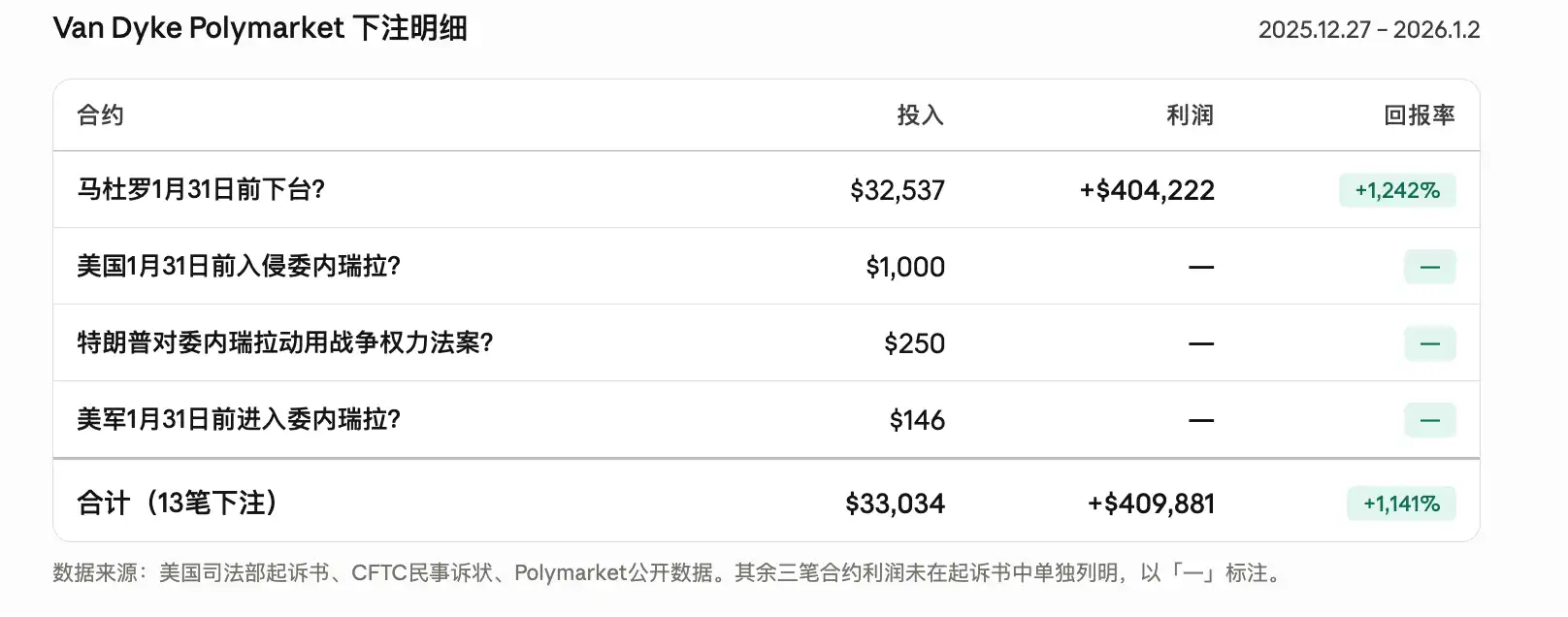
According to the indictment, Van Dyke opened a Polymarket account on December 26th, 2025. Between December 27th and January 2nd, he placed a total of 13 bets, with a total investment of approximately $33,034, all betting on the "Yes" outcome. These bets covered four contracts: "Maduro steps down before January 31st," "US invades Venezuela," "US troops enter Venezuela," and "Trump uses War Powers Act on Venezuela."

The final net profit was approximately $409,881. The single largest bet was $32,537 on "Maduro steps down before January 31st," with a return of 1,242%, profiting $404,222.

First Case Concluded: DOJ and CFTC Attack on Two Fronts

This is the first time the U.S. Department of Justice has brought criminal charges for insider trading on a prediction market, and it is also the first time the Commodity Futures Trading Commission (CFTC) has brought charges for insider trading in event contracts.

The CFTC simultaneously filed a civil lawsuit in the Federal Court for the Southern District of New York, demanding that Van Dyke return his profits, pay civil penalties, and be permanently banned from participating in futures trading. CFTC Chairman Michael S. Selig stated in a declaration that the defendant's actions endangered U.S. national security and put soldiers' lives at risk.

Van Dyke is charged with five federal crimes: three counts of violating the Commodity Exchange Act (each carrying a maximum sentence of 10 years in prison), one count of wire fraud (maximum 20 years), and one count of illegal monetary transactions (maximum 10 years).

The legal basis for this case is particularly noteworthy. According to an Axios report, the CFTC cited the so-called "Eddie Murphy Rule," which originates from Section 746 of the 2010 Dodd-Frank Act. Named after the movie "Trading Places," it explicitly prohibits trading commodities using stolen or misused non-public government information.

Attempted to Destroy Evidence After the Fact, Polymarket Actively Cooperated with Investigation

The indictment also reveals Van Dyke's attempts to cover his tracks after profiting from the bets.

On the day of the operation (January 3rd), Van Dyke withdrew most of the proceeds from his Polymarket account, transferred them to an overseas cryptocurrency vault, and then deposited them into a newly opened online brokerage account. On January 6th, when media and social platforms began reporting abnormal trading in Maduro-related contracts on Polymarket, Van Dyke requested that Polymarket delete his account, falsely claiming he had lost access to the registered email address. On the same day, he also changed the registered email address for his cryptocurrency exchange account to one not under his name; this email had been registered as early as December 14th, 2025.

According to the indictment, a few hours after the operation ended, a photo of Van Dyke was uploaded to his Google account. The photo shows him wearing a U.S. military combat uniform, holding a rifle, standing on the deck of a warship with three other soldiers, with a sunrise at sea in the background.

Polymarket stated in a post on platform X that the company proactively referred the matter to the Department of Justice and fully cooperated with the investigation after discovering a user was trading using classified government information. Polymarket Chief Legal Officer Neal Kumar stated that the platform is not anonymous and users like this one will be found.

Insider Trading Risks in Prediction Markets Extend Far Beyond the Maduro Case

The Van Dyke case is not an isolated incident. Questions surrounding insider trading on Polymarket have created systemic pressure.

In February of this year, Israeli authorities arrested and charged a reservist and a civilian, accusing the two of profiting on Polymarket using classified information about Israeli military operations against Iran.

In March, an account with the username "Magamyman" began placing bets approximately 71 minutes before a joint U.S.-Israel airstrike on Iran, ultimately profiting about $553,000.

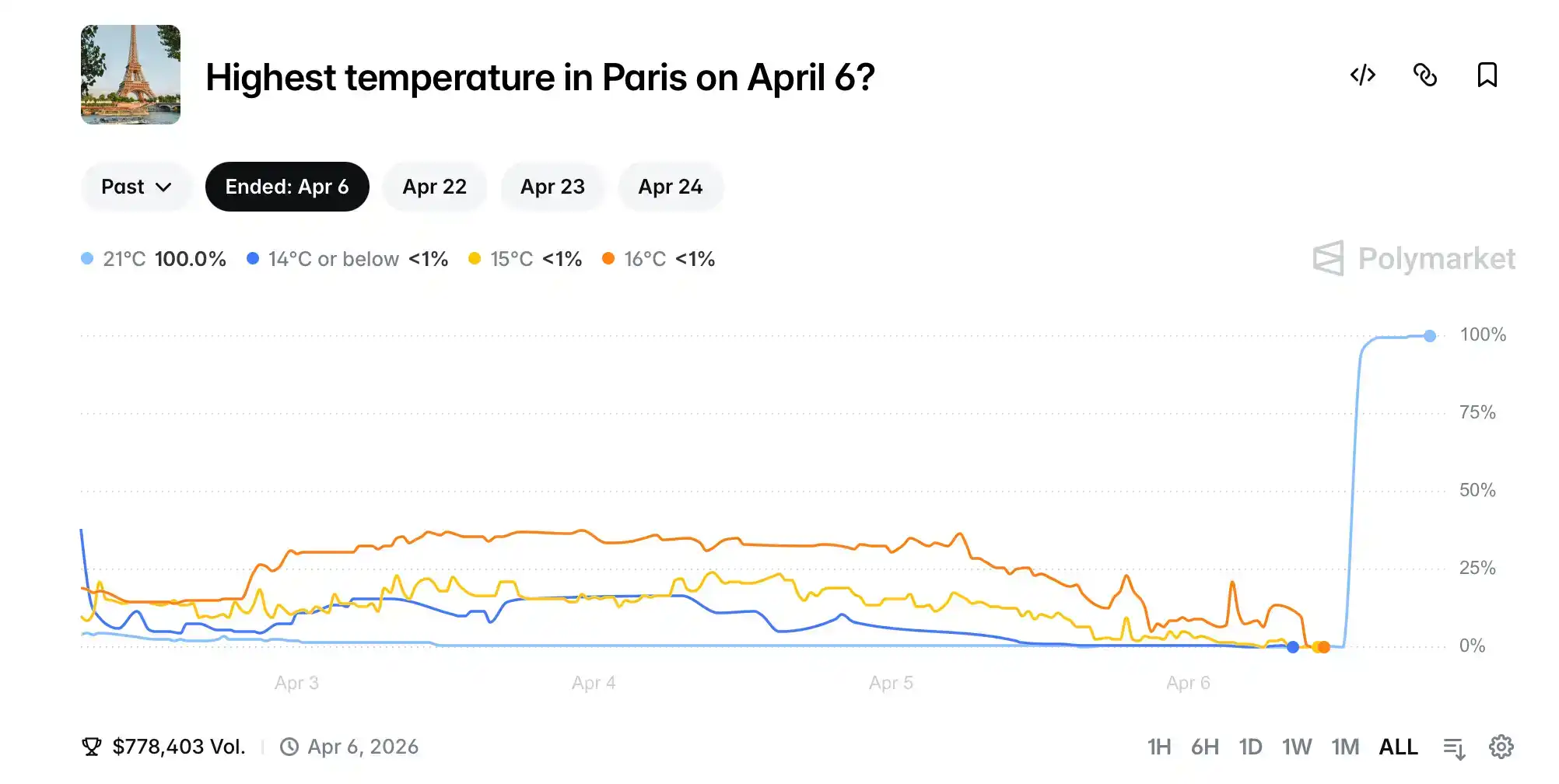
And just yesterday, someone used a hairdryer to heat a temperature sensor near Paris's Charles de Gaulle Airport, thereby affecting weather data reported by the station, and profited from weather predictions on a prediction market.

When asked about the case by reporters at the White House on Thursday, Trump said it was like Pete Rose betting on his own team to win. He then added that the world has unfortunately become a kind of casino and expressed dissatisfaction with such bets on prediction markets.

The compliance dilemma for prediction markets lies in the fact that Polymarket's international site runs on the Polygon blockchain, operates outside U.S. jurisdiction, and is accessible via VPN. Although the CFTC approved Polymarket to operate within the U.S. last year, its U.S. site is not yet fully launched.

The Trump family also has business ties to Polymarket. The president's son, Donald Trump Jr., serves as an advisor to Polymarket, and his venture capital firm, 1789 Capital, has invested millions of dollars in the platform.

Связанные с этим вопросы

QWhat was the U.S. Army Staff Sergeant charged with in relation to the Polymarket prediction market?

AU.S. Army Staff Sergeant Gannon Ken Van Dyke was charged with using classified information obtained from his participation in the military operation to capture Venezuelan President Maduro to place bets on the Polymarket prediction market, netting over $409,000 in profit.

QWhich U.S. government agencies were involved in this first-of-its-kind case against prediction market insider trading?

AThe U.S. Department of Justice (DOJ) brought the criminal charges, and the Commodity Futures Trading Commission (CFTC) filed a parallel civil lawsuit. This is the first case of its kind for both agencies.

QWhat is the 'Eddie Murphy Rule' cited by the CFTC in this case?

AThe 'Eddie Murphy Rule' is a provision from the 2010 Dodd-Frank Act (Section 746) that explicitly prohibits trading commodities using stolen or misappropriated government non-public information. It is named after the movie 'Trading Places'.

QWhat specific contracts on Polymarket did Van Dyke bet on using the insider information?

AVan Dyke bet on four contracts: 'Maduro out by Jan 31', 'US invades Venezuela', 'US troops enter Venezuela', and 'Trump uses War Powers Act on Venezuela'. He placed 13 bets totaling approximately $33,034, all betting on the 'Yes' outcome.

QHow did Polymarket respond to the discovery of this insider trading activity?

APolymarket stated that after discovering a user was trading on confidential government information, it proactively referred the matter to the Department of Justice and fully cooperated with the investigation. Their Chief Legal Officer emphasized that the platform is not anonymous and users can be identified.

Похожее

The Value Distribution of Stablecoins

**Summary: The Value Distribution of Stablecoins** The article argues that stablecoins are evolving from mere trading tools into broader channels for dollar access. It divides the stablecoin ecosystem into four layers to analyze how value is distributed: 1. **Issuance Layer:** Mints stablecoins, holds reserve assets, and captures the spread between reserve yield and user costs (e.g., Tether, Circle). This layer currently earns the largest profit margin. 2. **Infrastructure Layer:** Connects stablecoins to the traditional financial system, handling fiat on/off-ramps, banking integration, compliance (KYC/AML), and asset management (e.g., Bridge, BVNK). This is the "unglamorous" but critical work, building the essential bridges between crypto and real-world finance. 3. **Acquiring/Distribution Layer:** Integrates stablecoins into merchant systems, manages payment flows, and provides enterprise financial software (e.g., Stripe, Coinbase). They act as the access point for businesses. 4. **Application Layer:** The end-users and businesses that ultimately use stablecoins for payments, settlements, or as a store of value. They benefit from convenience but have little pricing power. The core thesis is that while the issuance layer currently dominates profits, the often-overlooked **infrastructure layer holds significant long-term potential**. The real challenge and barrier to mass adoption is not the on-chain transfer of stablecoins (which is simple), but the complex "last mile" integration into existing business workflows, banking systems, and regulatory frameworks across different countries. Companies in this layer are currently in a "land grab" phase, investing heavily to build networks, secure bank partnerships, and establish compliance pathways. While their position is currently pressured by the profitable issuers above and distribution platforms below, the article suggests that if stablecoins become a default financial rail for businesses, the infrastructure providers who have done the hard work of integration will ultimately gain strong pricing power and become entrenched, essential players.

marsbit5 ч. назад

The Value Distribution of Stablecoins

marsbit5 ч. назад

The Value Distribution of Stablecoins

The Value Distribution of Stablecoins The article argues that stablecoins are evolving from a mere trading tool into a broad "dollar channel." It analyzes the industry's value chain through four layers: 1. **Issuance Layer (e.g., Tether, Circle):** The top layer that mints stablecoins, holds reserve assets, and captures the thickest interest rate spread. 2. **Infrastructure Layer (e.g., Bridge, BVNK):** Connects stablecoins to the traditional financial system, handling critical but complex "dirty work" like fiat on/off-ramps, banking integration, compliance (KYC/AML), and cross-border settlement. 3. **Acquiring/Distribution Layer (e.g., Stripe, Coinbase):** Embeds stablecoins into merchant systems, manages payment flows, and integrates with enterprise software. 4. **Application Layer:** End-users and businesses that ultimately use stablecoins for payments, settlement, or storing value. The author posits that while the issuance layer currently captures the most profit, the most overlooked and potentially critical layer is infrastructure. The core challenge for stablecoin adoption isn't the on-chain transfer (which is simple), but bridging the gap between blockchain and the real-world financial system. This involves solving practical problems for businesses: fiat conversion, reconciliation, tax handling, and user onboarding. Infrastructure companies are currently in a difficult "land-grab" phase—building networks, securing banking relationships, and achieving compliance country-by-country. They face pressure from both the profitable issuance layer above and distribution platforms below. However, the author suggests this layer is building a crucial moat. Once stablecoins become a default business rail, the infrastructure players who have done the hard work of integration may gain significant, durable value and pricing power.

链捕手5 ч. назад

The Value Distribution of Stablecoins

链捕手5 ч. назад

Торговля

Спот
Фьючерсы

Популярные статьи

Как купить S

Добро пожаловать на HTX.com! Мы сделали приобретение Sonic (S) простым и удобным. Следуйте нашему пошаговому руководству и отправляйтесь в свое крипто-путешествие.Шаг 1: Создайте аккаунт на HTXИспользуйте свой адрес электронной почты или номер телефона, чтобы зарегистрироваться и бесплатно создать аккаунт на HTX. Пройдите удобную регистрацию и откройте для себя весь функционал.Создать аккаунтШаг 2: Перейдите в Купить криптовалюту и выберите свой способ оплатыКредитная/Дебетовая Карта: Используйте свою карту Visa или Mastercard для мгновенной покупки Sonic (S).Баланс: Используйте средства с баланса вашего аккаунта HTX для простой торговли.Третьи Лица: Мы добавили популярные способы оплаты, такие как Google Pay и Apple Pay, для повышения удобства.P2P: Торгуйте напрямую с другими пользователями на HTX.Внебиржевая Торговля (OTC): Мы предлагаем индивидуальные услуги и конкурентоспособные обменные курсы для трейдеров.Шаг 3: Хранение Sonic (S)После приобретения вами Sonic (S) храните их в своем аккаунте на HTX. В качестве альтернативы вы можете отправить их куда-либо с помощью перевода в блокчейне или использовать для торговли с другими криптовалютами.Шаг 4: Торговля Sonic (S)С легкостью торгуйте Sonic (S) на спотовом рынке HTX. Просто зайдите в свой аккаунт, выберите торговую пару, совершайте сделки и следите за ними в режиме реального времени. Мы предлагаем удобный интерфейс как для начинающих, так и для опытных трейдеров.

1.5k просмотров всегоОпубликовано 2025.01.15Обновлено 2026.06.02

Как купить S

Sonic: Обновления под руководством Андре Кронье – новая звезда Layer-1 на фоне спада рынка

Он решает проблемы масштабируемости, совместимости между блокчейнами и стимулов для разработчиков с помощью технологических инноваций.

2.3k просмотров всегоОпубликовано 2025.04.09Обновлено 2025.04.09

Sonic: Обновления под руководством Андре Кронье – новая звезда Layer-1 на фоне спада рынка

HTX Learn: Пройдите обучение по "Sonic" и разделите 1000 USDT

HTX Learn — ваш проводник в мир перспективных проектов, и мы запускаем специальное мероприятие "Учитесь и Зарабатывайте", посвящённое этим проектам. Наше новое направление .

1.8k просмотров всегоОпубликовано 2025.04.10Обновлено 2025.04.10

HTX Learn: Пройдите обучение по "Sonic" и разделите 1000 USDT

Обсуждения

Добро пожаловать в Сообщество HTX. Здесь вы сможете быть в курсе последних новостей о развитии платформы и получить доступ к профессиональной аналитической информации о рынке. Мнения пользователей о цене на S (S) представлены ниже.

活动图片