U.S. Crypto Reserves Shrink by 26%: No 'Strategy' for Purchases, Only Shrinking 'Reserves'

比推Опубликовано 2026-03-06Обновлено 2026-03-06

Введение

A year after former US President Donald Trump signed an executive order establishing a "Strategic Bitcoin Reserve" and a "US Digital Asset Reserve," the value of the US government's cryptocurrency holdings has fallen by 26%, from over $30 billion to approximately $22.39 billion. The reserves, which consist primarily of seized assets and are not involve new purchases, include about 328,272 Bitcoin (valued at roughly $22 billion), as well as Ethereum, USDC, wrapped Bitcoin, and BNB. The government has not increased its Bitcoin holdings since the order was issued and has no plans to use taxpayer funds for additional acquisitions. Officials emphasize that market volatility does not change the administration's commitment to US leadership in crypto, but critics warn that a lack of transparency and a clear framework could distort markets and erode public trust.

Author: Cointelegraph

Compiled by: AididiaoJP, Foresight News

Original title: U.S. Still Has No Plans to Advance Bitcoin Strategic Reserve


One year ago, U.S. President Trump signed an executive order to establish a U.S. Strategic Cryptocurrency Reserve. Now, a year later, the reserve's value has shrunk by billions of dollars.

Early in his administration, Trump established a special task force to study how the government could better implement and regulate cryptocurrencies, including plans for Bitcoin and cryptocurrency reserves.

Over the past year, the Trump administration has introduced multiple macroeconomic and policy adjustments. Among them, friendly regulatory policies from Washington have been beneficial for cryptocurrencies, but punitive tariffs and escalating geopolitical tensions have had negative impacts.

Currently, the number of tokens in the U.S. cryptocurrency reserve has remained largely unchanged since its establishment.

Trump's Crypto Reserve Largely Unchanged

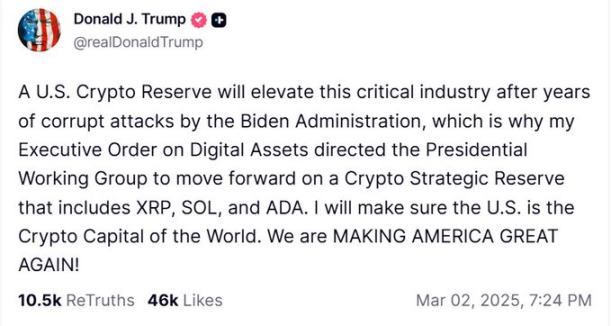
On March 6, Trump established the "Strategic Bitcoin Reserve" and the "U.S. Digital Asset Reserve" via executive orders. The Bitcoin Reserve contains only Bitcoin, while the Digital Asset Reserve includes various altcoins. Before the order was issued, Trump had stated that the reserve would include XRP, Solana, and Cardano.

Source: Donald Trump

These two reserves "will not acquire additional assets by any means other than forfeiture proceedings."

This executive order essentially consolidated previously scattered seized assets from multiple federal regulatory and law enforcement agencies. The order stated that centralizing ownership, control, and management of these assets within the federal government would ensure proper oversight, accurate tracking, and a unified approach to managing the government's cryptocurrency holdings.

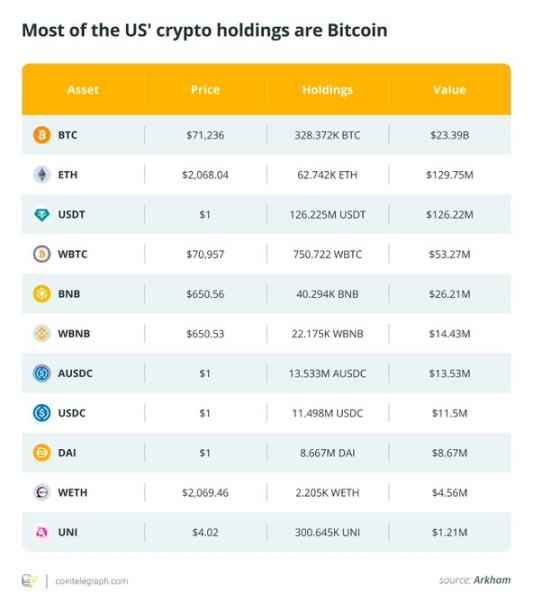
The government has not disclosed specific details of the Bitcoin Reserve and Digital Asset Reserve, but blockchain analytics company Arkham Research has identified multiple blockchain wallets associated with the U.S. government.

As of press time, the total value of cryptocurrencies held by the U.S. government is approximately $22.39 billion, with Bitcoin alone accounting for about $22 billion. Other major holdings include the stablecoin USDC, Ether, Wrapped Bitcoin (WBTC), and BNB.

(Data collected on March 4)

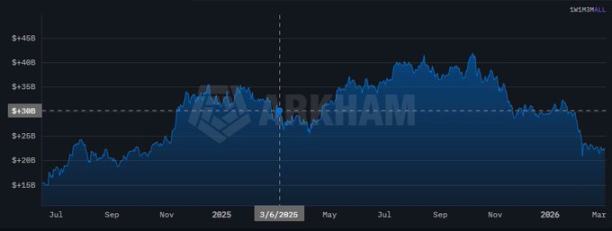
It is currently unclear how much of these assets belong to the formal reserve, and whether and how these assets have been transferred. However, the dollar value of the reserve has significantly decreased. Arkham data shows that when Trump signed the executive order, the total value of crypto assets held by the U.S. was over $30 billion. As of press time, this figure has dropped to $22 billion, a decline of 26%.

Significant decline in the value of the U.S. crypto asset portfolio since March 2025. Source: Arkham

The White House does not appear to be swayed by this. Deputy Press Secretary Kush Desai, commenting on the recent price drop, said: "In a free market, the government does not set prices. Market volatility does not change the Trump administration's determination to ensure U.S. dominance in cryptocurrency and other frontier technologies."

Bitcoin Holdings Unchanged, No Purchase Plans Yet

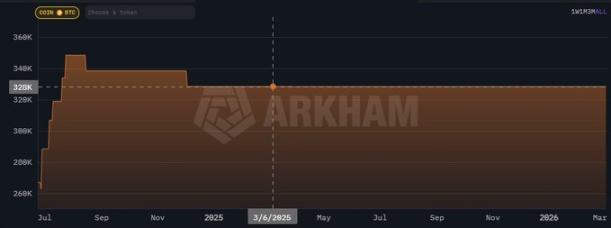
Despite hopes from staunch Bitcoin supporters that the U.S. government would start buying Bitcoin, the amount of Bitcoin held by the government has not changed. Since the executive order was signed, the U.S. government has held approximately 328,272 Bitcoin.

U.S. Bitcoin holdings have remained constant since the reserve's establishment. Source: Arkham

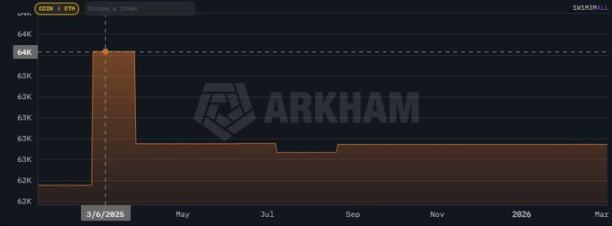
Ether is the second-largest crypto asset held by the U.S. government. Its quantity decreased after the executive order was signed, possibly due to exchanges or transfers. However, after April 2025, Ether holdings have remained largely stable.

Changes in Ether holdings. Source: Arkham

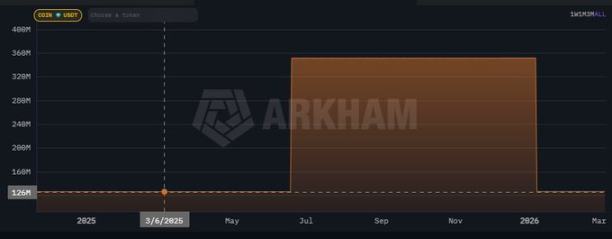
Tether's USDT is the largest stablecoin held by the U.S. government. It saw a significant increase of over 200 million tokens in May 2025, before falling back to pre-March 2026 levels.

Changes in USDT holdings. Source: Arkham

These buying and selling patterns are not entirely clear. As mentioned, the government has not publicly disclosed specific transaction volumes.

The new crypto reserve strategy does not completely rule out the possibility of the government buying Bitcoin, but requires that any purchases must be made in a way that "does not impact the budget." Commissioner for AI and Crypto Affairs David Sacks said last year: "Cannot increase the deficit, cannot increase debt, cannot tax the American people."

"Not a single penny from taxpayers. But if the Treasury Secretaries can find a way to accumulate more Bitcoin without burdening taxpayers, they can do so."

A year on, it is unclear whether the government has developed such a strategy, or how it would be implemented.

Jason Yanowitz, co-founder of crypto company Blockworks, told the BBC last year that a crypto reserve containing a variety of different assets could negatively impact the market. "Without a clear framework, arbitrarily selecting assets can distort markets and lead to a loss of public trust," he said. "Ensuring transparency through independent audits and public reporting is crucial for fostering innovation and avoiding favoritism."

Following the success of software company-turned-Bitcoin investment vehicle Strategy, the idea of establishing Bitcoin reserves gained traction last year, both at the state and corporate levels. The narrative of Bitcoin as "digital gold" made holding the asset attractive for government budgets.

According to data from tracking website BitcoinTreasuries.net, 10 countries including the United States, China, Ukraine, El Salvador, the United Kingdom, and North Korea currently hold Bitcoin.

At the corporate level, analysts expect industry consolidation as the bear market continues. Wojciech Kasicki, Chief Strategy Officer of crypto infrastructure and treasury company BTCS, previously told Cointelegraph that companies with Bitcoin treasury values below net asset value might be acquired by operating businesses.

Bitcoin reserves remain a new concept and have not yet been tested through a full crypto winter.


Twitter:https://twitter.com/BitpushNewsCN

Bitpush TG Discussion Group:https://t.me/BitPushCommunity

Bitpush TG Subscription: https://t.me/bitpush

Original link:https://www.bitpush.news/articles/7617407

Связанные с этим вопросы

QWhat was the total value of the US government's cryptocurrency holdings when the strategic reserve was established, and what is it now?

AWhen the strategic reserve was established, the US government's cryptocurrency holdings were valued at over $30 billion. As of the article's publication, that value has decreased to approximately $22.39 billion, a decline of 26%.

QAccording to the executive order, how can the US government acquire additional assets for its crypto reserves?

AAccording to the executive order, the US government can only acquire additional assets for its crypto reserves through forfeiture proceedings, not through purchases or any other means.

QWhat is the government's position on the recent price decline of its crypto assets, as stated by the deputy press secretary?

AThe deputy press secretary, Kush Desai, stated that in a free market, the government does not set prices, and market volatility does not change the Trump administration's determination to ensure US dominance in cryptocurrency and other frontier technologies.

QWhat was the condition set by Commissioner David Sacks for the government to potentially purchase more Bitcoin?

ACommissioner David Sacks stated that any purchase of Bitcoin must be done in a way that is 'budget-neutral,' meaning it cannot add to the deficit, increase debt, or tax the American people. Taxpayers should not spend a single penny.

QWhich other countries, besides the US, are listed as holding Bitcoin according to BitcoinTreasuries.net?

AAccording to BitcoinTreasuries.net, the countries that hold Bitcoin, besides the US, are China, Ukraine, El Salvador, the United Kingdom, and North Korea, among others, for a total of 10 nations.

Похожее

La Liga Team Bets $1 Million Against Themselves Before Match: Does Using Prediction Markets for Insurance Comply with Sports Regulations?

A Spanish La Liga club, reportedly Osasuna, purchased insurance against relegation and was linked to a transaction of over $1 million on the prediction market platform Kalshi, betting against its own victory in a crucial season-ending match. While Osasuna confirmed buying €1.2 million insurance for a potential €6 million payout in case of relegation through broker Howden, it did not confirm involvement with Kalshi. The reported trade involved intermediaries like Game Point Capital and Greenlight Commodities, with quant firm Susquehanna as the counterparty. This incident highlights the blurring line between financial hedging and gambling in prediction markets. Such markets allow trading on future event outcomes, like sports results. In the US, Kalshi operates as a regulated event contract market under the CFTC. However, Spanish authorities recently initiated penalties against Kalshi and Polymarket, considering their activities unlicensed gambling. The case raises core questions about prediction markets: who can trade, how insider information is handled, and whether participants can influence outcomes, especially in sports where results are human-driven. While leagues like La Liga and Serie A have partnered with Polymarket in North America, the regulatory clash and potential for conflicts of interest, as seen in this club's alleged transaction, present significant challenges as prediction markets evolve toward institutional risk management.

Foresight News31 мин. назад

La Liga Team Bets $1 Million Against Themselves Before Match: Does Using Prediction Markets for Insurance Comply with Sports Regulations?

Foresight News31 мин. назад

From Shouting 150 Dollars to Liquidating HYPE in Just Three Days, How Much Credibility Does Arthur Hayes Have Left?

How much of Arthur Hayes's market credibility remains? Recently, the "godfather of crypto perpetual swaps" and BitMEX co-founder has faced public criticism, including accusations from on-chain investigator ZachXBT about creating exit liquidity for his followers. Starting last week, Hayes executed multiple sudden sell-offs. He had repeatedly publicly predicted the HYPE token would reach $150. After a $100,000 bet defending Hyperliquid on June 1st, he announced just three days later that he had completely sold his HYPE and NEAR holdings, successfully exiting near the peak. He also sold ZEC and WLD. His sale of WLD appeared to be a classic "pump and dump" maneuver. On June 3rd, he publicly set a $10 target for WLD, causing its price to surge over 35%. By June 6th, he announced he had sold his WLD, citing "anomalous" SpaceX pre-IPO price action, which triggered a sharp price drop. On June 9th, Hayes published a lengthy article explaining his actions, citing factors like rising energy costs and a potential AI bubble burst. Consequently, his family office, Maelstrom, now holds positions in US energy producers and only core crypto assets BTC and ETH, having sold AI-related stocks and non-core cryptocurrencies. This pattern is not new. In 2025, he similarly touted HYPE before selling it at what turned out to be a cycle peak, only to repurchase it at the next cycle's low. Similar scenarios played out with tokens like ETHFI and ENA. Long-term observers have developed a strategy: ignore Hayes's public statements but closely monitor his on-chain actions—be cautious following his buys, but decisively follow his sells. If he continues these tactics, especially as seen with the WLD case, his market credibility risks being permanently damaged. As Hayes himself admitted in his latest article, "I remain an unapologetic gambler."

marsbit49 мин. назад

From Shouting 150 Dollars to Liquidating HYPE in Just Three Days, How Much Credibility Does Arthur Hayes Have Left?

marsbit49 мин. назад

Fundraising is Like a Strange Dance: The 'Absurd Drama' of Silicon Valley Founders' Capital Raises

The article details a series of absurd and revealing anecdotes shared by Silicon Valley founders about their venture capital fundraising experiences, sparked by Greg Isenberg's story of pitching to a sleeping a16z partner. Founders describe surreal pitch meetings: one faced a barefoot, peanut-eating investor who offered triple the requested amount after 30 seconds; another performed a pitch in a VC's parked car; a founder discovered his audience understood no English beyond "yes." These stories highlight the often irrational and performative nature of fundraising. Beyond the absurdity, darker power imbalances are exposed. Stories include investors suggesting founders fire co-founders for their equity, blatant market misjudgments, disrespectful behavior from LPs, and discriminatory remarks. A debate also emerges around "Sequoia's" practice of splitting a round into two valuations. However, the thread isn't solely critical. Positive counter-narratives celebrate supportive VCs who offered crucial advice during crises, respected founders' timelines, and showed simple gestures of respect—like a partner personally fetching coffee before a major pitch. Ultimately, the collective sharing acts as a pressure release, illustrating that fundraising is a complex dance of power, trust, and sometimes sheer theater. It underscores that beyond capital, mutual respect and integrity remain the most enduring foundations of the founder-investor relationship.

marsbit1 ч. назад

Fundraising is Like a Strange Dance: The 'Absurd Drama' of Silicon Valley Founders' Capital Raises

marsbit1 ч. назад

Торговля

Спот
Фьючерсы
活动图片