Twitter Tags Lead Directly to Market Quotes, Is Trading Far Behind?

marsbitОпубликовано 2026-01-12Обновлено 2026-01-12

Введение

X is advancing its "Everything App" vision with the upcoming launch of Smart Cashtags, a feature that allows users to tag specific financial assets and view real-time prices directly within posts. This enhancement addresses issues like ambiguous ticker symbols in crypto by enabling precise asset identification via smart contract addresses. It aggregates discussions and may integrate one-click buy/sell functionality, potentially compressing the traditional financial decision-making process into a seamless social-to-trading experience. This move aligns with Elon Musk’s ambition to transform X into an all-in-one platform encompassing social, media, payment, and trading services. The feature could also support AI agents in processing asset information more accurately. However, challenges include ensuring reliable data sources, mitigating market manipulation risks (e.g., pump-and-dump schemes), and navigating complex global financial regulations. The announcement by X product lead Nikita Bier—who has a background in crypto, including an advisory role at Solana—hints at potential ecosystem biases, as evidenced in demo visuals featuring tokens like BONK and a speculative Base token. Ultimately, Smart Cashtags may accelerate the convergence of social media and financial trading, positioning X as a central hub for global capital flow and decision-making.

When asset tags represent a real-time money interface, X takes another step closer to its "Everything App" dream.

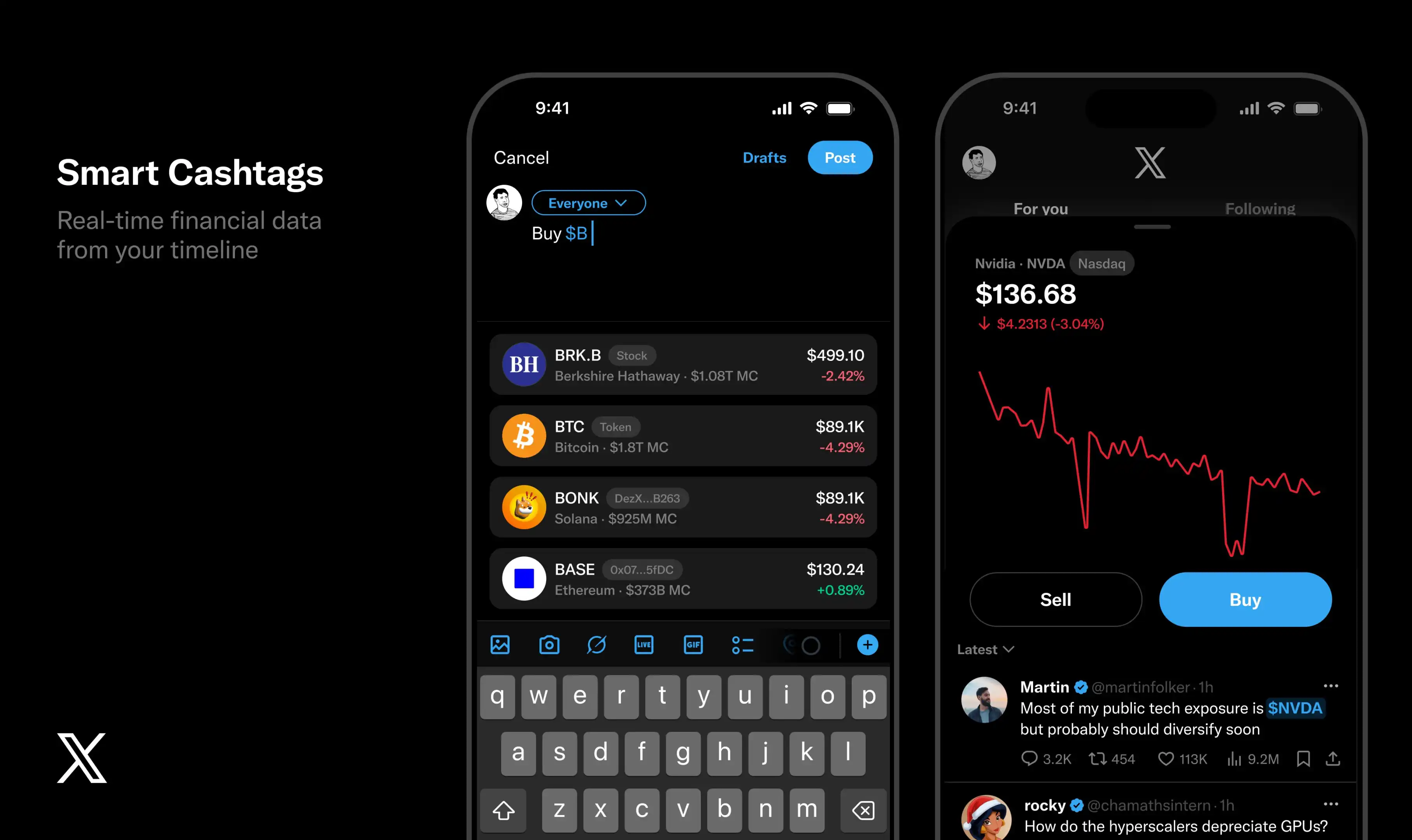
On January 11, 2016, X Product Lead Nikita Bier announced the launch of the Smart Cashtags feature next month. At first glance, this seems like a minor improvement allowing users to precisely tag assets and view real-time prices. But when placed within X's grand financial ecosystem strategy, this is undoubtedly a key move in building the "Everything App".

What is Smart Cashtags?

According to the content and screenshots released by Nikita Bier, the upcoming Smart Cashtags brings several fundamental changes:

1. Precise Asset Anchoring: Posters can assign a tag to a specific asset or smart contract address. This means that when multiple assets or tokens with the same name exist, especially a common pain point in the crypto market with rampant同名代币 (Ticker), clicking the tag will directly point to the unique target asset.

2. One-Click Real-Time Price Viewing: Cashtags in the timeline can be clicked directly to instantly display real-time prices.

3. Aggregated Discussion: Aggregates all tweets mentioning that asset, forming a complete discussion view.

4. Trading Closed-Loop: The screenshot shown by Nikita Bier displayed one-click buy or sell buttons after opening the NVDA tag. Although it's not yet clear if this feature will cover crypto assets, it sends a strong signal: X is experimenting with embedding trading functions directly into the information feed.

In response to a question about "Does this mean we will be able to use self-custody wallets or even CEX widgets to trade on X in the future?", Nikita Bier replied with an Emoji "".

When the information flow and price flow merge into one, X is no longer just a chat box, but a financial trading terminal in its infancy. The traditional financial decision path is: see news → switch apps to search → check quotes → find analysis → decide to trade. Smart Cashtags compresses this to: see news / discussion → click tag (check quotes / view sentiment)→ one-click trade.

The Larger Game: From Social Media to "Everything App"

Musk has repeatedly stated his desire to build X into an Everything App encompassing social, media, payment, and trading. On January 11, 2026, he emphasized again that X is the set of all things.

It's worth emphasizing that in June 2025, former X CEO Linda Yaccarino, before stepping down, stated that users would "soon" be able to invest or trade on X, and that X was also exploring the launch of an X credit or debit card. X had previously stated it would launch a digital wallet and peer-to-peer payment service X Money, with Visa as its first partner.

On the other hand, what's active on X in the future might not just be people, but also AI agents. Smart Cashtags can help these AI agents more accurately identify and process asset information.

What are the Potential Challenges?

Of course, this feature is not without challenges. First is the credibility of the data source. For cryptocurrencies, where does the real-time price come from? Centralized exchanges, decentralized oracles, or multi-source aggregation?

Secondly, Smart Cashtags and the ensuing trading functions could also exacerbate market manipulation risks. If a KOL tweets promoting a small-cap coin, and fans can just "click to buy", FOMO sentiment can be amplified instantly, potentially making Pump and Dump easier than ever. How X limits malicious tags will be a huge challenge.

Last but not least, there's the minefield of regulatory compliance. When X starts providing real-time financial data, pushing related assets through algorithms (could this be considered asset recommendation?), and trading functions, could it be classified as an "exchange" or "investment advisor" by regulators? Regulatory attitudes vary greatly across different jurisdictions, and X needs to balance innovation and compliance globally.

Key Figure: Nikita Bier's Crypto Background

Nikita Bier is not just X's product lead; he previously founded the social apps tbh app and Gas, which were acquired by Meta and Discord respectively. He is also an investment partner at Lightspeed and began serving as a Solana advisor in March 2025.

In Nikita Bier's Smart Cashtags announcement screenshot today, the dropdown list after typing "$B" included BTC" and the Solana ecosystem's BONK token. Some community users believe that BONK, as a leading Solana Meme, being placed in such a prominent position is clearly not a coincidence, reflecting Nikita Bier's preference and push for the Solana ecosystem.

Another point is that the screenshot also showed a Base token, displaying a market cap of $373 billion and a single token price of $130, which was interpreted by some community users as an abstract prophecy of an upcoming Base token issuance. Previously, in mid-September at the BaseCamp 2025 conference in Stowe, Vermont, Base network lead Jesse Pollak stated that Base was exploring the possibility of issuing a network token to accelerate Base's decentralization process.

Summary

The boundary between social media and financial terminals is completely dissolving. The launch of Smart Cashtags will mark the official arrival of the era of "social-driven trading".

For ordinary users, this means more transparent information and faster tools; but for regulators and traditional financial institutions, this may mean a "new battlefield" that is harder to control, more volatile, and entirely driven by community sentiment.

Nikita Bier stated bluntly, "X is the best platform for financial information—what users read here influences the allocation of trillions of dollars."

Whoever controls the financial information flow controls the entry point for capital movement. When X completes the closed loop of "information + payment + trading", it will become one of the operating systems of the global financial market. At that time, decisions on the allocation of hundreds of billions of dollars will not only be based on information on X, but will happen directly on X.

Связанные с этим вопросы

QWhat is the core function of the newly announced Smart Cashtags feature on X?

ASmart Cashtags allows users to precisely tag specific financial assets or smart contract addresses, view real-time prices directly within the timeline, aggregate discussions about the asset, and potentially execute buy/sell orders through an integrated interface.

QHow does Smart Cashtags contribute to X's broader strategic vision?

AIt is a key step in X's plan to become an 'Everything App' by integrating social interaction, media, payment services, and financial trading into a single platform, effectively merging information flow with capital flow.

QWhat are some potential challenges associated with Smart Cashtags?

AChallenges include ensuring reliable data sources (especially for crypto assets), mitigating market manipulation risks like pump-and-dump schemes facilitated by quick trading access, and navigating complex regulatory compliance across different jurisdictions.

QWho is Nikita Bier and why is his role significant for this feature?

ANikita Bier is X's Product Lead, a former founder of social apps acquired by Meta and Discord, a Lightspeed investment partner, and a Solana advisor. His crypto background and product expertise signal X's serious intent to integrate financial and blockchain elements.

QWhat does the integration of trading functionality via Smart Cashtags imply for the future of financial interactions?

AIt signifies the arrival of 'social-driven trading,' where users can seamlessly transition from seeing news/discussions to executing trades without leaving the platform, potentially making X a global financial operating system that influences trillion-dollar capital allocation decisions.

Похожее

La Liga Team Bets $1 Million Against Themselves Before Match: Does Using Prediction Markets for Insurance Comply with Sports Regulations?

A Spanish La Liga club, reportedly Osasuna, purchased insurance against relegation and was linked to a transaction of over $1 million on the prediction market platform Kalshi, betting against its own victory in a crucial season-ending match. While Osasuna confirmed buying €1.2 million insurance for a potential €6 million payout in case of relegation through broker Howden, it did not confirm involvement with Kalshi. The reported trade involved intermediaries like Game Point Capital and Greenlight Commodities, with quant firm Susquehanna as the counterparty. This incident highlights the blurring line between financial hedging and gambling in prediction markets. Such markets allow trading on future event outcomes, like sports results. In the US, Kalshi operates as a regulated event contract market under the CFTC. However, Spanish authorities recently initiated penalties against Kalshi and Polymarket, considering their activities unlicensed gambling. The case raises core questions about prediction markets: who can trade, how insider information is handled, and whether participants can influence outcomes, especially in sports where results are human-driven. While leagues like La Liga and Serie A have partnered with Polymarket in North America, the regulatory clash and potential for conflicts of interest, as seen in this club's alleged transaction, present significant challenges as prediction markets evolve toward institutional risk management.

Foresight News8 мин. назад

La Liga Team Bets $1 Million Against Themselves Before Match: Does Using Prediction Markets for Insurance Comply with Sports Regulations?

Foresight News8 мин. назад

From Shouting 150 Dollars to Liquidating HYPE in Just Three Days, How Much Credibility Does Arthur Hayes Have Left?

How much of Arthur Hayes's market credibility remains? Recently, the "godfather of crypto perpetual swaps" and BitMEX co-founder has faced public criticism, including accusations from on-chain investigator ZachXBT about creating exit liquidity for his followers. Starting last week, Hayes executed multiple sudden sell-offs. He had repeatedly publicly predicted the HYPE token would reach $150. After a $100,000 bet defending Hyperliquid on June 1st, he announced just three days later that he had completely sold his HYPE and NEAR holdings, successfully exiting near the peak. He also sold ZEC and WLD. His sale of WLD appeared to be a classic "pump and dump" maneuver. On June 3rd, he publicly set a $10 target for WLD, causing its price to surge over 35%. By June 6th, he announced he had sold his WLD, citing "anomalous" SpaceX pre-IPO price action, which triggered a sharp price drop. On June 9th, Hayes published a lengthy article explaining his actions, citing factors like rising energy costs and a potential AI bubble burst. Consequently, his family office, Maelstrom, now holds positions in US energy producers and only core crypto assets BTC and ETH, having sold AI-related stocks and non-core cryptocurrencies. This pattern is not new. In 2025, he similarly touted HYPE before selling it at what turned out to be a cycle peak, only to repurchase it at the next cycle's low. Similar scenarios played out with tokens like ETHFI and ENA. Long-term observers have developed a strategy: ignore Hayes's public statements but closely monitor his on-chain actions—be cautious following his buys, but decisively follow his sells. If he continues these tactics, especially as seen with the WLD case, his market credibility risks being permanently damaged. As Hayes himself admitted in his latest article, "I remain an unapologetic gambler."

marsbit26 мин. назад

From Shouting 150 Dollars to Liquidating HYPE in Just Three Days, How Much Credibility Does Arthur Hayes Have Left?

marsbit26 мин. назад

Fundraising is Like a Strange Dance: The 'Absurd Drama' of Silicon Valley Founders' Capital Raises

The article details a series of absurd and revealing anecdotes shared by Silicon Valley founders about their venture capital fundraising experiences, sparked by Greg Isenberg's story of pitching to a sleeping a16z partner. Founders describe surreal pitch meetings: one faced a barefoot, peanut-eating investor who offered triple the requested amount after 30 seconds; another performed a pitch in a VC's parked car; a founder discovered his audience understood no English beyond "yes." These stories highlight the often irrational and performative nature of fundraising. Beyond the absurdity, darker power imbalances are exposed. Stories include investors suggesting founders fire co-founders for their equity, blatant market misjudgments, disrespectful behavior from LPs, and discriminatory remarks. A debate also emerges around "Sequoia's" practice of splitting a round into two valuations. However, the thread isn't solely critical. Positive counter-narratives celebrate supportive VCs who offered crucial advice during crises, respected founders' timelines, and showed simple gestures of respect—like a partner personally fetching coffee before a major pitch. Ultimately, the collective sharing acts as a pressure release, illustrating that fundraising is a complex dance of power, trust, and sometimes sheer theater. It underscores that beyond capital, mutual respect and integrity remain the most enduring foundations of the founder-investor relationship.

marsbit40 мин. назад

Fundraising is Like a Strange Dance: The 'Absurd Drama' of Silicon Valley Founders' Capital Raises

marsbit40 мин. назад

Торговля

Спот
Фьючерсы
活动图片