Turning $50 into a Million by Age 18 Through Wallet Tracking

深潮Опубликовано 2025-12-30Обновлено 2025-12-30

Введение

At 18, the author turned $50 into over $1 million in less than a year using wallet tracking strategies after initially losing $80 in meme coin trades. Early mistakes included buying based on hype, narratives, or social media buzz, which often led to losses. The key shift was focusing on tracking "smart money" movements—wallets of insiders, KOLs, teams, market makers, or coordinated groups—rather than relying on subjective judgments. The author’s methods evolved over time: - Initially tracking influential KOLs’ wallets, turning $50 into $5,000 in a month. - Later monitoring coordinated groups (e.g., turning $4,000 into $600,000 on $ROCKY). - Advanced techniques included tracking new wallets, project team wallets, and market maker wallets for early entry (e.g., $BARRON and $HOOD trades yielding 50x returns). Strict rules were followed: no more than 5% of capital per trade, avoiding large positions to prevent being targeted, and maintaining emotional discipline. The author emphasizes that success came from replicable strategies, not luck, and advises understanding the motives and patterns of tracked entities. The journey is shared as inspiration, with gratitude to those indirectly involved and a focus on ethical, data-driven trading.

Written by: Ugo

Compiled by: Luffy, Foresight News

In February 2024, I entered the world of Meme coin trading with $80 and lost everything. I had this kind of disastrous experience twice.

It was at that time that I realized I hadn't figured out the way of this market at all and had been using the wrong methods.

Later, I re-entered the market with $50. This time, I used a wallet tracking strategy. In less than a year, by February 2025, that $50 had grown to over $1 million.

Early Pitfalls

My previous logic for buying Meme coins was simple: "This coin has a funny meme, good promotional content, and a clean-looking website. Just buy it."

Admittedly, this method could occasionally make some money, but most of the time, it was no different from pure gambling. You had no solid basis and couldn't find objective reasons to judge how high the price could specifically go.

If you want stable profits, you must find a way to get key information *before* the market moves, not just follow the hype after it pumps.

I was once addicted to all sorts of rumors on X and Telegram: "This coin will definitely hit a $100 million market cap this week, just you wait." I later learned that most people who post these things are paid shills, or they had already accumulated 15% of the token supply at low prices. You rush in excitedly, only to end up as the bag holder.

If your profit-taking targets aren't based on real information, then your actions are merely reacting to someone else's interests, not truly following market规律 (laws/patterns).

Turning the Tide with Wallet Tracking

I quickly realized a critical piece was missing from my previous approach. I would look at the operations of top traders and wonder, "How can he predict the market moves, but I can't?" So I had to find a solution.

And wallet tracking completely颠覆 (overturned) my understanding of trading. I stopped trying to guess market tops and bottoms, stopped chasing various narrative hotspots, and stopped being led by the nose by hype on X. Instead, I focused on just one thing: where is the smart money flowing?

The origin of any major market move isn't on social media, but in a small number of wallets. These wallets are either the project's initial wallets, large holding wallets, or early institutional wallets. Insiders, KOLs, industry big shots, market makers, newly created anonymous wallets... are all hidden in these addresses.

My success wasn't based on the luck of one single trade, but on repeatedly capturing replicable market patterns.

At that moment, I completely understood: I don't need to be smarter than the entire market, I don't need to incorporate any subjective judgment, and I don't need to pay attention to market炒作 (hype/speculation). I just need to closely watch the data, analyze fund movements, and then decisively execute my trading strategy.

From then on, my goal became extremely clear: build a trading system that reacts solely based on the movements of smart money, not on hearsay.

My Practical Wallet Tracking Methods

Watch KOL Wallets Closely

When I first started in February 2024, the wallet tracking method was actually very simple. Back then, almost no one frequently changed wallet addresses.

All you had to do was find the stealth wallet addresses of KOLs who truly had influence, and then follow their moves. That's it.

They accumulate at low prices → Pump aggressively → Price instantly pumps 10x.

Using this method, I turned $50 into $5,000 in the first month. Immediately in the second month, $5,000 became $30,000.

For example, on February 24th: A project team specifically launched a token for a certain KOL. This industry big shot quietly accumulated positions using multiple stealth wallets when the token's market cap was only $20,000. I followed his moves and bought in when the market cap reached $30,000. Subsequently, he aggressively promoted it in Telegram groups and on X, and the token's market cap instantly broke through $400,000. I took partial profits at this level.

Later that day, the market cap surged to $1 million, and I cashed out again. All calculated, my entry capital increased about 30 times in just a few hours.

My capital base was still very small at that time, so I didn't have to worry about liquidity issues at all and could exit cleanly.

Tracking Cabal Wallets

A few months later, I stopped focusing on individual KOLs and switched to tracking the wallet movements of cabals (pump groups). At that time, people were changing wallet addresses more and more frequently. Tracking the operational consensus of a group of people was much more reliable than looking at a single wallet. For example, 10 different people's wallets, all belonging to the same circle, were synchronizing the same operations.

This kind of signal gave me far more confidence than a single wallet could.

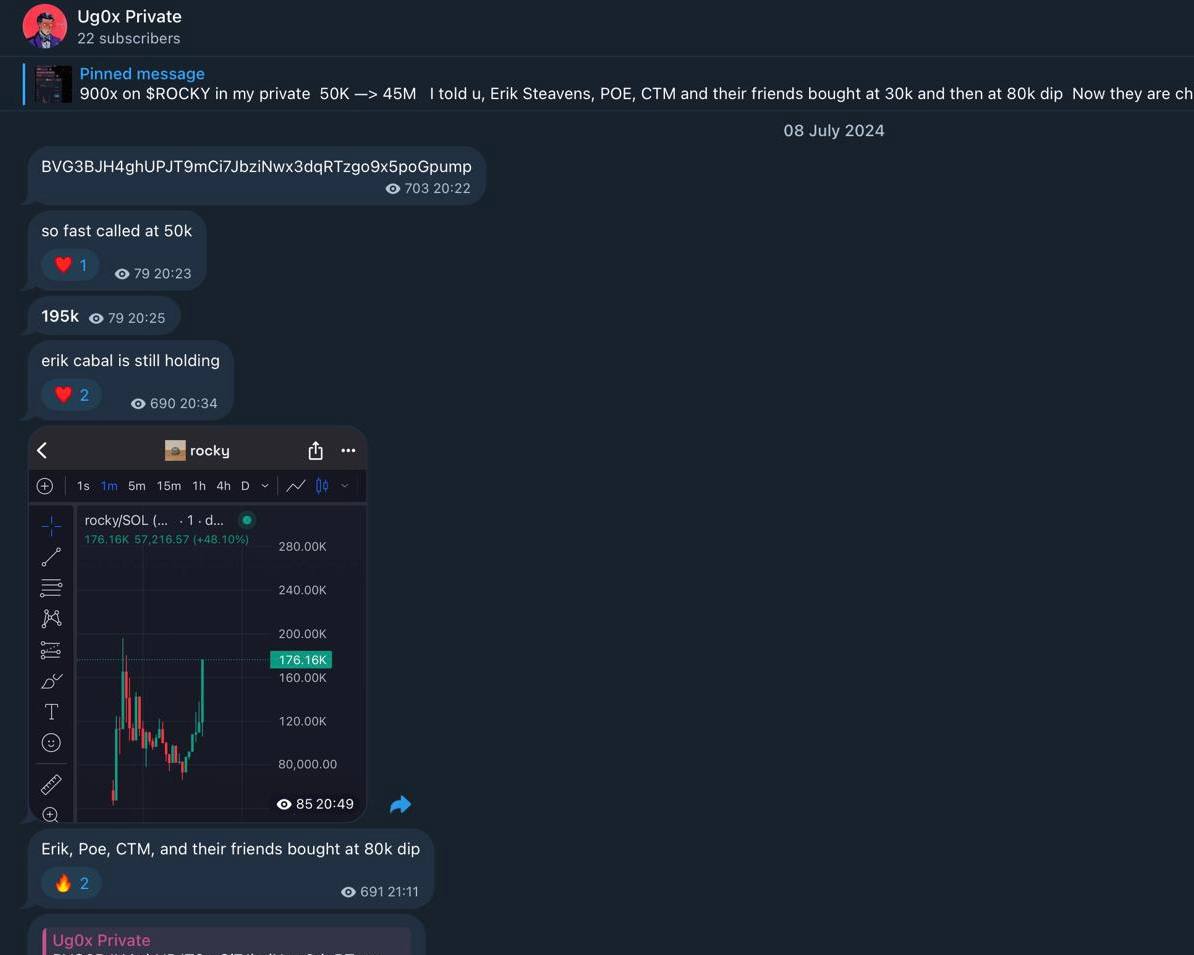
July 8, 2024, the operation around the $ROCKY token was a perfect case study. At that time, people like Erik Steavens, POE, DOGEN, and CTM were all quietly buying in the range of $10,000 to $80,000 market cap.

Seeing this signal, I knew it was no coincidence; they were definitely planning a pump.

I bought 2.8% of the circulating supply when the market cap was $40,000.

In the following days, this group of big shots联合发力 (joined forces) to pump the price, and the token's market cap soared to $45 million.

I took profits in batches between a $2 million and $10 million market cap, averaging an exit around $6 million.

In this trade, my entry capital increased 150 times. Although holding to the peak could have yielded 1100x, I strictly executed my exit plan. I was more than satisfied with making my first six-figure profit from this trade.
Tracking New Wallets, Project Wallets & Large Holding Wallets

By January 2025, the crypto market trading atmosphere was unprecedentedly hot, but wallet tracking was also becoming increasingly difficult. To continuously get first-hand insider information, I had to constantly optimize my methods and adapt.

The key to tracking these insiders' wallets was finding their new wallets that had just withdrawn funds from centralized exchanges like Binance. This meant accurately tracing fund transfer records and timestamps between multiple Binance addresses. This process was time-consuming but absolutely worth it.

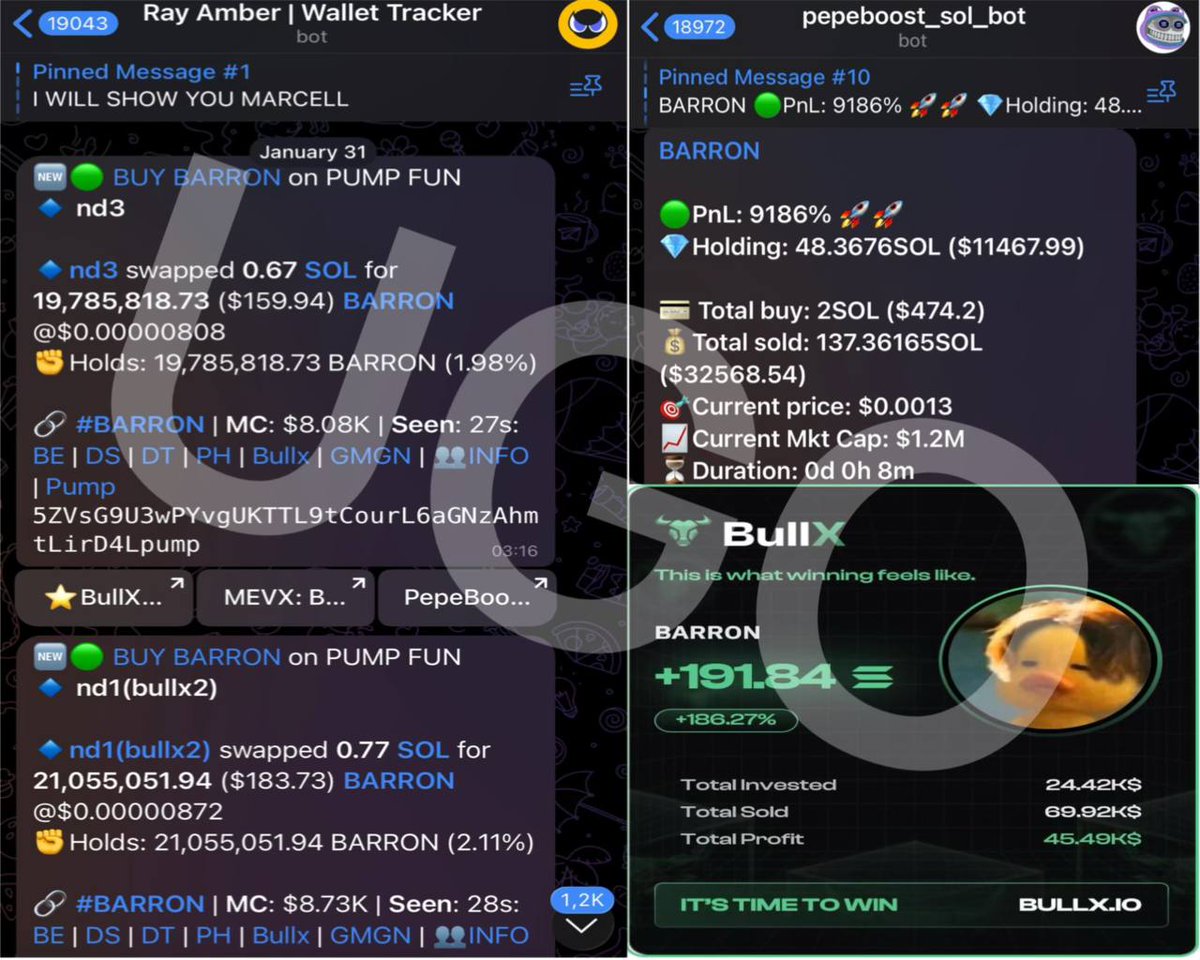
For example, I was closely tracking Marcell's wallet movements, so I could see his newly funded wallets every day. On January 31st, he personally launched and took a large position in the $BARRON token.

I built my position across 3 wallets in the market cap range of $15,000 to $25,000. About three minutes later, Marcell started posting to pump it. I quickly took profits and exited between a $1 million and $2.5 million market cap.

This was one of the fastest trades I ever executed: an initial investment of $1,300 eventually yielded over $110,000. (The trading platform BullX showed my buy amount as $24,000 because I later bought the dip in this wallet, maximizing the profit).
Tracking Market Maker Wallets

Market maker wallets are wallet addresses directly controlled by the token project team, primarily used to manipulate the token price for the benefit of the project team or the token itself.

Common manipulation tactics include: triggering stop-loss orders by placing big buy/sell orders, or dumping the price 30% in minutes to cause panic selling, allowing new investors to enter at low prices.

However, market makers often transfer tokens between wallets shortly after the token is launched. If these wallets aren't newly created or are easily identifiable, we can directly track the project team's movements and accurately capture every new token launch opportunity.

This is how I operated the $HOOD token trade on January 31, 2025.

This project team大概 (roughly) launches a new token every month. They completed their large position allocation when the market cap was pumped to around $2 million, and I bought in decisively at this level, getting in before the top KOLs started promoting it. A few hours later, I took profits between an $80 million and $120 million market cap, achieving roughly a 50x return on this trade.

Meanwhile, during the gap while managing the initial position profit-taking, I also used the market maker's large sell-offs to re-enter heavily, making 40% to 70%差价 (price difference/profit) in just a few minutes.

The total profit for this day was a whopping $152,000. Until the ASTER token trade in September of the same year, January 31st was my highest profit day.

My Ironclad Trading Rules

I always strictly adhere to capital management rules. For example, the capital投入 (input/allocated) to each trade never exceeds 5% of the total portfolio. I also flexibly adjust risk exposure based on the quality of the trading opportunity and my own level of confidence.

When trading with a wallet tracking strategy, you absolutely cannot use heavy leverage (or: take large positions). Once the target you are tracking discovers your presence, they can easily turn around and rug you.

You also need to learn to think from their perspective, understand their interests, operating habits, and rhythm control. This is how you minimize the risk of being rugged and achieve consistent, stable profits.

Of course, I strictly follow my own trading plan and never let emotions dictate decisions. I actually rarely have trouble with this because I started learning forex trading at age 14, and discipline is already deeply ingrained.

That said, I have also experienced several painful lessons of profit drawdowns. But these setbacks didn't crush me; instead, they became motivation for me to move forward. Driven by this unwillingness, I studied even harder, constantly refining my trading edge.

Finally

I am writing this article not to show off. On one hand, I want to use it as a diary to look back on my growth in 5 years. On the other hand, I also hope to inspire and help more people, letting everyone understand: as long as you are willing to主动求变 (actively seek change) and put in the effort, there is always a way to achieve your goals.

I must clarify one point: I never use these tracking techniques against friends or people around me. Everything I do is purely to understand the underlying logic of market operation and then go with the flow.

I am also very grateful to those I track, and to the project teams that truly work hard. I always trade with敬畏之心 (awe and respect), without any hostility. I am also sincerely grateful to all the friends I have met on this journey, they have given me so much help. Thank you all, and thank heaven's blessing.


Связанные с этим вопросы

QWhat was the key strategy the author used to turn $50 into over $1 million in less than a year?

AThe author used a wallet tracking strategy, focusing on following the money flow of 'smart money'—such as KOLs, insider groups, project teams, market makers, and large holders—instead of relying on social media hype or subjective judgments.

QWhat were the four main types of wallets the author tracked to identify profitable trading opportunities?

AThe author tracked four types of wallets: KOL wallets, conspiracy group (insider circle) wallets, new/project team/large holder wallets, and market maker wallets.

QHow did the author's approach to trading change after realizing the limitations of following social media hype?

AThe author stopped guessing market tops and bottoms, chasing narratives, or being influenced by social media trends. Instead, they focused solely on analyzing data and capital movements to execute trades based on the actions of informed investors.

QWhat was the author's strict rule regarding risk management in each trade?

AThe author never risked more than 5% of their total portfolio on a single trade and adjusted their risk exposure based on the quality of the opportunity and their confidence level.

QWhy did the author avoid using large positions when employing the wallet tracking strategy?

AThe author avoided large positions to prevent being noticed and targeted by the tracked entities, who could reverse their actions and exploit the follower's position.

Похожее

Stuck Polymarket: The Real Test After Riding the Traffic Boom Has Arrived

Polymarket, a leading prediction market platform, is facing significant technical challenges as its growth outpaces its current infrastructure on Polygon. Users are experiencing laggy transactions, unresponsive orders, and delayed confirmations, severely impacting the trading experience. In response, DeFi Engineering VP Josh Stevens outlined a comprehensive engineering overhaul. The plan includes reducing on-chain data delays, fixing order cancellation issues, rebuilding the central limit order book (CLOB), improving website performance, and developing a unified SDK and API. A major revelation was the ongoing "chain migration," indicating a potential move away from Polygon. The core issue is that Polymarket has evolved from a simple prediction market into a high-frequency trading platform, making Polygon's limitations—such as block space, gas fees, and block time—a ceiling for further growth. The migration is not just a simple chain switch but a fundamental rebuild of its trading system to support more complex products like perpetual contracts (Perps). This announcement has sparked competition among chains like Solana, Sui, and Algorand, all vying to host Polymarket. For Polygon, losing this key application, which contributes significantly to its gas fee revenue, would be a major setback. The real test for Polymarket is no longer attracting users but proving it can provide a stable, reliable trading environment that retains them.

Odaily星球日报29 мин. назад

Stuck Polymarket: The Real Test After Riding the Traffic Boom Has Arrived

Odaily星球日报29 мин. назад

Lowering Expectations for BTC's Next Bull Market

The author, Alex Xu, explains his decision to significantly reduce his Bitcoin holdings (from full to ~30% of his portfolio) during the current bull cycle, citing a lowered long-term outlook for BTC's price appreciation in the next cycle. He outlines six key reasons for this reduced expectation: 1. **Diminished Growth Drivers:** The narrative of exponential user adoption has largely played out with institutional ETF adoption. The next major growth phase—adoption by sovereign national reserves or central banks—seems unlikely in the near future. 2. **Personal Opportunity Cost:** More attractive investment opportunities have emerged in other assets, such as undervalued companies. 3. **Industry-Wide Contraction:** The broader crypto industry is struggling, with most Web3 business models (SocialFi, GameFi, DePIN) failing. This overall萧条 (depression) reduces the fundamental demand and consensus for Bitcoin. 4. **Strain on Major Buyer:** MicroStrategy, a major corporate buyer of BTC, faces rising financing expenses for its debt, which could slow its purchasing rate and create significant marginal pressure on the market. 5. **Increased Competition from Gold:** The emergence of "tokenized gold" has closed the functional gap (portability, divisibility) between physical gold and Bitcoin, offering a strong competitor in the non-sovereign store-of-value space. 6. **Security Budget Concerns:** The block reward halving continues to exacerbate the long-standing issue of funding Bitcoin's network security, with new fee source explorations like Ordinals and L2s largely failing. The author's decision to hold a significant (though reduced) position reflects a cautious, not bearish, outlook. He remains open to increasing his exposure if the fundamental reasons for his skepticism change or if new positive catalysts emerge.

marsbit1 ч. назад

Lowering Expectations for BTC's Next Bull Market

marsbit1 ч. назад

Can Iran 'Control' the Strait of Hormuz?

Iran has announced a comprehensive plan to assert control over the strategic Strait of Hormuz, a critical global oil shipping chokepoint. The proposed measures include requiring all vessels to obtain Iranian permission for passage, imposing fees for security, environmental protection, and navigation management—preferably paid in Iranian rials—and absolutely banning Israeli ships. Vessels from countries deemed hostile by Iran’s top security bodies may also be barred. Analysts suggest Iran’s motives are multifaceted: increasing pressure on the U.S. and Israel by leveraging control over oil transit to influence global prices and inflation; creating a new revenue stream, potentially exceeding $7.7 billion annually, to counter Western sanctions and support postwar reconstruction; and using transit permissions as bargaining chips in future negotiations, notably with the U.S. However, the plan faces significant practical and diplomatic challenges. Enforcing comprehensive interception and fee collection in the busy waterway, patrolled by international military forces, would be difficult. The U.S. has already countering with a blockade of Iranian ports and threats to intercept any ship paying fees, potentially strangling Iran’s oil exports and fee revenue. Broad international opposition, led by European and Gulf states, and legal controversies further complicate implementation. The proposal may ultimately serve more as a negotiating tactic than a feasible policy, with its execution remaining highly uncertain.

marsbit2 ч. назад

Can Iran 'Control' the Strait of Hormuz?

marsbit2 ч. назад

Торговля

Спот
Фьючерсы

Популярные статьи

Как купить USDS

Добро пожаловать на HTX.com! Мы сделали приобретение USDS (USDS) простым и удобным. Следуйте нашему пошаговому руководству и отправляйтесь в свое крипто-путешествие.Шаг 1: Создайте аккаунт на HTXИспользуйте свой адрес электронной почты или номер телефона, чтобы зарегистрироваться и бесплатно создать аккаунт на HTX. Пройдите удобную регистрацию и откройте для себя весь функционал.Создать аккаунтШаг 2: Перейдите в Купить криптовалюту и выберите свой способ оплатыКредитная/Дебетовая Карта: Используйте свою карту Visa или Mastercard для мгновенной покупки USDS (USDS).Баланс: Используйте средства с баланса вашего аккаунта HTX для простой торговли.Третьи Лица: Мы добавили популярные способы оплаты, такие как Google Pay и Apple Pay, для повышения удобства.P2P: Торгуйте напрямую с другими пользователями на HTX.Внебиржевая Торговля (OTC): Мы предлагаем индивидуальные услуги и конкурентоспособные обменные курсы для трейдеров.Шаг 3: Хранение USDS (USDS)После приобретения вами USDS (USDS) храните их в своем аккаунте на HTX. В качестве альтернативы вы можете отправить их куда-либо с помощью перевода в блокчейне или использовать для торговли с другими криптовалютами.Шаг 4: Торговля USDS (USDS)С легкостью торгуйте USDS (USDS) на спотовом рынке HTX. Просто зайдите в свой аккаунт, выберите торговую пару, совершайте сделки и следите за ними в режиме реального времени. Мы предлагаем удобный интерфейс как для начинающих, так и для опытных трейдеров.

84 просмотров всегоОпубликовано 2026.04.13Обновлено 2026.04.13

Как купить USDS

Неделя обучения по популярным токенам 12: Крипто-конференция на 25 апреля 2026 года в Mar-a-Lago привлекает внимание, волна мем-монет вновь поднимается

Сообщество с большим нетерпением ожидает крипто-конференцию на 25 апреля 2026 года в Mar-a-Lago, многие рассматривают это как возможность «купить монету = приблизиться к президенту».

948 просмотров всегоОпубликовано 2026.04.14Обновлено 2026.04.14

Неделя обучения по популярным токенам 12: Крипто-конференция на 25 апреля 2026 года в Mar-a-Lago привлекает внимание, волна мем-монет вновь поднимается

Обсуждения

Добро пожаловать в Сообщество HTX. Здесь вы сможете быть в курсе последних новостей о развитии платформы и получить доступ к профессиональной аналитической информации о рынке. Мнения пользователей о цене на A (A) представлены ниже.

活动图片