Tsinghua '00s Alumnus Wang Guan's New Work: Disrupting Transformer Pretraining Models with 1/900 Tokens, 1/432 Compute Power

marsbitОпубликовано 2026-05-26Обновлено 2026-05-26

Введение

Tsinghua alumnus Wang Guan's team proposes HRM-Text, a novel pre-training paradigm using a Hierarchical Recurrent Model to replace standard Transformers. With just 1B parameters and 40B unique tokens trained at a cost of ~$1500, HRM-Text achieves performance comparable to 2B-7B open-source models, using up to 900x fewer tokens and 432x less estimated compute. Key innovations include a dual-timescale recurrent architecture for greater effective depth, a task-completion objective training only on answer tokens with PrefixLM masking, and techniques like MagicNorm and Warmup Deep Credit Assignment for stability. Evaluations show strong results on benchmarks like MMLU (60.7%) and GSM8K (84.5%). The work highlights how architectural priors and targeted objectives can lower pre-training barriers, though limitations include knowledge-reasoning coupling, fixed compute per token, and scalability beyond 3B parameters.

Breaking the traditional paradigm of large model pretraining, Tsinghua '00s alumnus Wang Guan's team has released a new work:

They used a Hierarchical Recurrent Model (HRM) to replace the standard Transformer, proposing HRM-Text, an efficient pretraining method that goes beyond Scaling.

Paper link: https://arxiv.org/abs/2605.20613

While using approximately 100-900x fewer training tokens and 96-432x less estimated compute compared to the standard baseline model, HRM-Text still achieved performance comparable to open-source models with 2B to 7B parameters.

Furthermore, using 1B parameters, 40B non-repeating tokens, and a training cost of about $1500, HRM-Text achieved the following scores on mainstream benchmarks: MMLU 60.7%, ARC-C 81.9%, DROP 82.2%, GSM8K 84.5%, MATH 56.2%.
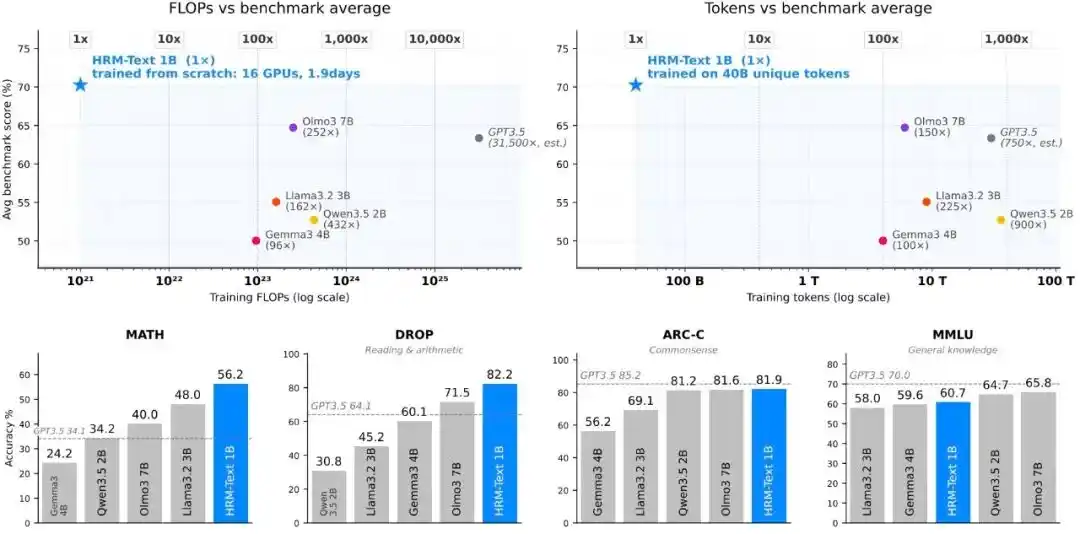
Figure|Pretraining efficiency.

Based on this, they clearly propose: Structural priors and targeted training objectives can significantly lower the barrier to pretraining. This training approach makes training a foundational model from scratch feasible.

How is HRM-Text designed?

Large Language Model (LLM) pretraining is increasingly reliant on a few institutions with ample computing and data resources. Training a competitive foundational model often requires trillions of tokens, thousands of GPUs, and even tens of millions of dollars in compute investment.

However, the current training paradigm is inefficient. A large amount of computation is consumed on irrelevant tokens such as prompts, formatting padding, and web noise, resulting in a significant portion of training compute not directly serving inference.

In this work, the research team redesigned the architecture and training objective, making the pretraining of HRM-Text relatively more efficient.

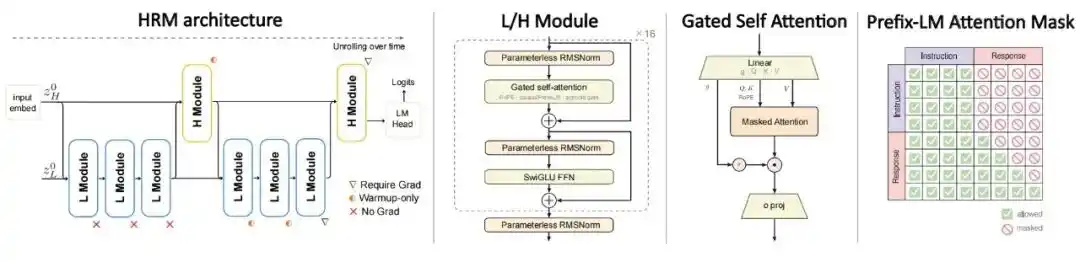
Architecture: Employs a Hierarchical Recurrent Model with dual timescales, splitting computation into a slow H module and a fast L module. While a standard Transformer performs one forward pass per token, HRM performs multiple rounds of recursive updates on the same token. The H and L modules each account for only half of the recursive core parameters. The overall computational load is roughly equivalent to performing 4 recursive unrolls on the same set of parameters, increasing computational depth without adding more parameters.

Training Objective: Abandons the standard full-text autoregressive pretraining. Instead, training is performed directly on instruction-answer pairs, with loss calculated only on the answer part, combined with PrefixLM masking, allowing bidirectional attention on the instruction part and causal masked generation for the answer part.

Figure|HRM-Text architecture.

To enhance the stability of recursive training, the research team introduced MagicNorm and Warmup Deep Credit Assignment.

MagicNorm is a hybrid normalization strategy that leverages the asymmetry between forward and backward computation depths under Truncated Backpropagation Through Time (Truncated BPTT). It uses PreNorm internally within modules and adds an extra normalization layer at the module exit, thereby improving the stability of deep recursive training.

Warmup Deep Credit Assignment, on the other hand, only backpropagates gradients from the last 2 recursive steps during the initial training phase, then linearly extends to the last 5 steps. This training mechanism allows the model to converge stably on shorter credit assignment paths before gradually introducing longer dependencies.

How effective is it?

Experimental results show that HRM-Text demonstrates clear advantages in architecture efficiency, training objectives, and overall performance.

1. Under fixed training compute, is the recurrent architecture more effective?

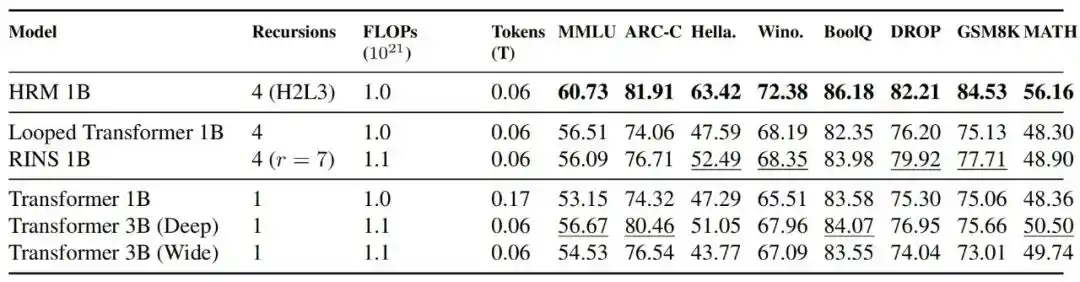
Results show that under FLOPs-aligned conditions, HRM 1B outperforms Transformer 1B, Transformer 3B, Looped Transformer 1B, and RINS 1B on most benchmarks; comparison with TRM also indicates that HRM training is more stable.

Figure|Comparison of performance and stability with Transformer models. HRM maintained stable training dynamics across all scales, while Transformer models exhibited severe instability at the 1-billion-parameter scale. Furthermore, at the 0.6B scale, HRM achieved competitive performance on most benchmarks using only 2x less computation than Transformer models.

2. Does the task completion objective and PrefixLM help?

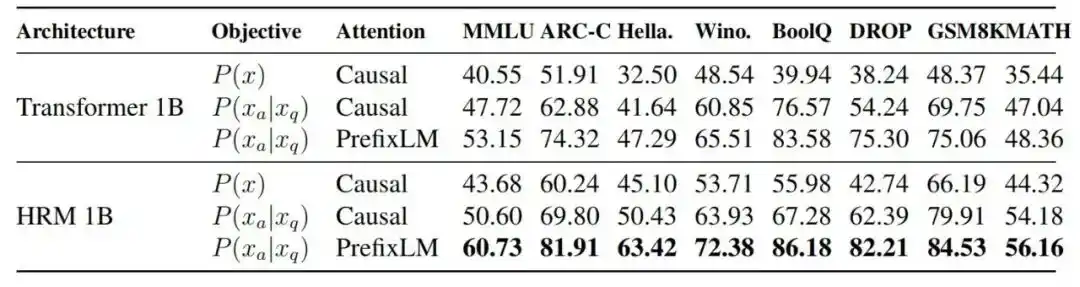
Ablation studies show that under FLOPs-aligned conditions, the MMLU score for a 1B Transformer increased from 40.55 with standard autoregressive training, to 47.72 after introducing the task completion objective, to 53.15 after adding PrefixLM, and finally to 60.73 after switching to the HRM architecture.

Figure|Performance comparison between different model architectures and training objectives

3. How does HRM-Text's efficiency compare to contemporary open models?

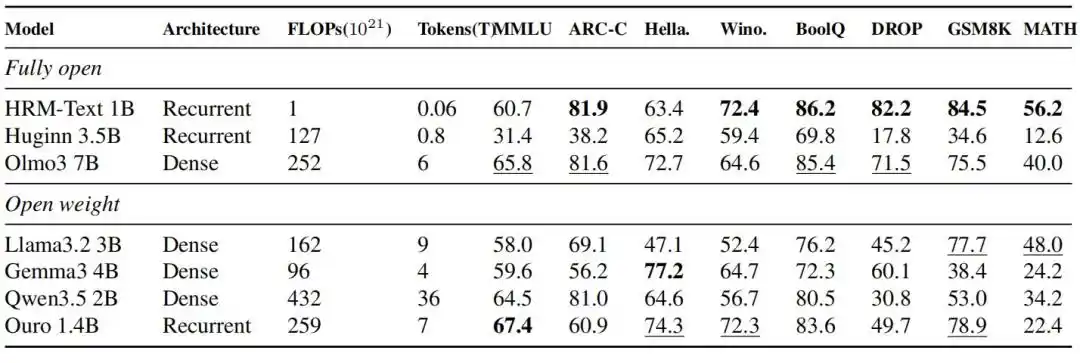
HRM-Text 1B achieved scores of 60.7, 81.9, 82.2, 84.5, and 56.2 on MMLU, ARC-C, DROP, GSM8K, and MATH respectively. Compared to open models that generally have larger training budgets, it entered the performance range of 2B to 7B open-source models using only 40B unique tokens and 1B parameters; training required up to 900x fewer tokens and up to 432x less compute.

Figure|Evaluation results of HRM-Text 1B compared with contemporary fully open-source models and open-weight models

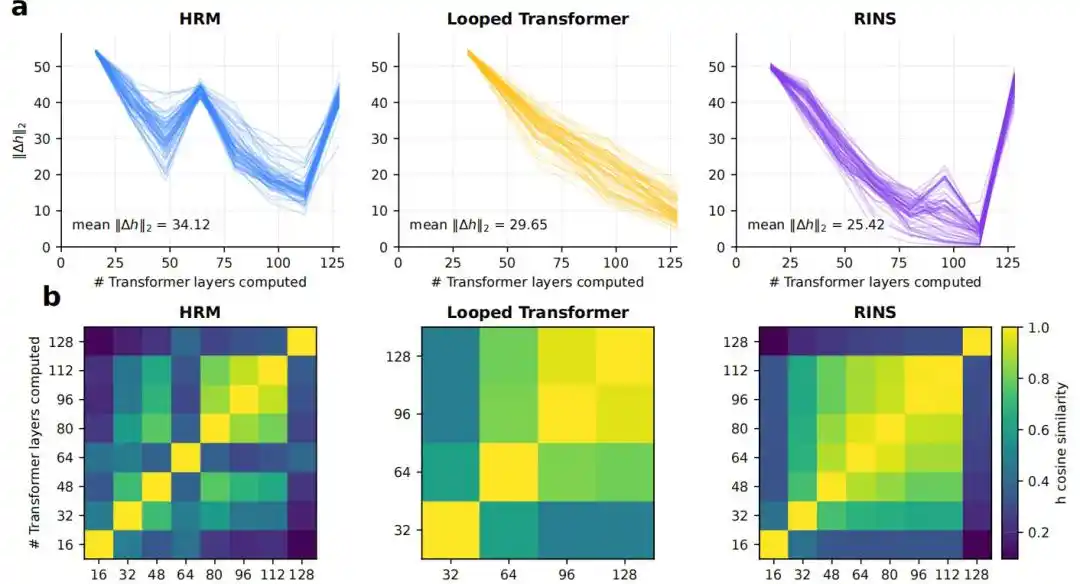
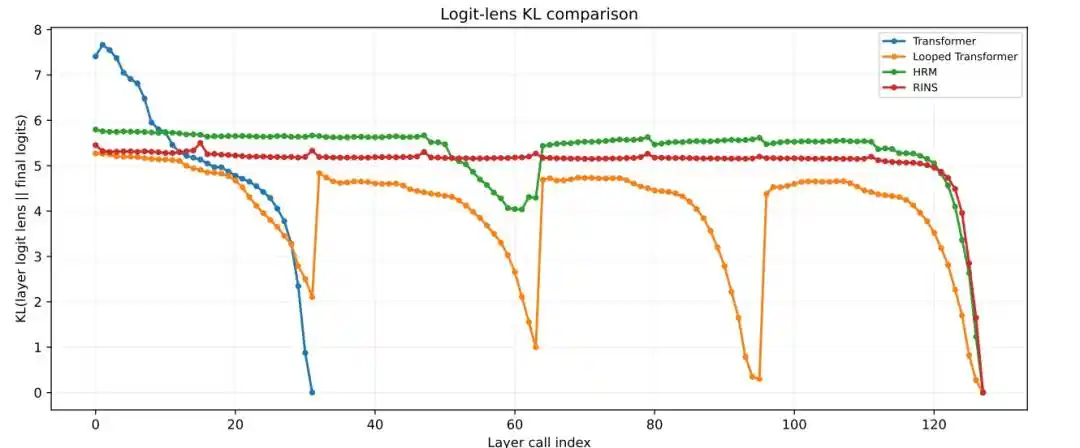
4. Does the recurrent structure bring greater effective depth?

Results show that the standard Transformer and Looped Transformer stabilize at shallower depths, while HRM maintains more pronounced inter-block representation changes, lower cosine similarity, and higher logit lens KL values even at deeper layers.

Figure|Effective depth analysis.

Figure|Layer-wise Logit Lens KL analysis.

Limitations and Future Directions

Although HRM-Text demonstrates strong performance on inference-intensive tasks, this method still has limitations, and future research directions are proposed.

1. Towards Decoupling "Knowledge" and "Reasoning"

Currently, broader factual knowledge coverage still depends more on model scale and data breadth. HRM-Text was only trained on 40B unique tokens, and explicit knowledge sources constitute only part of the task-formatted mixed data. In the future, researchers need to design a compact reasoning core separately from external fact storage, delegating knowledge breadth to curated corpora, retrieval-augmented modules, or learnable memory.

2. Adaptive Computation Time

The recurrent scheduling of HRM-Text brings greater effective serial depth, but this also means the model must execute a fixed number of recursive steps during inference. A promising future direction is to introduce an adaptive computation time mechanism, allowing simple samples to stop computation earlier and reserving the full recursive budget for difficult samples, thereby reducing inference cost.

3. Current Scaling Validation Scope Remains Limited

The current scaling experiments only cover up to the 3B parameter Transformer control group and the 1B parameter HRM-Text. The research team states that it remains to be verified by subsequent work whether similar efficiency advantages can be maintained at larger model scales.

4. PrefixLM and Inference Frameworks

Currently, PrefixLM still faces certain engineering implementation constraints in practical deployment. Although it can run on standard text generation inference frameworks like vLLM, this requires the framework to support custom attention masks during the prefill stage. Extending it to multi-turn dialogue scenarios further requires designing a KV-cache mechanism that ensures bidirectional visibility within user segments while maintaining causal constraints for the assistant's generation process.

For more technical details, please refer to the original paper.

This article comes from the WeChat public account "Academic Headlines" (ID: SciTouTiao), author: Xia Qiansi

Связанные с этим вопросы

QWhat is HRM-Text and how does it differ from the standard Transformer architecture for pre-training large language models?

AHRM-Text is an efficient pre-training model proposed by a Tsinghua University research team. It uses a Hierarchical Recurrent Model (HRM) instead of the standard Transformer. The key difference is that HRM employs a two-timescale hierarchical recurrence, where each token undergoes multiple recursive updates (via slow 'H' and fast 'L' modules), increasing computational depth without adding parameters. This contrasts with the Transformer's single forward pass per token.

QAccording to the article, what are the key efficiency claims of HRM-Text in terms of training tokens and computational cost?

AThe article claims HRM-Text achieves performance comparable to 2B to 7B parameter open-source models while using approximately 100-900 times fewer training tokens and 96-432 times less estimated computational power compared to standard baseline models. A specific example is a 1B parameter model trained on 40B unique tokens at a cost of around $1,500.

QWhat are the two main design choices in HRM-Text's training objective that contribute to its efficiency?

AThe two main design choices in the training objective are: 1) Training directly on instruction-answer pairs and computing the loss only on the answer part, rather than using standard full-sequence autoregressive pre-training. 2) Employing PrefixLM masking, which allows bidirectional attention on the instruction (prefix) part and causal masking for generating the answer.

QWhat techniques did the researchers introduce to improve the stability of deep recurrent training in HRM-Text?

ATo improve stability for deep recurrent training, the researchers introduced two techniques: 1) MagicNorm, a hybrid normalization strategy using PreNorm inside modules and an extra normalization at the module output, leveraging asymmetry in forward/backward depths under Truncated BPTT. 2) Warmup Deep Credit Assignment, which initially backpropagates gradients only from the last 2 recursion steps and linearly extends to the last 5 steps during training.

QWhat are some of the limitations and future research directions mentioned for HRM-Text?

AThe mentioned limitations and future directions include: 1) Decoupling 'knowledge' and 'reasoning', suggesting a need to combine the compact reasoning core with external factual storage (e.g., curated corpora, retrieval-augmented modules). 2) Exploring Adaptive Computation Time to reduce inference cost for easier samples. 3) Validating the efficiency advantage at larger model scales beyond the current 3B/1B experiments. 4) Addressing engineering challenges for deploying PrefixLM in multi-turn dialogue, such as designing a suitable KV-cache mechanism.

Похожее

DAT Failure? Listed Companies Betting on HYPE Floating Profit of $12.5 Billion

Several public companies that adopted a "HYPE Treasury" strategy—holding significant reserves of the HYPE token from the Hyperliquid ecosystem—have achieved substantial paper gains, collectively exceeding $1.25 billion. This contrasts with the reported struggles of MicroStrategy's flagship BTC treasury strategy. The article profiles three such HYPE-focused treasury companies: 1. **Hyperliquid Strategies Inc. (PURR):** The largest holder, with approximately 22.3 million HYPE tokens valued at ~$1.636 billion, resulting in an unrealized gain of ~$1.22 billion. It has fully transitioned from a biotech firm to a dedicated crypto treasury, adding staking and validator operations to enhance returns. 2. **Hyperion DeFi (HYPD):** Holds around 2 million HYPE tokens (~$147 million value) with a gain of ~$49.4 million. It is deeply integrated into the Hyperliquid ecosystem, running a major validator node and building DeFi products for additional yield. 3. **Lion Group Holding (LGHL):** A smaller holder with ~194,000 HYPE tokens (~$14.14 million value), maintaining a long-term commitment to the token. The success of these HYPE treasuries is attributed not only to the token's significant price appreciation but also to active on-chain participation through staking, validation, and ecosystem integrations, creating a compounding "flywheel" effect. The article posits that while MicroStrategy's BTC strategy faces challenges, HYPE treasuries may offer a more sustainable model through deeper protocol engagement, with potential for further growth if HYPE's price rises as predicted by some analysts.

marsbit3 мин. назад

DAT Failure? Listed Companies Betting on HYPE Floating Profit of $12.5 Billion

marsbit3 мин. назад

DAT Failing? Listed Companies Betting on HYPE Have Floating Profits of $12.5 Billion

Facing a potential need to sell Bitcoin to pay dividends amid a $12.5B quarterly net loss, the crypto treasury strategy pioneered by Strategy appears strained. In contrast, public companies that adopted a similar strategy by betting on the HYPE token are seeing massive gains, with collective unrealized profits exceeding $1.25 billion. Three key HYPE treasury companies are highlighted: 1. **Hyperliquid Strategies Inc. (PURR):** The largest holder, with approximately 22.3 million HYPE tokens valued at ~$1.636 billion, resulting in ~$1.22 billion in unrealized gains. It has fully transitioned from a biotech firm to a native crypto treasury, focusing on staking and ecosystem participation via validator operations. 2. **Hyperion DeFi (HYPD):** Holds about 2 million HYPE tokens (~$147M value) with ~$49.4M in gains. It is deeply integrated into the Hyperliquid ecosystem, running a top validator node and building DeFi products to generate additional yield. 3. **Lion Group Holding (LGHL):** A smaller player holding ~193,775 HYPE tokens (~$14.14M value), maintaining a long-term holding strategy alongside other crypto assets. The article argues that HYPE treasuries have an advantage over Bitcoin-based ones like Strategy's. Their success stems not just from price appreciation but from active on-chain participation—staking, earning validator rewards, and engaging with ecosystem protocols—creating a compounding "flywheel" effect. With Hyperliquid dominating the on-chain perpetuals market and HYPE's tokenomics encouraging buys and burns, these treasuries are positioned to benefit further if HYPE's price rises as some predict. While the original Bitcoin treasury strategy isn't declared a failure, the current narrative highlights the outsized success of early movers into the HYPE ecosystem.

Odaily星球日报7 мин. назад

DAT Failing? Listed Companies Betting on HYPE Have Floating Profits of $12.5 Billion

Odaily星球日报7 мин. назад

Comics Illustration: Helping You Understand China's New Regulations on Outbound Investment

Summary: Understanding China's New Regulations on Overseas Investment The State Council has announced new regulations on overseas investment, effective July 1, 2026. The core message is not a prohibition on international investment, but a call for both companies and individuals to operate with strong regulatory awareness. Here are the key points: 1. **Scope is Broad:** The rules apply not only to companies but also to other organizations and individual residents. 2. **Definition of Investment is Wide:** It encompasses not just capital transfers but also asset contributions, obtaining equity or rights, financing, providing guarantees, and direct or indirect acquisition of rights related to overseas entities or assets. 3. **Companies Must Plan Comprehensively:** Beyond simple ownership charts, firms need clear plans covering the investing entity, required approvals or filings, fund transfer paths, and compliance with technology, data, and security reviews. 4. **Individuals Should Prioritize Compliance:** Before focusing on returns, individuals must first assess their eligibility, understand legal channels for capital outflow, know what they are acquiring, and identify responsible parties in case of issues. 5. **Penalties are Significant:** Violations can result in fines and potentially restrictions on future overseas investment activities. In essence, overseas investment remains possible, but it must be approached with regulatory compliance as a fundamental priority, not solely based on commercial opportunity. *Note: This is a general informational summary and does not constitute legal advice or investment recommendations.*

marsbit21 мин. назад

Comics Illustration: Helping You Understand China's New Regulations on Outbound Investment

marsbit21 мин. назад

Nvidia Rack Disassembly Reveals New Growth Opportunity, MLCC Value Surges 182%

Supply bottlenecks in AI infrastructure have expanded to fundamental hardware components like multilayer ceramic capacitors (MLCCs), crucial for stabilizing power and filtering noise in AI servers. Both Goldman Sachs and Morgan Stanley highlight MLCCs as entering a historic "volume-price dual increase" supercycle driven by AI. Goldman forecasts the AI server MLCC market to surge over fourfold from ~$1.4B in FY2025 to ~$5.8B in FY2030, a 34% CAGR. The core driver is a structural supply-demand imbalance. While AI server demand is projected to grow ~4.3x by 2030, industry capacity expands at only ~10% annually, constrained by internal production of equipment and materials. This is compounded by strong demand from electric vehicles. The shortage is evident, with lead times for high-end MLCCs exceeding 20 weeks. The price cycle has officially begun. Japanese leaders Murata and Taiyo Yuden have raised prices by 15-35% for AI server and automotive MLCCs since April, citing material costs. Japan's April export data confirms the trend, with MLCC export value up 28% year-over-year. Profit leverage is significant: Goldman estimates a mere 5% price increase could boost Murata's FY2027 operating profit by ~13% and Taiyo Yuden's by up to 37%. Morgan Stanley's teardown of Nvidia's upcoming Vera Rubin AI rack reveals another catalyst: the MLCC value per rack has skyrocketed 182% from the previous generation to ~$4,320, highlighting the component's growing importance. With demand set to massively outstrip constrained supply, and price increases just starting, analysts position MLCCs at the beginning of a major, prolonged upcycle.

marsbit22 мин. назад

Nvidia Rack Disassembly Reveals New Growth Opportunity, MLCC Value Surges 182%

marsbit22 мин. назад

A 134% Surge, 75 P/E Ratio: Why Is the Market Paying Up for Murata's 'Zero Growth'?

Murata Manufacturing, the world's largest passive components maker, saw its stock price surge 134% over the past year and hit a record high on May 28th, despite reporting nearly zero growth in operating profit for its latest fiscal year. This has pushed its valuation to a P/E ratio of approximately 75x. The disconnect is driven by a fundamental market re-rating. The catalyst was a late-May meeting where management upgraded the AI investment cycle outlook to "lasting until around 2030" and noted that demand for its components is roughly double its supply capacity, with customers prioritizing securing volume over price. While Murata's revenue grew only 5.0% and operating profit stagnated at ¥281.8 billion for the fiscal year ending March 2026, its guidance for the current fiscal year projects a 34.8% jump in operating profit to ¥380 billion. This sharp growth is underpinned by expectations that its AI/data center-related revenue will nearly double from ¥170 billion to ¥325 billion, becoming a key pillar of its business. Analysts highlight that this growth stems not from broad price hikes but from a shift towards higher-value, cutting-edge MLCCs for AI servers, where Murata holds over 70% market share. The market is now pricing Murata not as a cyclical component maker but as a critical "AI pick-and-shovel" supplier with structural pricing power. However, the high valuation also carries risk if future AI demand or quarterly guidance falls short of the elevated expectations.

marsbit44 мин. назад

A 134% Surge, 75 P/E Ratio: Why Is the Market Paying Up for Murata's 'Zero Growth'?

marsbit44 мин. назад

Торговля

Спот
Фьючерсы

Популярные статьи

Как купить S

Добро пожаловать на HTX.com! Мы сделали приобретение Sonic (S) простым и удобным. Следуйте нашему пошаговому руководству и отправляйтесь в свое крипто-путешествие.Шаг 1: Создайте аккаунт на HTXИспользуйте свой адрес электронной почты или номер телефона, чтобы зарегистрироваться и бесплатно создать аккаунт на HTX. Пройдите удобную регистрацию и откройте для себя весь функционал.Создать аккаунтШаг 2: Перейдите в Купить криптовалюту и выберите свой способ оплатыКредитная/Дебетовая Карта: Используйте свою карту Visa или Mastercard для мгновенной покупки Sonic (S).Баланс: Используйте средства с баланса вашего аккаунта HTX для простой торговли.Третьи Лица: Мы добавили популярные способы оплаты, такие как Google Pay и Apple Pay, для повышения удобства.P2P: Торгуйте напрямую с другими пользователями на HTX.Внебиржевая Торговля (OTC): Мы предлагаем индивидуальные услуги и конкурентоспособные обменные курсы для трейдеров.Шаг 3: Хранение Sonic (S)После приобретения вами Sonic (S) храните их в своем аккаунте на HTX. В качестве альтернативы вы можете отправить их куда-либо с помощью перевода в блокчейне или использовать для торговли с другими криптовалютами.Шаг 4: Торговля Sonic (S)С легкостью торгуйте Sonic (S) на спотовом рынке HTX. Просто зайдите в свой аккаунт, выберите торговую пару, совершайте сделки и следите за ними в режиме реального времени. Мы предлагаем удобный интерфейс как для начинающих, так и для опытных трейдеров.

1.4k просмотров всегоОпубликовано 2025.01.15Обновлено 2025.03.21

Как купить S

Sonic: Обновления под руководством Андре Кронье – новая звезда Layer-1 на фоне спада рынка

Он решает проблемы масштабируемости, совместимости между блокчейнами и стимулов для разработчиков с помощью технологических инноваций.

2.3k просмотров всегоОпубликовано 2025.04.09Обновлено 2025.04.09

Sonic: Обновления под руководством Андре Кронье – новая звезда Layer-1 на фоне спада рынка

HTX Learn: Пройдите обучение по "Sonic" и разделите 1000 USDT

HTX Learn — ваш проводник в мир перспективных проектов, и мы запускаем специальное мероприятие "Учитесь и Зарабатывайте", посвящённое этим проектам. Наше новое направление .

1.8k просмотров всегоОпубликовано 2025.04.10Обновлено 2025.04.10

HTX Learn: Пройдите обучение по "Sonic" и разделите 1000 USDT

Обсуждения

Добро пожаловать в Сообщество HTX. Здесь вы сможете быть в курсе последних новостей о развитии платформы и получить доступ к профессиональной аналитической информации о рынке. Мнения пользователей о цене на S (S) представлены ниже.

活动图片