Trump, the "Stock Market Manipulator" in U.S. Stocks, Lifts Up the Entire Quantum Computing Sector

marsbitОпубликовано 2026-05-27Обновлено 2026-05-27

Введение

"Trump, the 'U.S. Stock Market Mastermind,' Boosts the Entire Quantum Computing Sector" This article details how former U.S. President Donald Trump's policies and public statements have significantly influenced the stock market, particularly in the quantum computing sector. A key example is the U.S. government's direct investment in Intel stock in August 2025, which yielded over $45 billion in gains within seven months. Trump publicly credited himself for this profit. Recently, the Trump administration announced a new $2 billion initiative. Through the Department of Commerce, funding from the CHIPS and Science Act will be provided to nine quantum computing companies in exchange for minority, non-controlling equity stakes. The recipients include IBM ($1B for its subsidiary Anderon), GlobalFoundries ($375M), and listed companies like D-Wave, Infleqtion, and Rigetti ($100M each). Private firms such as Atom Computing and PsiQuantum also received $100M. This "investment-for-equity" strategy marks a shift from pure subsidies to an "active investor" model under the CHIPS Act. The announcement immediately boosted quantum computing stocks. The article frames this as part of Trump's "America First" industrial policy, aimed at securing U.S. technological leadership, similar to past investments in semiconductors, rare earths, and lithium. The author suggests this pattern of government-backed market intervention, alongside Trump's personal stock endorsements, is a hallmark of his appro...

Original | Odaily Planet Daily (@OdailyChina)

Author | Wenser (@wenser 2010)
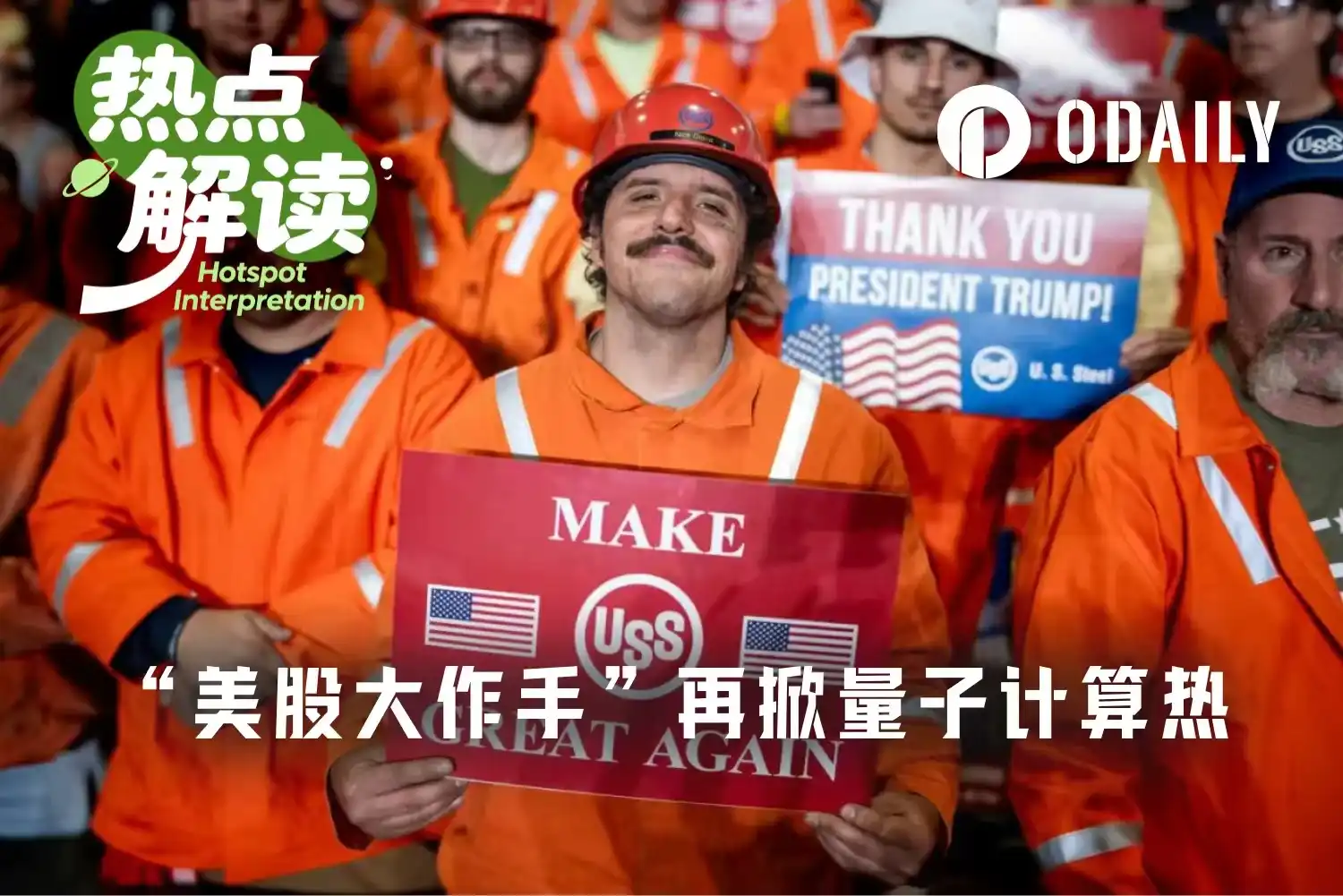
Last August, driven by Trump, the U.S. government completed the conversion of funds through the CHIPS Act, directly purchasing nearly 10% of Intel's newly issued original shares (approximately 433.3 million shares) at $20.47 per share. At that time, the value was less than $9 billion; by early May less than a year later, as Intel's stock price hit a record high, the total value of those shares had reached $54.1 billion, increasing by over $45 billion in just seven months.

Mentioning this, Trump could not hide his pride and posted: "I made the United States $45 billion in the past 8 months."

As a capital maestro who "manipulates the U.S. stock market by posting at a whim," Trump exerts an extraordinary influence on the rise and fall of U.S. stocks. Recently, he has started his performance again—providing a total of $2 billion in funding to 9 quantum computing companies through the U.S. Department of Commerce in exchange for equity. Odaily Planet Daily will provide a brief analysis in this article.

U.S. Government Acts Again, Investing $2 Billion in Quantum Computing Sector

On May 21, the Trump administration announced it would provide a total of $2 billion in funding to 9 quantum computing companies through the U.S. Department of Commerce, in exchange for partial equity. The specific allocation of funds is as follows:

  • $1 billion will be awarded to IBM (IBM) for the operation and development of its independent subsidiary, Anderon;
  • $375 million is allocated to chip manufacturer GlobalFoundries (GFS);
  • Listed companies such as D-Wave (QBTS), Infleqtion (INFQ), and Rigetti (RGTI) each receive $100 million;
  • Private companies such as Atom Computing, PsiQuantum, and Quantinuum (Honeywell-HON's independent subsidiary) each receive $100 million;
  • Startup Diraq is expected to receive $38 million.

According to official documents, this is part of the Trump administration's "active investor" industrial policy, with funding sourced from R&D appropriations under the 2022 CHIPS and Science Act. The Department of Commerce emphasized that this is a "portfolio" strategy, covering two quantum wafer foundries and 7 quantum computing companies, targeting various quantum modalities such as neutral atoms, silicon spin, superconductors, photons, and trapped ions, addressing critical engineering bottlenecks like device reproducibility, error rates, optical complexity, and cryogenic system integration.

On the day the news was released, the U.S. stock quantum computing sector surged at the market open. Among them, D-Wave Quantum rose 16%, Rigetti Computing rose 14%, Infleqtion stock rose 25%, Quantum Computing rose 9%, and IonQ rose 3.1%.

It is worth mentioning that among these companies receiving funds, only GlobalFoundries Inc. (GFS) revealed the equity exchange ratio is approximately 1%. For other companies, whether public or private, the equity is a minority, non-controlling stake, with specific ratios not yet disclosed. Final ratios will be disclosed after formal agreements are signed and filed with the SEC.

Capital Operations Under the "America First" Strategy

Examining this "investment-for-equity" operation, it remains an action under the Trump administration's "America First" strategy.

Previously, U.S. government investments in Intel (INTC), MP Materials (MP) (the only fully integrated U.S. rare earth producer), Trilogy Metals (TMQ), Lithium Americas (LAC), U.S. Steel, and others were also strategic moves to maintain the dominant position of the domestic semiconductor industry chain.

Especially the nearly $9 billion investment in Intel, the Trump administration explicitly stated that this move was to support domestic advanced semiconductor manufacturing in the U.S. and reduce dependence on TSMC (TSM). Therefore, the U.S. government's related holdings are passive, with no board seats, and it does not participate in the company's daily operations and management, largely following board votes on most matters.

However, the U.S. government's "equity investments" include not only financial support but also credit endorsement and multi-layered policy support (such as export licenses, tariff protection). Previously, after receiving U.S. government funding, Intel received strong support from U.S. Secretary of Commerce Lootnick, who met with Apple CEO Cook, Tesla CEO Musk, and NVIDIA CEO Jensen Huang multiple times over the past year, persuading them to cooperate with Intel successively. With Apple joining, Intel has now established relevant collaborations with all three companies mentioned.

Operational Shift Under the CHIPS and Science Act: From Grants to Equity Exchange

The $2 billion behind the investment in quantum computing companies stems from the CHIPS and Science Act, a landmark bipartisan bill introduced by the U.S. government in 2022, officially titled the "CHIPS and Science Act of 2022." The bill authorizes approximately $280 billion over 10 years to support semiconductor industry development and basic science and technology R&D. Its primary purpose is to revitalize U.S. semiconductor manufacturing, strengthen scientific research and innovation capabilities, and address competition from other nations in high-tech fields through massive investment.

However, unlike the fund grants or pure subsidy model during the Biden administration, the Trump administration's operational model is the aforementioned "active investor" model—switching to providing funding in exchange for minority, non-controlling equity. As of this May, the Act has attracted over $645 billion in private investment in semiconductor manufacturing, with over 140 projects, creating 525,000 new jobs.

It must be said that aside from personally manipulating and hyping stocks like Dell (DELL), Micron (MU), and Palantir (PLTR), Trump is also promoting U.S. stock market prosperity in the name of the U.S. government and its departments. No wonder he has repeatedly boasted, "The new highs in the stock market are mainly because of me."

Additionally, it is noteworthy that a previous investment announcement from the U.S. Department of Commerce stated, "The CHIPS Research and Development Office continues to solicit proposals from eligible applicants for research, prototyping, and commercial solutions in microelectronics technologies in the United States. Eligible applicants should submit applications via Announcement 2025-NIST-CHIPS-CRDO-01 on the www.grants.gov website." In other words, the U.S. government's "investment door" remains open. More information and funding announcements can be found in official sources.

Of course, the U.S. government invests in a wide range of company sectors, also involving critical minerals/rare earths, lithium batteries and other new energy sources, medical supplies, communication infrastructure, etc., such as Westinghouse Electric, Lithium Americas, Trilogy Metals, USA Rare Earth, Vulcan Elements, XLight, L3Harris Technologies, and others.

Furthermore, U.S. Secretary of Commerce Lootnick once revealed to the media that the current U.S. administration might take stakes in major defense contractors like Lockheed Martin (LMT).

In summary, the aforementioned numerous listed companies, key minerals/rare earths/battery material supply chains, nuclear energy/small modular reactors (SMRs) and advanced nuclear fuel, and other quantum computing targets may become directions for the Trump administration's continued investment in the second half of the year.


Связанные с этим вопросы

QAccording to the article, what significant action did the Trump administration recently take regarding quantum computing companies?

AThe Trump administration announced it would provide a total of $2 billion in funding to nine quantum computing companies through the U.S. Department of Commerce in exchange for equity stakes.

QWhich specific company received the largest share of the $2 billion quantum computing funding mentioned in the article?

AIBM received the largest share, with $1 billion allocated to its independent subsidiary, Anderon.

QWhat is the source of the $2 billion funding for the quantum computing initiative as stated in the article?

AThe funding comes from the research and development appropriations of the 2022 CHIPS and Science Act.

QHow did the stock prices of quantum computing companies react to the news of the government funding?

AOn the day of the announcement, the quantum computing sector's stock prices rose sharply at market open. Specifically, D-Wave Quantum rose 16%, Rigetti Computing rose 14%, Infleqtion stock rose 25%, Quantum Computing rose 9%, and IonQ rose 3.1%.

QHow does the Trump administration's approach to implementing the CHIPS and Science Act differ from the previous administration's, as described in the article?

AUnlike the Biden administration's model of providing grants or pure subsidies, the Trump administration's approach is an 'active investor' model, where funding is provided in exchange for minority, non-controlling equity stakes.

Похожее

Who Funds the Agents?

**Summary: Who Funds AI Agents?** OpenAI recently shut down a feature allowing AI agents to shop for users, highlighting the challenge of creating a secure and regulated environment for agent-driven transactions. While payment infrastructure exists, a crucial governance layer—defining spending limits, fraud detection, tax handling, and return policies—is largely missing. The potential is enormous: AI agents already processed $73M across 176M transactions last year, with McKinsey forecasting this could grow to $3-5T in global consumer commerce by 2030. The core competition isn't just about processing payments, which can be very cheap (especially with crypto-based settlement), but about controlling the rules that govern agent spending. Key players like Stripe and Coinbase are racing to dominate this governance layer. Stripe's acquisition of wallet provider Privy allows it to set spending policies, identity checks, and human-in-the-loop approvals directly at the wallet level. Similarly, Coinbase's stack, including its x402 protocol and AgentKit, embeds governance rules. This vertical integration across settlement, wallet, and governance layers is becoming the dominant strategy. Control over the governance layer is where significant future value lies. If agents handle trillions in transactions, even a small fee for managing compliance, fraud prevention, and policy enforcement could generate billions in annual revenue. The companies that successfully integrate across the payment stack will capture value from idle agent balances, transaction fees, and governance services, positioning themselves as the foundational banks of the AI agent economy.

marsbit10 мин. назад

Who Funds the Agents?

marsbit10 мин. назад

A Nation Blocks Chips, a Giant Buys a Nuclear Power Plant: Why It's Time to Seriously Consider DeAI

**Title: Great Powers Blockade Chips, Giants Buy Nuclear Plants: Why It's Time to Seriously Consider DeAI** In May 2026, the US closed loopholes for Chinese firms to acquire advanced NVIDIA chips via overseas subsidiaries. That same month, Kenya halted a $1B geothermal data center project involving Microsoft, fearing its immense energy consumption. Meanwhile, Huawei announced mass production of its Ascend AI chip. These disparate events underscore a new reality: the competition for computing power ("compute") has escalated beyond the tech industry, becoming a geopolitical and infrastructural battleground. A new era of oligopoly is forming, with control over the AI stack—from GPU chips (NVIDIA) and cloud platforms (AWS, Azure, Google Cloud) to foundational models (OpenAI, Anthropic)—concentrating in a few Western "AI Octopus" corporations. This centralization creates systemic risks: pricing power and platform lock-in for users, infrastructure fragility, and a widening "compute divide" that threatens to marginalize nations without independent AI capacity. An "AI Iron Curtain" is deepening through export controls. In response, some nations like Saudi Arabia and the UAE are investing heavily to buy compute power, aiming to transition from oil to AI economies. The EU seeks to triple its compute capacity by 2030 to reduce dependency. However, the spending gap is vast, with four US tech giants alone planning ~$750B in AI capex for 2026. The race is increasingly constrained by energy, with AI tasks consuming up to 1000x more power than web searches, pushing firms to even acquire nuclear plants. This landscape is fueling interest in Decentralized AI (DeAI). It proposes a third way: using open protocols to coordinate a global network of idle GPUs, independent developers, and data centers, creating an AI infrastructure without a single controlling entity. Leveraging blockchain and cryptographic verification, DeAI aims to break market concentration, disperse energy demands, reduce geopolitical dependencies, and enhance transparency. While still nascent in performance and stability, DeAI's core promise is not immediate superiority but providing a crucial alternative architecture to resist monopoly, censorship, and centralized power. As specialized AI hardware costs fall and open-source models flourish, the window to build this foundation is open. The very existence of such competition serves as a vital check against the inevitable abuse of concentrated power.

marsbit1 ч. назад

A Nation Blocks Chips, a Giant Buys a Nuclear Power Plant: Why It's Time to Seriously Consider DeAI

marsbit1 ч. назад

Outpoll Review: A Prediction Market Platform Built for Active Traders

Outpoll Review: A Prediction Market Platform Built for Active Traders In recent years, prediction markets have grown from a niche sector to a mainstream arena, attracting billions in trading volume and institutional capital. However, the user experience and tools for traders have not kept pace. Outpoll, a new global prediction market platform, aims to fill this gap by providing enhanced trading infrastructure for active and professional traders. Built on standard prediction market principles, Outpoll allows users to trade on the outcome of specific events. It uses fully collateralized contracts with USDC settlement, charges a competitive 0.1% fee per trade, and provides clear settlement rules upfront to minimize disputes. A key focus for Outpoll is its professional-grade trading tools. The platform supports limit and market orders, as well as take-profit and stop-loss orders for open positions—features uncommon in prediction markets. For automated trading, Outpoll offers comprehensive REST and WebSocket APIs, enabling portfolio management, price arbitrage, and integration with existing tools. The platform also features a creator-led market model, where approved experts and community leaders can create and manage markets for niche topics under platform supervision. Its integrated interface combines news feeds directly with trading functions, allowing users to monitor events and manage positions seamlessly. Outpoll launched with a native Android app (available on Google Play) and plans an iOS version later this year. In summary, Outpoll distinguishes itself with trader-focused tools, practical APIs, transparent and collateralized markets, integrated news, and an expanding creator program. For active traders, its advanced order types and API access alone make it a platform worth watching. Outpoll is now globally accessible via outpoll.com and Google Play.

marsbit1 ч. назад

Outpoll Review: A Prediction Market Platform Built for Active Traders

marsbit1 ч. назад

Торговля

Спот
Фьючерсы
活动图片