Trend in US Stocks: A Post Triggers a 930-Point Rebound, Tonight Belongs to SpaceX

marsbitОпубликовано 2026-06-12Обновлено 2026-06-12

Введение

On Thursday (June 11, U.S. Eastern Time), Wall Street staged a textbook V-shaped reversal. The Dow Jones surged 929.97 points (+1.86%) to close above 50,000, while the Nasdaq and S&P 500 rose 2.54% and 1.75%, respectively. The rally occurred despite the hottest PPI report in years, with May data showing a 6.5% year-on-year surge, the highest since 2022. The market ignored the inflation data, focusing instead on reports that former President Trump called off a planned strike on Iran, hinting at a potential multi-party peace agreement draft. This sparked a sharp drop in oil prices, fueling hopes that inflation may have peaked. Sector rotations were stark: previously battered AI hardware and cyclical stocks led the gains, while defensive sectors that hit record highs the prior day were sold off. Chip stocks like Micron and Intel saw sharp rebounds. In contrast, software giant Oracle plunged nearly 10% despite beating earnings, with concerns over cloud revenue and cash flow. Adobe also fell after hours despite raising guidance, as its CFO announced departure. The rally's sustainability is questioned, driven largely by social media posts about unconfirmed geopolitical developments. Inflation risks remain, with pipeline pressures still high. Meanwhile, the market's risk appetite faces a major test with SpaceX's historic IPO. Priced at $135 per share, it aims to raise ~$75 billion with a $1.75 trillion valuation, becoming the largest U.S. IPO ever. It will join the Nasdaq 100 in 1...

Author: Trend Research

Thursday (US Eastern Time, June 11) witnessed a textbook V-shaped reversal on Wall Street. Funds that were fleeing headlong from inflation and war the day before collectively reversed course within 24 hours.

The Dow Jones surged 929.97 points (+1.86%) to close at 50,848.75, recapturing the 50,000 mark; the Nasdaq rose 2.54% to 25,809.66; the S&P 500 gained 1.75% to 7,394.30. The Russell 2000 index led all major indices with a 3.02% gain. The VIX fear index fell nearly 12%, dropping back below 20.

The interesting part is that this big green candle emerged despite the hottest inflation data of the year.

Hottest PPI, Coldest Reaction

The May PPI released in the morning soared 6.5% year-over-year, the highest since November 2022; it rose 1.1% month-over-month, far exceeding the expected 0.7%. Breaking it down is even more startling: goods prices rose 2.8% month-over-month, the largest single-month increase since records for this data series began in 2009, with about 80% coming from energy—wholesale gasoline prices surged a staggering 23.4% in a single month. The first-stage intermediate demand prices, closer to the upstream pipeline, rose 3.2% month-over-month, also setting a historical record.

On any ordinary trading day, this data would be enough to knock the Nasdaq down 2%. But the market cared about only one thing: whether the war is about to end.

In the afternoon, Trump announced the cancellation of a scheduled strike against Iran that night, stating that Iran's top leadership had approved a draft multilateral consensus agreement, and allies including Israel had "agreed in principle." Upon the news, WTI crude oil plummeted over 4% intraday to around $86, and Brent fell below $89. Oil is the engine of this round of inflation; an oil price plunge directly dismantles the ammunition for PPI. Trump's own response to inflation was even more blunt: "I like, I like this inflation," and stated that once the war ends, oil prices will "fall like a rock."

The logical chain for funds was thus closed: draft agreement, oil price plunge, peak inflation expectations, buy everything. Sectors that fell the hardest the previous day—tech, industrials, materials—led the gains, while defensive sectors (consumer staples, real estate, energy), which hit record highs on Wednesday, were conversely sold off. In two trading sessions, the same batch of funds completed a full rotation from short to long.

Chip Stocks' Vengeful Rebound, Software Stocks' No Man's Land

The rebound firepower concentrated on AI hardware. Micron surged nearly 12%, erasing all of this week's losses in a single day; Sandisk rose 14%; Intel, upgraded by Bank of America, gained about 10% on the rationale of a surge in CPU orders; AMD rose 8%. The Philadelphia Semiconductor Index, counting from the crash on June 5th, completed its sentiment repair in just four trading sessions.

Software is a different world. Oracle plunged 9.56%, closing around $184. Beating earnings expectations was meaningless; the market focused on cloud revenue missing expectations, negative free cash flow of $23.7 billion, and a new $40 billion financing plan. After hours, Adobe delivered a standard "beat and raise" combo: Q2 revenue of $6.62 billion up 13%, full-year EPS guidance raised to $24.35 to $24.45, AI-related recurring revenue tripling year-over-year. The stock's response was a further drop of over 5% after hours. The trigger was CFO Dan Durn announcing his departure next Monday to join Marvell, following CEO Narayen's announcement of succession in March, making him the second core executive to leave Adobe in three months. The stock is down 38% year-to-date. At current prices, a company whose AI revenue has tripled is being priced as a victim of AI.

The same AI narrative: hardware is being scooped up, software is being abandoned. The market's subtext is brutal: the money in computing power is visible; software moats are not. The direction executives are voting with their feet coincides precisely with the stock price—the CFO is going to Marvell, a chip company.

Tonight, The Largest IPO in History Opens

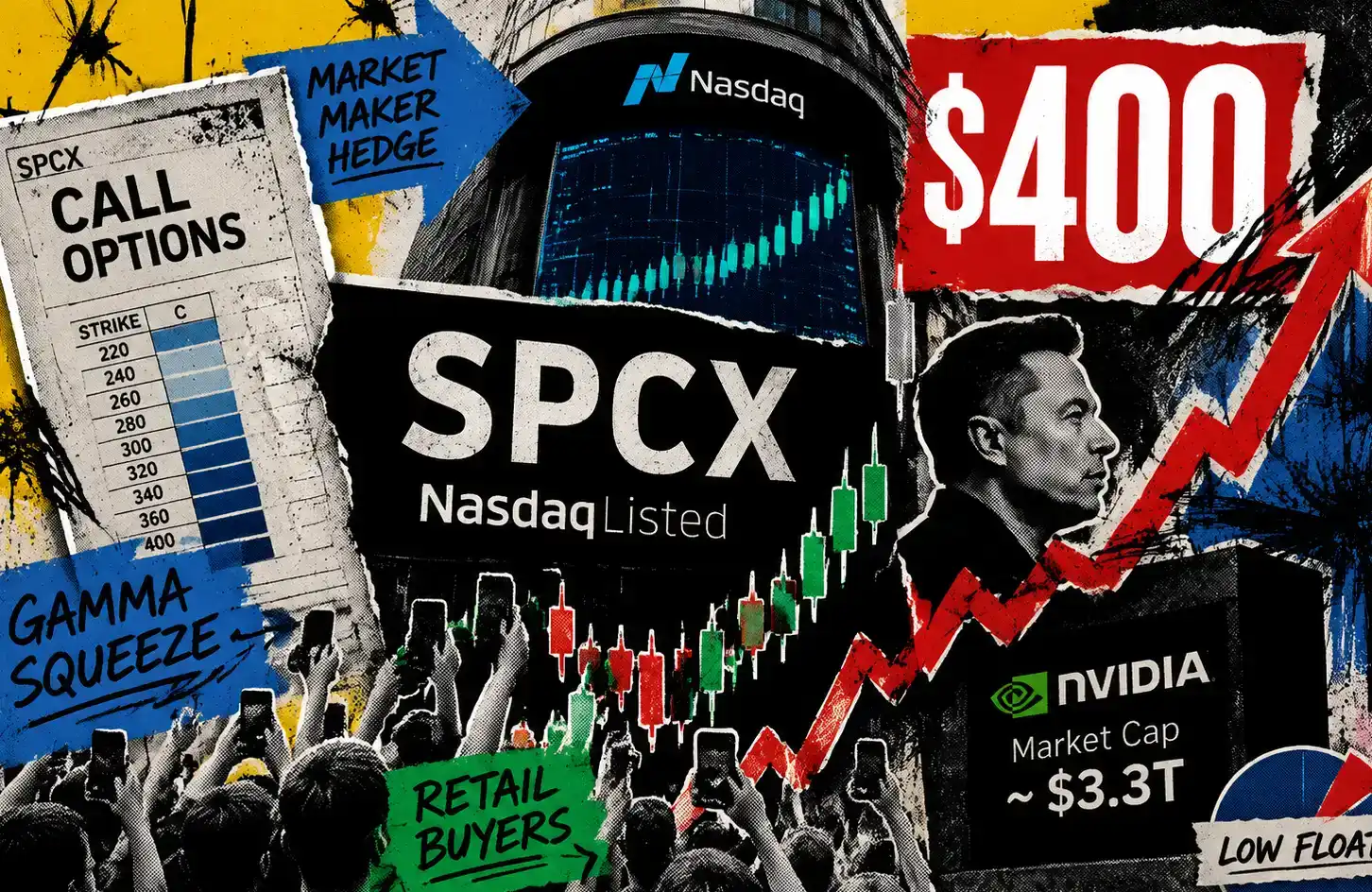
Another motive for the late Thursday buying spree lies in Friday: SpaceX priced at $135 per share and officially debuts on Nasdaq tonight, ticker SPCX.

The scale of this deal is unprecedented: the base offering raises approximately $75 billion, nearly triple the previous record holder Saudi Aramco ($25.6 billion); the offering valuation is about $1.75 trillion, making it the seventh-largest US company by market cap upon listing, ahead of its sibling Tesla (approx. $1.6 trillion). Reports indicate subscription demand exceeded $250 billion, roughly 3.5 to 4 times the fundraising target. About 30% of the shares were allocated to retail investors, three times the industry norm. Musk retains over 82% of the voting power post-offering.

More noteworthy for traders is the follow-up: by rule, SpaceX will be added to the Nasdaq-100 Index 15 days after listing, at which point global index funds tracking QQQ will be forced to buy mechanically, estimated at $22 to $27 billion.

Risks are also clear. Senator Warren wrote to the SEC requesting a delay in the offering, questioning the valuation's detachment from financial fundamentals (annual revenue approx. $20 billion, implying a P/S ratio of about 88x) and the dual-class share structure; Morningstar directly gave it a "significantly overvalued" rating. There's a more practical issue: the $75 billion fundraising will drain liquidity from the secondary market within a week; part of the violent volatility in the storage and CPU sectors this week was the result of funds repositioning for the IPO.

Trend Observation

The quality of this rebound warrants a question mark.

Wednesday's 953-point plunge and Thursday's 930-point surge were driven by the same person's social media account. The draft agreement is not yet signed, confirmation from Iran still comes from unofficial channels, and historically this conflict has seen multiple reversals after being "close to a deal." If an index is pulled back from the cliff edge by a post, it can be pushed back over by another.

The inflation line also remains un-de-risked. The record surge in intermediate PPI demand is water already in the pipeline; even if oil prices peak immediately, it will still feed into CPI over the next two to three months. Pricing for a 25-basis-point rate hike in December remained unmoved after the data release; the ECB already hiked to 2.25% on Thursday, with the Fed, Bank of Japan, and Bank of England taking the stage next week. The market is betting on the perfect script: "war ends, oil prices plummet, rate hikes canceled"—all three links are indispensable.

Counterarguments are also on the table: core PPI month-over-month at 0.4% was below expectations, indicating that inflation momentum excluding energy is indeed slowing; Intel's CPU orders and Micron's demand are real orders, not sentiment; if a peace deal materializes, the inflation path corresponding to $86 oil will look completely different from this week's panic pricing. Bulls don't need a perfect script; they just need oil prices to stop making new highs.

Tonight's SPCX opening price will be the most honest gauge of this market's risk appetite. $75 billion in new shares, an 88x P/S ratio, 4x oversubscription—greed and skepticism will meet in the same candlestick.


Связанные с этим вопросы

QWhat was the primary reason for the sharp market rebound on Thursday, June 11th, despite hot inflation data?

AThe primary reason for the sharp market rebound was news from former President Donald Trump, who announced the cancellation of a planned strike on Iran and indicated that a multilateral consensus agreement draft had been approved, raising hopes for an end to conflict. This led to a sharp drop in oil prices, fueling expectations that inflation may have peaked and prompting a broad market rally.

QHow did the performance of hardware (chip) stocks differ from software stocks during the market rally described in the article?

AHardware (chip) stocks, particularly in the AI sector, led the rally with strong gains, such as Micron (up nearly 12%), Intel (up about 10%), and AMD (up 8%). In contrast, software stocks like Oracle (down 9.56%) and Adobe (down over 5% after-hours) were sold off despite positive earnings, reflecting market skepticism about software's competitive moats compared to the more tangible demand for computing hardware.

QWhat are the key details and potential market impacts of SpaceX's (ticker SPCX) upcoming IPO as mentioned in the article?

ASpaceX's IPO is priced at $135 per share, aiming to raise approximately $75 billion, making it the largest IPO on record. It will have a valuation of around $1.75 trillion, ranking it as the seventh-largest U.S. company. Key market impacts include: significant liquidity being drawn from the market for subscriptions, its expected inclusion in the Nasdaq 100 index 15 days post-listing (triggering estimated $22-$27 billion in forced buying by index funds), and concerns over its high valuation (around 88x price-to-sales) and dual-class share structure.

QWhat concerns does the article raise about the sustainability and quality of the market rebound?

AThe article questions the rebound's sustainability, noting it was largely driven by social media posts regarding unconfirmed peace prospects, which could easily reverse. Inflation risks remain, as record-high intermediate demand PPI will likely feed into CPI in coming months. The market is betting on a 'perfect script' of war ending, oil prices crashing, and rate hikes being canceled, but any failure in this chain could undermine the rally. The high valuation and massive capital absorption of the SpaceX IPO also pose near-term risks to market liquidity and sentiment.

QAccording to the article, what is the market's implicit view on AI-related companies, as illustrated by the contrasting performance of hardware and software stocks?

AThe market's implicit view, as illustrated by the divergent performance, is a preference for AI hardware companies over software companies. The perception is that the demand and profits for computing power (chips, semiconductors) are more visible and secure, while the competitive advantages and monetization paths for AI software are less clear and more vulnerable, as evidenced by software companies' weak stock performance even with strong AI revenue growth and executive departures to hardware firms.

Похожее

After Tokenization of Assets, How to Exit?

Title: How to Exit After Asset Tokenization? Author: Symbiotic Compiled by: Hu Tao, ChainCatcher Summary: Tokenization addresses how assets go on-chain but largely leaves the redemption question unresolved. While tokenized assets can settle instantly, the underlying redemption for assets like treasuries, private credit, or real estate can take from T+1 to 180 days. This gap hinders DeFi adoption of Real World Assets (RWAs). Three emerging models aim to provide instant exit liquidity, differing primarily in their capital structure and efficiency: 1. **Balance Sheet Model (e.g., Grove Basin):** A single entity (like Sky) provides immediate liquidity from its balance sheet, acting as a bridge during the settlement period. It offers simplicity and deep initial liquidity but is constrained by a single entity's capacity and risk appetite. 2. **Asset-Specific Vault Model (e.g., Upshift Clear):** Independent liquidity providers fund dedicated vaults for each supported asset, earning fees. It decentralizes capital sources but isolates liquidity and capital per asset, leading to potential fragmentation. 3. **Shared Liquidity Layer Model (e.g., Symbiotic Liquid Lane):** A shared capital pool supports multiple RWA types simultaneously. Funds remain productive between redemptions (e.g., earning yield in lending markets). Exits are settled via a competitive RFQ market. This model aims for higher capital efficiency, scalability across assets, and serves longer-duration assets like private credit. Key differentiators are: 1) Source of capital and risk bearer, 2) Redemption pricing mechanism, 3) Capital efficiency, 4) Scalability to new asset types, and 5) Composability. The shared liquidity layer model represents a move from piecemeal solutions toward scalable infrastructure, enabling T+0 exits by pooling capital, maintaining yield, and using competitive pricing, thus enhancing RWA utility in DeFi.

marsbit14 мин. назад

After Tokenization of Assets, How to Exit?

marsbit14 мин. назад

After Tokenizing Assets, How to Exit?

After tokenization, a key unresolved issue is providing holders with a reliable exit mechanism, as underlying asset settlement (taking days to months) lags far behind on-chain token settlement. Three primary models for instant liquidity have emerged, differing in their capital structure and efficiency: 1. **Balance Sheet Model (e.g., Grove Basin):** A single, well-capitalized entity (like Sky) provides immediate liquidity from its own reserves. This offers simplicity and deep initial liquidity but is constrained by that single balance sheet's capacity and risk appetite, limiting scalability. 2. **Dedicated Vault Model (e.g., Upshift Clear):** Independent liquidity providers (LPs) fund separate vaults for each supported asset. This decentralizes capital sources but isolates liquidity and capital, which becomes inefficient as the number of tokenized assets grows. 3. **Shared Liquidity Layer Model (Symbiotic Liquid Lane):** Independent capital providers fund shared vaults that can support multiple tokenized assets simultaneously. Capital remains productive between redemptions (e.g., earning yield in DeFi markets). Exits are settled via a competitive RFQ market where market makers bid. The article argues that the shared layer model offers superior capital efficiency and scalability. It transforms exit liquidity from an asset-specific patch into shared market infrastructure, allowing liquidity capacity to grow with overall market participation rather than being fragmented per asset. This is particularly valuable for longer-duration assets like private credit, where reliable T+0 exits can significantly enhance their utility in DeFi.

链捕手27 мин. назад

After Tokenizing Assets, How to Exit?

链捕手27 мин. назад

Anthropic's Triple Moment: Code Leak, Government Confrontation, and Weaponization

This article analyzes Anthropic's recent conflicts and strategic moves following the U.S. government's emergency halt of its new Fable model, citing national security concerns over potential "jailbreaks." The author argues this incident reveals deeper tensions between AI labs, governments, and the software industry. While critics view Anthropic's safety-focused rhetoric as marketing fear, the author suggests it serves as a commercial moat masking the company's core economic imperative: moving closer to end-users and their valuable data to avoid being commoditized. The piece outlines a coming clash between frontier AI labs like Anthropic and established software companies. Labs need real-world usage data for model improvement via reinforcement learning, creating a cycle where better products attract more users and more data. This threatens software firms who, as Microsoft's Satya Nadella warns, risk having their value captured by a few dominant models. Anthropic's controversial policy changes—initially secretly degrading Fable's performance for LLM development and expanding data retention—are framed as assertions of control, justified by its safety narrative. The company's foundational belief that it alone is sufficiently concerned about superintelligent AI dangers legitimizes its actions, from resisting government demands to shaping usage policies. The author concludes that this alignment of mission, talent, and business strategy is powerful but concerning, as it concentrates immense potential power in the hands of those convinced of their own righteous understanding.

marsbit37 мин. назад

Anthropic's Triple Moment: Code Leak, Government Confrontation, and Weaponization

marsbit37 мин. назад

Торговля

Спот
Фьючерсы
活动图片