Tiger Research: Can Bitcoin, Plunging Amid Geopolitical Crisis, Still Be Called 'Digital Gold'?

marsbitОпубликовано 2026-03-04Обновлено 2026-03-04

Введение

Tiger Research questions Bitcoin's status as "digital gold" after its price fell sharply during the Iran-Israel geopolitical crisis in February 2026, while gold rose. Historical data from six major crises shows Bitcoin consistently drops during such events, unlike gold. Neither sovereign states (which hoard gold but exclude Bitcoin from reserves) nor investors treat Bitcoin as a safe-haven asset. For investors, it falls with stocks but doesn’t rise with them—a poor risk profile. Three structural asymmetries explain this gap: 1) market structure (Bitcoin’s derivatives market is 6.5x larger than spot, causing cascading sell-offs), 2) participant composition (leveraged traders dominate vs. patient capital in gold), and 3) behavioral accumulation (gold has decades of "crisis buying" trust; Bitcoin lacks this record). However, Bitcoin proves useful in crises for its functional value—enabling transfers when borders close or banks fail, as seen in Ukraine and Iran. For Bitcoin to become "next-generation gold," these asymmetries must shrink. Key enablers include generational shift (as digital-native generations inherit wealth) and algorithmic adoption (embedding "buy in crisis" logic into AI trading systems. Bitcoin isn’t digital gold yet, but could evolve into a new asset class if these changes occur.

This report is written by Tiger Research, February 2026. Following the airstrike incident in Iran, the price of gold rose, while the price of Bitcoin plummeted. Can we still believe Bitcoin is 'digital gold'? We will explore the conditions Bitcoin must meet to become the 'next gold'.

Key Takeaways

  • In every geopolitical crisis, the price of gold rises, and the price of Bitcoin falls. After six tests, the 'digital gold' narrative has never been confirmed by data.
  • Countries hoard gold but exclude Bitcoin from their reserves. For investors, Bitcoin exhibits asymmetry: it falls with stocks but does not rise with them. Three structural asymmetries prevent Bitcoin from gaining safe-haven status: derivative excess (market structure), dominance of leveraged traders (participant composition), and lack of a behavioral track record (behavioral accumulation).
  • Bitcoin is not a safe-haven asset, but it is a 'useful asset in a crisis,' functioning effectively when borders are closed or banks fail.
  • If these three asymmetries diminish, Bitcoin may no longer be a replica of gold but could become a全新的全新的 (brand new) 'next-generation gold.' Generational shift and the widespread application of algorithms are key factors that could accelerate this process.

1. Is Bitcoin Really 'Digital Gold'?

On February 28, 2026, the US and Israel launched airstrikes against Iran. Immediately after the operation was announced, the price of gold rose. In contrast, the price of Bitcoin plummeted to $63,000 that day before recovering within 24 hours.

The same event, yet completely opposite reactions.
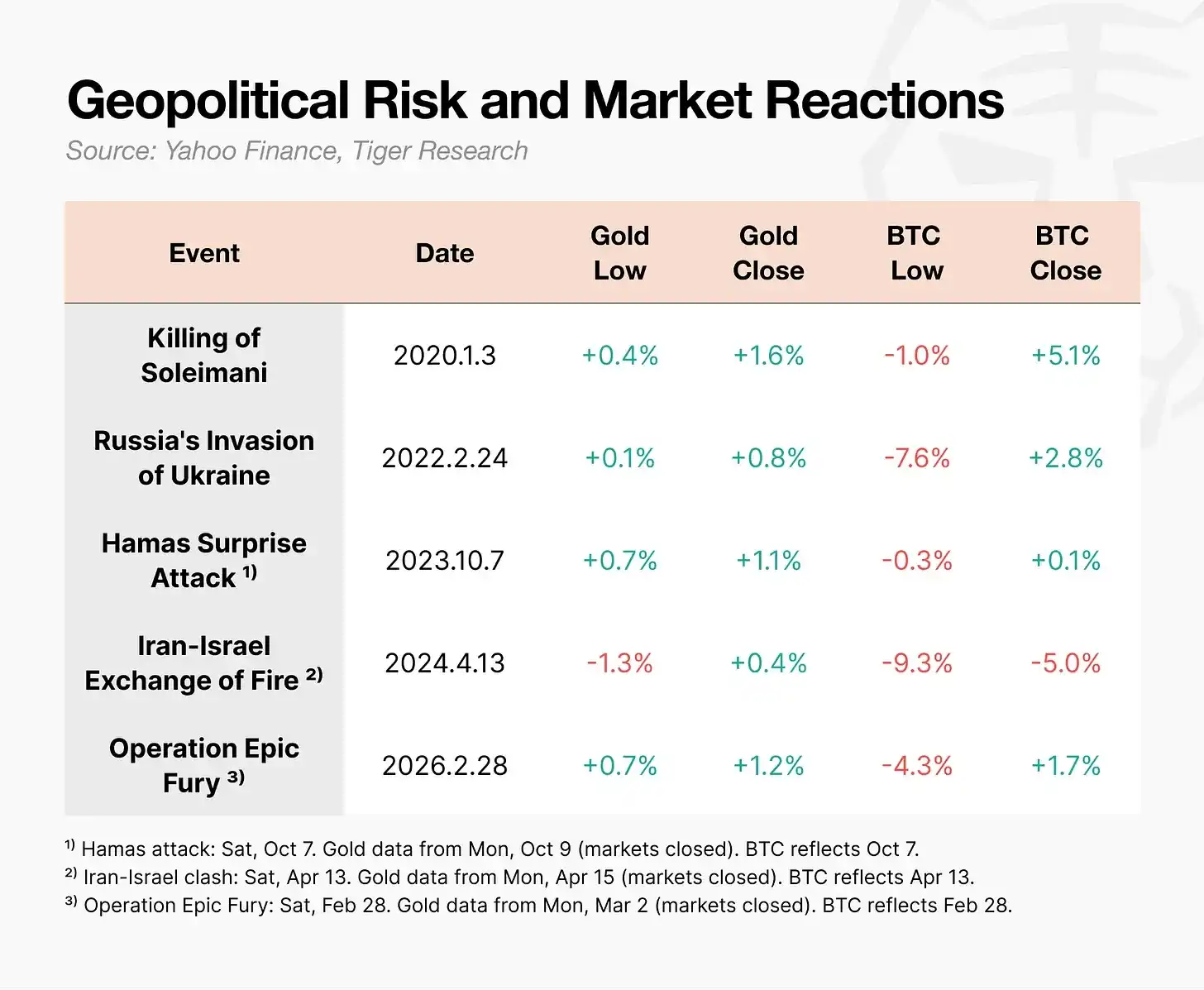
During geopolitical shocks like war, Bitcoin's movement differs from gold's.

Bitcoin often recovers quickly after an initial drop, but the chain reaction triggered by forced liquidations of leveraged traders exacerbates the decline. During the Iran-Israel conflict, Bitcoin's intraday drop reached 9.3%; during the Ukraine war, it fell by 7.6%. This stands in stark contrast to gold, which rose during the same periods.

Bitcoin is often the first asset to fall at the onset of a crisis. Can we really still call it 'digital gold'?

2. Bitcoin is Not 'Digital Gold' for Nations or Investors.

Bitcoin was not originally designed to be 'digital gold.' The title of Satoshi Nakamoto's 2008 whitepaper was 'Bitcoin: A Peer-to-Peer Electronic Cash System.' Its starting point was as a transfer mechanism, not a store of value.

The concept of 'digital gold' as we know it today gained popularity during the period of zero interest rates and quantitative easing in 2020. As fears of currency devaluation peaked, Bitcoin attracted attention as a store of value. However, in practice, neither nations nor investors treat Bitcoin as 'digital gold.'

2.1. Sovereign Nations: Hoard Gold, But Not Bitcoin

Data from the World Gold Council shows that central banks have never stopped buying gold year after year. However, no major central bank includes Bitcoin in its full reserve assets.

Some might counter that the US formally established a 'Strategic Bitcoin Reserve' via executive order in March 2025. The text of the order even noted that 'Bitcoin is often referred to as 'digital gold.'' But the details tell a different story. The reserve is limited to assets seized through criminal and civil forfeiture proceedings. The government is not purchasing new Bitcoin but merely holding seized Bitcoin instead of selling it.

Notably, as the attractiveness of US Treasury bonds declines, Europe and China are actively buying gold, but Bitcoin has not yet made their list of alternatives.

2.2 Investors: Falls Together, Doesn't Rise Together

The second half of 2025 was crucial. The Nasdaq hit a record high, while Bitcoin plummeted over 30% from its October high of $125,000. These two assets began to decouple.

But the real issue is not the decoupling itself, but the direction. Bitcoin falls when stocks fall but does not rise when stocks rise. For investors, this is the worst combination. There is no point in holding an asset that bears downside risk but misses upside gains. Bitcoin is far from a safe haven; even as a risk asset, its appeal is questionable.

3. Why Bitcoin Has Failed to Become 'Digital Gold'

A safe-haven asset is not merely one whose price rises. Academically, it refers to an asset whose correlation with other assets drops to zero or even turns negative during extreme economic downturns. The key question is whether its reaction in a crisis is predictable. Measured by this standard, the gap between gold and Bitcoin is evident.
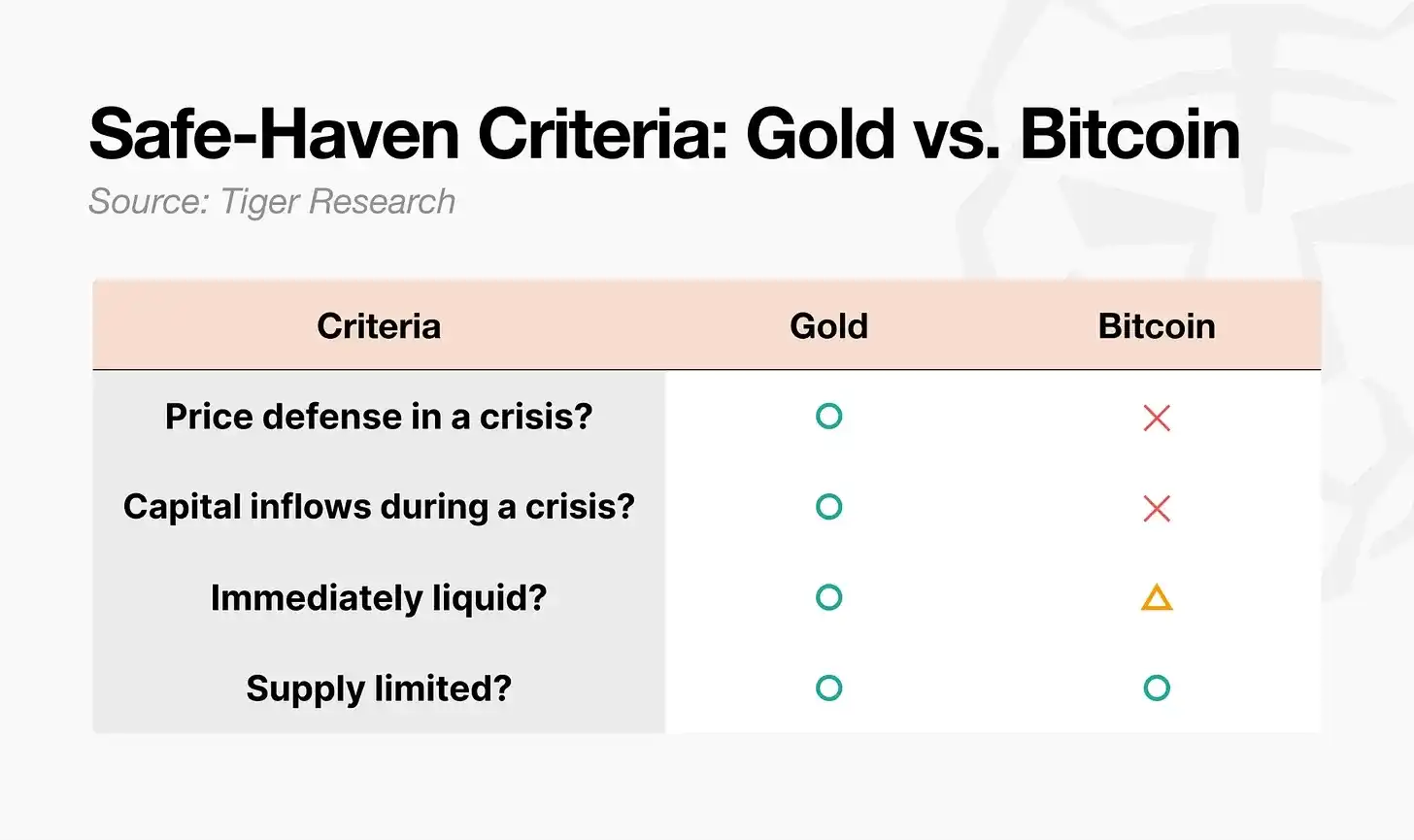
Gold meets all four requirements. Bitcoin clearly meets only one: fixed supply. Liquidity is conditional. The other two requirements are not met. Three structural asymmetries can explain this gap.

  • Market Structure Asymmetry: Physical demand for gold supports a price floor, and its futures have lower leverage. Bitcoin's derivative trading volume is about 6.5 times its spot trading volume, and its market trades 24/7, making it often the first asset sold off when a crisis hits.
  • Participant Asymmetry: The buyers during gold crises are patient capital, such as central banks, pension funds, and sovereign wealth funds. The main participants in the Bitcoin market are leveraged traders and hedge funds—capital that is the first to flee when a crisis erupts.
  • Behavioral Accumulation Asymmetry: The behavioral pattern of 'buying gold in a crisis' has repeated for decades, eventually becoming a fixed pattern. Bitcoin needs time to earn the same trust.

4. Not Safe, But Proven Useful

In terms of safety, it's hard to call Bitcoin 'digital gold.' But its role in crises is undeniable.

After the outbreak of the Russia-Ukraine war in 2022, the Ukrainian central bank immediately restricted electronic transfers and limited ATM withdrawals. Bank branches closed, and people couldn't even access their deposits. Some refugees crossed the border carrying USB drives with Bitcoin seed phrases. Reports indicate that upon arrival in Poland, they exchanged Bitcoin for local currency via Bitcoin ATMs or P2P transactions to cover living expenses.

The UN Refugee Agency went further, distributing the stablecoin USDC to displaced persons and running a program allowing them to exchange it for local currency at MoneyGram outlets. During the 2026 'Operation Epic Fury,' outflows from Iran's largest crypto exchange, Nobitex, surged 700% immediately after the airstrikes.
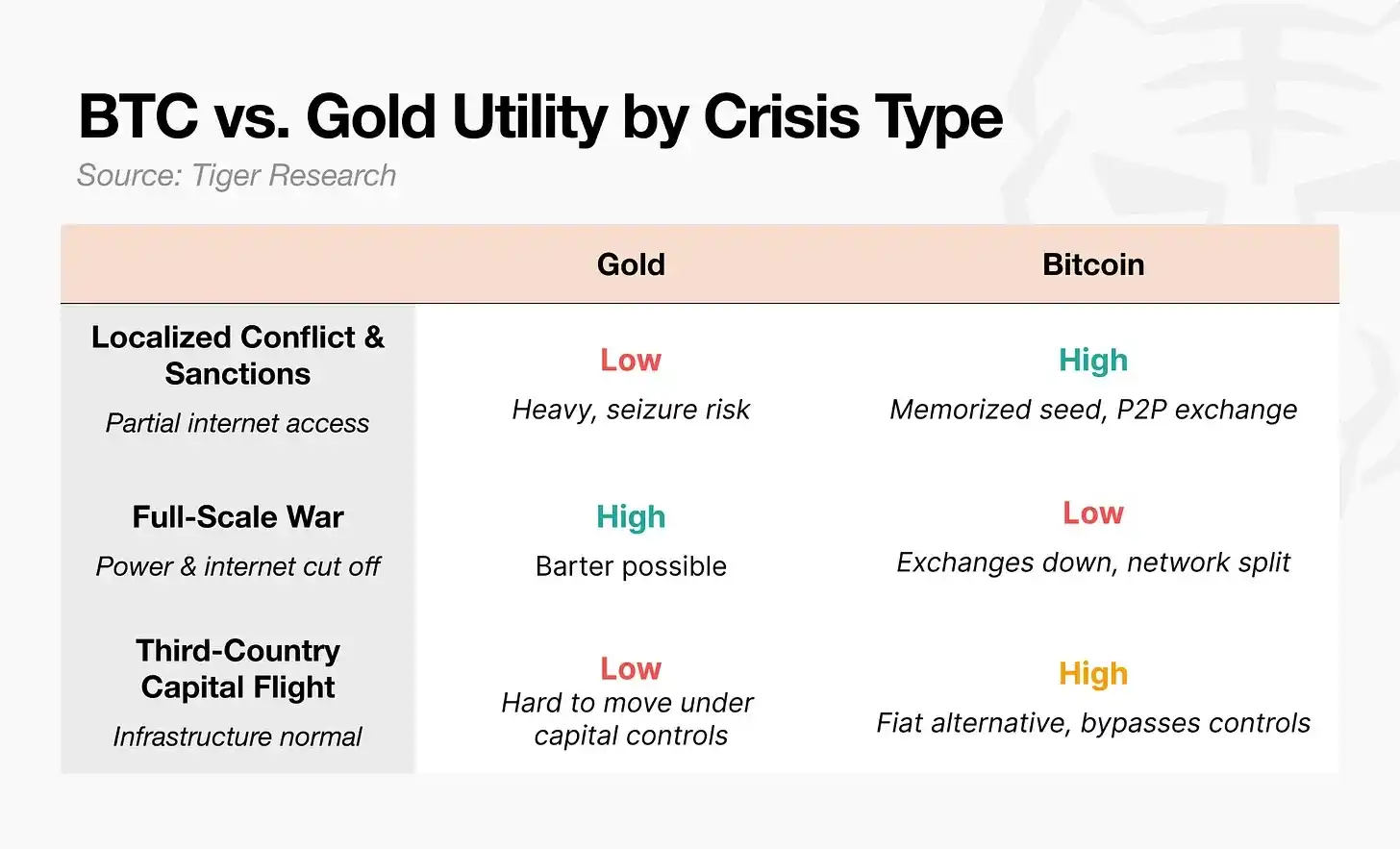
These cases show people turn to Bitcoin not because it is a safe-haven asset, but because it functions when the financial system fails.

In finance, a 'safe-haven asset' refers to one whose price remains stable during a crisis. This is different from an asset that can be used during a crisis. Bitcoin clearly provides functional value for transfer and remittance in wartime, but it cannot guarantee its own price. What constitutes a safe-haven asset is not utility, but the predictability of price behavior. Bitcoin has the former but cannot guarantee the latter.

5. Bitcoin's 'Next-Generation Gold' Scenario

In every crisis, Bitcoin's movement is the opposite of gold's. Neither nations nor investors see it as 'digital gold.' Yet, its utility in regions with closed borders and shuttered banks is undeniable. Given this potential, the path to 'next-generation gold' opens if these three asymmetries diminish.

5.1 Market Structure Shift

Derivative trading volume being 6.5 times spot volume triggers chain sell-offs in every crisis. Recently, futures open interest has declined, and price discovery mechanisms show signs of shifting towards spot and ETFs. But the real test is whether leverage will be rebuilt in the next bull market.

5.2. Participant Shift

After the approval of spot ETFs in 2024, institutional capital flooded in, and Bitcoin became a mainstream financial asset. But this created a paradox: the more institutional investors include Bitcoin in their portfolios, the more likely it is to be sold off alongside stocks during risk-off sentiment. Bitcoin's accessibility increased, but its independent price volatility disappeared. This is the financialization paradox.

Gold ETFs have also become mainstream, yet in crises, gold moves opposite to stocks because 'buying in a crisis' is a pattern formed over half a century. To break this paradox, the participant composition must shift from leveraged traders to patient capital.

There is an often-overlooked variable: generational shift. When Generation Z begins to inherit and manage real wealth, gold might remain their parents' safe haven. This generation's first investment account was not a securities account but a crypto exchange. For a generation whose first接触 (contact with) asset was Bitcoin, they might instinctively choose Bitcoin over gold in a crisis. This participant shift might not begin with institutional decisions but with generational behavioral change.

5.3 Behavioral Accumulation Shift

After the Nixon Shock, the 'buy gold in a crisis' pattern took about 50 years to form. Does Bitcoin need the same time? Not necessarily. This US-Iran conflict was the sixth test, and the result was the same again: an intraday plunge, then a rebound. As this pattern continues, belief grows that 'it will fall, but it always recovers.'

A more important variable is algorithms. A significant portion of Bitcoin trading volume today comes from AI agents and algorithmic trading. If a 'buy Bitcoin in a crisis' strategy is embedded in these algorithms, this pattern could form without the accumulation of human behavior. In this case, trust is built in code before it is built in people.

Bitcoin is not 'digital gold' today. But if market structure, participant composition, and behavioral accumulation patterns shift based on its proven utility, it has the potential to become 'next-generation gold.' It is not a replica of gold, but the birth of a全新 category.


Связанные с этим вопросы

QAccording to the article, why does Bitcoin fail to act as a 'digital gold' during geopolitical crises?

AThe article states that Bitcoin fails to act as 'digital gold' because its price consistently falls during geopolitical crises, unlike gold which rises. This is due to three structural asymmetries: an oversupply of derivatives (market structure), dominance by leveraged participants (participant composition), and a lack of a long-term behavioral track record (behavioral accumulation).

QWhat is the 'financialization paradox' mentioned in the report regarding Bitcoin?

AThe 'financialization paradox' refers to the situation where increased institutional adoption of Bitcoin through instruments like ETFs makes it more mainstream and accessible, but also causes it to be sold off alongside stocks during risk-off events, thereby losing its independent price action and failing to act as a safe haven.

QHow does the article differentiate between a 'safe haven asset' and a 'useful asset in a crisis'?

AThe article defines a 'safe haven asset' as one whose price remains stable or increases predictably in a crisis, like gold. In contrast, a 'useful asset in a crisis' is one that provides functional utility, such as enabling transfers when borders are closed or banks fail, but does not guarantee its own price stability. Bitcoin is presented as the latter.

QWhat potential factors could help Bitcoin transition into becoming 'next-generation gold'?

AThe potential factors for Bitcoin to become 'next-generation gold' are a shift in market structure (reduced derivatives leverage), a shift in participant composition (from leveraged traders to patient capital like sovereign wealth funds), and a shift in behavioral accumulation, potentially accelerated by generational change and the embedding of 'buy-in-crisis' logic into trading algorithms.

QWhat evidence does the article provide for Bitcoin's utility as a 'useful asset in a crisis'?

AThe article cites examples such as Ukrainian refugees using Bitcoin stored on USB drives to access funds and convert them to local currency in Poland after the 2022 invasion, the UNHCR distributing stablecoins to displaced persons, and a 700% surge in outflows from an Iranian crypto exchange following airstrikes, demonstrating its use when traditional financial systems fail.

Похожее

Allbridge приостанавливает основное протокол после эксплойта с мгновенным займом на $1,65 млн в сети Solana

Кросс-чейновая платформа Allbridge Core приостановила работу своего основного протокола после взлома, в результате которого 14 апреля было похищено 1,65 миллиона долларов. Атака произошла в развертывании платформы на блокчейне Solana, после чего средства были переведены в сеть Ethereum. Злоумышленник использовал стратегию мгновенного кредита (flash loan), взяв в займ 1,12 миллиона USDC на платформе Kamino. Последующие быстрые обмены между USDC и USDT создали дисбаланс цен в пуле ликвидности, что позволило эксплуатировать ошибку в алгоритме автоматического маркет-мейкера (AMM) и изъять средства по завышенной цене. Это уже вторая подобная атака на Allbridge Core после инцидента на 573 000 долларов в пулах BNB Chain в апреле 2023 года. Приостановка работы моста приводит к задержкам в обработке транзакций и сокращению доступной ликвидности, заставляя пользователей и поставщиков ликвидности искать альтернативы. Инцидент вновь подчеркивает сохраняющиеся риски безопасности, связанные с кросс-чейновыми мостами и пулами ликвидности.

TheNewsCrypto9 мин. назад

Allbridge приостанавливает основное протокол после эксплойта с мгновенным займом на $1,65 млн в сети Solana

TheNewsCrypto9 мин. назад

Корейский подрядчик проник в MetaMask на месяц, и настоящая уязвимость криптопроектов — не в коде

Автор: Liam 'Akiba' Wright Компиляция: TechFlow Консорциум Consensys, создатель кошелька MetaMask, сообщил об инциденте с безопасностью. Подрядчик, связанный с КНДР, получил доступ к репозиторию кода MetaMask через третьего поставщика услуг с 9 марта и работал до апреля, когда доступ был отключен. Consensys заявил, что расследование не выявило кражы активов или данных, развертывания вредоносного кода и какого-либо воздействия на безопасность пользователей. Компания быстро идентифицировала угрозу, прекратила доступ, начала расследование и уведомила правоохранительные органы. Инцидент высветил критическую уязвимость в аутсорсинге криптопроектов: 76% украденных из DeFi средств в первой половине 2024 года произошли из-за эксплуатации операционных уязвимостей (доступы, подписи), а не уязвимостей смарт-контрактов. Эксперты и руководства по безопасности (MetaMask, FBI, UK NCSC) рекомендуют следующие меры для снижения подобных рисков: * Тщательная проверка личности подрядчиков при найме и на постоянной основе. * Аудит компаний-поставщиков услуг. * Принцип минимальных привилегий (ограниченный доступ к коду). * Аппаратная аутентификация. * Независимый аудит каждого изменения в производственной среде. * Немедленный отзыв прав доступа при прекращении необходимости. * Мониторинг аномальной активности. Consensys также пересмотрел практики работы с третьими сторонами, распространив строгие внутренние стандарты на внешние отношения.

marsbit30 мин. назад

Корейский подрядчик проник в MetaMask на месяц, и настоящая уязвимость криптопроектов — не в коде

marsbit30 мин. назад

От золота к биткойну: фиксированное предложение + институциональная лихорадка — повторится ли история «взрывного» роста цен?

Аналитики проводят параллели между биткоином и золотом, отмечая схожие черты: фиксированное предложение, статус негенерирующих доход активов-убежищ и зависимость цены от настроений инвесторов. Эксперт Bloomberg Intelligence Эрик Бальчунас указывает, что история золотых ETF за 22 года может служить дорожной картой для биткоин-ETF. После запуска в 2004 году золотые ETF пережили взлёты, болезненные коррекции и долгое восстановление, но каждый цикл устанавливал новые максимумы. Биткоин-ETF, одобренные в 2024 году, стали одними из самых быстрорастущих в истории, открыв криптоактив для институциональных инвесторов. Однако это привело к повышенной волатильности: крупные оттоки средств из ETF, как у BlackRock IBIT, могут оказывать значительное давление на рынок. Несмотря на падение цены более чем на 50% с октября 2025 года, многие остаются оптимистичны в долгосрочной перспективе, видя в биткоине "цифровое золото". Устойчивый институциональный спрос на ETF и растущее включение биткоина в инвестиционные портфели компаний помогают смягчать продажи. Если биткоин сможет занять даже небольшую часть рыночной капитализации золота (около $28 трлн), это откроет огромный потенциал для роста. Путь, вероятно, будет сопряжён с высокой волатильностью, но фиксированное предложение в сочетании с волнами институционального спроса может вновь привести к взрывному росту цены.

Foresight News46 мин. назад

От золота к биткойну: фиксированное предложение + институциональная лихорадка — повторится ли история «взрывного» роста цен?

Foresight News46 мин. назад

Почему AI-агенты для покупок не так широко распространены?

**Почему AI-агенты для покупок не получили широкого распространения?** Идея о том, что AI-агент с кошельком может полностью заменить человека в совершении покупок, кажется простой, но содержит логические изъяны. Она смешивает два ключевых аспекта шопинга: **информационный поиск** (сбор, фильтрация, сравнение) и **ценностную оценку** (субъективное суждение о качестве, уместности, доверии к продавцу). Машинный поиск данных успешно автоматизируется. Однако ценностная оценка, особенно **определение потребностей** (что важно для меня и почему), остается прерогативой человека. Исследования показывают, что предпочтения нестабильны и формируются в процессе выбора, поэтому взаимодействие с AI должно быть итеративным, а не разовым. Критическое разграничение — является ли сам процесс выбора **рутиной или удовольствием**. * **Стандартные товары** (бумага, батарейки): выбор не имеет ценности, идеальны для полной автоматизации. * **Товары для удовольствия** (вино, книги, одежда): сам выбор — часть наслаждения. Здесь AI должен выступать как помощник, сужая опции для финального решения человека. Схема **«дать AI кошелек»** решает лишь самую простую проблему — проведение платежа, и только в сценарии, где AI обладает полной автономией. Отраслевые решения (Stripe, Mastercard, Google, Visa) уже разделяют **авторизацию** и **хранение средств**, предоставляя AI ограниченные, одноразовые платежные токены, а не полный контроль над кошельком. Истинные сценарии для автономных AI-кошельков лежат не в розничной торговле, а в **B2B-закупках** и **межмашинных расчетах (M2M)**, где процессы стандартизированы, а решения лишены субъективизма. Таким образом, главными препятствиями для повсеместного внедрения AI2C-покупок являются не технологии платежей, а: 1. **Недостаток достоверных данных** (фальшивые отзывы, поддельные товары), без которых любая автоматизация опасна. 2. **Принципиальная невозможность автоматизировать определение человеческих потребностей и ценностей**. Итог: будущее AI в шопинге — не в полном замещении, а в усилении. AI должен взять на себя утомительный поиск и анализ, оставляя человеку ключевые права: **определять критерии выбора** и **получать удовольствие от самого акта выбора**. Платформам следует сосредоточиться на улучшении именно этого опыта.

Foresight News1 ч. назад

Почему AI-агенты для покупок не так широко распространены?

Foresight News1 ч. назад

Торговля

Спот
活动图片