Three Years Later: How Has AI Evolved from a 'Chat Tool'?

marsbitОпубликовано 2026-03-20Обновлено 2026-03-20

Введение

Three years ago, AI was primarily seen as a novel tool for chatting, image generation, and entertainment—products like ChatGPT, Midjourney, and Character.AI were used more for demonstration than daily reliance. The evolution occurred in two major phases. First, AI became embedded into established applications like CapCut, Canva, and Notion, transforming from a feature into core infrastructure. Platforms diverged: ChatGPT aimed to become a super-app entry point for consumer internet use, while Claude evolved into a professional operating system for knowledge work, creating sticky platform flywheels through integration into calendars, email, and workflows. The true breakthrough emerged recently as AI shifted from generating content to executing tasks autonomously. AI agents like OpenClaw now decompose goals, retrieve information, process data, and deliver results without human intervention. Simultaneously, "Vibe Coding" tools (e.g., Cursor, Replit) enable AI to build entire software products based on human-defined objectives. This progression toward autonomous action is naturally aligning AI with Web3. Blockchain offers machine-native interfaces, programmable assets, and 24/7 operational capability, allowing AI to execute and settle transactions trustlessly without human intermediaries. Together, AI and Web3 are forming the foundational stack for the next internet—where AI acts, and Web3 enables seamless, auditable machine-to-machine coordination and commerce.

Introduction

If you've been following AI over the past three years, you'll have noticed a significant shift: it's no longer just "useful"—it's becoming "indispensable." This change didn't happen overnight; it evolved through three distinct stages.

Phase One: AI Was a "New Species," But Not Yet Part of Daily Life

Three years ago, the hottest AI products were very concentrated:

  • ChatGPT: Chat and Q&A
  • Midjourney: Image generation
  • Character.AI: Virtual character conversations

What they had in common: They were all "AI-native applications," essentially existing to showcase AI capabilities.

User behavior at the time was also typical:

  • Asking questions
  • Generating images
  • Chatting for entertainment

It was essentially about "experiencing AI," not "relying on AI." In other words, AI in this phase was more of a capability showcase than a production tool.

Phase Two: AI Begins to "Embed into Every Product"

The real change happened in the last two years.

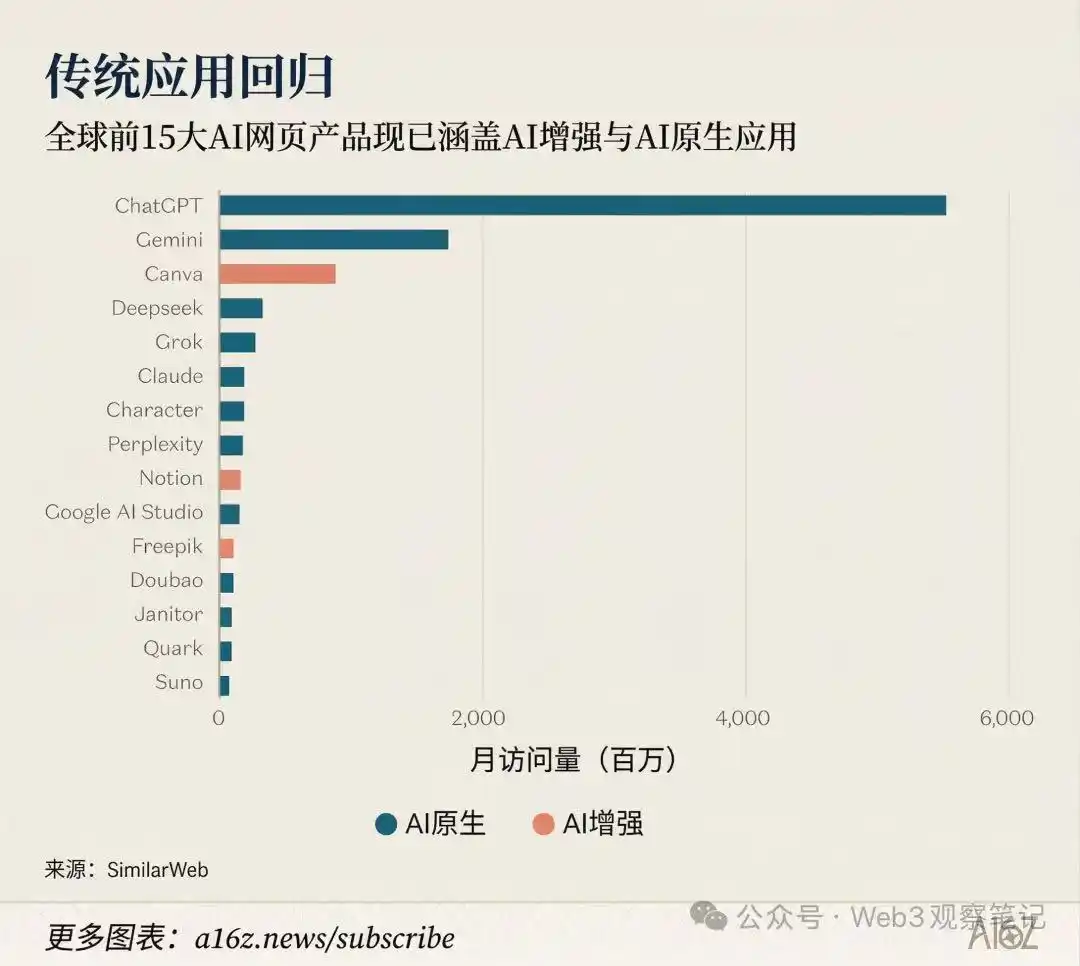
The leaders on the AI application charts are no longer "pure AI products" but established applications that have been rebuilt with AI:

  • CapCut (Jianying): 736 million monthly active users, with almost all core features AI-powered
  • Canva: Redesigned the design workflow around AI tools
  • Notion: AI feature adoption grew from 20% → 50%+

An even more critical signal emerged:

AI began contributing close to half of the revenue (ARR)

This signifies one thing:

AI is no longer just a feature; it's infrastructure.

Platform Differentiation Begins

As AI became a foundational capability, the role of large models also changed:

From "chat tool" to "usage entry point."

Two distinct paths became clear:

1) The Super Entry Point (Consumer)

What ChatGPT is doing includes:

  • GPTs + App Store
  • "Login with ChatGPT" account system
  • Integration into life scenarios like shopping, travel, health

The goal is clear: Become the starting point for your internet use

2) The Professional Work Platform (Productivity)

Claude's path is entirely different:

  • MCP (Model Context Protocol)
  • Deep integration with developer tools, data systems
  • Building complex workflows

It's more like: An AI operating system for knowledge workers

An Emerging Structure: The Platform Flywheel

As users began integrating AI into their daily systems:

  • Calendars
  • Email
  • CRM
  • Workflows

Switching costs rose rapidly, and platform stickiness began to form.

Thus, the classic flywheel effect emerged:

  • More users → More developers
  • More developers → Richer functionality
  • Richer functionality → Users become more dependent

This also leads to one outcome: This competition won't be winner-take-all; it will more likely be two ecosystems coexisting long-term.

Phase Three: AI Begins to "Act on Your Behalf"

The real watershed moment happened in the last year.

AI is no longer just "generating content for you"; it's starting to: Execute tasks for you. From "generating content" to "completing tasks"

Early AI (like Midjourney, DALL·E) solved:

  • Writing content
  • Generating images

But the new generation of products is now doing:

  • Task decomposition
  • Automatic execution
  • Complete delivery

AI Agents Emerge

Represented by products like OpenClaw, a key change has occurred:

  • Not just answering questions
  • But decomposing tasks
  • And automatically executing the entire process

For example, a complete workflow:

  • Receive objective
  • Query information
  • Analyze and process
  • Output result
  • Automatically send

At this stage, AI is no longer just a tool; it is: An "actionable software entity"

Another Trend: AI Starts "Building Products for You"

Vibe Coding is rapidly rising, represented by products including:

  • Cursor
  • Replit
  • Lovable

They are essentially doing one thing: Letting AI directly help you "build" the product This change isn't just about efficiency gains; it's a shift from "humans writing code" to "humans defining goals, AI completing the build."

Four: As AI Takes Action, Why is It Moving Towards Web3?

As AI moves from "answering questions" to "executing tasks," a practical question arises: How does it complete transactions and settlements? In the traditional internet, these rely on platforms and intermediaries, but this system was designed for "humans," not for machines to operate independently.

Web3 provides an underlying structure more suited for AI:

  • 24/7 Operation: AI can continuously execute and respond
  • Machine-Native Interfaces: Contracts as APIs, directly callable
  • Programmable Assets: Fund transfers can be automated

The change this brings: AI doesn't just "do things"; it can also automatically handle payment and settlement in the process.

More importantly, blockchain provides immutability and auditability, enabling AIs to collaborate without intermediaries. This signifies a shift in how trust works on the internet—from "trusting the platform" to "trusting the rules."

Therefore, the relationship between AI and Web3 is more like a natural division of labor: AI handles action, Web3 handles settlement. As AI truly begins to participate in transactions and collaboration, this combination will likely become the foundation of the next generation of the internet.

Связанные с этим вопросы

QWhat are the three main stages of AI evolution described in the article?

AThe three stages are: 1) AI as a 'new species' for demonstration and experience, 2) AI becoming embedded into all products as infrastructure, and 3) AI starting to perform tasks and execute actions autonomously.

QHow did user behavior towards AI change from the first to the second stage?

AIn the first stage, users primarily used AI to 'experience' it through activities like asking questions, generating images, or chatting for entertainment. In the second stage, AI became integrated into mature applications, and users began to depend on it as a core part of their workflow, with AI contributing significantly to product revenue.

QWhat are the two distinct platform paths that emerged as AI became a foundational capability?

AThe two paths are: 1) The 'Super Entry' for consumer use, exemplified by ChatGPT aiming to be the starting point for internet use, and 2) The 'Professional Work Platform' for productivity, exemplified by Claude, which functions like an AI operating system for knowledge workers.

QWhat is the key difference between early AI tools and the newer generation of AI agents like OpenClaw?

AEarly AI tools like Midjourney were focused on generating content (text, images). Newer AI agents like OpenClaw are capable of task decomposition, automatic execution, and full delivery of results, acting as a 'software entity that can act' rather than just a tool.

QWhy does the article suggest that AI's evolution towards performing tasks will lead it to integrate with Web3 technologies?

ABecause Web3 provides a machine-native infrastructure with 24/7 operation, smart contracts as APIs, and programmable assets, allowing AI to autonomously complete transactions and settlements. This creates a trust model based on rules and code rather than centralized platforms, which is essential for AI-to-AI collaboration and action.

Похожее

How Many Tokens Away Is Yang Zhilin from the 'Moon Chasing the Light'?

The article explores the intense competition between two leading Chinese AI companies, DeepSeek and Kimi (Moon Dark Side), and the mounting pressure on Yang Zhilin, the founder of Kimi. While DeepSeek re-emerged after 15 months of silence with its powerful V4 model—boasting 1.6 trillion parameters and low-cost, long-context capabilities—Kimi has been focusing on long-context processing and multi-agent systems with its K2.6 model. Yang faces a threefold challenge: technological rivalry, commercialization pressure, and investor expectations. Despite Kimi’s high valuation (reaching $18 billion), its revenue heavily relies on a single product with low paid conversion rates, while DeepSeek’s strategic silence and open-source influence have strengthened its market position and valuation prospects, now targeting over $20 billion. Both companies reflect broader trends in China’s AI ecosystem: Kimi aims for global influence through open-source contributions and agent-based advancements, while DeepSeek prioritizes foundational innovation and hardware independence, notably shifting to Huawei’s chips. Their competition is seen as vital for China’s AI progress, with the gap between top Chinese and U.S. models narrowing to just 2.7% on the Elo rating scale. Ultimately, the article argues that this rivalry, though anxiety-inducing for leaders like Zhilin, is essential for driving innovation and solidifying China’s role in the global AI landscape.

marsbit4 ч. назад

How Many Tokens Away Is Yang Zhilin from the 'Moon Chasing the Light'?

marsbit4 ч. назад

TechFlow Intelligence Bureau: ChatGPT Helps Amateur Mathematician Crack 60-Year-Old Problem, CFTC Sues New York Regulator Over Coinbase and Gemini

An amateur mathematician, with the assistance of ChatGPT, has solved a combinatorial mathematics puzzle originally proposed by Hungarian mathematician Paul Erdős in the 1960s. This marks another milestone in AI-aided mathematical research, demonstrating the evolving capabilities of large language models in formal reasoning. In other AI developments, OpenAI introduced a new privacy filter tool for enterprise API usage, automatically screening sensitive data. Meanwhile, the Qwen3.6-27B model achieved 100 tokens per second on a single RTX 5090 GPU using quantization, significantly lowering the cost barrier for local AI deployment. In crypto and Web3, the U.S. CFTC sued New York’s financial regulator, challenging its oversight of Coinbase and Gemini—a first-of-its-kind federal-state regulatory clash. Following a vulnerability, KelpDAO and major DeFi protocols established a recovery fund. Tether froze $344 million in assets linked to Iran’s central bank upon U.S. Treasury request, highlighting the centralized control risks in stablecoins. Separately, Litecoin underwent a 3-hour chain reorganization to undo a privacy-layer exploit. In the U.S., former President Trump invoked the Defense Production Act to address power grid bottlenecks affecting AI data centers and dismissed the entire National Science Board, raising concerns over research independence. A retail trader gained 250% on a $600k Intel options bet amid AI-related speculation. Xiaomi announced its first performance electric vehicle, targeting rivals like Tesla. Meanwhile, iPhone users reported devices automatically reinstalling a hidden app daily, suspected to be MDM-related. A Chinese securities report noted that A-share institutional crowding has reached its second-longest streak since 2007, signaling high valuations and potential style rotation. The day’s developments reflect a dual narrative: AI is enabling unprecedented individual breakthroughs, while centralized power structures—whether governmental or corporate—are becoming more assertive, underscoring that decentralization is as much a political-economic challenge as a technical one.

marsbit4 ч. назад

TechFlow Intelligence Bureau: ChatGPT Helps Amateur Mathematician Crack 60-Year-Old Problem, CFTC Sues New York Regulator Over Coinbase and Gemini

marsbit4 ч. назад

Торговля

Спот
Фьючерсы

Популярные статьи

Неделя обучения по популярным токенам (2): 2026 может стать годом приложений реального времени, сектор AI продолжает оставаться в тренде

2025 год — год институциональных инвесторов, в будущем он будет доминировать в приложениях реального времени.

1.8k просмотров всегоОпубликовано 2025.12.16Обновлено 2025.12.16

Неделя обучения по популярным токенам (2): 2026 может стать годом приложений реального времени, сектор AI продолжает оставаться в тренде

Обсуждения

Добро пожаловать в Сообщество HTX. Здесь вы сможете быть в курсе последних новостей о развитии платформы и получить доступ к профессиональной аналитической информации о рынке. Мнения пользователей о цене на AI (AI) представлены ниже.

活动图片