Three-Year Valuation Reaches $2 Billion: How Does RedotPay Play?

marsbitОпубликовано 2026-01-27Обновлено 2026-01-27

Введение

RedotPay, a Hong Kong-based crypto payment company, achieved a $1.07 billion Series B funding round in late 2025, led by Goodwater Capital, with participation from Sequoia China, Pantera Capital, and Circle Ventures. Valued at $2 billion within three years, the platform has over 10 million registered users and processes over $10 billion in annual payments across 100+ countries. The company employs a Visa-linked debit card system, allowing users to spend cryptocurrencies like USDT and BTC globally. Its services include Global Payout (local currency withdrawals), P2P trading, and Earn & Credit financial products for yield and lending. RedotPay initially targeted emerging markets with volatile currencies, such as Nigeria and Brazil, using an offline "ground force" distribution model with high fee incentives for local promoters. Despite its rapid growth, RedotPay faces challenges in maintaining high fee structures and regulatory compliance. Its "puzzle-style" regulatory approach—holding licenses like MSO in Hong Kong and VASP registrations elsewhere—does not fully cover all its financial services, particularly around Earn products and crypto-backed lending, which may face securities law scrutiny. Competitors like Rain are also advancing, with a $2.5 billion Series C at a $19.5 billion valuation. RedotPay’s future depends on strengthening compliance to transition from a payment tool to a sustainable NeoBank.

Author: Zhou, ChainCatcher

By the end of 2025, Hong Kong-based crypto payment company RedotPay completed a $107 million Series B funding round led by Goodwater Capital, with top-tier institutions such as Sequoia China, Pantera Capital, and Circle Ventures also appearing on the list of co-investors.
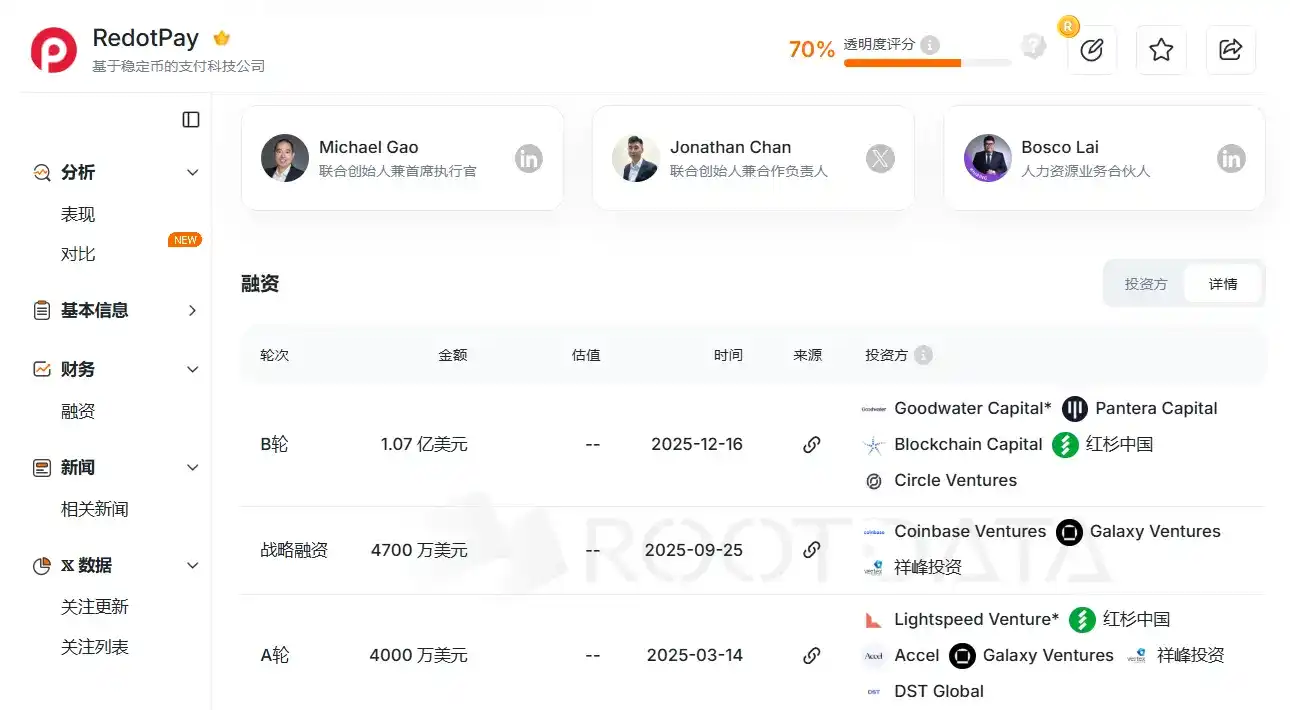
Image from RootData

Why Did It Become a Dark Horse in the Payment Track?

RedotPay's story began in early 2023. Its co-founder and CEO, Michael Gao, had worked for top banks such as HSBC and DBS, and was also a core member of加密技术服务商 ChainUp. Additionally, the company's COO Troy Yao and CTO Xinman Fang both have years of experience in the crypto industry or software development, coming from platforms like Huobi or VCB.

According to informed sources, RedotPay was initially invested in and incubated by Yuan Dawei, who began researching Bitcoin as early as 2010. He was one of the early co-founders of Huobi and the founder of库神钱包, wielding significant influence and trust within the early Bitcoin investor community and miner groups. He is also one of the behind-the-scenes operators of several hot tokens in recent years, well-versed in early user growth and narrative logic in the crypto industry.

The team background determined that RedotPay follows a typical Chinese internet playbook: first, seize market share regardless of cost, then raise连续融资 after scale effects form, and finally monetize through diversified financial services.

Specifically, RedotPay's core business is driven by a Visa co-branded debit card. Users top up cryptocurrencies like USDT and BTC into the App, and can then use the card for instant settlement through the global Visa payment network, including offline ATM withdrawals, supermarket刷卡, online subscriptions, and Apple Pay/Google Pay, with the system automatically handling the清算 of cryptocurrency to fiat.

On this basis, RedotPay further衍生出 Global Payout (local fiat代付), P2P fiat trading zone, and the Earn & Credit financial module with interest-earning and lending functions.

  • Visa payment card: Supports direct stablecoin settlement, covering over 100 countries globally.
  • Global Payout: Supports direct withdrawal of local fiat (e.g., BRL, NGN).
  • OTC and P2P market: By introducing local OTC merchants, users can directly buy or sell cryptocurrencies with local currency.
  • Earn生息: Increases资金停留时长 through financial products.
  • Crypto Credit: Provides credit lines collateralized by coins.

Image from RedotPay APP

RedotPay's early landscape was highly focused on emerging markets with剧烈 fluctuating fiat exchange rates, such as Nigeria, Brazil, and Southeast Asia.

  • May 2023: RedotPay officially launched in Hong Kong and quickly obtained an MSO license.
  • October 2023: Officially launched virtual Visa cards and physical cards, supporting Apple Pay and Google Pay.
  • August 2024: User base surpassed 5 million.
  • March 2025: Completed a $40 million Series A funding round led by Lightspeed.
  • June 2025: Officially launched the Global Payout (global代付) function.
  • September 2025: Received $47 million in strategic investment,引入 Coinbase Ventures and other capital, valuation reaching the $1 billion mark.
  • October 2025: Announced that the P2P market supports trading in over 50 local fiat currencies.
  • December 2025: Completed a $107 million Series B funding round, introducing top institutions like Sequoia China, Pantera Capital, and Circle Ventures. Meanwhile, the company disclosed that its global registered users exceeded 6 million, annualized payment volume exceeded $10 billion, covering over 100 countries, and it had already achieved profitability.

According to informed sources, its global registered real users have now exceeded 10 million, with the latest valuation potentially reaching $2 billion. From its official start in 2023 to achieving stable profitability now, RedotPay took less than three years, which is rare in the illiquid crypto market.

Its growth logic is a combat model called the "Army System." Simply put, it abandons high-cost online user acquisition and instead builds an offline distribution network.

An anonymous crypto card entrepreneur emphasized that RedotPay initially relied almost entirely on this ground promotion system, maintaining high card issuance fees and transaction fees to leave significant profit margins for the offline promotion teams. Currently, its virtual card issuance fee is $10, the physical card is $100, and each transaction includes about a 1% handling fee.

The high profit-sharing mechanism makes every local KOL, OTC merchant, community leader, and even micro-loan intermediary a promoter of RedotPay.

An industry observer stated that RedotPay's traffic experienced a step-change growth in early 2025, and almost all of it came from user主动搜索, which means it formed word-of-mouth diffusion among scenario-specific populations, making its user acquisition efficiency top-tier in the early stages.

According to official data, as of November 2025, RedotPay added over 3 million new users in that year alone, with annual payment volume growing nearly three times year-on-year. Industry insiders said that among RedotPay's users, there might be a group of core users with high consumption capacity and frequency, contributing a significant proportion of revenue.

Valuation Premium Behind the NeoBank Closed Loop

However, how far can a strategy relying on high fees to maintain incentives go?

Although users are willing to pay high costs at this stage, relying on high fees to 'feed' offline agents is essentially trading financial spreads for growth speed.

In the highly competitive environment of crypto payments in 2026, RedotPay seems to be caught in a paradox: to maintain agent loyalty, it must maintain high profit-sharing; but to cope with erosion by licensed giants, it must lower fees.

The high valuation given by the capital market is clearly not just paying for the bid-ask spread (Spread). In fact, what capital values is who can make users leave their money behind, and the market is currently paying a premium for this potential banking attribute.

The真正值钱的地方 of RedotPay lies in the high degree of completion in their transition from a payment tool to a crypto-native bank (NeoBank).

Pure payment channels have extremely low毛利 and are极易被替代, while RedotPay, through the Earn interest-earning and Crypto Credit lending functions, builds a complete资金闭环 of "top-up - earn interest - borrow - consume," preventing users from topping up and leaving immediately.

Under this logic, users top up USDT into the App, retain funds through the Earn (interest-earning) function, and then use Credit (collateralized lending) to obtain fiat credit for consumption. As an industry observer said, even if only 10% of the $10 billion transaction volume is converted into retained沉淀, the interest spread and financial derivative income generated will make its profit margin far exceed that of traditional payments.

BKJ market负责人伯言 believes that the key to RedotPay's success lies in its early courage to make product decisions围绕真实使用场景, because users' real needs are the source of development momentum.

However, behind the seemingly beautiful closed loop lies a liquidity game. 伯言 also reminded that once there is insufficient risk control buffer between interest earning, credit granting, and consumption, in极端行情 or during liquidity紧张, the highly nested financial closed loop may face极大的承压风险.

Under the NeoBank shell, whether the assets have achieved true legal隔离 is the next拷问 it must answer.

Compliance Concerns and Boundary Racing

From another perspective, RedotPay is actually utilizing the window period where regulation has not yet fully covered emerging markets to complete a race关于效率与合规边界.

After all, behind the prosperity of the payment track始终存在 the达摩克利斯之剑 of compliance.

Chaintech founder Kevin Piao emphasized that the famous "compliance cliff" theory同样适用 in the Web3 payment field, meaning the smaller the scale, the safer; the larger the scale, the more dangerous.

Early rapid growth is usually because监管的灰色地带 or bank risk control滞后性 are utilized. But when transaction volume突破某个临界点 (e.g., tens of millions of USD per month), it triggers deep compliance audits from the card issuer (Issuer) and clearing network (Visa/Mastercard). Many once-popular加密卡商 died here.

Although RedotPay has been actively布局合规 and spends high compliance maintenance costs, the challenge it faces still lies in the dynamic upgrade of regulatory standards.

RedotPay adopts a "jigsaw puzzle-style compliance" structure. Although it holds an MSO (Money Service Operator), Money Lender license, and TCSP (Trust or Company Service Provider) license in Hong Kong, and has obtained VASP registration in places like Lithuania and Argentina, this does not mean it can rest easy.

Mankun Law Firm lawyer Liu Honglin analyzed that this组合整体属于 'the business can run, and it can also be explained to regulators,' but it is not one license that covers everything.

Why is it called a jigsaw puzzle? Because it actually stacks together businesses like收款,换汇,转账,跨境兑付,借贷, and生息, which have completely different legal categorizations in traditional finance.

The biggest risk of this structure is that certain links in the product chain may only "look similar," but their legal定性 remains in a gray area.

Lawyer Liu Honglin pointed out that Hong Kong's MSO essentially regulates "fiat exchange," but "stablecoin-to-fiat exchange" is not automatically considered a foreign exchange business in many countries. Furthermore, the real regulatory gray areas are concentrated in the担保执行 of crypto-collateralized lending and the性质定性 of Earn products.

Regarding the Earn interest-earning function, which has attracted much capital attention, Lawyer Liu直言, such products are极易被视为未经注册的证券化产品或集体投资计划 from the perspective of regulators in many countries. "Regulators believe you are issuing financial products with return expectations to the public and should be subject to securities law regulation, not bypass it using 'crypto innovation.' The hefty fine imposed by the U.S. SEC on BlockFi is a lesson from the past."

In the Crypto Credit (crypto-collateralized lending)环节, although the money lender license solves the "lending资格," crypto assets as collateral have far less legal certainty than traditional collateral.一旦遭遇极端行情 or清算纠纷, whether its担保权益 can obtain court support still lacks a mature legal framework.

Conclusion

The crypto market in 2026 is in a collective window期走向台前的 IPO window期. RedotPay and its competitors are accelerating. In January this year, its core competitor Rain announced the completion of a $250 million Series C funding round, with a valuation reaching $1.95 billion.

For RedotPay, licenses are just the shell; continuous compliance内功 is the lifeblood, and this is the team's most fragile一环. Whether it can repair its jigsaw structure through compliance内功 before regulators close the net will determine whether it ultimately becomes a financial giant in the crypto world or merely a流星 in payment history.

In short, this race about efficiency, greed, and boundaries has already entered the second half.

Click to learn about open positions at ChainCatcher

Связанные с этим вопросы

QWhat is RedotPay's core business model and how does it generate revenue?

ARedotPay's core business is driven by Visa co-branded debit cards, allowing users to spend cryptocurrencies like USDT and BTC globally. It generates revenue through card issuance fees ($10 for virtual, $100 for physical cards) and approximately 1% transaction fees. It also offers financial services like Earn (yield-generating products) and Crypto Credit (collateralized lending) to increase user retention and profitability.

QHow did RedotPay achieve rapid user growth in its early stages?

ARedotPay adopted an 'Army System' strategy, focusing on offline distribution networks instead of costly online advertising. It incentivized local influencers, OTC merchants, and community leaders with high commission rates from card fees and transaction fees, leading to organic growth through word-of-mouth and targeted emerging markets like Nigeria, Brazil, and Southeast Asia.

QWhat are the key regulatory challenges RedotPay faces despite its 'puzzle-style compliance' approach?

ARedotPay holds licenses like MSO, Money Lender, and TCSP in Hong Kong, and VASP registrations in other regions, but its integrated services (e.g., stable-to-fiat conversion, Earn products, Crypto Credit) may fall into regulatory gray areas. Key risks include Earn products being classified as unregistered securities (similar to SEC actions against BlockFi) and uncertain legal enforcement for crypto collateral in lending during market extremes.

QWhy do investors value RedotPay at $2 billion, and what potential risks could affect its valuation?

AInvestors value RedotPay for its transition from a payment tool to a NeoBank with a closed-loop ecosystem (deposit-earn-borrow-spend), which promises higher margins through financial derivatives. However, risks include reliance on high fees for growth (unsustainable in competitive markets), liquidity pressures during extreme volatility, and unresolved regulatory gaps that could trigger compliance audits or legal challenges as scale increases.

QHow does RedotPay's growth and valuation compare to its competitors, such as Rain?

ARedotPay reached a $2 billion valuation with over 10 million users and $10 billion annual payment volume by late 2025, focusing on aggressive expansion and financial service integration. Its competitor Rain raised $250 million at a $19.5 billion valuation in early 2026, indicating intense competition in the crypto payment space, with both companies racing to scale and IPO amid regulatory evolution.

Похожее

После трёх кварталов падения: получится ли у крипторынка стабилизироваться в третьем квартале?

Криптовалютный рынок пережил худший квартал с 2022 года, общая капитализация упала на 12,6% до $2,1 трлн, а дневные объемы торгов снизились на 20,9%. Впервые за три года сократилась и капитализация стейблкоинов. Основные факторы спада — отток средств из биткоин-ETF, распродажа биткоинов корпоративным казначейством Strategy и ужесточение монетарной политики ФРС. Второй квартал завершился чистым оттоком $46,7 млрд из ETF, при этом в июне отток достиг рекордных $45 млрд. Ключевым событием третьего квартала станет заседание ФРС 28–29 июля. Мягкий сигнал может поддержать биткоин в диапазоне $68 000–84 000 и вернуть приток в ETF, тогда как жесткая риторика способна сместить торговый диапазон к $50 000–56 000. Законодательная неопределенность также давит на рынок: прогресс по закону CLARITY Act, определяющему регуляторные границы, замедлился, и вероятность его принятия в 2026 году упала до 40–45%. Несмотря на общий спад, два сегмента показали рост: объемы на рынках предсказаний выросли на 48,7%, а торговля токенизированными коллекционными предметами увеличилась на 143%. Сектор RWA продолжает стабильно развиваться, достигнув $28,1 млрд. Рынок, вероятно, миновал фазу острой распродажи, но для устойчивого восстановления необходимы ясность от ФРС и регуляторный прогресс.

marsbit20 мин. назад

После трёх кварталов падения: получится ли у крипторынка стабилизироваться в третьем квартале?

marsbit20 мин. назад

BIT Торговые часы: BTC по-прежнему под давлением 200 EMA на недельном графике, после отскока возможен перезапуск нисходящего движения; секторы хранения данных и полупроводников, выросшие ночью, начали падение в вечерней сессии

**Краткий обзор рынка: BTC под давлением, коррекция на рынке акций, внимание к данным и событиям** Рынок криптовалют демонстрирует осторожное восстановление. Bitcoin торгуется около $66 000, сталкиваясь со значительным сопротивлением в районе $68 000, где сосредоточены объемные "застрявшие" позиции. Ключевые технические уровни — 200-недельная скользящая средняя (~$63 333) и 200-недельная EMA (~$68 328). Аналитики отмечают низкую ликвидность, характерную для летнего периода. На фондовом рынке после сильного роста во вторник наблюдается коррекция. Фьючерсы на основные индексы США снижаются. Акции полупроводниковой и памяти, которые резко выросли накануне, падают в ночных торгах. Исключением стал SMCI, который вырос более чем на 15% после оптимистичного прогноза. На общий настрой негативно влияют рост цен на нефть (более $91 за баррель Brent) и доходности государственных облигаций США (10-летние — около 4,64%), что возрождает инфляционные опасения. Азиатские рынки показали нестабильную динамику. Индекс KOSPI в Корее вырос на 0,74%, а японский Nikkei 225 снизился на 0,18%. Основной риск для региона — ослабление японской иены до минимумов с 1986 года, что повышает вероятность вмешательства властей. **Ключевые события для наблюдения:** * **24 июля:** Финансовые отчеты Alphabet (Google), Tesla, IBM. Событие AMD, посвященное ИИ. * **25 июля:** Решение по процентной ставке ЕЦБ и пресс-конференция Кристин Лагард. Финансовые отчеты Intel, American Airlines, Honeywell и других. Данные по числу первичных заявок на пособие по безработице в США.

marsbit28 мин. назад

BIT Торговые часы: BTC по-прежнему под давлением 200 EMA на недельном графике, после отскока возможен перезапуск нисходящего движения; секторы хранения данных и полупроводников, выросшие ночью, начали падение в вечерней сессии

marsbit28 мин. назад

Бывший глава CFTC и президент Circle Тарберт: призывает к долгосрочной стратегии, но сам выводит $30 млн

Бывший председатель CFTC и президент Circle Хит Тарберт, публично пропагандируя долгосрочное видение компании для инвесторов на фоне падения акций на 70% с пиковых значений, сам активно распродавал свои акции CRCL. С момента IPO Circle он по плану 10b5-1 продал более 360 тысяч акций, выручив около 30 миллионов долларов, и при этом ни разу не докупал акции на открытом рынке. Эта разница между его публичными заявлениями и личными действиями вызвала критику. Карьера Тарберта демонстрирует классическое использование «вращающейся двери» между регулирующими органами и частным сектором. Уйдя с поста председателя CFTC в 2021 году, через 27 дней он занял должность главного юрисконсульта в маркет-мейкере Citadel Securities, который в тот момент находился под пристальным вниманием из-за скандала с акциями GameStop. Позже, уже работая в Citadel, Тарберт выступал за расширение полномочий CFTC на крипторынок, в то время как его работодатель планировал выход на этот рынок. В 2023 году Тарберт присоединился к Circle, где его опыт и связи сыграли ключевую роль в успешном проведении IPO компании в 2025 году. Однако его последующие массовые продажи акций, совпавшие с падением котировок и его же призывами к долгосрочным инвестициям, ставят под сомнение искренность его уверенности в будущем компании. Критики видят в его карьере образец превращения регуляторного опыта и политических связей в личную выгоду, в то время как риски несут обычные инвесторы, верящие его нарративам.

marsbit51 мин. назад

Бывший глава CFTC и президент Circle Тарберт: призывает к долгосрочной стратегии, но сам выводит $30 млн

marsbit51 мин. назад

Gate Research: Взлет «уолл-стритизации» криптофинансовых продуктов — это конкуренция или интеграция?

**Аналитический обзор Gate Research Institute: Волна "уолл-стритизации" криптофинансовых продуктов — конкуренция или интеграция?** Создание биткоина в 2009 году было ответом на финансовый кризис и стремлением построить децентрализованную систему без доверенных посредников. Однако к 2026 году значительная часть биткоинов (около 7,14%) хранится через ETF таких гигантов, как BlackRock. Это символизирует глубокую интеграцию традиционных финансов (TradFi) и крипторынка. С появлением биткоин-ETF, фьючерсов, RWA (токенизированных реальных активов) и государственных облигаций на блокчейне, традиционные институты получают всё больше влияния на выпуск, ценообразование, кастодию и дистрибуцию криптоактивов. Однако это не одностороннее поглощение, а взаимодополняющая конвергенция. Криптосфера приносит TradFi глобальную 24/7 ликвидность и программируемость, а TradFi предоставляет криптосфере регулируемые каналы, институциональное доверие и массовый доступ. Яркий пример — две противоположные, но ведущие к одной цели траектории: * **Путь А:** Криптобиржи, такие как Gate, начинают с токенизированных акций и CFD, а затем напрямую подключаются к инфраструктуре традиционных брокеров, предлагая реальную торговлю акциями США, Гонконга и Кореи за стейблкоины. * **Путь Б:** Традиционные брокеры, такие как Robinhood, интегрируют криптоактивы, а затем создают собственные Layer 2 для токенизации своих акций, стремясь к круглосуточной торговле. Обе стратегии нацелены на создание **универсального финансового аккаунта будущего** — единой точки доступа к акциям, криптовалютам, ETF, токенизированным облигациям и другим активам. Ключевой конкурентной борьбой становится не между CEX и брокерами, а между этими "супераккаунтами". Параллельно, слой RWA и токенизированных гособлигаций растёт даже на медвежьем рынке, становясь "прослойкой" для объединения капиталов. Хотя этот рынок (около $150 млрд токенизированных казначейских облигаций) ещё мал по сравнению с традиционным ($30 трлн), он демонстрирует устойчивый структурный тренд, привлекающий крупнейшие финансовые институты (JPMorgan, DTCC и др.). **Вывод:** "Уолл-стритизация" — это не поражение идеалов децентрализации, а формирование новой гибридной модели. Децентрализованные протоколы продолжают работать на базовом уровне, в то время как на уровне приложений и пользовательского опыта формируется более эффективный, глобальный и свободный объединённый рынок капитала, где активы TradFi и DeFi торгуются бок о бок в одном интерфейсе. Уолл-стрит не завоевала криптосферу, а криптосфера не обошла Уолл-стрит — они совместно строят новые финансовые рельсы.

marsbit54 мин. назад

Gate Research: Взлет «уолл-стритизации» криптофинансовых продуктов — это конкуренция или интеграция?

marsbit54 мин. назад

S&P Dow Jones и Pantera выпускают криптоиндекс, биткоин оставлен за бортом из-за «отсутствия прибыли»

Стандард энд Пурс (S&P Dow Jones Indices) совместно с Pantera Capital запускает индекс S&P Pantera Digital Asset Index. Новый индекс включает 18 токенов, но исключает биткоин, XRP и мем-токены. Критерием отбора послужила «финансовая жизнеспособность», по аналогии с S&P 500: протокол должен демонстрировать положительный доход в течение нескольких кварталов и распределять стоимость среди держателей токенов. Это первое применение фундаментального подхода к оценке криптоактивов со стороны крупнейшего в мире провайдера индексов. В первую пятерку активов вошли Ethereum (ETH), BNB, Solana (SOL), TRON (TRX) и Hyperliquid (HYPE). Pantera отмечает, что совокупный годовой доход всех протоколов индекса превышает $30 млрд. Биткоин был исключен по трем причинам: он рассматривается как монетарный актив, доступный через отдельные ETF; он не генерирует доход протокола; а смешивание его в индексе с доходными активами затрудняет фундаментальный анализ для институциональных инвесторов. Пока индекс является эталонным, но Pantera ведет переговоры о создании на его основе ETF и других инвестиционных продуктов. Компания также отмечает значительный разрыв на рынке: многие институциональные инвесторы готовы к аллокации в криптоактивы, но им не хватает структурированных продуктов, фокусирующихся на активах с реальной экономической деятельностью.

marsbit56 мин. назад

S&P Dow Jones и Pantera выпускают криптоиндекс, биткоин оставлен за бортом из-за «отсутствия прибыли»

marsbit56 мин. назад

Торговля

Спот
活动图片





