They Missed $2 Million Because Maduro Wasn't Supposed to Be Home for the New Year

marsbitОпубликовано 2026-01-04Обновлено 2026-01-04

Введение

On the early morning of January 3, 2026, US special forces captured Venezuelan President Nicolás Maduro at his residence and extradited him to the United States. Prior to the raid, several anonymous accounts on the prediction market platform Polymarket placed large bets on the highly unlikely outcome that Maduro would lose power before January 31, 2026, turning a significant profit once the operation succeeded. Three new wallets, with no prior history, collectively gained over $600,000, suggesting possible insider trading based on confidential intelligence. Further analysis revealed that the operation was originally scheduled for December 29, 2025, but was delayed due to severe weather. Two other traders who had placed early large bets on Maduro’s removal in 2025 suffered major losses when the operation was postponed. However, after learning the raid was rescheduled for January 3, they placed new bets and managed to recover some profits. One trader, Chiwawas, missed out on potential earnings of $750,000 due to the delay. The incident highlights how Polymarket has become a platform where individuals with privileged information can exploit timing and knowledge gaps for financial gain.

At 2 a.m. local time on Saturday in Venezuela, while President Nicolás Maduro was still asleep during the New Year holiday, U.S. special forces completed a raid within an hour, apprehending Maduro and transporting him to the United States via aircraft.

This world-shocking "blitzkrieg" seemed to come without warning, but on the leading prediction market platform Polymarket, it appeared to have become a profit-making tool for several insiders well before the operation.

3 Pentagon Employees "Placing Bets While Working Overtime"

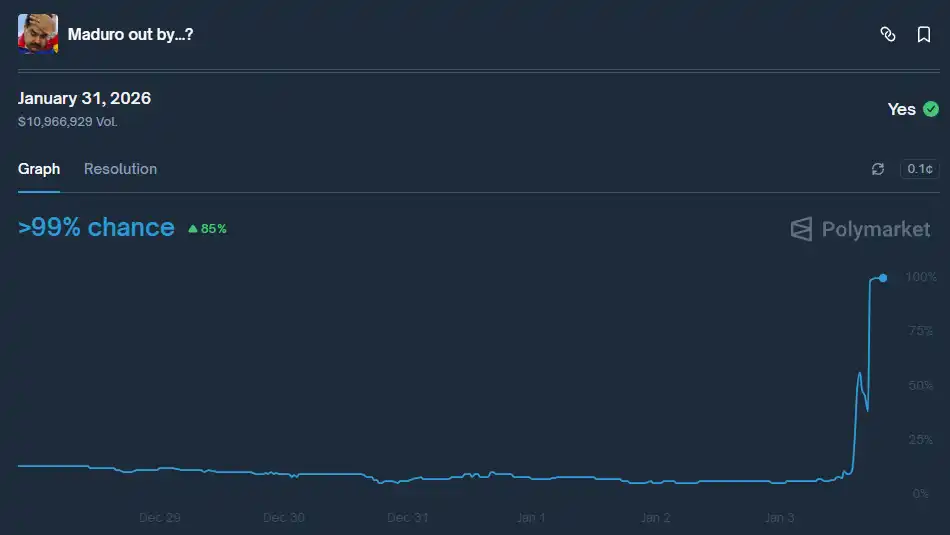
Hours before the operation began, three new wallets with no prior history on Polymarket suddenly started heavily betting "Yes" on the highly improbable market "Maduro loses power before January 31, 2026".

At that time, the mainstream market view was still that Trump would adopt a温和的围城策略 (mild siege strategy) to force Maduro to compromise, and the probability for "Yes" on this market was only 5%. However, as Maduro was loaded onto the plane, these three mysterious accounts instantly reaped profits exceeding $500,000.

It was only after the fact that people began to redefine the trio's purchases hours before the airstrike: only those with reliable intelligence could execute such a "dimensionality reduction strike" with such precise timing using new accounts.

These three insiders were:

0xa72db1749e9ac2379d49a3c12708325ed17febd4, profit $74,982.34;

0x6baf05d193692bb208d616709e27442c910a94c5, profit $145,619.92;

0x31a56e9e690c621ed21de08cb559e9524cdb8ed9, profit $409,882.03.

But the news from Polymarket goes far beyond this.

Maduro's "Flight Delay": The U.S. Operation Was Originally Scheduled for 4 Days Earlier

There are two very representative addresses; although they profited from this event, they actually lost significant potential earnings because they received the information too early.

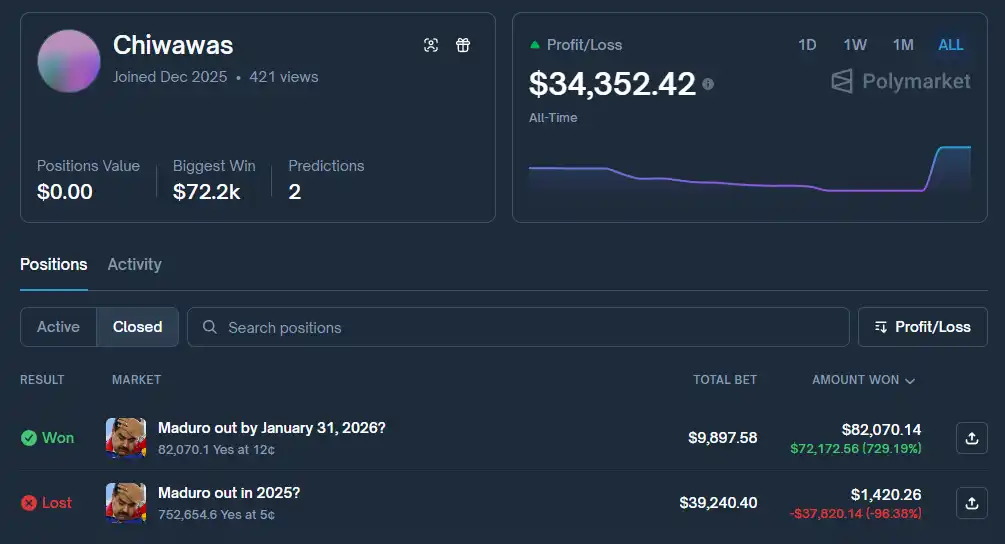
Like the three insiders mentioned above, Chiwawas also placed a precise bet of $10,000 three hours before the airstrike, profiting over $70,000.

But in fact, Chiwawas had already heavily bet nearly $40,000 on the market "Maduro loses power within 2025" on the evening of December 26th.

Assuming he was an insider, he must have received accurate information to make such a heavy bet. Unfortunately, the arrest operation, originally scheduled for December 29th, was canceled due to weather. Thunderstorm clouds over the Caribbean Sea forced the U.S. military to abort for tactical safety reasons.

This was confirmed in Trump's recent speech regarding the operation: "The airstrike against Maduro was originally scheduled for 4 days ago (i.e., the night of December 29 to the early morning of December 30, 2025)."

Therefore, since the market settled as "No" on the last day of 2025, this trade resulted in his account facing huge losses as 2026 arrived.

If everything had gone according to the script Chiwawas possessed, his account should have settled with a whopping $750,000 return on December 30th.

Unfortunately, the weather did not cooperate. The thunderstorm clouds over the sea not only disrupted the U.S. military's original airstrike plans but also shattered Chiwawas's dream of using military intelligence to make a fortune during the Christmas holiday.

Fortunately, upon learning that the U.S. military would restart the operation on the night of January 3rd, he rallied, depositing funds and placing bets again. This final gamble, while unable to make up for the missed $750,000, ultimately brought his total account profit back into positive territory, reaching $34,000.

Besides Chiwawas, another account also missed massive profits due to the weather. Since late last month, he had bet approximately $20,000 across multiple related markets like "Military conflict between US and Venezuela occurs within the year" and "Nothing happens: National leader loses power," convinced that a US-Venezuela conflict would occur in the remaining days of 2025 and that Maduro would fall because of it.

If not for the weather impact, he should have received a huge profit of $1.04 million on the 30th.

Like Chiwawas, after suffering significant losses, he bet on "US-Venezuela conflict occurs before 2026.1.15" three hours before the airstrike and profited over $40,000.

Conclusion

Only three days into 2026, we have already seen that Polymarket is not just a prediction platform but also an automatic teller machine for individuals across various industries with information advantages to疯狂套现 (cash out疯狂ly) using "knowledge gaps" and "time gaps."

As Polymarket's popularity continues to grow, one wonders what other surreal insider stories will play out here this year?

Связанные с этим вопросы

QWhat was the outcome of the US special forces operation against Venezuelan President Nicolás Maduro on the early morning of January 3rd, 2026?

AUS special forces conducted a raid, captured President Nicolás Maduro within an hour, and transported him to the United States via a transport aircraft.

QHow did three new wallets on Polymarket profit from the event before it occurred?

AThree new wallets with no prior history placed large bets on the highly unlikely outcome 'Maduro loses power before January 31, 2026' just hours before the raid, when the probability was only 5%. They collectively profited over $500,000 when the event happened.

QWhy did the US military's operation to capture Maduro get delayed from its original date?

AThe operation, originally planned for December 29th, 2025, was canceled due to thunderstorm clouds over the Caribbean Sea, which forced the US military to postpone for tactical safety reasons.

QHow much potential profit did the user 'Chiwawas' miss due to the weather-related delay of the operation?

AChiwawas missed a potential profit of $750,000 because the operation was delayed past the December 31st, 2025 settlement date for his bet on 'Maduro loses power within 2025'.

QWhat does the article suggest about the nature of Polymarket as a platform?

AThe article suggests that Polymarket has become a platform where individuals with insider information or a significant 'knowledge and time advantage' can use it to profit, effectively turning it into an 'ATM' for such actors.

Похожее

The Era Has Arrived Where Human Writers Must Prove They Are Not Machines

The article describes an era where AI-generated content is flooding the market, forcing human authors to prove they are not machines. It begins with the example of dozens of AI-written, error-ridden biographies of Henry Kissinger appearing on Amazon within hours of his death, a pattern repeated for other deceased celebrities and even living experts who find fraudulent books under their names. This spam content has exploded, with monthly new book releases on platforms like Amazon reaching 300,000 by late 2025. The issue spans genres, from suspiciously high proportions of AI-written teen romance and self-help books to dangerous, AI-generated foraging guides containing lethal advice. The platforms' automated review systems, designed to catch plagiarism and banned words, are ill-equipped to detect AI-generated text that avoids these pitfalls while being nonsensical or fraudulent. The problem has infiltrated traditional publishing. A major publisher, Hachette, had to recall a bestselling horror novel after AI detection tools suggested 78% of its content was machine-generated. An acclaimed European philosophy book was later revealed to be entirely written by AI under a fake author persona. In response, authors are fighting back. At the 2026 London Book Fair, 10,000 writers published a blank book titled "Don't Steal This Book" containing only their signatures—using emptiness as a protest weapon in an age of AI overproduction. Initiatives like the "Human Author Certification" program have emerged, ironically placing the burden on humans to prove their work is not machine-made. The article warns of a vicious cycle: AI-generated low-quality books pollute the data used to train future AI models, leading to "model collapse" and an ever-worsening flood of digital waste, eroding trust in publishing and devaluing human creativity.

marsbit8 мин. назад

The Era Has Arrived Where Human Writers Must Prove They Are Not Machines

marsbit8 мин. назад

The King of Blind Date Attire in Korea: How SK Hynix Made a Comeback Against Samsung?

In South Korea's dating scene, SK Hynix employees are now highly sought after, a status shift fueled by the company's astronomical profits and employee bonuses, projected to reach up to 6.1 million RMB per person by 2027. This marks a dramatic reversal for the long-time second-place player in memory semiconductors, which has now surpassed its rival Samsung in annual operating profit. The turnaround story began in 2008 when a struggling Hynix, emerging from bankruptcy restructuring, took a risky bet by agreeing to develop High Bandwidth Memory (HBM) with AMD. At the time, HBM had no clear market beyond high-end graphics cards and was a costly, complex technology. Major players like Samsung, pursuing its own HMC technology, declined. For Hynix, with only memory as its core business, it was a gamble born of necessity. The pivotal moment came in 2012 when SK Group Chairman Chey Tae-won acquired Hynix. Defying industry downturns, he invested heavily in R&D and fabrication, sustaining the HBM project through over a decade of commercial uncertainty and internal challenges. A key break occurred around 2016-2017 when Samsung faced production issues supplying HBM2 for Google's TPU, allowing SK Hynix to gain a crucial foothold in the data center market. The AI explosion post-ChatGPT in 2022 was the catalyst, turning HBM into a critical bottleneck for AI accelerators like NVIDIA's GPUs. By 2025, SK Hynix captured 62% of the global HBM market, leaving Samsung at 17%. For the first time, its annual operating profit exceeded Samsung's. Analysts point to the "innovator's dilemma" to explain Samsung's miss: its vast, successful business portfolio made it risk-averse, preventing an all-in bet on the initially niche HBM technology. In contrast, SK Hynix, as a challenger with its back against the wall, had no choice but to commit fully. The story highlights how Korea's chaebol system allows for ultra-long-term bets beyond quarterly pressures. However, SK Hynix's lead isn't guaranteed. Samsung is aggressively catching up on HBM4, and challenges like customer concentration (heavy reliance on NVIDIA) and technical hurdles in advanced packaging remain. The narrative underscores a market truth: the greatest alpha often comes from betting on uncertain, long-term directions others dismiss, much like HBM in 2008.

marsbit48 мин. назад

The King of Blind Date Attire in Korea: How SK Hynix Made a Comeback Against Samsung?

marsbit48 мин. назад

Торговля

Спот
Фьючерсы

Популярные статьи

Как купить HOME

Добро пожаловать на HTX.com! Мы сделали приобретение Defi.app (HOME) простым и удобным. Следуйте нашему пошаговому руководству и отправляйтесь в свое крипто-путешествие.Шаг 1: Создайте аккаунт на HTXИспользуйте свой адрес электронной почты или номер телефона, чтобы зарегистрироваться и бесплатно создать аккаунт на HTX. Пройдите удобную регистрацию и откройте для себя весь функционал.Создать аккаунтШаг 2: Перейдите в Купить криптовалюту и выберите свой способ оплатыКредитная/Дебетовая Карта: Используйте свою карту Visa или Mastercard для мгновенной покупки Defi.app (HOME).Баланс: Используйте средства с баланса вашего аккаунта HTX для простой торговли.Третьи Лица: Мы добавили популярные способы оплаты, такие как Google Pay и Apple Pay, для повышения удобства.P2P: Торгуйте напрямую с другими пользователями на HTX.Внебиржевая Торговля (OTC): Мы предлагаем индивидуальные услуги и конкурентоспособные обменные курсы для трейдеров.Шаг 3: Хранение Defi.app (HOME)После приобретения вами Defi.app (HOME) храните их в своем аккаунте на HTX. В качестве альтернативы вы можете отправить их куда-либо с помощью перевода в блокчейне или использовать для торговли с другими криптовалютами.Шаг 4: Торговля Defi.app (HOME)С легкостью торгуйте Defi.app (HOME) на спотовом рынке HTX. Просто зайдите в свой аккаунт, выберите торговую пару, совершайте сделки и следите за ними в режиме реального времени. Мы предлагаем удобный интерфейс как для начинающих, так и для опытных трейдеров.

684 просмотров всегоОпубликовано 2025.06.10Обновлено 2025.06.10

Как купить HOME

Обсуждения

Добро пожаловать в Сообщество HTX. Здесь вы сможете быть в курсе последних новостей о развитии платформы и получить доступ к профессиональной аналитической информации о рынке. Мнения пользователей о цене на HOME (HOME) представлены ниже.

活动图片