The Time of Machines: When Agents Consume Stablecoins

marsbitОпубликовано 2026-03-30Обновлено 2026-03-30

Введение

"The Age of Machines: When Agents Consume Stablecoins" explores the convergence of AI and cryptocurrency, focusing on the emerging narrative of AI agents as economic actors. The author argues that while AI is rapidly advancing into production and consumption, crypto, particularly stablecoins, is struggling to find its role beyond financialization. The piece begins by reflecting on how AI-powered bots are evolving from nuisances to become autonomous economic entities, potentially even developing a "dislike" for humans. This shift creates a sense of desperation in the crypto community, which is now trying to prove its value to AI by promoting stablecoins as the preferred medium of exchange for agents. A core tension is highlighted: AI is mastering both production and the new "relations of production" by replacing human labor, while crypto remains confined to a narrow financial role. Previous attempts by crypto to capture AI use cases—through decentralized storage, compute, or GPU lending—have largely failed. The author warns that compliant, bank-issued stablecoins on networks like Canton could ultimately prevail over native crypto stablecoins. The emergence of payment protocols for machines, like Stripe's MPP, is noted, but these efforts are seen as integrating machines into the existing traditional financial system rather than creating a new crypto-native one. The crypto industry's strategy of selling stablecoins to AI based on technical merits like cheapness and speed is p...

Author: Zuo Ye Wai Bo Shan

We live in a vast gap, and the passage of time always brings a sense of dizziness.

In 2023, Musk called for small payments to block Bots and maintain the community atmosphere for human discussion. But just two or three years later, Bots, empowered by AI, are about to become the main actors of small payments and are showing a "rejection emotion" towards humans.
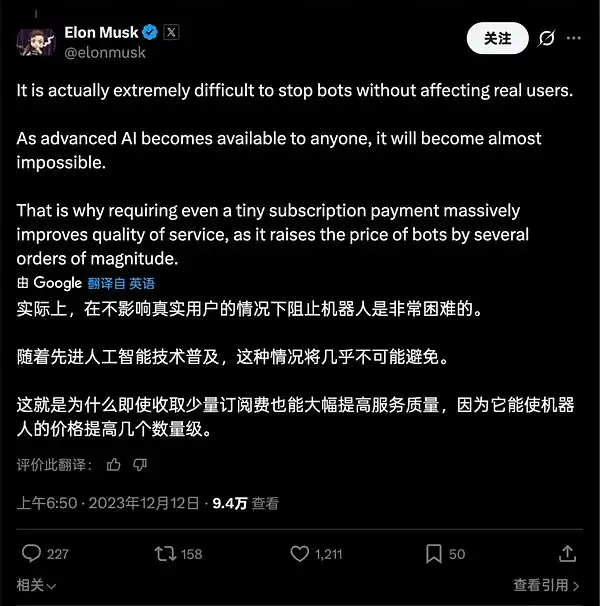
Image Caption: Musk wants to use micropayments to block Bots

Image Source: @elonmusk

It's not just ordinary white-collar workers who feel abandoned; more so, it's the sense of backwardness in the crypto community. You can repeatedly experience this despair from Vitalik's sutra-like repetition of the importance of ZK for trustworthy AI, de Agents like Virtuals seeking decentralized LLMs, and the latest—Agents should consume stablecoins.

This time, Crypto must prove its value to AI, in the name of stablecoins.

AI Steps into Productivity, Crypto Stuck in Finance

When you pursue freedom, you have already lost it.

In the narratives about AI and Crypto, the most classic is "AI is responsible for productivity, Crypto is responsible for production relations," but this relationship has never materialized.

Production relations refer to human collaboration models, and the biggest feature of this round of AI is "replacing humans."

AI Agents are climbing out of the screen, taking over white-collar jobs, while also invading the mechanically repetitive areas of manual labor. Admittedly, as Jensen Huang said, AI itself is also limited by physical hardware like electricity, firmly anchored in the geometric space woven by humans.
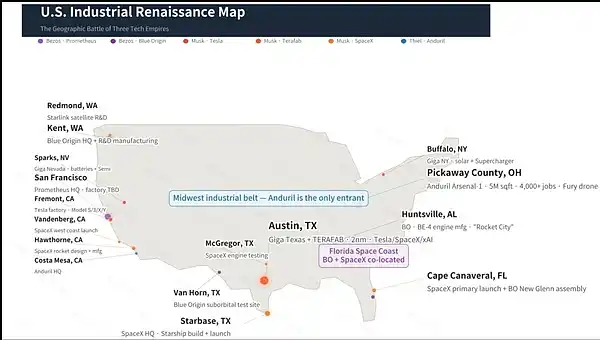
Image Caption: AI enters the production field

Image Source: @zuoyeweb3

If humans can only serve the production and consumption of AI, can they still preserve their subjectivity in labor?

At the same time, Crypto's vision is gradually narrowing, from early decentralized storage like IPFS/Filecoin, to computing power and storage projects in the 24/25 cycle, to USDAI focusing on GPU lending models. You can't say Crypto isn't trying, but each wave fails to capture AI's real use cases.

"AI is responsible for both productivity and production relations" is more likely to come true. Even if the Agent narrative is not a bubble, the stablecoins used may not be "stablecoins based on BTC/ETH assets, running on Ethereum."

I am not spreading terror or pessimism. The Genius Act has effectively allowed the OCC to take the definition power of "compliant stablecoins." Sky's USDS is just a U.S. debt certificate running on Ethereum. So, in the upcoming RWA era, will more assets choose Canton backed by Goldman Sachs or Solana, which is actively BDing?

ETH L1 has once again become a high-performance public chain, at the cost of node scale exploding rapidly. First, use compliant stablecoins to replace "YBS," then use Canton to replace ETH/SOL, and finally co-opt Vitalik as an institutionalized rebel.

Liangshan was good because it could surrender; the coin circle is bad because it's all about finance.

But Liangshan had the military foundation to surrender; the coin circle has all the套件 for financialization. And, no matter how much Agent replaces human consumption power, it must act according to human will.

In other words, Agent is the behavioral subject, and humans are the意愿 subject. Agent's consumption behavior can only be an infinite extension of human will.

In March 2026, Stripe launched the MPP protocol (Machine Payments Protocol), seemingly to摆脱 humans, but it is actually a failed restart之作 to incorporate machines into the existing financial system.

As early as last September, Stripe联合 OpenAI launched the ACP (Agentic Commerce Protocol) protocol, hoping to replace the previous "Google Search + Amazon Mall" through OpenAI's chat page. But unfortunately, Agent cannot cross the non-standard存量 of the old giants over 20 years, and the complexity leads to a conversion rate that is聊胜于无.

There are many such protocols, including Visa and the banking industry, which are urgently launching their own "machine payment" protocols. But归根到底, they are just adding stablecoins on the acquiring side. You hardly see merchants actively integrating stablecoins.
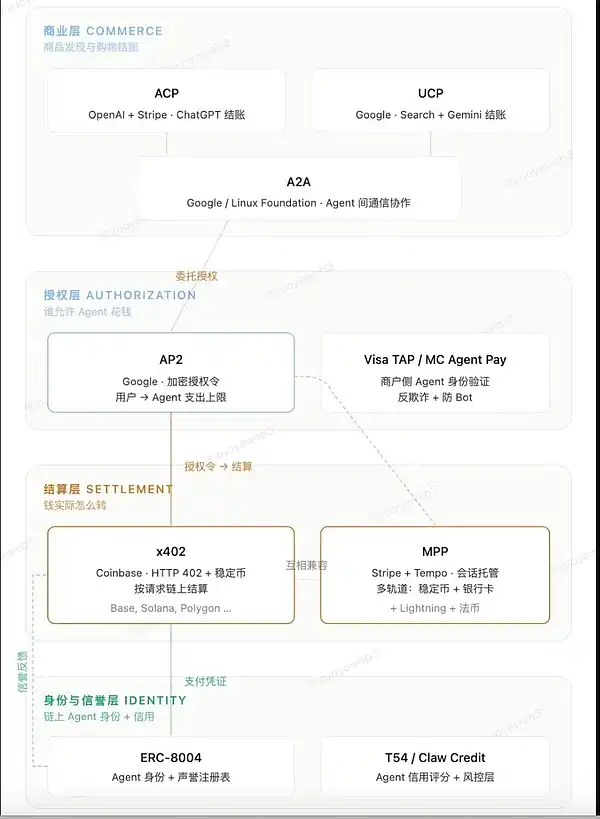
This is not to deny the trend of combining stablecoins and Agents. Borrowing a sentence from @Shoal Research, "In the past fifty years, efforts to replace card organizations, from PayPal to Apple Pay, have ultimately failed."

If the stablecoins issued by banks, running on Visa's private chain, ultimately defeat Crypto's efforts like they defeated Fintech, this story is not friendly to us.

On this point, Crypto must learn from AI, from Prompt Engineering, to Context Engineering, to the current Harness Engineering. The survival form of Agent has been constantly changing.

Early on, people optimized their prompts in Chat; then, people optimized their expressions in AI response texts, summarizing them into skills, and then疯狂购买 API and Mac Mini and other software and hardware services, ultimately training Agent into a version that is easier to replace themselves.

The narrative of Agent consuming stablecoins is a helpless move after only having financial value. It can only sell its cheap, fast and other technical narratives to AI and the public. This is无异于 putting on the rope that will hang itself, and at a clearance price.

Crypto Token ⇄ AI Token ⇄ Crypto Token

Stay away from the sound of gunfire, observe the battle from afar as much as possible.

If you are caught in it, try to create a new battlefield for yourself.

Providing liquidity for the AI industry is a dead end (no money, and it will relegate the coin circle to the background). Being treated as SaaS and channels will be swallowed and have profits taken away. Only by focusing on volatility can we trigger human FOMO emotions, thereby creating miracles of asset price surges.

The most exciting narrative of Agent is being the dual subject of production and consumption. Letting Agent consume can greatly surpass human physiological limitations:

  1. The number of humans is limited, or rather, the subjects of stablecoin consumption are limited, at most 8 billion. But the number of Agents is endless,无限递归. A human's Agent calls an Agent; the vassal of my vassal is not my vassal.
  2. Agent does not need sleep. This is the first time a "tool" has shown a physiological advantage over humans, a biological advantage over human labor—not smarter, but more耐磨, the Scaling Law on the time scale.
  3. Agent is good at handling Fuzzy tasks, or always gives you a solution. In multi-Agent mode, AI shows all-weather working ability for the first time.

Agent is not an evolution of the Ford assembly line, but the theoretical optimum of Taylorism. People are unstable, but Agent can be continuously tuned to最终适配 the ultimate dream of capitalism—capital appreciation.

This is not alarmist. The word Token, in both Chinese and English contexts, already points to the throughput of AI, no longer the competition of PoW.
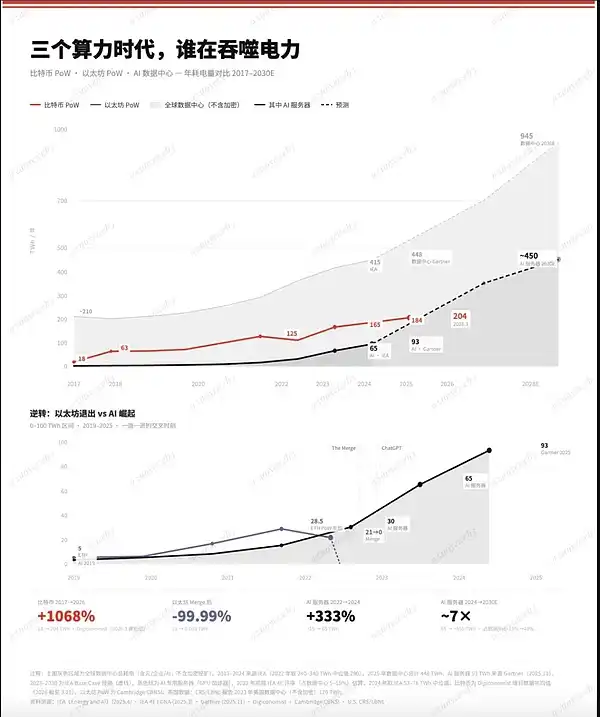
Image Caption: The变迁 of the computing power era

Data Source: @DigiEconomist @IEA

Ethereum abandoned the PoW mechanism in 2022; ChatGPT started the AI computing power competition era in 2022. Fate likes to play tricks on us. When Token in crypto became a pure emission game, more people chose AI supported by computing power consumption.

Transitioning from Crypto Token to AI Token is not difficult; stablecoins are trying. But the reverse, converting AI Token into the liquidity of Crypto Token, has become a difficult sutra to chant.

Computing power, reasoning, storage—all lost. How can the stablecoin story come true?

Perhaps AI can give us a reference. Agent's replacement of Chat is based on the fact that the Chat model cannot sustain a business model. ChatGPT shows no signs of replacing Google or Amazon; Claude specializes in "deterministic" areas like Coding.

Now it's time to consider whether Crypto will decline slowly and painfully like Binance, or rapidly like FTX.

We must learn from AI in reverse: create volatility based on stability. This is what crypto is best at. Traditional finance's adoption of AI pursues accuracy to reduce labor, but traditional finance's adoption of Crypto pursues "tokenization" to reduce friction.

This is not Crypto's own story. Volatility has always been built on a stable foundation. For example, RWA shifts from national debt to corporate debt; lending shifts from floating rates to fixed income.

What the crypto industry needs is, under the premise of Agent using stablecoins, how to create volatility, or rather, the inflation of asset prices?
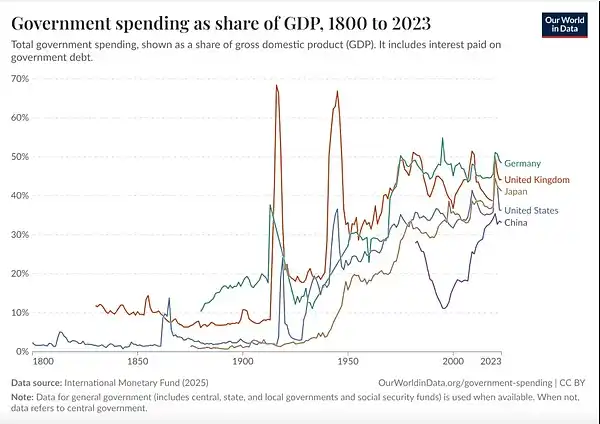
Image Caption: Government becomes the consumption subject

Image Source: @OurWorldInData

It's not as difficult as we imagine. Since the industrial revolution, the state has become the main body of economic operation. Even after the neoliberal narrative began in the 1980s, the proportion has still been steadily increasing.

The water released by QE, strong bank regulation, eventually turned into the withdrawal tide of asset management giants in 2026. This market never lacks AUM; it always lacks demand侧.

This is the significance of stablecoins for the retail market. Whether you package it as the chosen one for Agent or a post-human necessity, human emotions are always needed to trigger the initial purchase.

The AI narrative is the same, and the crypto narrative is the same. Ultimately, they must be sold to a small demand market.

Only technological progress can generate wealth surplus, gradually提高 the overall per capita income level, and thereby提升 consumption levels. This is the story AI tells. But now, the wealth effect of tokens is approaching zero; there is no growth. This is Crypto's biggest困境.

It has never been about productivity and production relations. This is a良缘 about consumption and finance. AI can become the subject of consumption; the government is the driving force of consumption. But humans are always needed to execute the financial big bang to complete the cycle.

The leap from AI Token to Crypto Token also requires letting Token break free from quantity restrictions and re-enter the space of imagination.

Conclusion

Circle's真正聪明之处 is to let Agent replace the limits of human numbers and consumption power,造了一个 dream of infinite users for the capital market.

But compliant Circle will also fall sharply due to the clear act "prohibiting" passive interest. This shows that the market hopes for a vague sense of朦胧感—when compliance is不利, there is also room for survival.

This is the characteristic of the crypto industry—always the frontline financial laboratory.

Current AI is becoming increasingly stable in methodology. The only breakthrough direction is Li Fei-Fei and Yann LeCun's world model, but this is essentially not a complete innovation of "algorithms," but still a dimensional update on the data side.

The significance of Agent for consumption and finance is about to enter the落地 stage after experimentation, and stablecoins carry all the hopes of Crypto.


Связанные с этим вопросы

QWhat is the core argument the author makes about the relationship between AI and Crypto in the context of stablecoins?

AThe author argues that the narrative of 'AI for productivity, Crypto for production relations' has failed. Instead, AI is taking over both roles. Crypto, now largely confined to finance, is desperately trying to prove its value to AI by pushing the narrative of AI Agents consuming stablecoins, but this is a weak position that may lead to its co-option by traditional finance systems like Visa or Canton, rather than dominance.

QAccording to the author, what is the fundamental shift in the role of 'Token' between the Crypto and AI industries?

AThe term 'Token' has shifted from referring to a unit in Proof-of-Work (PoW) crypto mining competitions to denoting the computational throughput and consumption of AI models. The author highlights that while it's easy for value to flow from Crypto Tokens to AI Tokens (e.g., funding compute), the reverse—converting AI's computational value back into Crypto Token liquidity—has become extremely difficult.

QWhat are the three key advantages the author cites for AI Agents over humans as consumers of stablecoins?

AThe three key advantages are: 1. Infinite Scale: The number of Agents is potentially limitless, recursively creating more Agents, unlike the finite human population of 8 billion. 2. No Physiological Limits: Agents do not require sleep, giving them a biological advantage of continuous, 24/7 operation—a 'time-scale Scaling Law.' 3. Handling Fuzzy Tasks: Agents excel at processing ambiguous tasks and providing solutions, especially in multi-Agent systems, enabling full-time, optimized work capability.

QWhat is the author's view on the current efforts by traditional financial institutions like Stripe and Visa regarding machine payments?

AThe author is skeptical. They describe efforts like Stripe's Machine Payments Protocol (MPP) and Visa's initiatives as attempts to incorporate machines into the existing financial system that are ultimately failing or merely adding stablecoins as a payment option on the acquirer side. The author believes these traditional players, with their privately-backed stablecoins, could ultimately defeat Crypto's efforts, just as they previously defeated Fintech challenges to card networks.

QWhat does the author propose as Crypto's unique strength and survival strategy against the dominance of AI and traditional finance?

AThe author argues that Crypto's unique strength is not in stability but in creating volatility and speculation ('FOMO'). The survival strategy is to 'create a new battlefield' by leveraging this ability to generate asset price explosions and wealth effects. Crypto must focus on transforming the stability provided by assets like stablecoins into the volatility that drives financial markets, as this is what it does best and what attracts human capital.

Похожее

Директор XRPL Foundation предупреждает о мошенничестве с фальшивыми «уровнями владельцев XRP»

Директор по сообществу XRPL Foundation Хусейн Зангана (известный как «Vet») предупредил о фишинговой атаке, в которой мошенники распространяют поддельное объявление о «уровнях для держателей XRP». Цель атаки — заставить пользователей подключить свои кошельки к вредоносному сайту, что может привести к краже средств. Важно отметить, что это не означает взлома систем Ripple. Это классическая схема социальной инженерии, использующая имитацию официального стиля Ripple для создания ложного чувства срочности. Мошенники играют на ожиданиях пользователей, связанных с аирдропами, наградами и особыми условиями для давних держателей. Подключение кошелька к непроверенному сайту может предоставить злоумышленникам разрешения на подписание транзакций и привести к полному истощению средств. XRP с его большим и активным сообществом часто становится мишенью для подобных атак. Эксперты призывают пользователей игнорировать подобные объявления, если они не подтверждены через официальные каналы. Прежде чем подключать кошелек, необходимо всегда проверять источник информации и не поддаваться на ощущение срочности, на которое рассчитывают фишеры.

bitcoinist7 мин. назад

Директор XRPL Foundation предупреждает о мошенничестве с фальшивыми «уровнями владельцев XRP»

bitcoinist7 мин. назад

Goldman Sachs однозначно заявляет: это крупнейший в истории человечества цикл спроса на капитал, ФРС — всего лишь зритель

Высокий спрос на капитал: исторический цикл и новая парадигма инвестиций По мнению главы европейского бизнеса хедж-фондов Goldman Sachs Марка Уилсона, мир вступает в самый масштабный в истории цикл спроса на капитал. Эпоха «избытка сбережений» и низких процентных ставок заканчивается. На смену ей приходит период интенсивной конкуренции за капитал, который будет определяться одновременным ростом инвестиций в несколько ключевых сфер: инфраструктуру искусственного интеллекта, реиндустриализацию, оборону, реконструкцию энергосистем, перестройку цепочек поставок, а также высокими потребностями суверенных государств в финансировании. Эта структурная конкуренция будет долгосрочным фактором, ведущим к удорожанию капитала и изменению инвестиционной парадигмы. При этом Уилсон подчеркивает, что Федеральная резервная система (ФРС) в этой ситуации выступает скорее «пассажиром», а не «водителем»: фундаментальной причиной роста доходности облигаций является именно структурный спрос, а не монетарная политика. Ожидать быстрого разворота этой тенденции не стоит. На рынках в июле под относительно спокойной поверхностью индексов скрывалась историческая волатильность: наблюдалась высокая дисперсия акций (например, резкий рост Amazon и падение Apple в один день) и коллапс фактора импульса (momentum), что привело к масштабному снижению рисков у управляющих активами. Несмотря на такую волатильность, фундаментальные показатели, особенно прибыль, остаются устойчивыми. Прогнозы EPS на 2026-2027 гг. пересматриваются в сторону повышения. Особенно впечатляют отчеты компаний hyperscale (Amazon, Microsoft, Alphabet), которые демонстрируют ошеломляющий рост капитальных затрат на ИИ на фоне столь же мощного роста выручки и обещаний высокой рентабельности. Например, Amazon сообщил, что его годовой доход от ИИ превышает $25 млрд с трехзначным ростом, а AWS видит потенциал стать бизнесом с выручкой в $1 трлн. Уилсон заключает, что экономика переживает переходный период: частный сектор активно инвестирует в будущее с ИИ, в то время как государственный сектор сталкивается с бюджетными ограничениями. Это противоречие будет обостряться. На ближайшую перспективу, август, вероятно, станет периодом консолидации и переваривания июльских событий, в то время как суперцикл ИИ продолжает разворачиваться.

marsbit16 мин. назад

Goldman Sachs однозначно заявляет: это крупнейший в истории человечества цикл спроса на капитал, ФРС — всего лишь зритель

marsbit16 мин. назад

Flowra внедряет комплаенс-проверки в блокчейн Solana

Платформа инфраструктуры Flowra, работающая в сети Solana, объявила о партнерстве с провайдером комплаенс-инфраструктуры Honeypot. Цель сотрудничества — внедрение проверок на соответствие санкционным требованиям и другим рискам непосредственно в процесс формирования блоков. Интеграция позволит объединить данные Honeypot с системой Programmable Block Policy (PBP) от Flowra. Это даст институциональным валидаторам возможность самостоятельно настраивать правила, определяющие, какие транзакции могут быть включены в блоки. Система будет проверять кошельки, связанные с подсанкционными организациями, а также анализировать сетевые признаки, такие как использование VPN, прокси и Tor. По оценкам компаний, это поможет выявлять от 31% до 61% трафика, скрывающего своё происхождение. Каждый валидатор сможет определять собственную комплаенс-политику. На первом этапе партнеры сосредоточатся на проверке санкционных рисков, криптокошельков и обеспечении аудируемости для регулируемых организаций.

cryptonews.ru18 мин. назад

Flowra внедряет комплаенс-проверки в блокчейн Solana

cryptonews.ru18 мин. назад

JAN3: принятие биткоина в течение 2025 года было беспрецедентным

Согласно докладу «Nation-State Bitcoin Adoption Report 2025» от компании JAN3, в 2025 году биткоин вышел за рамки корпоративного применения и стал ключевым элементом государственной стратегии. Страны начали использовать его для монетизации избыточной энергии, привлечения инвестиций и защиты от валютной нестабильности. Новый индекс Bitcoin 20 (B20) оценивает вовлечённость государств: лидерами являются США (7.42, BBB), Бутан (6.64, BB), Великобритания (6.44, BB), Сальвадор (5.68, B) и ОАЭ (4.35, CCC). Примеры агрессивного развития новой финансовой инфраструктуры включают подготовку Сальвадором первого в мире криптобанка и успешную конвертацию Бутаном гидроэнергии в суверенный биткоин-резерв. Кульминацией институционального принятия стало создание в США 6 марта Стратегического биткоин-резерва (Strategic Bitcoin Reserve) президентским указом. Этот переход на уровень национальных стратегий формирует мощный институциональный фундамент. Скоординированные действия разных стран показывают, что биткоин теперь воспринимается как полноценный геополитический инструмент и долгосрочное средство обеспечения монетарного суверенитета, а не просто спекулятивный актив.

cryptonews.ru22 мин. назад

JAN3: принятие биткоина в течение 2025 года было беспрецедентным

cryptonews.ru22 мин. назад

Отток стейблкоинов из Южной Кореи продолжается 18 месяцев подряд и превысил $360 млн в июне

В июне 2026 года чистый отток стейблкоинов из Южной Кореи на зарубежные криптобиржи составил 367 млн долларов, что составило около 78% от чистых покупок иностранных акций южнокорейскими инвесторами. По данным Службы финансового надзора (FSS), отток продолжается 18 месяцев подряд, с января 2025 года. Во втором квартале 2026 года чистый отток криптоактивов достиг 1,1 млрд долларов. Основными причинами являются доступ на иностранных платформах к финансовым инструментам, недоступным в Корее: криптодеривативам, продуктам, привязанным к акциям крупных местных компаний (Samsung, Hyundai), а также услугам в сфере RWA, DeFi и стейкинга. Депутат Ли Чон Ук предупреждает, что это ведет к оттоку капитала и оставляет инвесторов без защиты, призывая правительство ускорить реформу регулирования.

cryptonews.ru22 мин. назад

Отток стейблкоинов из Южной Кореи продолжается 18 месяцев подряд и превысил $360 млн в июне

cryptonews.ru22 мин. назад

Торговля

Спот
活动图片