The New Narrative of the $5,000 Era: The 'Old King' Returns, How to Understand the Tokenization Logic of Gold?

marsbitОпубликовано 2026-01-29Обновлено 2026-01-29

Введение

Amidst global macroeconomic instability and a weakening US dollar, gold has surged past $5,000 per ounce, reasserting its role as a consensus asset independent of sovereign promises. However, traditional gold ownership—either physical bullion with high storage costs and low liquidity, or paper gold/ETFs confined within centralized financial systems—fails to meet the needs of the digital age. Tokenized gold, exemplified by Tether’s XAUt, offers a solution: each token is backed 1:1 by physical gold stored in auditable vaults, combining the security of real gold with the full liquidity and composability of crypto assets. Unlike paper gold, tokenized gold operates on-chain, enabling global 24/7 transfers, fractional ownership, and integration into DeFi protocols, payments, and consumption scenarios. Platforms like imToken Web further enhance accessibility through self-custody and seamless management, allowing users to hold, trade, and even spend gold digitally. This transformation elevates gold from a static store of value to a dynamic, usable asset for the modern era—proving that true value lies in minimizing reliance on external promises.

Author: imToken

If a year ago, someone told you that gold would quickly rise to $5,000 per ounce, most people's first reaction would probably be that it was wishful thinking.

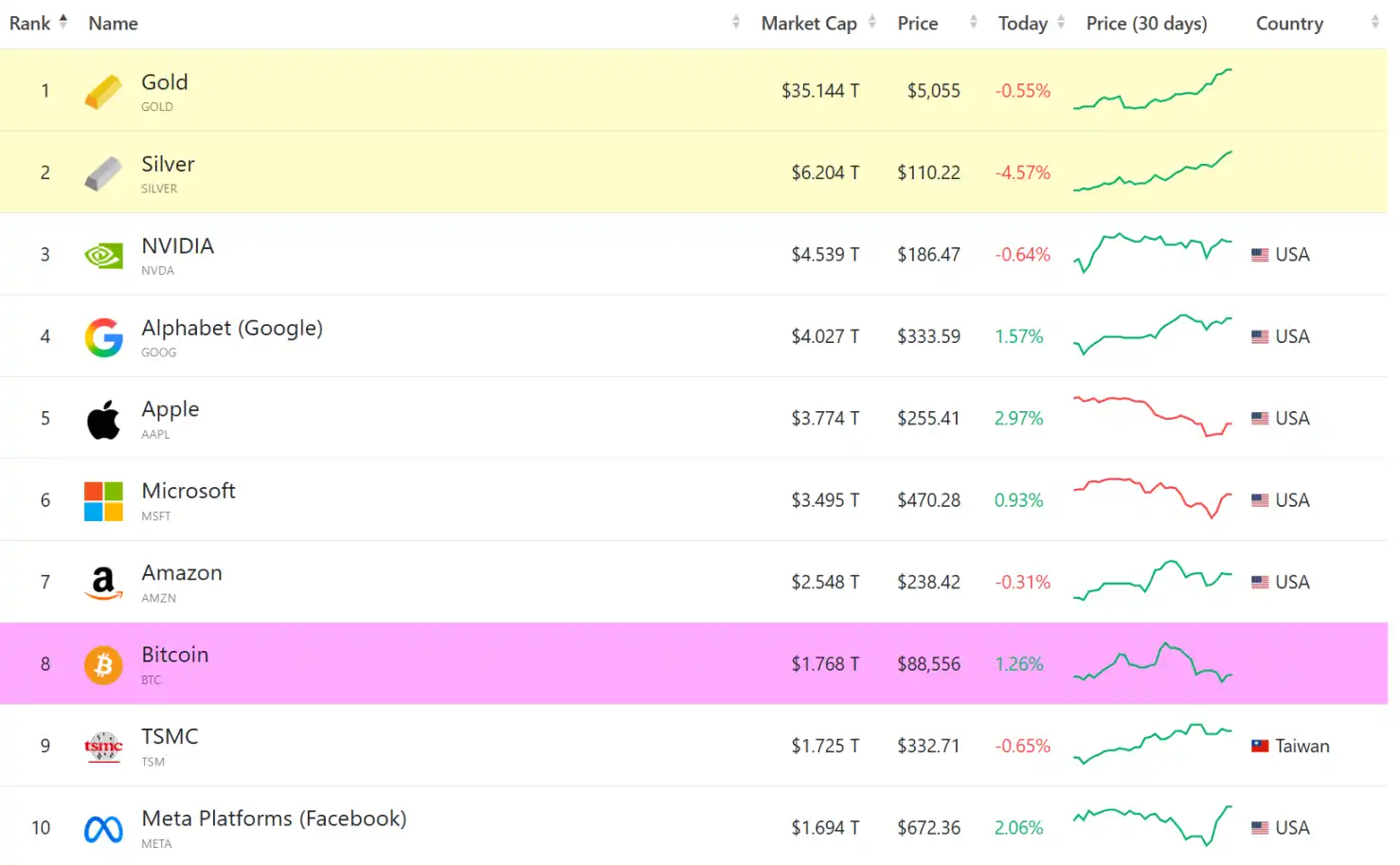
But that's exactly what happened. In just half a month, the gold market has been like a runaway horse, continuously breaking through multiple historical barriers of $4,700, $4,800, and $4,900 per ounce, and heading toward the collective market gaze of the $5,000 moment with almost no looking back.

Source: companiesmarketcap.com

It can be said that after global macro uncertainties have been repeatedly verified, gold has returned to its most familiar position—as a consensus asset that does not rely on any single sovereign promise.

But at the same time, a more practical question is emerging: As the gold consensus returns, are traditional holding methods no longer able to meet the needs of the digital age?

I. The Inevitability of the Macro Cycle: The 'Old King' Returns to the Throne

From a longer macro cycle perspective, this round of gold's upward cycle is not short-term speculation but a structural return against the backdrop of macro uncertainty and a weakening U.S. dollar:

Geopolitical risks have extended from Russia-Ukraine to key resource and shipping regions such as the Middle East and Latin America; the global trade system has been repeatedly interrupted by tariffs, sanctions, and policy games; the U.S. fiscal deficit continues to expand, and the long-term stability of the U.S. dollar's credit is being discussed more frequently. In such an environment, the market will undoubtedly accelerate its search for a value anchor that does not rely on any single country's credit and does not require others' endorsement.

From this perspective, gold does not need to prove that it can generate returns; it only needs to repeatedly prove one thing: in an era of credit uncertainty, it still exists.

This also partly explains why, in this cycle, BTC, which was once expected to be 'digital gold,' has not fully assumed the same consensus role—at least in the dimension of macro hedging, the choices of funds have already provided the answer, which will not be elaborated here (extended reading: 'From Trustless BTC to Tokenized Gold: Who Is the Real 'Digital Gold'?').

However, the return of the gold consensus does not mean that all problems have been solved. After all, for a long time, investors have almost had to choose between two imperfect holding methods.

The first is physical gold, which is secure and sovereign but almost illiquid. Locking gold bars in a safe means high storage, anti-theft, and transfer costs, and it also means that it can hardly participate in real-time trading or daily use.

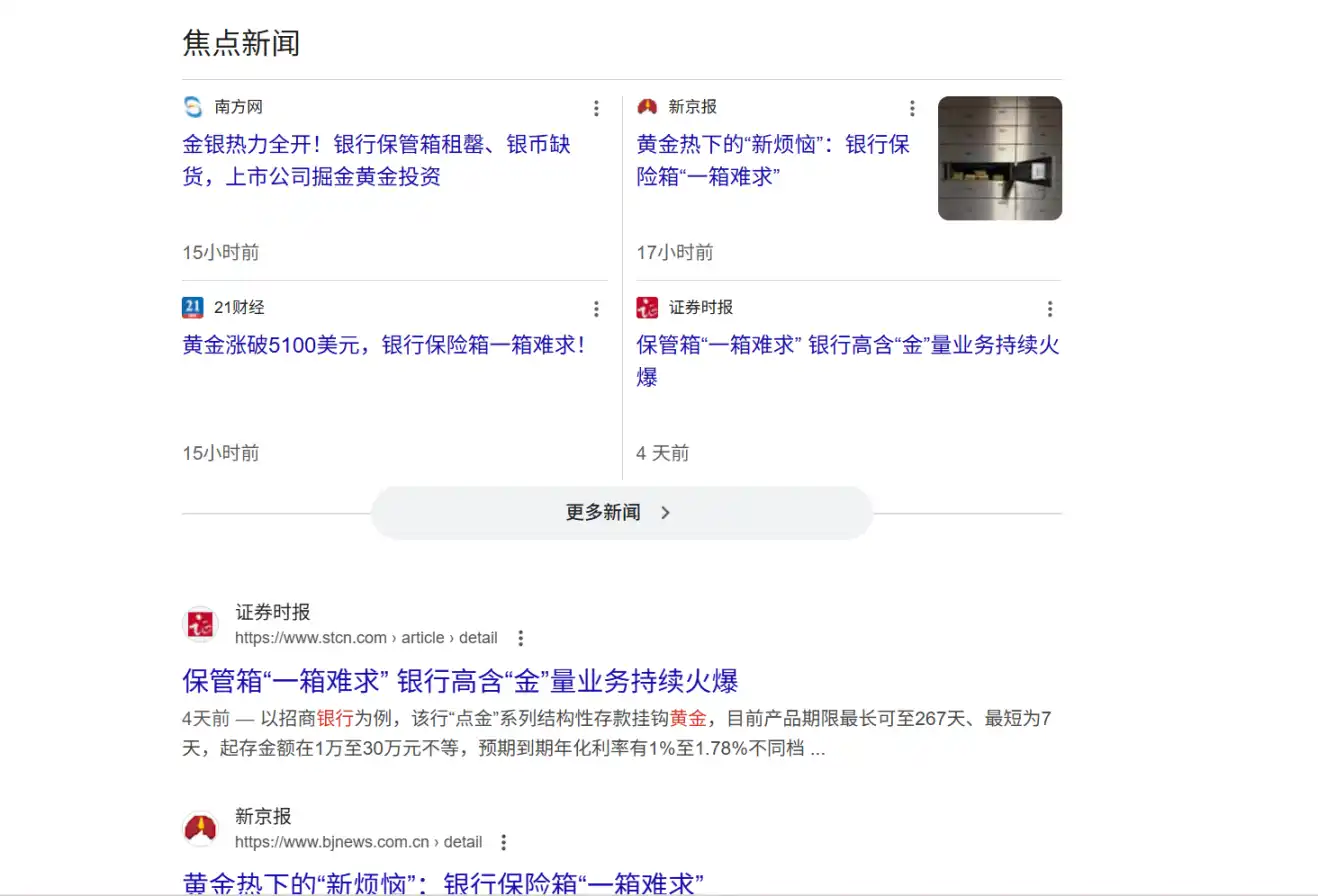
The recent phenomenon of 'one safe-deposit box is hard to find' in many banks恰恰 illustrates that this contradiction is being amplified, meaning that more and more people want to hold gold in their own hands, but现实条件并不总是配合.

The second is paper gold or gold ETFs, which to some extent make up for the physical holding threshold of physical gold, such as paper gold products issued by bank accounts or brokerage systems. These are essentially a claim on financial institutions, giving you a settlement promise backed by the account system.

But the problem is that this liquidity itself is not complete—the liquidity provided by paper gold and gold ETFs is only locked within a single financial system. It can be bought and sold within a certain bank, a certain exchange, or a certain set of clearing rules, but it cannot freely flow outside this system.

This means it cannot be split, combined, or collaborate with other assets across systems, let alone be directly used in different scenarios. It is only 'in-account liquidity,' not true asset liquidity.

For example, the first gold investment product I owned, 'Tencent Micro Gold,' was like this. From this perspective, paper gold does not truly solve the liquidity problem of gold but only temporarily replaces the physical inconvenience with counterparty credit.

In the end, security, liquidity, and sovereignty have long been in a state where it is difficult to have all three. And in a highly digitalized and cross-border era, such trade-offs are becoming increasingly unsatisfactory.

It is against this background that tokenized gold has begun to enter the视野 of more people.

II. Tokenized Gold: Returning 'Complete Liquidity' to the Asset Itself

Tokenized gold, represented by XAUt (Tether Gold) issued by Tether, attempts to solve not just the surface-level problem of 'making gold easier to hold/trade,' which paper gold can also achieve, but a more fundamental proposition:

How can gold achieve the same complete liquidity and composability as crypto assets that can flow across systems, without sacrificing the 'physical gold endorsement' of gold?

If we take XAUt as an example and拆解 its design logic, we will find that it is not radical but even quite traditional and restrained: each XAUt corresponds to 1 ounce of physical gold in a London vault, and the physical gold is stored in a professional vault, auditable and verifiable. At the same time, tokenized gold holders have the right to claim the underlying gold.

This design does not introduce complex financial engineering, nor does it attempt to amplify gold's attributes through algorithms or credit expansion. On the contrary, it deliberately maintains respect for the traditional gold logic—first ensuring that the physical gold attribute is established, and then discussing the changes brought by digitization.

In the final analysis, tokenized gold like XAUt and PAXG is not 'creating a new gold narrative' but is using blockchain to repackage the oldest asset form. In this sense, XAUt is more like a 'digital physical gold' than a speculative derivative in the crypto world.

But at the same time, the more important change is that the liquidity level of gold has fundamentally shifted. As mentioned above, in the traditional system, whether it is paper gold or gold ETFs, the so-called liquidity is essentially in-account liquidity—it exists within a certain bank, a certain brokerage, or a certain clearing system and can only be bought, sold, and settled within established boundaries.

The liquidity of XAUt is directly attached to the asset itself. Once gold is mapped as an on-chain token, it naturally possesses the basic attributes of crypto assets and can be freely transferred, split, combined, and circulated among different protocols and applications without needing permission from any centralized institution.

This means that for the first time, gold no longer relies on an 'account' to prove its liquidity but circulates freely globally 24/7 in the form of the asset itself (extended reading: 'The 'Gold Godfather' Debates CZ: Who Is the Real 'Digital Gold'? A Trust Battle Across TradFi and Crypto'). In the on-chain environment, XAUt and others are no longer just 'tradable gold tokens' but basic asset units that can be recognized, called, and combined by other protocols:

  • It can be freely exchanged with stablecoins and other assets;
  • It can be incorporated into more complex asset allocation and组合 strategies;
  • It can even be used as a value carrier to participate in consumption and payment scenarios;

This is precisely the part of 'liquidity' that paper gold has never been able to provide.

III. From 'On-Chain' to 'Usable': The True Watershed for Digital Physical Gold

For this reason, if tokenized gold only completes the step of 'going on-chain,' it is far from reaching the finish line.

The real watershed lies in whether this 'digital physical gold' can truly be easily held, managed, traded, and even used as 'currency' for consumption and payment? That is, returning to the point mentioned above, if tokenized gold remains just a string of code on the chain and is ultimately encapsulated in a centralized platform or a single entry point, then it is no different from paper gold.

Against this background, the significance of lightweight self-custody solutions like imToken Web begins to emerge. Taking imToken Web's exploration as an example, it allows users to access through a browser—like opening a webpage, instantly managing their tokenized gold and other crypto assets on any device.

Moreover, in a self-custody environment, the private key is完全 controlled by the user. Your gold does not exist on any service provider's server but is truly anchored in a blockchain address.

Additionally, thanks to the interoperability of Web3 infrastructure, XAUt is no longer a heavy metal sleeping in a safe. It can be purchased flexibly in small amounts, and when needed, its purchasing power can be released in real-time into global consumption scenarios through支付 tools like imToken Card.

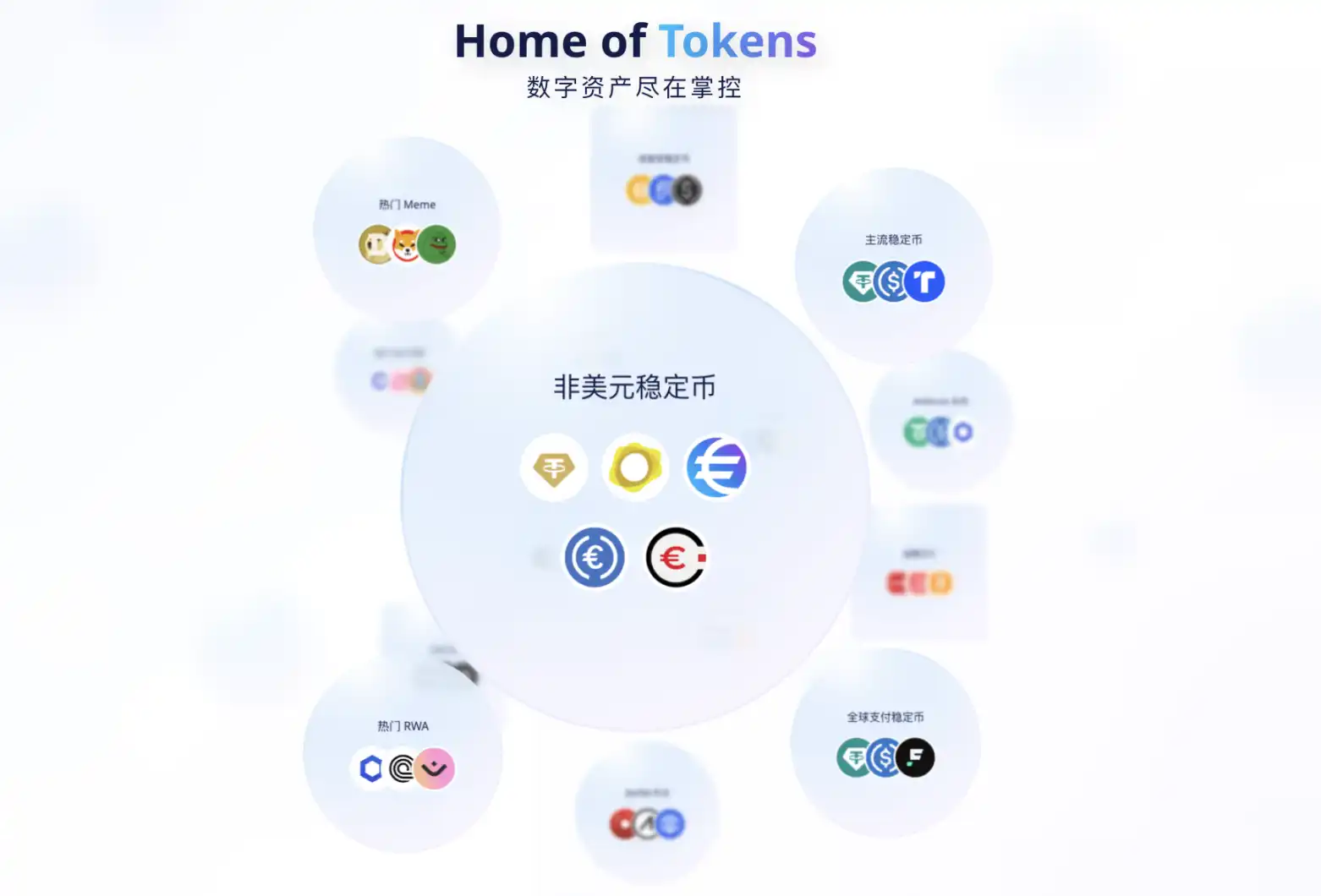
Source: imToken Web

In short, in the Web3 environment, XAUt can not only be traded but also combined with other assets, exchanged, and even connected to payment and consumption scenarios.

And when gold simultaneously possesses extremely high storage certainty and modern usage potential for the first time, it truly completes the leap from an 'old-school避险品' to a 'future currency.'

After all, gold, as a consensus that can span millennia, is not inherently陈旧; what is陈旧 is only the way it is held.

So when gold enters the chain in the form of XAUt and returns to personal control through self-custody environments like imToken Web, what it continues is not a new narrative but a logic that spans eras:

In an uncertain world, true value is to rely as little as possible on the promises of others.

Связанные с этим вопросы

QWhat are the main factors driving the recent surge in gold prices to $5000 per ounce?

AThe surge is driven by global macroeconomic uncertainties, including geopolitical risks in regions like Ukraine, the Middle East, and Latin America, disruptions in global trade systems due to tariffs and sanctions, and concerns about the long-term stability of the US dollar due to expanding fiscal deficits. These factors have increased demand for gold as a consensus asset that doesn't rely on any single sovereign promise.

QWhat are the limitations of traditional gold holding methods like physical gold and paper gold/ETF?

APhysical gold offers security and sovereignty but lacks liquidity due to high storage, security, and transfer costs. Paper gold or gold ETFs provide some liquidity within specific financial systems but are essentially claims on financial institutions, limiting their use to internal account systems. They cannot be freely transferred, split, combined, or used across different platforms or scenarios, offering only 'account liquidity' rather than true asset liquidity.

QHow does tokenized gold, such as XAUt, address the limitations of traditional gold investments?

ATokenized gold like XAUt represents physical gold stored in auditable vaults, with each token backed by one ounce of gold. It combines the security of physical gold with the full liquidity and composability of crypto assets. Unlike paper gold, it can be freely transferred, split, combined, and used across different protocols and applications without relying on centralized institutions, enabling global 24/7 circulation and integration into various financial strategies and payment scenarios.

QWhat role do self-custody solutions like imToken Web play in the adoption of tokenized gold?

ASelf-custody solutions like imToken Web allow users to manage tokenized gold through lightweight, accessible interfaces (e.g., web browsers) while retaining full control of their private keys. This ensures that the gold is truly owned by the user and not held on centralized servers. It enhances usability by enabling easy trading, combination with other assets, and practical applications such as spending via tools like imToken Card, bridging the gap between storage and real-world use.

QHow does tokenized gold transform gold from a 'traditional safe-haven asset' to a 'future currency'?

ATokenized gold merges gold's historical value as a stable store of wealth with modern digital capabilities. By being on-chain, it gains full liquidity, divisibility, and interoperability with other assets and payment systems. This allows it to be used not just for investment but also in daily transactions, consumption, and complex financial strategies, effectively transitioning gold from a passive holding into an active, versatile medium of exchange in the digital economy.

Похожее

Has the 'Digital Gold' Narrative for BTC Failed?

**Title: Has the "Digital Gold" Narrative for Bitcoin Failed?** The article argues that Bitcoin's "digital gold" narrative remains valid despite a recent sharp price decline (from a peak near $126k in Oct 2025 to briefly under $61k in Feb 2026). It presents a long-term investment framework based on three core points: **1. Viewing Bitcoin as an Asset:** Bitcoin is presented as a superior potential store of value compared to gold. Key arguments are its absolute scarcity (21 million cap), superior portability, and transparent auditability via its public ledger. While acknowledging its current use in early, volatile stages (~3-4% global adoption), the author draws parallels to the early, disruptive phases of the internet and e-commerce. **2. Understanding the Recent Downturn:** The current ~50% correction is framed as a predictable, consensus-driven cycle following its post-halving peak (the 2024 halving preceded the Oct 2025 high). A crucial factor is a historic "changing of hands": the influx of new institutional buyers via ETFs allowed early, low-cost holders (miners, OG believers) to take profits. The author notes that while severe, Bitcoin's historical drawdowns (e.g., 93% in 2011, 77% in 2021-22) have been progressively smaller, suggesting maturing holder structure and decreasing volatility over time. **3. The Long-Term Perspective:** The long-term thesis hinges on Bitcoin capturing a portion of gold's market value. With Bitcoin's market cap at ~$1.4 trillion (at $70k) versus gold's ~$20 trillion, significant upside potential exists if the "digital gold" narrative is partially realized. However, the author strongly cautions that short-term risks remain, the bottom is unpredictable, and high volatility is inherent. The real risk is not Bitcoin failing but poor personal position management (over-leverage, wrong capital) and a lack of deep understanding, which can force investors out during severe downturns. The conclusion uses Amazon's 95% crash post-2000 dot-com bubble and subsequent 42x recovery as an analogy. The ultimate question is not if Bitcoin's price will rise, but if an investor's strategy and conviction can withstand the volatility to see the long-term play out. The recent divergence (gold up, Bitcoin down) is posed not as a narrative failure, but as potential evidence of this ongoing, painful transition from a speculative asset to a mainstream allocation.

marsbit1 ч. назад

Has the 'Digital Gold' Narrative for BTC Failed?

marsbit1 ч. назад

Has BTC's 'Digital Gold' Narrative Failed?

The article discusses Bitcoin's "digital gold" narrative, its recent price drop, and long-term outlook through the perspective of "Jason". It argues the narrative is not a failure but that Bitcoin represents a superior, new asset class due to its fixed supply (21 million), portability, and auditability. The piece compares its current ~3-4% global adoption rate to early internet/e-commerce, suggesting significant growth potential. Regarding the 2025-2026 price decline (from ~$126k to briefly under $61k), the author views it as a predictable, consensus-driven sell-off within Bitcoin's ~4-year cycle post-halving, exacerbated by a major "handover" from early, low-cost holders to new institutional buyers via ETFs. A key observation is that historical peak-to-trough drawdowns have lessened over time (e.g., 93% in 2011 to ~50% in 2026), indicating maturing volatility as holder structure changes. For the long term, the author uses a simple framework: Bitcoin's total market cap (~$1.4T at $70k) is only about 7% of gold's (~$20T). Even capturing 30-50% of gold's value would imply substantial upside. However, the article strongly cautions against viewing this as investment advice, emphasizing extreme volatility and the critical importance of risk management, position sizing, and deep fundamental understanding to survive severe drawdowns. It concludes by drawing a parallel to Amazon's 95% crash in 2000 and subsequent 42x recovery, stressing that the key is surviving market cycles to realize long-term potential.

链捕手1 ч. назад

Has BTC's 'Digital Gold' Narrative Failed?

链捕手1 ч. назад

From Code to Cognition: A Ten-Thousand-Word Guide to the Evolution of the Robot Brain

"From Code to Cognition: The Evolution of Robot Brains" The journey of robotic intelligence has shifted dramatically from manually coded systems to AI-driven brains. For decades, robots relied on layered software stacks—perception, state estimation, planning, control—each handcrafted. While predictable, they lacked adaptability. The 2010s saw deep learning revolutionize perception (e.g., object detection) and control (via reinforcement learning), but learned skills remained narrow. The arrival of Large Language Models (LLMs) marked a turning point. LLMs acted as high-level planners, interpreting natural language instructions and generating sequences of actions for traditional robotic systems to execute. However, true integration came with Visual-Language-Action (VLA) models, which fused vision, language, and motion prediction into a single network. Pioneered by models like RT-2 and open-source projects like OpenVLA, VLAs enable robots to reason and act directly from visual input and commands. The most advanced humanoid robots now employ a "dual-brain" architecture: a slow-thinking, large VLA (System 2) for reasoning and planning, and a fast-reacting, small network (System 1) for high-frequency motion control, sometimes with an even lower-level System 0 for balance. This split balances cognition with the physics of real-time movement. Computation is split between onboard hardware (e.g., NVIDIA Jetson) for safety-critical control loops and cloud/edge servers for non-critical tasks like learning and interfaces. A crucial driver is the open-source ecosystem—models like GR00T and OpenVLA allow startups to build upon pre-trained brains and fine-tune them with their own data, accelerating development. Despite progress, current systems struggle with recovery from errors, sample inefficiency, and long-horizon tasks. This has spurred the rise of **World Models**—neural networks that predict the consequences of actions. By simulating possible futures before acting (like NVIDIA Cosmos or Meta V-JEPA), robots can plan, recover, and generalize better. This represents the next frontier: shifting intelligence from learned reactions to an internal model of physics and cause-and-effect. The field is rapidly evolving. While not yet at its "ChatGPT moment," the convergence of cheaper hardware, scalable simulation, and world models points toward robots that are increasingly capable, adaptive, and useful. The question is shifting from "what can robots do?" to "what *should* they do?"

marsbit2 ч. назад

From Code to Cognition: A Ten-Thousand-Word Guide to the Evolution of the Robot Brain

marsbit2 ч. назад

AI Bubble Is Bursting

The AI Bubble is Bursting: A Necessary Purge on the Path to Ubiquitous Intelligence Market volatility has reignited debates about an AI bubble, with figures like Ray Dalio pointing to high valuations. However, this parallels the dot-com bubble, which, despite its crash, laid the physical infrastructure for today's internet era. The current AI investment frenzy, with tech giants planning trillions in infrastructure spending far outstripping current AI application revenues, appears similarly imbalanced. This 'bubble' is seen as an inevitable phase for a disruptive technology, paying the "innovation tax." Critically, AI inference costs have plummeted over 99.7% since 2023, making intelligence nearly free at the margin. This hasn't reduced spending but has instead unlocked massive new demand, as seen in enterprise AI cloud expenditure tripling. This follows the Jevons Paradox: efficiency gains lead to greater total consumption. The market is now entering a cleansing phase, weeding out speculative ventures lacking real moats. The deeper shift is a move from capital expenditure (CapEx) on hardware to value creation in operational expenditure (OpEx) through AI applications that solve real industry problems. While infrastructure valuations are high, rapid earnings growth from widespread AI adoption across sectors—from manufacturing and finance to law and healthcare—may digest these valuations over time. Ultimately, this creative destruction will leave behind robust infrastructure and optimized models, cheaply powering an AI-augmented future for all industries, much as the internet became indispensable after its own bubble burst. The core productive potential remains undiminished.

链捕手2 ч. назад

AI Bubble Is Bursting

链捕手2 ч. назад

Торговля

Спот
Фьючерсы

Популярные статьи

Как купить ERA

Добро пожаловать на HTX.com! Мы сделали приобретение Caldera (ERA) простым и удобным. Следуйте нашему пошаговому руководству и отправляйтесь в свое крипто-путешествие.Шаг 1: Создайте аккаунт на HTXИспользуйте свой адрес электронной почты или номер телефона, чтобы зарегистрироваться и бесплатно создать аккаунт на HTX. Пройдите удобную регистрацию и откройте для себя весь функционал.Создать аккаунтШаг 2: Перейдите в Купить криптовалюту и выберите свой способ оплатыКредитная/Дебетовая Карта: Используйте свою карту Visa или Mastercard для мгновенной покупки Caldera (ERA).Баланс: Используйте средства с баланса вашего аккаунта HTX для простой торговли.Третьи Лица: Мы добавили популярные способы оплаты, такие как Google Pay и Apple Pay, для повышения удобства.P2P: Торгуйте напрямую с другими пользователями на HTX.Внебиржевая Торговля (OTC): Мы предлагаем индивидуальные услуги и конкурентоспособные обменные курсы для трейдеров.Шаг 3: Хранение Caldera (ERA)После приобретения вами Caldera (ERA) храните их в своем аккаунте на HTX. В качестве альтернативы вы можете отправить их куда-либо с помощью перевода в блокчейне или использовать для торговли с другими криптовалютами.Шаг 4: Торговля Caldera (ERA)С легкостью торгуйте Caldera (ERA) на спотовом рынке HTX. Просто зайдите в свой аккаунт, выберите торговую пару, совершайте сделки и следите за ними в режиме реального времени. Мы предлагаем удобный интерфейс как для начинающих, так и для опытных трейдеров.

733 просмотров всегоОпубликовано 2025.07.17Обновлено 2026.06.02

Как купить ERA

Обсуждения

Добро пожаловать в Сообщество HTX. Здесь вы сможете быть в курсе последних новостей о развитии платформы и получить доступ к профессиональной аналитической информации о рынке. Мнения пользователей о цене на ERA (ERA) представлены ниже.

活动图片