Original Title: The Smartest Move That Won't Work
Original Author: Garrett
Original Compilation: Peggy, BlockBeats
Editor's Note: On April 12, after 21 hours of failed negotiations between the U.S. and Iran, Trump announced that the U.S. Navy would blockade all vessels entering or exiting the Strait of Hormuz. Subsequently, the U.S. Central Command confirmed that the measures would take effect at 10 a.m. EST on Monday, covering all Iranian ports and applying to all countries. At this moment, the world's most critical energy chokepoint underwent a transfer of power.
Tactically, this is a "smart" move: without the need for occupation or destruction, the U.S. directly seized Iran's most effective tool over the past six weeks—control over the Strait of Hormuz—and turned it into a means of reverse pressure. The blockade also reset the narrative, allowing the U.S. to regain the initiative.
However, this is not a war that can be ended with a single "smart move." While the blockade weakens Iran's revenue, it also narrows the space for negotiation. As the chips available for exchange diminish, the conflict is more likely to escalate.
The deeper change lies at the level of order. Over the past decades, the U.S. built global trust in trade and energy systems based on "keeping sea lanes open"; this time, it chose to actively close the passage. When the "gatekeeper" begins to weaponize the sea lanes, the risk-pricing logic of markets and nations also changes.
Therefore, the blockade may alter short-term gains but is unlikely to address the fundamental constraints of the conflict. A more likely outcome is a prolonged war of attrition and accumulating tail risks.
Below is the original text:
Trump "Took" the Strait of Hormuz.
Not by reaching a peace agreement, nor by reopening the sea lane, but quite the opposite—he chose to blockade it himself.
On Sunday night, after 21 hours of failed negotiations in Islamabad, Trump posted on Truth Social: "Effective immediately, the U.S. Navy will initiate procedures to blockade all vessels attempting to enter or exit the Strait of Hormuz." The U.S. Central Command (CENTCOM) later confirmed: The measures will take effect at 10 a.m. EST on Monday, covering all Iranian ports and applying to all countries without exception.
The world's most critical energy chokepoint has thus changed hands.
Over the past six weeks, the Strait of Hormuz has been Iran's weapon. Tehran charged $2 million per vessel for passage, allowing allies to pass while blocking opponents. While neighboring countries' exports plummeted by 80%, Iran earned $139 million daily from oil.
Now, this chokepoint is under the control of the U.S. Navy.
This is Trump's smartest tactical move in this war, but it is almost certain—it will not work.
Transfer of the Weapon
There is a concept that accurately explains what just happened: the "chokepoint effect." In global networks, whoever controls the key nodes holds the power to exert pressure on all participants dependent on them.
Before the war, the U.S. was the guardian of the Strait of Hormuz. Since World War II, the U.S. Navy has maintained the strait's openness, allowing oil to flow and the global economy to function. This role formed the cornerstone of "Pax Americana," which is why Southeast Asian nations trusted Washington's "freedom of navigation" operations in the South China Sea, and Gulf monarchies were willing to allocate their sovereign wealth into U.S. Treasury bonds.
Iran rewrote these rules on February 28. The moment the U.S.-Israel airstrike hit Iranian soil, Tehran chose to close the strait—not entirely, but selectively and strategically controlling passage. This 21-mile-wide waterway was transformed into the world's most expensive "toll road."
Over these six weeks, Iran controlled this critical node and thus gained coercive power.
And Trump just took it back.
Compared to directly seizing Kharg Island (Iran's oil export hub), this is a smarter choice. Theoretically, seized oil cargoes could be resold on the open market, excluding Tehran from its own revenue chain. The entire strategy can be summarized as: blockade, intercept, pressure.
On paper, the logic is clear: Iran earned more during the war than before, while its neighbors bled. The only way to turn Iran's economic advantage into a burden is to take away its "weapon."
So, Trump did it.
Why This Is a Brilliant Move
Objectively, this move is tactically brilliant in two ways.
First, it reverses Iran's economic structure.
Before the blockade, Iran exported about 1.7 million barrels of oil per day. With high wartime oil prices, this meant daily revenue of $139 million, even higher than pre-war levels. Meanwhile, Iraq's exports plummeted by 80%, and Saudi Arabia was forced to reroute through pipelines operating near full capacity.
In the entire Gulf region, Iran was almost the only oil-producing country consistently profiting from this war. If the blockade is enforced, this revenue will be directly reduced to zero.
Second, it is lower cost than invasion.
Choosing to seize Kharg Island would require ground troops to be stationed long-term in hostile territory, within range of Iranian missiles. A naval blockade allows for "remote operation." Currently, the U.S. military has deployed three carrier strike groups and over 18 missile destroyers in the region—the infrastructure is already in place.
So, this strategy seems almost flawless. But don't jump to conclusions yet.
The Real Change
Before discussing the problems, it is necessary to first see a change at a level higher than tactics.
Over the past six weeks, the U.S. has been in a passive state. Iran closed the Strait of Hormuz, the U.S. called for negotiations; Iran set passage fees, the U.S. expressed dissatisfaction; Iran decided who could pass and who couldn't, the U.S. could only watch. The ceasefire framework was set by Iran, the negotiation location chosen in Pakistan was Iran's preference, and the "ten-point plan" was Tehran's initial conditions.
This blockade breaks that pattern.
Since February 28, this is the first time Washington has proactively set the rules of engagement, rather than responding to Tehran. This is more important than it seems.
Control over a "chokepoint" is never just about who has ships on the surface; more crucially, it's about who the world believes is in control.
Over the past six weeks, all shipping companies, insurance agencies, and oil traders priced risk based on one premise: Iran decides who passes through the Strait of Hormuz. Starting at 10 a.m. EST on Monday, this "pricing anchor" has been completely flipped, and the decision-making power has returned to the U.S.
Whether there will be loopholes in the blockade (there almost certainly will be) is a secondary issue. What truly matters is the reset of the narrative. Markets, allies, and opponents will readjust their behavior based on "who holds the initiative." And at this moment, in this war, the initiative has returned to Washington for the first time.
This deserves serious attention.
Over the past six weeks, the U.S. looked more like a superpower that started a war but couldn't control the situation. Each round of the "TACO cycle"—maximum pressure, temporary concessions, nominal "ceasefires"—reinforced the impression: Trump was improvising, not advancing with a strategy.
This blockade is the first action that looks like "strategy," not "reaction." It is also the first time the U.S. is leading the rhythm, not passively following.
This is not trivial.
In a conflict where "perception also determines the escalation path," the initiative itself is a variable that affects markets. It will change how allies hedge, alter China's calculations, and influence the debates within Tehran's various factions about the next steps.
But holding the initiative does not equal winning the war. And the cost of this proactive move may be greater than the action itself.
Why It Won't Work
The problem is simple: This blockade is premised on the idea that economic pressure will force Iran back to the negotiating table.
But in reality, it won't.
Iran has a population of 88 million, a battle-hardened Revolutionary Guard, near-nuclear-threshold capabilities, and a proxy network spanning from Lebanon, Yemen, to Iraq. This is not a regime that will yield to economic pressure.
There are four reasons.
1. Iran Will Not Concede, It Will Escalate
Bloomberg Economics issued a judgment within hours of the announcement: Iran will view the blockade as an act of war. The so-called "two-week ceasefire" has effectively expired. Hardliners in the Islamic Revolutionary Guard Corps (IRGC) are likely to see attacking U.S. ships as an "irresistible option."
Statements from the IRGC itself confirm this: Any military vessel approaching the Strait of Hormuz "under any pretext" will be considered a violation of the ceasefire and "met with a severe response." Supreme Leader Khamenei posted on Telegram: "Iran will bring the management of the Strait of Hormuz into a new phase."
This is not the language of a regime preparing to compromise.
2. China Will Not Let Iran Be "Strangled"
China imports 80% of Iran's oil and cannot sit idly by while its key alternative crude source is "cut off" by the U.S. Navy. Bloomberg Economics pointed out the most direct countermeasure: China could leverage its dominance in the rare earth supply chain to pressure Washington.
China just helped broker the ceasefire agreement and has $270 billion in investments in the Middle East. What they least want to see is Trump controlling the distribution of global oil.
A more realistic assessment is: China will find ways to keep Iranian oil flowing, whether through shadow fleets, ship-to-ship transfers, or overland transport via Pakistan or Turkey. These methods have appeared in every previous round of sanctions against Iran.
The blockade will only increase difficulty, not stop the flow.
3. The Blockade Itself Has Loopholes
Even in the U.S. Central Command's statement, an "exit" was embedded.
The original text reads: "CENTCOM forces will not impede the freedom of navigation of vessels transiting the Strait of Hormuz to or from non-Iranian ports." This means a Chinese tanker departing from an Omani port, transiting the Strait of Hormuz to Shanghai? Will not be intercepted.
The U.S. is blockading Iranian ports, not the entire strait. This difference is crucial. Iranian-linked vessels flying "flags of convenience," loading cargo at non-Iranian terminals, transshipping through third-party ports—these evasion paths are real.
Most countries' oil exports are highly concentrated and easily targeted; Iran's export system is more dispersed and has been operating a "gray market" system for six weeks.
4. The Escalation Ladder Works Both Ways
This is the truly unsettling part. If the blockade really starts to hurt Iran's income, Tehran's countermeasures extend far beyond the Strait of Hormuz.
Red Sea direction. Iran's Houthi rebels in Yemen have proven capable of interfering with the critical chokepoint at the southern end of the Red Sea—the Bab el-Mandeb Strait. In 2023-24, Houthi attacks forced global shipping to detour around Africa. Bloomberg Economics warned: "The blockade could trigger Houthi actions in this region." And recently, Saudi Arabia just restarted its Red Sea oil pipeline—the timing is extremely unfavorable.
Gulf infrastructure. Iran has repeatedly struck energy facilities in the region. The 2019 attack on Saudi Abqaiq facility used drones far cheaper than Patriot interceptors to destroy half of Saudi Arabia's capacity. If Iran decides "no one sells oil," its tools are both cheap and mature.
Nuclear breakout. This was the core reason for the breakdown of negotiations. Vance stated that Iran refused to commit not to develop nuclear weapons. If Iran believes it will face economic siege regardless, accelerating towards nuclear weapons becomes a more attractive option.
The logic is cold but clear: A regime cornered, with nothing left to lose, will not negotiate—it will escalate.
Paradox
For the market, what is truly worth noting is the reversal logic here.
The design intent of this blockade was to speed up the end of the war by squeezing Iran's economy. But the most likely result is the opposite—it will prolong the war because it eliminates Iran's incentive to negotiate.
Before the blockade, Iran had both chips (the Strait of Hormuz) and income (oil exports). It had the ability to negotiate and something to exchange.
After the blockade, Iran loses income but gains no new chips. The Strait of Hormuz is no longer a resource it can bring to the table. The only chips it has left are its nuclear program and proxy network.
But these two are things Tehran would never willingly give up. Diplomatic space has not expanded; it has shrunk.
There is an even deeper paradox.
By blockading the Strait of Hormuz, the U.S. has essentially violated the principle it has upheld for the past 80 years.
To put it more directly: If the U.S. can close the Strait of Hormuz when its own interests require it, what is to stop the Navy from taking another step forward in the South China Sea? What is to stop other countries from following suit? The U.S. did not "fail to keep the Strait of Hormuz open"; it actively chose to close it. These two are completely different, and the consequences of the former are far more profound.
In the past, the U.S. was the "lock"; now, it has become the "key." Once the world sees that the nation responsible for guarding sea lanes is also willing to weaponize them, this perception cannot be erased.
Four Scenarios
We don't make predictions; we prepare. Below is the decision matrix for this game.
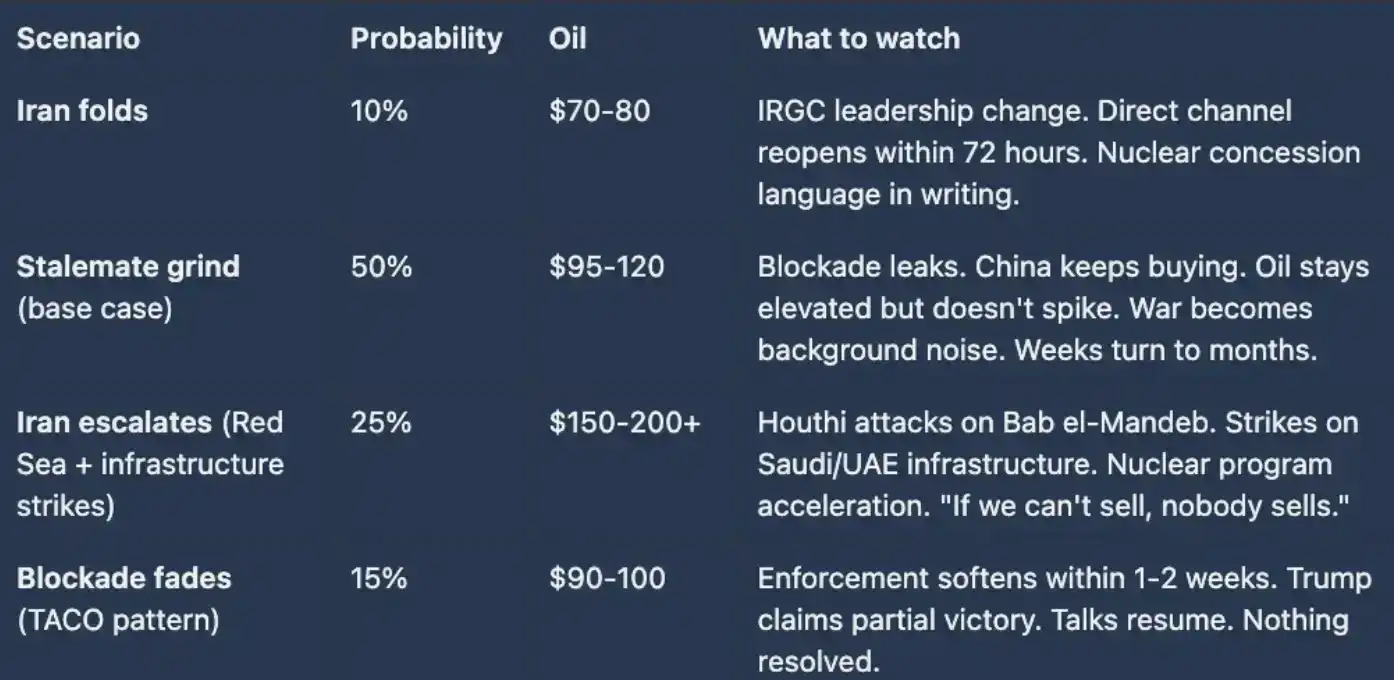
Scenario 1: Iran Concedes. Probability 10%, Oil Price $70–80, Observational Signals: High-level changes in the IRGC, restoration of direct communication channels within 72 hours, written expressions of nuclear concessions;
Scenario 2: Prolonged Stalemate (Baseline Scenario). Probability 50%, Oil Price $95–120, Observational Signals: Loopholes in the blockade, China continues buying Iranian oil, oil prices remain high but don't spike sharply, the war turns into "background noise," the cycle extends from weeks to months;
Scenario 3: Iran Escalates (Red Sea + Infrastructure Attacks). Probability 25%, Oil Price $150–200+, Observational Signals: Houthi attacks in the Bab el-Mandeb Strait, strikes on Saudi/Emirati energy infrastructure, accelerated nuclear program, logic shifts to "If we can't sell oil, then no one can";
Scenario 4: Blockade Fails (TACO Mode). Probability 15%, Oil Price $90–100, Observational Signals: Enforcement weakens within 1–2 weeks, Trump declares "phased victory," negotiations restart but core issues remain unresolved.
Our baseline judgment is: Scenario 2—Prolonged Stalemate.
Iran will not concede because it cannot. Conceding on the nuclear issue and the Strait of Hormuz is equivalent to regime suicide. China will maintain its economic lifeline through various workarounds. The blockade will only become an additional layer of pressure, not a decisive blow. Oil prices remain in the $95 to $120 range, the war continues to consume and drag on.
But for positioning, what is more critical is: Scenario 3, although only 25% probable, has 3 to 5 times the market impact of the baseline scenario. It is this asymmetry that makes us maintain long positions in crude oil, gold, and defense sectors. The expected value of the tail scenario is higher than the baseline.
Key Focus This Week
- Monday 10 a.m. EST: Blockade officially takes effect. Focus on the first 24 hours of enforcement data—how many vessels are intercepted? Does China test the boundaries?
- Iran's Response: The Revolutionary Guard has stated any approach will be considered a ceasefire violation. Monitor for drone or missile probes. The first substantive attack on a U.S. warship will accelerate the evolution towards Scenario 3.
- Oil Market Opening: Brent crude futures performance on Sunday night. The gap will reflect the market's judgment on the "reality" of the blockade.
- China's Moves: Does Beijing issue a statement? Does it provide naval escorts for tankers? The activation rhythm of the "shadow fleet" will be a key variable.
- IMF Spring Meetings (April 13–18): Global fiscal and central bank officials gather in Washington. What's truly worth watching is the off-record exchanges—are countries coordinating responses or acting separately?
Conclusion
Trump just made the smartest move of this war—he took away Iran's "weapon" and turned it against them.
But "smart" does not equal "effective." This blockade will only work if all the following conditions are met simultaneously: Iran concedes under economic pressure, accepts U.S. terms, abandons its nuclear program, and reopens the Strait of Hormuz according to Washington's pace.
But Iran will not concede. It has a proxy network spanning four countries, near-nuclear-threshold capabilities, a revolutionary national identity formed by 88 million people, and a China that will not stand by and watch it be strangled.
A more likely result is: The blockade becomes just another phase in this war with no clear endgame. Oil prices remain high, chain reactions continue to spread, the world gradually adapts to a new normal, and the nation that once built the global shipping order is now disturbing it.
This is not a stable equilibrium. Some link will eventually break—it could be a provocation by the Revolutionary Guard, the appearance of escort fleets from other nations, U.S. ground intervention, a policy reversal by Trump, or a new round of negotiations that no one truly believes in.
The blockade is just a move, not the endgame. And in this war, each step will trigger new escalation faster than the last.
The market has priced in the "blockade" itself, but not yet its chain reactions.
Original Link