The Limits of Finance, The Channel Value of Global Markets

marsbitОпубликовано 2026-03-10Обновлено 2026-03-10

Введение

This article explores the evolving relationship between traditional finance and decentralized finance (DeFi), focusing on the growing institutional interest in on-chain vaults and real-world assets (RWA). While major asset managers like BlackRock and Apollo are investing heavily in DeFi tokens, the sector faces challenges, including liquidity crises and structural limitations. A central theme is the absence of a native DeFi risk-free interest rate. Despite multiple attempts—from algorithmic stablecoins to liquidity staking tokens—DeFi has largely adopted USDT and USDC for their scale, effectively making U.S. Treasury bonds the de facto benchmark. However, this dependency creates vulnerability, as DeFi cannot interact bidirectionally with traditional finance. The article argues that the next phase of DeFi will revolve around vaults—on-chain repositories that aggregate assets and yield. These vaults, managed by "curators," aim to offer fixed-rate products and credit systems but currently lack mechanisms for asset price inflation and clear risk management. The piece concludes that while vaults and curators are gaining traction, the true innovation lies in creating efficient "channels" or broker-like systems that enhance global capital flow. These could eventually replace centralized exchanges as the primary liquidity hubs, enabling a more integrated and efficient financial system without relying on traditional tokenomics.

Author: Zuo Ye

No matter how many lies are woven, the truth will still illuminate the outline of light.

Asset management giants are showing increasing interest in on-chain Vaults, and the mainstreaming of the DeFi dream seems to be becoming a reality.

This is the best of times. BlackRock buys $UNI tokens, Apollo commits to buying hundreds of millions of dollars worth of $Morpho tokens, and Wall Street is collectively bullish on the future of DeFi.

This is the worst of times. BlackRock, Blackstone, and Blue Owl face concentrated redemption waves, and the founder of Aave warns that Wall Street is using RWA as a liquidity exit channel.

Crises always contain rare bargain prices. Faced with future asset price inflation, emerging forces are eager to act, completely disregarding the iceberg ahead.

No matter what you call it—DeFi/RWA/Vault—on-chain finance must eat the sugar coating and fire the cannonball back. Only by being good at breaking an old world can we possibly build a new Eden.

This sweet apple can even be made concrete—the risk-free rate.

The Dream of a Risk-Free Rate

Establishing a risk-free rate market based on on-chain assets and stablecoins is essential to have bargaining power against traditional asset management giants.

Let's start with a question to anchor our discussion: Why has DeFi not yet achieved a risk-free rate?

Or, reframe it as the linear narrative of how "U.S. Treasuries" became the benchmark rate for DeFi.
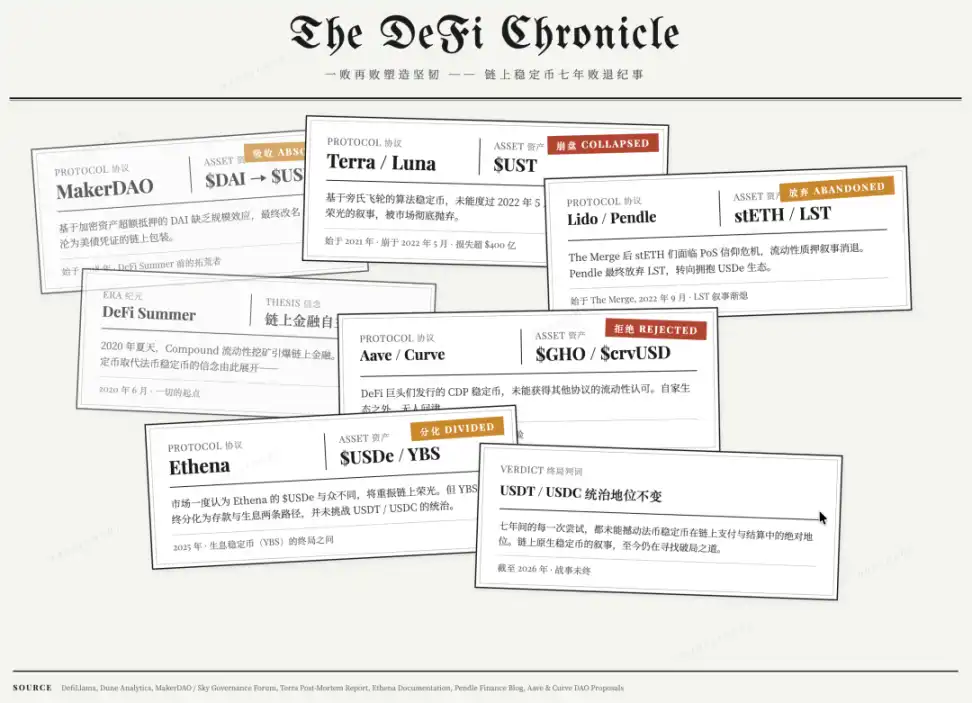
Image Caption: Stablecoin Chronicle

Image Source: @zuoyeweb3

Starting from the DeFi Summer of 2020, repeated failures have forged resilience:

  • Starting in 2018, DAI based on crypto assets lacked scale, and $USDS ultimately became a U.S. Treasury certificate.
  • Starting in 2021, the ponzi-based $UST did not survive the 2022 bank run; the story of rebuilding algorithmic stablecoin glory was abandoned.
  • In 2022, stETH and other LSTs faced a PoS faith crisis post-Merge; Pendle ultimately abandoned LSTs and embraced USDe.
  • In 2023/24, CDP stablecoins issued by DeFi giants like Aave/Curve were not recognized by other protocols.
  • In 2025, the market once believed Ethena's $USDe was different, reviving on-chain glory, but yield-bearing stablecoins ultimately split into deposit and yield activities, failing to challenge the dominance of USDT/USDC in their respective fields.

The facts are clear: It's not that USDT swallowed user profits, but that DeFi chose the scale effect of USDT/USDC.

Trading the Treasury profits generated from $300 billion for the entire market's trading foundation is not a bad deal for DeFi and the crypto market.

But at what cost?

The cost is not the evil of Tether taking profits, as claimed by yield-bearing stablecoin challengers, or the selfishness of banks prohibiting interest-bearing accounts, as accused by Coinbase and Donald Trump Jr.

The bitter pill DeFi has swallowed is that the U.S. Treasury rate is transmitted on-chain via stablecoins, but U.S. Treasuries are assets of the U.S. government, which acts without regard for on-chain sentiments.

This is also the fundamental reason for the bankruptcy of tokenomics. UNI relies on A16Z, A16Z relies on USD financing, the USD is an incarnation of U.S. Treasuries—so UNI is just the fourth derivative reliant on U.S. Treasuries. Why not just buy Treasuries directly, with no middlemen taking a cut?

U.S. Treasuries are the de facto benchmark for DeFi, but DeFi can only passively endure, unable to interact with them bidirectionally. This is the root of all happiness or pain.
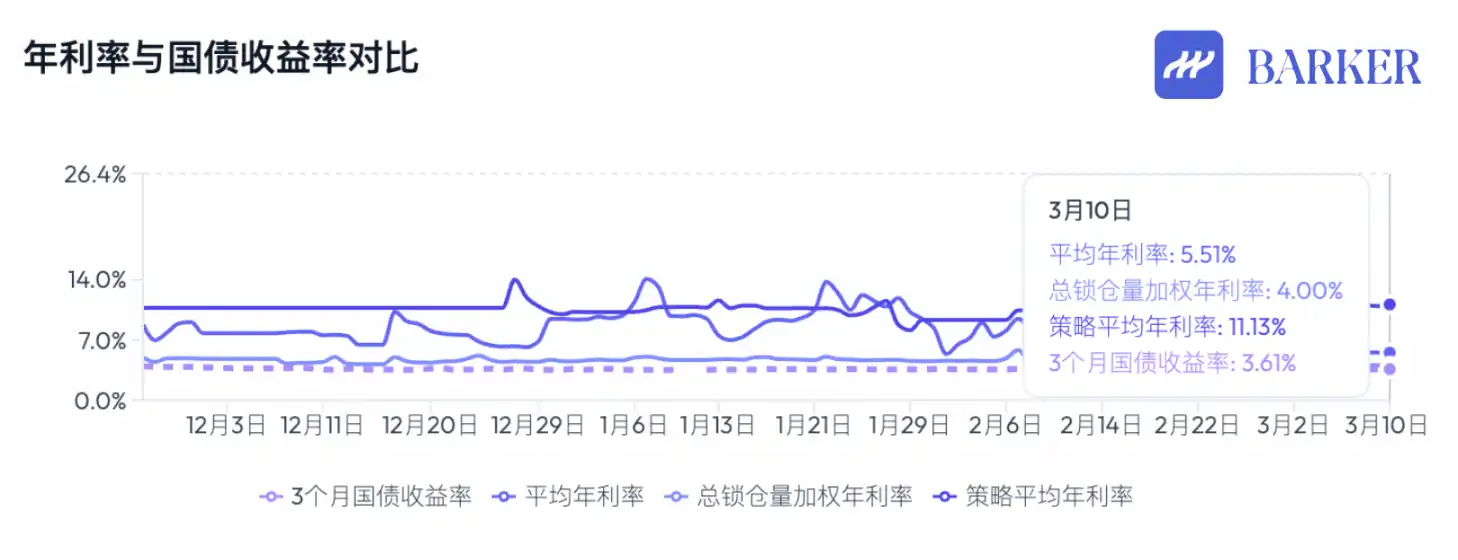
Image Caption: Comparison of On-Chain Stablecoin Yield APY and U.S. Treasury Yields

Image Source: @BarkerMoneyX

The salvation of DeFi never stops. Although tokenomics are bankrupt and DAO governance structures have collapsed, the overall direction of DeFi remains clear:

  1. Fixed-rate investment and financing, a recognized risk grading system, unsecured credit lending –> the main axis of the next stage,蕴含着某种形式的全民化产品 (implying some form of mass-market product);
  2. The expansion period for public chains, exchanges, and DeFi protocols is over. New application forms are evolving into Vaults. It's not yet certain that Vaults are the form of the mass-market product, but this is the starting point of the new stage.

Note here: Public chains and exchanges are no longer the center of value capture, but this does not mean their time is zero. Their period of asset price inflation has ended; only linear, steady growth remains.

This can also connect to the progressive relationship between UNI and U.S. Treasuries. Aave/Morpho are closer to asset management itself; their businesses don't have much narrative space but are indispensable for the industry.

The real star product will definitely be a Vault used by the masses, built on top of public chains and DeFi protocols, based on RWA-diversified assets, and triggering an asset price inflation mechanism.

For mass usage, Curators choose to ally with exchanges. Morpho entered Coinbase via Stakehouse; Aave expanded its C-end users through Metamask and other U-cards.

Based on RWA assets, Curators partner with custodians like Galaxy to constantly maneuver between crypto assets and real-world assets, such as Grove purchasing Galaxy's CLO bonds.

But what's missing is the Vault that triggers the price inflation mechanism. Even before this wave of large-scale asset management moving on-chain, BlackRock's BUILD token was already listed, and Circle's USYC also supports yield, but neither could replicate their own success.

It's not important that Vaults lack their own tokens. Asset price inflation is a mechanism. U.S. stocks, real estate, bonds, tulips, graphics cards, and Mac Minis all have their own price cycles. Current Vaults are just interest-bearing black boxes but have始终 failed to solve two problems:

  1. Where does the high yield actually come from?
  2. How is high risk actually handled?

Towards a New Financial System

The form of the channel is evolving; Vaults are not the endpoint.

The crypto industry evolves extremely fast. Before this year, we never dared to imagine that the global financial system would truly move on-chain, but today it is an undeniable ongoing process.

It's not yet time for a victory banquet. RWA can only serve as a funding source; Vaults are still boring deposit games. Various Curators haven't demonstrated brand效应 (brand effect). Veda-like white-label Vaults are highly similar to SaaS, and the operators (Curators) only earn management fees.

This has no imagination for price inflation. If traditional asset management, with its $2 trillion scale, endures cyclical煎熬 (hardships), it's hard to imagine Vaults being able to withstand it.
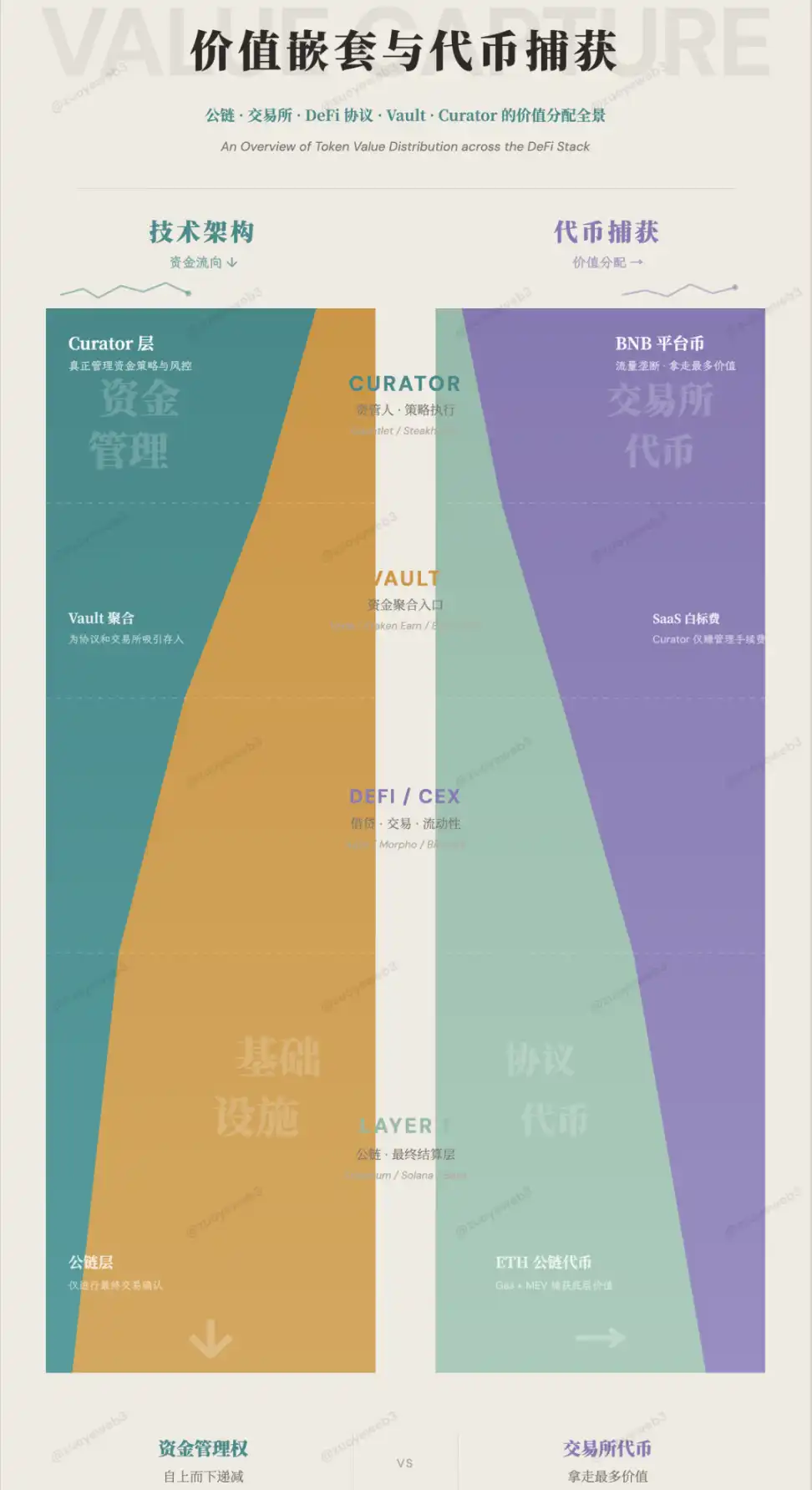
Image Caption: Fund Flows and Value Distribution

Image Source: @zuoyeweb3

Asset management moving on-chain is not driven by短暂情绪 (short-term sentiment). In a sense, it's like the banking industry's IOE—we can't go back to the paper era. Even Spark has begun unifying margin calculations for CEX/DEX positions; DeFi is becoming the next step for TradFi.

Whether Vaults, after absorbing sufficient funds, will trigger the establishment of a risk-free rate is the biggest博弈点 (point of contention) of this cycle.

During the previous DeFi Summer, TVL was the decisive metric. The amount of capital mapped to the get-rich-quick coefficient of tokens, creating mining that延续至 (continued into) airdrop farming, studios, and Binance Alpha. The core logic was "projects need more capital to support token growth."

But with Vaults, for the first time, there is a great demand for deposits but an inability to support their own tokens. Even if Morpho captures more market share from Aave, it cannot trigger a token surge.

Extending this, Hyperliquid compared to Binance, Lighter compared to Hyperliquid—their market size and token prices show a huge inversion. This is a great change unprecedented in DeFi.

On one hand, old infrastructure continues to吸血 (suck blood). For example, after the listing effect disappeared, $BNB should have declined, but CEXs still have a much larger user base than the entire on-chain + DeFi ecosystem. A very ironic fact: exchanges have retail users; DeFi protocols like Aave and Morpho have completely become the domain of a few professionals.

Against this background, the high risk of Vaults & Curators comes from code and structure:

  • Curve's immutable contract programming language could have problems; the xUSD team self-issued tokens.
  • Aave ended the superficial harmony between the DAO and the development team; Re7 severely damaged the credibility of on-chain asset management.

Against this background, where does the high yield of Vaults & Curators come from?

I know it's not regulatory arbitrage, HLP fees, or token incentives, but many still cling to these three, believing that traditional finance's compliance creates too-big-to-fail credibility.

They completely forget that tokenomics are already bankrupt, while Vault deposits have been growing. Sky is already deeply integrated into the Morpho system, and the future of Aave V4 is also institutionalization and modularization.

Moreover, this article has consistently emphasized that the capital scale of Vaults has not triggered some price inflation mechanism. This is the structural dilemma of Vaults.

The yield of Vaults essentially comes from the trading efficiency of global markets. If CEXs don't offer a certain Vault, then move on-chain to configure it. Personified Curators happen to be suitable for dealing with all sorts of people.

TradFi's global markets, even like U.S. stocks, face lengthy account opening, trading times, and process limitations. Can we really say that the gradual move towards 24/7 trading for U.S. stocks and DTCC going on-chain is also for arbitrage?

The final question: What mechanism can actually trigger asset price inflation, allowing the capital沉淀 (sedimented) in Vaults to create a price-to-dream ratio legend?

In other words, what is missing between Vaults and asset price inflation?

Channels are missing. Channels for funds to couple with each other. The personification of Curators hinders the programmability of DeFi Legos.

Currently, CEXs serve as a placeholder—still the quickest place for funds to intertwine.

Referring to the evolution of Perp DEXs, they are capturing market share from CEX futures. RWA funding sources are also抢夺 (snatching) market share from CEXs.

CEXs only have存量 (existing stock); they can't even solve their own user acquisition problems, let alone help Vaults expand to hundreds of millions of users. Vaults started by white-labeling, but in the future, they must build their own超级工厂 (gigafactories).

I speculate the channel will be some form of Broker product.

Under a high degree of social division of labor, Super Apps like exchanges that integrate deposit/withdrawal, trading, custody, and清算 (clearing) will gradually separate their businesses. Binance's compliance framework in Abu Dhabi's ADGM is already divided into three parts.

This will fundamentally facilitate the professionalism of fund handling while utilizing blockchain's unified ledger system, and it will require the coordination of Vaults & Curators.

Referencing Neobrokers like Robinhood/Trade Republic, they attract younger, retail-oriented users to participate in professional trading, then build asset management, wealth management, and other business forms. The model of stablecoins at the front end and Curator-managed Vaults is more efficient.

In summary, Binance monopolizes the capital flow, and BNB gets the strongest赋能 (empowerment). Next, Brokers handle fund interaction. Some asset form, or even纯粹的业务流 (pure business flow), could be extremely profitable. After all, Robinhood is just a fancy front for profitable market makers.

Conclusion

Compared to code and trading, regulation and tokens appear more stable.

Private credit and RWA cycles have halted. The rush to issue Document No. 402 feels prophetic. DeFi can serve as a liquidity exit channel, but it lacks the mechanism for asset price inflation.

Asset Management ≈ Aave/Morpho. They will slowly, like public chains, complete their historical task. They will exist long-term but only with scale growth and stable token prices.

Vaults & Curators ≈ Star fund managers. They are rapidly acquiring customers and monopolizing markets. Giantization already shows preliminary signs. Whether they can continuously capture value is highly doubtful.

Channels ≈ CEX (temporary). Ironically, they have the most room for innovation. Facilitating the freedom of funds will always receive the highest reward.

A highly efficient global market is operating on a traditional token-less public chain. This is the proposition of the next era, and everyone must provide an answer.

Связанные с этим вопросы

QWhy hasn't DeFi established a risk-free interest rate yet?

ADeFi has not established a risk-free interest rate because it has chosen the scale and liquidity of USDT/USDC over creating its own native benchmark. The U.S. Treasury bond, which acts as the de facto benchmark, is a one-way street; its policies are set by the U.S. government without consideration for the on-chain ecosystem, making DeFi a passive recipient rather than an active participant in setting this rate.

QWhat is the fundamental problem with the current token economics model in DeFi according to the article?

AThe fundamental problem is that token economics has 'bankrupted.' The value of tokens like UNI is derived through multiple layers of dependency (e.g., UNI -> A16Z -> USD -> U.S. Treasuries), making them an inefficient proxy compared to holding the underlying asset (U.S. Treasuries) directly, with no intermediaries.

QWhat new application form is emerging as the focus of the next stage in DeFi, replacing protocols and exchanges?

AThe new application form emerging is the Vault (or金库). While public chains and exchanges will continue to exist with linear growth, Vaults are seen as the starting point for the next stage, potentially forming the basis for mass-market products built on top of existing infrastructure.

QWhat are the two core unresolved problems facing Vaults that prevent an asset price inflation mechanism?

AThe two core unresolved problems are: 1) The unclear source of high yields, and 2) The lack of a defined process for handling high risks. Vaults currently function as 'boring deposit games' or 'interest-bearing black boxes' without a mechanism to drive significant price appreciation.

QWhat does the article propose as the potential future 'channel' that could replace CEXs for efficient global market access and value capture?

AThe article proposes that a 'Broker' product形态 (product form), similar to neobrokers like Robinhood, could become the essential channel. This would involve a专业化分业经营 (professionalized separate operation) of functions currently bundled in CEXs (like deposits, trading, custody), using blockchain's unified ledger and managed by Vaults & Curators for greater efficiency and freedom of capital movement.

Похожее

Has Hook Summer Truly Arrived? sato, Lo0p, FLOOD Ignite the New Uniswap v4 Narrative

With the broader market showing signs of recovery, a new wave of interest has emerged around Ethereum-based meme coins. Following ASTEROID, tokens like sato, sat1, Lo0p, and FLOOD, built upon the Uniswap v4 Hook protocol, are capturing market attention. Their market capitalizations range from millions to tens of millions of dollars, injecting much-needed focused liquidity into a market lacking narratives. This article explores whether this trend signifies an incoming "Hook Summer" and its potential impact on UNI's price. Hooks are essentially plug-in smart contracts for Uniswap v4 liquidity pools, allowing developers to inject custom logic at key points in a pool's lifecycle (like initialization, adding/removing liquidity, swaps). This transforms the AMM into programmable building blocks. Key highlighted projects include: * **sato**: Peaked over $38M market cap. It utilizes a v4 curve for minting/burning; buying locks ETH as reserve to mint new tokens, while selling redeems ETH from the reserve and burns tokens. * **sat1**: Market cap briefly exceeded $10M, promoted as an "optimized sato," but later declined significantly. * **Lo0p**: Reached nearly $6.6M. It's a lending AMM protocol where buying LO0P tokens locks them as collateral, allowing users to borrow ETH from the pool reserve at 40% LTV, aiming to improve capital efficiency for idle ETH in LPs. * **FLOOD**: Peaked near $6M. Its mechanism directs asset reserves from buys into Aave v3 to generate yield, with fees and interest retained in the pool to potentially influence the token's price long-term. In the long term, the development of the Hook ecosystem can attract users and liquidity to Uniswap v4, benefiting UNI's fundamentals—especially combined with the recent activation of the protocol fee switch, where a portion of fees is used to burn UNI. However, in the short term, these Hook-based tokens are unlikely to directly drive significant UNI price appreciation. Their impact is moderated by factors like token sustainability, price volatility, and broader market and regulatory conditions. Currently, Uniswap v4's TVL ($595M) still trails behind v2 and v3, indicating adoption and growth will take time. The article concludes that while the Hook ecosystem provides long-term "nourishment" for UNI, its short-term role is more of a "catalyst" than a "booster." Readers are cautioned that these are early-stage experimental tokens and may carry unknown risks.

Odaily星球日报7 мин. назад

Has Hook Summer Truly Arrived? sato, Lo0p, FLOOD Ignite the New Uniswap v4 Narrative

Odaily星球日报7 мин. назад

Interview with Michael Saylor: I Did Say I Would Sell Bitcoin, But Never a Net Sale

Interview with Michael Saylor: I Said We'd Sell Bitcoin, But Never Be a Net Seller In a recent podcast, MicroStrategy Executive Chairman Michael Saylor clarified the company's stance on potentially selling Bitcoin. Following MicroStrategy's earnings call statement about being prepared to sell BTC to fund dividends for its STRC (Strategic) credit product, Saylor emphasized the distinction between selling and being a "net seller." Saylor explained the core business model: MicroStrategy sells credit instruments like STRC and uses the proceeds to buy Bitcoin, which is viewed as "digital capital" expected to appreciate around 30-40% annually. A portion of these capital gains can then be used to pay the dividends on the credit products. He stressed that even if the company sells some Bitcoin for dividends, it simultaneously buys much more with new credit issuance. For example, after raising $3.2 billion from STRC sales in April, the dividend obligation was only $80-90 million, making the company a net buyer. The clarification aims to counter market narratives questioning the value of Bitcoin on MicroStrategy's balance sheet if it were never sold, and to dismiss claims of a "Ponzi scheme." Saylor reiterated his personal philosophy for investors: "Don't be a net seller of bitcoin" and ensure your Bitcoin holdings increase each year. Saylor also discussed Bitcoin's role as the foundation for "digital credit," noting that STRC has become the largest and most liquid preferred stock issue in the U.S., offering high risk-adjusted returns (Sharpe ratio). He highlighted Bitcoin's deep liquidity, stating that even large purchases by MicroStrategy do not move the market significantly, which is driven by macro factors, geopolitical tensions, and capital flows from ETFs and credit products. Finally, Saylor reflected on his early inspiration from sci-fi books, which motivated his path to MIT, and maintained his fundamental thesis on Bitcoin remains unchanged: it is superior digital capital enabling superior digital credit.

链捕手11 мин. назад

Interview with Michael Saylor: I Did Say I Would Sell Bitcoin, But Never a Net Sale

链捕手11 мин. назад

Beaten SK Hynix Employees in China: Year-end Bonus Less Than 5% of Korean Staff's

"SK Hynix Chinese Staff Hit Hard: Bonuses Less Than 5% of Korean Counterparts" Driven by the AI boom, South Korea's SK Hynix is experiencing record performance, with media reports predicting massive year-end bonuses for its employees, making them highly desirable in the matchmaking market. However, this prosperity starkly contrasts with the situation for the company's Chinese employees. According to reports, SK Hynix operates under a rule allocating 10% of operating profit for employee bonuses. While projections suggest Korean employees could receive bonuses reaching millions of RMB, a Chinese employee with over a decade of technical experience revealed the disparity: "If they get 3 million, Chinese staff get less than 5% of that." After adjustments based on KPI ratings, this employee's highest bonus was slightly over 100,000 RMB. Bonuses are paid annually in Korea but semi-annually in China. During the industry downturn in 2023-2024, Chinese employees received no bonus at all. The gap extends beyond bonuses. Recruitment posts for SK Hynix's Chinese factories (in Wuxi, Dalian, Chongqing) show engineer monthly salaries ranging from 10,000 to 35,000 RMB, with a 13th-month salary promised. Chinese employees also receive standard benefits like annual leave but lack stock incentives, which are reportedly unavailable to them. Furthermore, management positions in China are predominantly held by Korean personnel, though industry observers note a gradual increase in local middle managers over time. SK Hynix has confirmed the 10% bonus rule but cautioned that specific future bonus amounts remain unpredictable. The company forecasts strong demand for HBM and other high-value enterprise products for the next 2-3 years, driven by AI infrastructure investment. This focus on business-to-business markets may continue to constrain supply for consumer products, potentially prolonging price increases for components like memory.

链捕手24 мин. назад

Beaten SK Hynix Employees in China: Year-end Bonus Less Than 5% of Korean Staff's

链捕手24 мин. назад

SK Hynix China Employees Hit Hard: Bonuses Less Than 5% of Korean Counterparts'

"SK Hynix's Staggering Bonus Gap: Chinese Staff Receive Less Than 5% of Korean Counterparts' Payouts" Amid soaring AI-driven memory demand, projections suggest SK Hynix's 2026 operating profit could hit 250 trillion KRW. Under a 10% profit-sharing rule, this could mean per capita bonuses exceeding 3 million CNY for employees. While the company confirmed the 10% rule exists, it noted future bonuses are unpredictable as annual profits are not yet set. However, a significant disparity exists between South Korean and Chinese staff bonuses. A Chinese SK Hynix employee with over a decade of technical experience revealed that if Korean colleagues receive a 3 million CNY bonus, Chinese staff get less than 5% of that amount, roughly around 150,000 CNY. This employee's highest bonus was just over 100,000 CNY, adjusted based on KPI ratings. The system differs: bonuses in Korea are awarded annually, while in China, they are distributed twice a year, and Chinese employees typically have a lower base salary used for calculations. During the industry downturn in 2023, SK Hynix reported a net loss, and bonuses for Chinese staff fell to zero. Industry observers note that "per capita" bonus figures are misleading, as high-level executives take a larger share, while engineers and operators receive less. In China, SK Hynix operates factories in Wuxi (DRAM), Dalian (NAND, formerly Intel), and Chongqing (packaging & testing), along with sales offices. Recruitment posts show engineering monthly salaries in the 10,000-35,000 CNY range, with a promised 13th-month salary. Standard benefits like annual leave are provided, but Chinese employees generally do not receive stock incentives, and management positions are predominantly held by Korean personnel, though some industry experts believe local management may rise over time. Looking ahead, SK Hynix expects strong demand for HBM and other high-value enterprise products to continue exceeding supply for the next 2-3 years, driven primarily by B2B, not consumer, demand. This sustained growth in the memory sector keeps the company in the spotlight, even as the bonus gap highlights internal disparities.

marsbit45 мин. назад

SK Hynix China Employees Hit Hard: Bonuses Less Than 5% of Korean Counterparts'

marsbit45 мин. назад

Торговля

Спот
Фьючерсы
活动图片