The Hidden War Behind Stablecoins: Issuers, Applications, and Users—Who Will Be the 'Biggest Winner'?

marsbitОпубликовано 2026-02-17Обновлено 2026-02-17

Введение

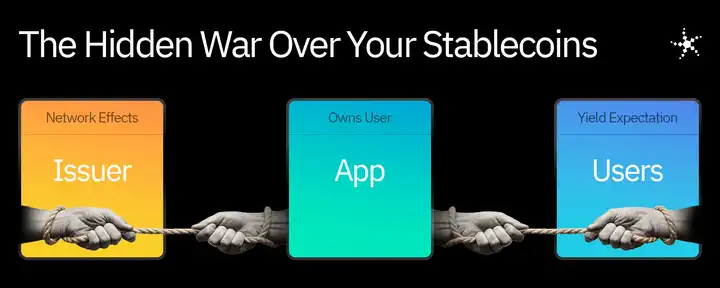
The article explores the intense competition among stablecoin issuers, applications, and users over the lucrative profits generated by stablecoins. Issuers like Tether and Circle earn significant risk-free returns by investing user funds in cash equivalents, creating a highly profitable business model. However, applications (wallets, exchanges, DeFi protocols) that control user relationships demand a share of these profits, leveraging their distribution power to negotiate revenue-sharing agreements or even launch their own branded stablecoins (e.g., Aave’s GHO or PayPal’s PYUSD via white-label services). Users, especially in developed markets, increasingly expect yield on their stablecoin holdings, pressuring applications to offer returns. This dynamic creates a three-way tug-of-war, with applications caught between profit-retentive issuers and yield-seeking users. The author suggests that users may ultimately benefit the most from this competition, gaining a larger share of the profits as the ecosystem evolves.

Author: Jonah Burian, Investor at Blockchain Capital

Compiled by: Felix, PANews

Summary: In this three-party game, users may ultimately be the beneficiaries and receive the majority of the profits.

In recent years, as stablecoin issuers have generated massive annual profits, the battle for benefits among issuers, application layers, and users has intensified. An investor from Blockchain Capital reveals the profit distribution mechanisms and evolving business logic of stablecoins. Below are the details.

Stablecoin issuers possess one of the most profitable business models on Earth, and these substantial profits have made them a target for various stakeholders. At Blockchain Capital, we have closely observed the three-way tug-of-war among issuers, application layers, and users as they compete for these profits.

We have invested in several major issuers (such as Tether, Circle, and Paxos) and also in applications trying to claim their share (such as Aave, Phantom, Polymarket, and RedotPay). Here are our observations.

Issuers Reap Significant Profits

Users send fiat currency to issuers, who then mint digital dollars on the blockchain. Behind the scenes, issuers invest this fiat in cash or cash equivalents, earning a risk-free interest rate. That’s the entire business. In contrast, banks take your deposits but must lend them out, manage credit risk, and maintain branches; insurers collect premiums but ultimately must pay claims. Stablecoin issuers essentially hold government bonds, generating cash flow without complexity or risk.

Issuer revenue grows with the increase in assets under management, while operational costs remain largely unchanged: this is a pure, unconstrained cash flow machine. Tether reports a team size of about 300 people and expects to achieve $10 billion in profits by 2025. This is arguably one of the best business models in history.

However, massive profits inevitably attract competition.

Applications Also Want a Share

Most users never interact directly with issuers; they access stablecoins through applications like Phantom, which control the user relationship.

Large exchanges, DeFi protocols, and well-known wallets have significant bargaining power over issuers. They can designate default stablecoins and integrate or deprecate them through single product decisions, exerting some control over fund flows. If tens of billions of dollars in stablecoins remain within an application, that app can demand a share of the float interest. The logic is simple: we are distributing your assets and anchoring user behavior, so you must share the profits, or we will steer users toward competing stablecoins.

This is already happening. The most typical example is the relationship between Coinbase and Circle. Early on, Coinbase was the primary distribution engine for USDC and negotiated a profit-sharing agreement. It is reported that Coinbase receives 100% of the interest income generated by USDC on its platform and 50% of the interest income from USDC outside the platform. Whether within or outside the portfolio, applications are increasingly adopting this strategy, actively negotiating for their share.

Creating Branded Stablecoins: Bypassing Issuers

Applications can also attempt to launch their own branded stablecoins or "wrappers," completely bypassing issuers. Instead of directly steering users to USDC or USDT, they offer a dollar balance backed by a combination of stablecoins and short-term notes. In this case, the distributor is partially involved in the issuance business. Aave’s GHO stablecoin is one such example.

However, applications often lack the resources or licenses required to build a full issuance infrastructure. Therefore, they opt for white-label solutions like "Issuer-as-a-Service." Paxos is currently the leading white-label provider, supporting PayPal’s PYUSD. This allows PayPal to profit from the float interest without negotiating with large issuer.

Issuer Leverage

Applications cannot fully control issuers. Established stablecoins like USDC and USDT have strong network effects. They are the reserve assets of the entire DeFi ecosystem and the base trading pairs for most transactions. Branded stablecoins may be less attractive to users due to lower liquidity and integration compared to other stablecoins.

Additionally, white-label stablecoins are not as "neutral" as USDT. A company competing with PayPal at the application layer may be reluctant to accept PYUSD, as doing so would fund a competitor. Similarly, this dynamic may have affected Circle’s early development, as exchanges like Binance may have been hesitant to fully promote USDC due to its close ties with rival Coinbase, which is why Binance instead defaulted to supporting USDT. Today, USDT trading volume on Binance is about five times that of USDC.

User Demand for Floating Returns

In developed markets, user expectations for returns put pressure on issuers and applications. When the risk-free interest rate is around 4%, users in the U.S. naturally ask why their digital dollars aren’t earning any yield. When one wallet offers returns and a competitor doesn’t, users flock to the former.

If this expectation becomes the norm, the application layer faces a dilemma. To remain competitive, we expect applications may have to return some of the profits to users, forcing them to negotiate more aggressively with issuers. If an application cannot secure a share, it will struggle to pay interest to users without incurring losses. As more products promote "stablecoin balance returns," the model where "all profits remain with the underlying issuer" will be difficult to sustain.
However, this pressure is not universal. In many overseas markets, the core value of dollar stablecoins lies in hedging against local inflation and foreign exchange controls, rather than pursuing returns. A user struggling to prevent their assets from halving in value each year may not care much about earning 4% interest. For global issuers with high penetration in these regions, user demand for returns is not as urgent as in the U.S. market. We believe this dynamic may benefit Tether, which has the largest overseas user base.

Conclusion

In summary, user expectations and issuer profits have placed applications in a difficult position. They are caught between users who expect returns and issuers who want to retain profits. The stablecoin architecture is evolving rapidly, and the distribution of profits is still being contested. My guess is: users may ultimately be the beneficiaries of this game and receive the majority of the profits.

Related reading: A Guide to Stablecoin Returns: Which of the 8 Types Is Best?

Связанные с этим вопросы

QWhat is the core business model of stablecoin issuers and why is it considered highly profitable?

AStablecoin issuers accept fiat currency from users and mint digital dollars on the blockchain. They invest this fiat in cash or cash equivalents, earning a risk-free interest rate. This model is highly profitable because their revenue scales with the growth of assets under management, while operational costs remain largely fixed, creating a powerful cash flow machine with minimal complexity or risk.

QHow do applications (like exchanges and wallets) attempt to capture a share of the profits from stablecoins?

AApplications, which control the user relationship, use their significant bargaining power to demand a share of the float income from issuers. They can dictate the default stablecoin and influence capital flows. Their logic is that they are distributing the issuer's assets and anchoring user behavior, so they deserve a share of the profits, or they will steer users to a competitor's stablecoin.

QWhat are two strategies applications might use to bypass traditional stablecoin issuers?

AApplications can either 1) launch their own branded stablecoin or 'wrappers' backed by a combination of stablecoins and short-term notes, or 2) use a white-label 'Issuer-as-a-Service' solution from a provider like Paxos, which allows them to profit from the float without negotiating with a major issuer.

QWhat leverage do major stablecoin issuers like USDT and USDC have over applications?

AMajor stablecoins like USDT and USDC have strong network effects; they are the reserve assets for the entire DeFi ecosystem and the base trading pairs for most transactions. Their brand recognition and liquidity are superior. Furthermore, a branded stablecoin from a competitor's application may not be seen as 'neutral' and could be rejected, as it would fund a rival.

QWhy does the author speculate that users might be the ultimate beneficiaries of the stablecoin profit struggle?

AThe author speculates that user expectations for yield, particularly in developed markets, will put pressure on applications. To remain competitive, applications will be forced to pass a portion of the earnings back to users. This dynamic, driven by competition for users, could ultimately result in users capturing the majority of the收益 (yield).

Похожее

Лицензия Ripple по MiCA открывает более широкий платежный коридор в Европе

Ripple получила полное разрешение в рамках законодательства MiCA (Markets in Crypto-Assets) в Европе. Это разрешение предоставляет компании чёткий нормативный путь для расширения услуг криптоплатежей на рынках ЕС и Европейской экономической зоны. Авторизация касается платежного подразделения Ripple и позволяет осуществлять деятельность в соответствии с общеевропейскими правилами. Важно отметить, что это не является общим нормативным одобрением торговли токеном XRP, а именно этапом лицензирования бизнес-операций Ripple в рамках MiCA. Для XRP это событие значимо, поскольку успешная платежная деятельность Ripple в Европе может укрепить позиции компании при работе с банками и финансовыми институтами, что в долгосрочной перспективе способствует полезности токена. Однако разрешение само по себе не гарантирует рост спроса на XRP, а лишь снижает регуляторную неопределённость. В более широком контексте, получение разрешения MiCA ставит Ripple в выгодное положение в условиях, когда криптокомпании стремятся закрепиться в Европе, обладающей более чёткими правилами, чем США. Ключевым испытанием теперь станет реальное внедрение: заключение новых партнёрств и увеличение объёмов платежей на основе этого нормативного статуса.

bitcoinist5 мин. назад

Лицензия Ripple по MiCA открывает более широкий платежный коридор в Европе

bitcoinist5 мин. назад

Chainlink CCIP участвует в пилотных проектах цифровых активов центробанков

Кросс-чейновый протокол взаимодействия Chainlink CCIP используется в пилотных проектах по цифровым активам центральных банков и токенизированным расчетам. Это включает эксперименты в рамках бразильской инициативы Drex, гонконгской сети Ensemble и программы e-HKD+ с участием A$DC от ANZ Bank. Хотя проекты находятся на стадии испытаний и не являются коммерческими системами, они демонстрируют, как регулируемые институты тестируют публичную блокчейн-инфраструктуру для будущих систем расчетов. Основная тема — обеспечение совместимости (интероперабельности) между различными сетями, что необходимо для кросс-граничной торговли, CBDC, стейблкоинов и токенизированных активов. CCIP позиционируется как защищенный уровень для обмена сообщениями и расчетов между цепочками. Для Chainlink участие в таких пилотах усиливает ее институциональный статус и акцент на надежности, хотя до полномасштабного внедрения еще далеко. Это отражает общий тренд рынка на переход от простой эмиссии активов к созданию программируемой финансовой инфраструктуры с акцентом на кросс-чейновые расчеты.

bitcoinist20 мин. назад

Chainlink CCIP участвует в пилотных проектах цифровых активов центробанков

bitcoinist20 мин. назад

Исправления в XRP Ledger приближаются к сроку голосования валидаторов

Сеть XRP Ledger приближается к ключевому периоду голосования валидаторов по предложенным поправкам к протоколу. Этот процесс подчеркивает, как обновления XRPL проходят через систему сетевого управления, а не активируются автоматически с выходом нового кода. Для активации любых изменений требуется поддержка не менее 80% валидаторов, которая должна сохраняться в течение определенного периода. Такой подход обеспечивает взвешенный путь обновления, снижая риск поспешного внедрения спорных функций и уделяя приоритетное внимание стабильности сети, ориентированной на платежи. Решение валидаторов важно, поскольку протокольные обновления могут повлиять на такие функции, как платежи, выпуск активов, децентрализованный обмен и возможности смарт-контрактов. Однако голосование — это лишь этап. Даже одобренные поправки должны быть реализованы разработчиками и востребованы пользователями, чтобы оказать реальное влияние на полезность сети. Текущее окно голосования представляет собой контрольную точку в управлении XRPL, демонстрирующую готовность сообщества к следующим шагам в развитии протокола, но не гарантирует немедленной активации изменений.

bitcoinist35 мин. назад

Исправления в XRP Ledger приближаются к сроку голосования валидаторов

bitcoinist35 мин. назад

Рыночная капитализация стейблкоинов Solana достигает 15 млрд долларов по мере углубления ликвидности сети

Рыночная капитализация стейблкоинов в сети Solana превысила $15 млрд, что свидетельствует об углублении ликвидности на блокчейне. Этот показатель, основанный на данных DeFiLlama, отражает рост реальной полезности сети, выходящей за рамки чисто спекулятивной активности, связанной с мем-коинами. Стейблкоины играют ключевую роль: они обеспечивают доступ к доллару, поддерживают торговые пары, рынки кредитования и упрощают платежи, выступая в качестве «рабочего капитала» для децентрализованных финансов (DeFi) и расчетов. Достижение отметки в $15 млрд укрепляет позиции Solana как серьезной среды для расчетов, усиливая ее конкурентные преимущества — высокую скорость и низкую стоимость транзакций. Хотя доминирующими активами остаются USDT и USDC, экосистема Solana становится более разнообразной. Основная задача для сети теперь — не просто наращивание объема, а активация этой ликвидности через увеличение торговых объемов, спроса на кредитование и реальных платежных потоков. Устойчивость ликвидности в периоды волатильности будет ключевым фактором для долгосрочного успеха Solana в сфере DeFi и платежей.

bitcoinist49 мин. назад

Рыночная капитализация стейблкоинов Solana достигает 15 млрд долларов по мере углубления ликвидности сети

bitcoinist49 мин. назад

Аster уже запустил 112 рынков RWA, так почему же ASTER всё ещё стоит на месте?

В первой половине 2026 года платформа Aster продемонстрировала значительный рост: запустила собственный блокчейн L1, ввела стейкинг, расширилась на 112 рынков токенизированных реальных активов (RWA) и привлекла строителей через Aster Code, генерируя объем в $12 миллиардов. Ключевое изменение для нативного токена ASTER произошло в июне — теперь 99% ежедневных комиссий платформы используются для выкупа и сжигания токенов, что теоретически может со временем вывести из обращения 5 миллиардов ASTER. Несмотря на эти фундаментальные улучшения и дорожную карту, включающую Aster Vault, Aster Card и расширение предложений TradFi, цена ASTER остается в боковом тренде около $0.626. Технические индикаторы, такие как RSI, показывают нейтралитет, а объем баланса (OBV) недостаточен для уверенного пробоя. Открытый интерес в деривативах снизился до примерно $149 миллионов, что указывает на осторожность трейдеров. Рынок, по-видимому, ждет более убедительных доказательств того, что новые инициативы приведут к реальному росту активности, увеличению комиссий и, как следствие, устойчивому спросу на токен ASTER.

ambcrypto1 ч. назад

Аster уже запустил 112 рынков RWA, так почему же ASTER всё ещё стоит на месте?

ambcrypto1 ч. назад

Торговля

Спот
活动图片