The Governance Struggle Behind the Power Play of Aave DAO and Aave Labs

marsbitОпубликовано 2025-12-15Обновлено 2025-12-15

Введение

The article details a governance conflict between Aave DAO and Aave Labs, centering on a dispute over revenue generated by the frontend. The controversy began when Aave Labs replaced the integrated ParaSwap with CoW Swap on its frontend and directed the resulting fees to its private address, rather than to the DAO treasury. An anonymous DAO member, EzR3aL, publicly criticized this move, accusing Labs of privatizing protocol value. Aave DAO represents the protocol layer, governed by $AAVE token holders who vote on proposals. Aave Labs is the development team responsible for building and maintaining the frontend, brand, and product partnerships. The core issue is whether Aave is a decentralized protocol owned by the DAO or a project built and controlled by Labs, and how this distinction affects revenue rights. DAO supporters argue that all value generated should benefit token holders, while Labs contends that frontend-related income rightfully belongs to them. The situation highlights a broader industry-wide governance dilemma: the tension between decentralized community control and the need for a centralized, efficient team to drive development and maintain market position. The article suggests that a potential compromise, such as transparent revenue-sharing agreements, may be necessary. It concludes that how Aave resolves this conflict could set a precedent for other DeFi projects facing similar governance challenges.

Author: Chen Mo cmDeFi

The recent heated dispute between Aave DAO and Aave Labs over governance power at the protocol and product layers reflects the broader governance challenges across the industry. Here’s a breakdown of the issue. Who truly owns Aave?

1/6 · The Origin

Aave Labs replaced the frontend integration of ParaSwap with CoW Swap, and the resulting fees were directed to a private address of Labs. An anonymous DAO member, EzR3aL, exposed this on the governance forum, accusing Labs of "privatizing" protocol value. Labs' stance is that this belongs to frontend and product layer revenue, which rightfully belongs to Labs, and is unrelated to the protocol core.

2/6 · First, Let's Break Down Who Aave DAO and Aave Labs Are

  • DAO represents the Protocol (protocol layer)
  • Labs represents the Project (product layer)

The core dispute is whether Aave is a Protocol (managed by the DAO) or a Project (built by Labs)? And the implications for revenue rights.

Aave DAO is straightforward to understand. It is a unique type of governance organization in the Crypto world, composed of $AAVE token holders who exercise power through voting within the DAO. Almost 90%+ of crypto projects follow this structure; the term "governance token" originates from this. Its primary power is to vote on project proposals, deciding whether to implement certain updates and developments, as well as the future direction of the project.

Aave Labs is a development team responsible for building, updating, and maintaining the protocol (e.g., frontend interfaces, mobile apps). Typically, they also maintain the Aave brand and IP, so on social media and in the market, Aave Labs is often defaulted to being Aave. Its founders are also quite influential on social media.

Generally, Aave Labs and Aave DAO need to collaborate. For instance, Labs leads the development of many plans, optimizations of certain features, and even version upgrades like V3 and V4. These proposals are led by Aave Labs but ultimately decided by DAO vote. Usually, when their interests align, they have a mutually supportive relationship, together forming Aave.

3/6 · What Core Resources Do They Respectively Control?

Once conflicts of interest emerge, these two roles can be separated, as they are inherently independent entities. Let’s look at the core resources and power each holds:

Aave DAO controls the underlying core. For example, the smart contracts; treasury control is in the hands of the DAO. Although Labs can propose development plans, they require a DAO vote to be implemented. So it is the Protocol; the upper layer can be any product that operates. Theoretically, multiple frontend products can be built on top of one Protocol—Aave, Bave, Cave, etc.

Aave Labs controls the frontend, brand, product marketing, and partnerships. So it interacts directly with users and represents a quality product.

Therefore, supporters of Labs generally believe that the CoW Swap integration is purely a frontend behavior, unrelated to Aave's underlying architecture. Labs could even unilaterally decide not to integrate it, so any revenue generated should naturally belong to Labs. Conversely, DAO supporters view this as a form of appropriation because, with the existence of the AAVE governance token, all benefits should优先 flow to AAVE holders or remain in the treasury for the DAO to decide. Additionally, previously, ParaSwap revenue consistently flowed into the DAO. The new CoW Swap integration changed this status, further leading the DAO to see this as a grab.

Both sides have their arguments.

4/6 · Governance Dilemma

This highlights a rather awkward governance and power dilemma. From the perspective of $AAVE holders, they typically side with the DAO, because revenue entering the treasury benefits token holders. Although Labs has corresponding annual expenses, these can be reimbursed through the DAO. If a separate channel for profit can be opened, it seems community power is gradually being eroded.

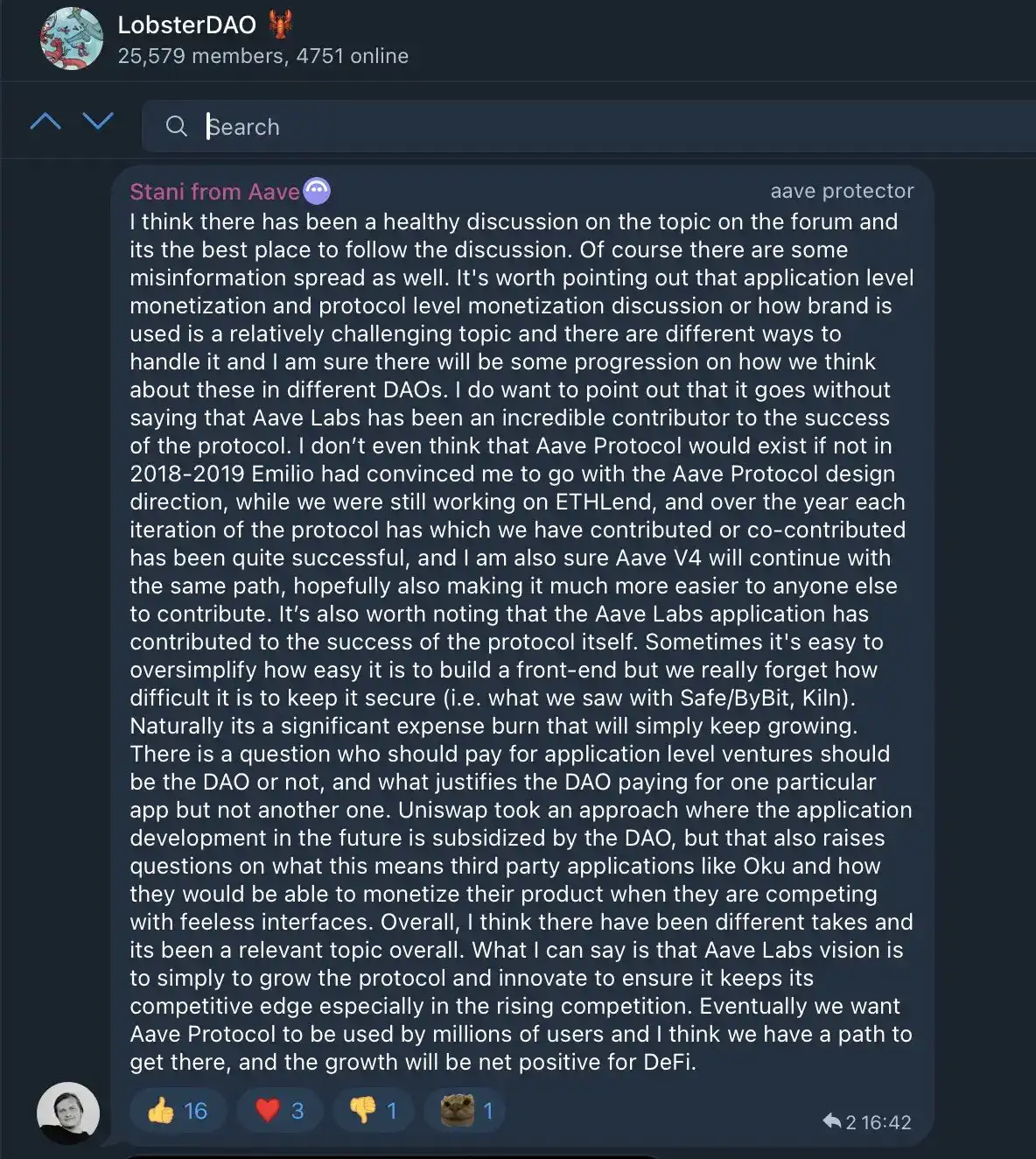
But from Aave Labs' perspective, although the theoretical core control lies with the DAO, and proposals ultimately require a vote to be implemented, from the first version of Aave to now, Labs has played a role in unifying and leading the overall situation, making huge contributions to the project's growth. As Stani said, "If it weren't for Emilio convincing me to adopt the Aave protocol design direction back in 2018-2019, when we were still working on ETHLend, I think the Aave protocol might not have existed at all."

Who is the true owner of Aave?
5/6 · Power Struggle

This governance dilemma exists in most projects. Governance tokens are bought with real money. Ideally, these holders collectively decide the project's future. When the team no longer holds voting power, they could even forcibly replace Labs.

But the reality is far from ideal. Even for projects with a certain market share, when internal team problems and disputes arise, the aftermath often leads to a loss of market position. Sushi is a good example. The DAO can exercise power, and the project can change hands. Although, thanks to smart contract design, even if a project undergoes a major reshuffle, the product functionality can remain perfectly stable. However, judging from past cases, the outcome of splits is usually not good.

The core issue here is that, for now, a DAO is a decentralized organization by nature. Although it has voting power, it struggles to operate efficiently. The community may include independent developers, VCs, and large holders. Once each role begins to exercise its power fully, a proposal can undergo multiple rounds of formulation, modification, and博弈 from the start. The success of a project requires a professional team and continuity. A DAO can hire a new team, but it may be difficult to quickly transition and iterate, easily losing market position. Therefore, the existence of Labs, on the surface,更像 the entity that can "control" the protocol (in collaboration with the DAO).

Personally, I lean towards the two parties eventually reaching a solution to balance the distribution of interests. But currently, everything is under discussion, and no governance vote has appeared. The potential risk behind this is that even if a reconciliation is ultimately reached, this incident has already exposed a divergence in expectations between the founding team and token holders.

Long-term, I remain optimistic about Aave's development because it is one of the few DeFi projects that has been market-verified with a strong moat. The矛盾 of governance power is a problem the entire industry needs to face. How Aave handles this incident may become a benchmark case for the industry in the future.

6/6 · Voices and Discussion

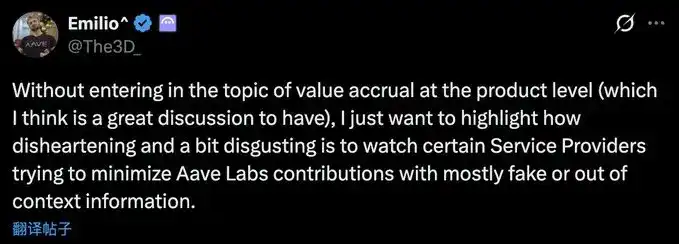
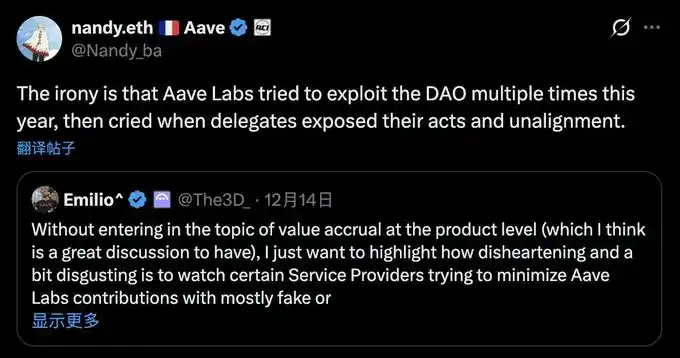
Arguments. Emilio believes someone is maliciously贬低 the contributions and value of Aave Labs. ACI team members pointed out that Aave Labs has repeatedly tried to exploit the DAO and been exposed.
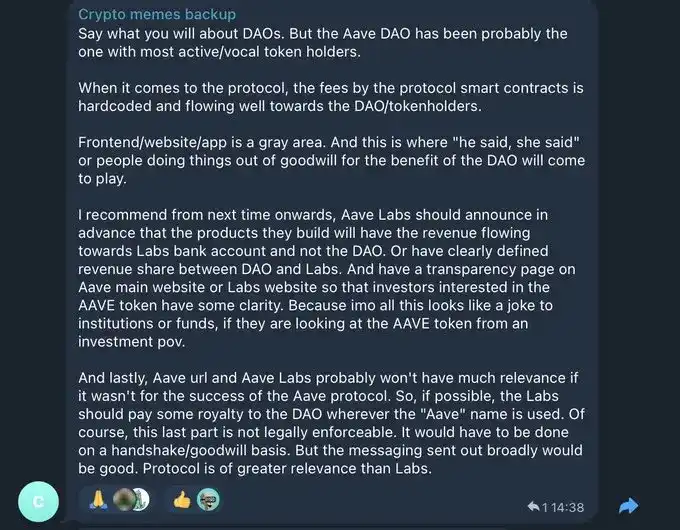
Community suggestions for Labs:

  • Labs should announce in advance that revenue from products they build will flow to Labs, not the DAO.
  • Or clearly define a revenue-sharing ratio between the DAO and Labs.
  • Establish a transparent page on the Aave main website or Labs website providing clear information to help investors interested in the $AAVE token (especially institutions or funds) make judgments.

Although the DAO model is controversial, Aave DAO token holders are among the most active and vocal groups, demonstrating the community's vitality. The frontend, website, and application are focal points of controversy, where "each sticks to their own argument" situations easily arise, lacking clear definition.
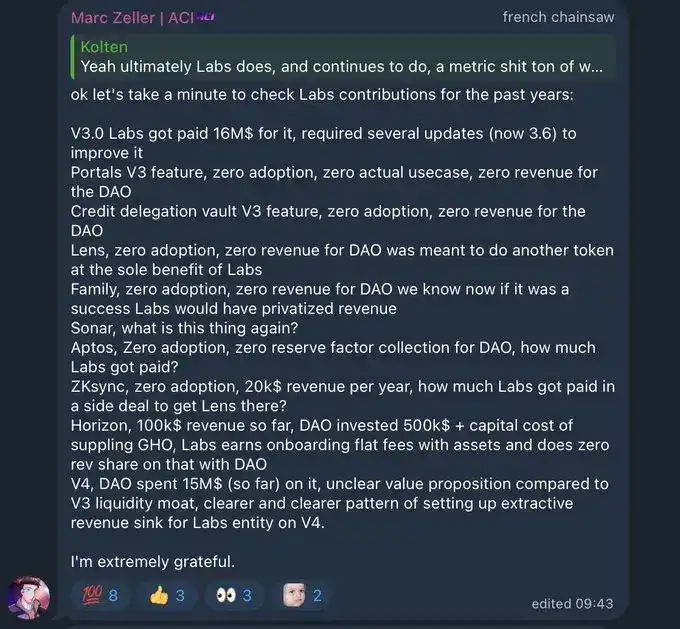
Some of Zeller's accusations against Labs for extracting protocol value:

The listed projects (Portals, Credit Delegation Vault, Lens, etc.) indeed indicate that many of Aave Labs' exploratory initiatives have not directly translated into protocol revenue or significant adoption rates.

It also mentions the V4 version. The DAO has spent $15 million so far. Compared to the liquidity moat of V3, the value proposition is unclear, raising concerns about whether this is a new trap for extracting revenue.

Failure is inevitable in the process of innovation. Not every feature or product can succeed. The DAO is, to some extent, investing in Aave Labs' R&D capability. My understanding is that Zeller is not否定 the contribution but calling for higher standards of accountability, transparency, and value alignment.
Recommended Reading:

Why Isn't Asia's Largest Bitcoin Treasury Company Metaplanet Buying the Dip?

Multicoin Capital: The Era of FinTech 4.0 Has Arrived

a16z's Heavily Funded Web3 Unicorn Farcaster Forced to Pivot, Is Web3 Social a False Proposition?

Связанные с этим вопросы

QWhat was the initial event that sparked the governance conflict between Aave DAO and Aave Labs?

AAave Labs replaced the frontend integration from ParaSwap to CoW Swap, and the fees generated from this new integration were directed to a private address controlled by Labs instead of the DAO treasury.

QWhat is the core dispute regarding the nature of Aave, as described in the article?

AThe core dispute is whether Aave is a Protocol (managed by the DAO) or a Project (built by Labs), and how this definition impacts the rights to revenue generated from its ecosystem.

QAccording to the article, what key resources does Aave DAO control versus Aave Labs?

AAave DAO controls the core protocol layer, including the smart contracts and the treasury. Aave Labs controls the frontend, brand, product marketing, and partnerships.

QWhat is one of the major governance dilemmas highlighted in the Aave case?

AA major dilemma is the tension between the ideal of decentralized governance by token holders (DAO) and the practical need for a centralized, efficient, and continuous development team (Labs) to maintain and grow the project.

QWhat was a community suggestion for Aave Labs to improve transparency and align interests?

AA community suggestion was for Labs to clearly announce in advance when product revenues will flow to Labs instead of the DAO, or to define a clear revenue-sharing ratio between DAO and Labs.

Похожее

China's AI Circle Has Just Established a Pecking Order, and Capital Is Already Changing the Rules Again

The article describes how the valuation logic for major Chinese AI model companies has undergone three dramatic shifts between 2022 and 2026, driven by capital's changing priorities. The first phase (around 2022) was **technology-driven valuation**, where funding was based on model performance and benchmark scores. This logic was disrupted when DeepSeek's R1 model demonstrated that comparable capabilities could be achieved at a fraction of the cost, challenging the notion of technical superiority as an unassailable moat. The second phase shifted to **IPO window-driven valuation**. Following favorable listing conditions in Hong Kong, capital flowed to companies like Zhipu and MiniMax with the clearest path to a public listing. However, this focus on liquidity over fundamentals became apparent as their Annual Recurring Revenue (ARR) lagged far behind international peers like Anthropic. The third and current phase is **national strategy-driven valuation**. This shift was marked by the state-backed "Big Fund" leading a major investment in DeepSeek, signaling that leading domestic AI models are now viewed as strategic national assets comparable to semiconductor manufacturing. This new logic, combined with soaring US valuation benchmarks (e.g., OpenAI at $850B), propelled the combined valuation of China's top AI firms ("The Four Dragons"/"Five Strong") past 1 trillion RMB. The article presents a "pricing leap model": each shift is triggered by a key event that invalidates the old logic, leading to rapid capital reallocation under a new narrative before its flaws (particularly the gap in fundamental ARR metrics) become evident. It concludes that the next major test for these valuations will be a return to scrutinizing core business fundamentals, specifically ARR growth, suggesting a fourth pricing shift is imminent.

marsbit8 мин. назад

China's AI Circle Has Just Established a Pecking Order, and Capital Is Already Changing the Rules Again

marsbit8 мин. назад

'Stock God' Trump's 3,642 Trades Disclosed: The 'Perfect Closed Loop' of Policy and Portfolio

Summary: Donald Trump's First Quarter stock trades, totaling 3,642 transactions, have been disclosed. While the White House maintains the trades were managed by an advisor and complied with disclosure laws, they reveal a portfolio heavily aligned with his policy agenda. The trades show a rotation away from major tech stocks like Microsoft, Amazon, and Meta, and into semiconductor and AI hardware companies such as NVIDIA, AMD, Broadcom, Dell, and Intel. Notably, Trump's account purchased Dell stock before he publicly praised the company, after which its stock rose. The Dell family also pledged funds to a Trump-affiliated policy project. A critical case is Intel. The Trump administration converted $8.9 billion in CHIPS Act subsidies into a 9.9% equity stake, making the U.S. government Intel's largest shareholder. Months later, Trump's personal account also bought Intel stock. This intertwines national industrial policy with potential personal financial interest. Unlike typical insider trading concerns, this situation creates a "closed loop": policy decisions (e.g., subsidies, tariffs, crypto regulation) can boost the value of his holdings, and those holdings may, in turn, influence future policy directions. This blending of presidential power and personal portfolio, while legally disclosed, raises profound questions about conflicts of interest that current rules do not address.

marsbit24 мин. назад

'Stock God' Trump's 3,642 Trades Disclosed: The 'Perfect Closed Loop' of Policy and Portfolio

marsbit24 мин. назад

Dialogue with Figure Robotics Founder: Behind the $39 Billion Valuation Lies Ambition to Mass-Produce Millions of Units

Title: Figure's Founder on the $39B Valuation and the Ambition to Mass Produce a Million Humanoid Robots In a Sourcery podcast interview, Figure founder and CEO Brett Adcock discusses the rapid rise of his humanoid robotics company. With a valuation that surged 15x in 18 months to $39 billion, Figure aims to create general-purpose humanoid robots for work in factories and homes. Adcock states that the company's primary goal is to make robots that perform real, paid work autonomously. He shares Figure's aggressive scaling plan: producing thousands of robots this year, with an ultimate ambition to reach one million units annually. Adcock explains Figure's vertically integrated strategy, designing its own motors, sensors, and joints to control its supply chain and destiny. He details the challenges, including achieving long-term, reliable, end-to-end autonomous operation—a feat no one has yet accomplished. The biggest risk is executing this complex vision at scale, but Adcock believes the potential market is enormous, representing a significant portion of global GDP. The interview also covers his departure from OpenAI, citing that Figure's internal AI team eventually surpassed OpenAI's capabilities for robotics applications. Adcock concludes by highlighting his focus for the year: large-scale commercial deployment of robots and advancing toward a "general robot" capable of any human task, potentially seeing the first signs of AGI (Artificial General Intelligence) in the physical world at Figure.

marsbit24 мин. назад

Dialogue with Figure Robotics Founder: Behind the $39 Billion Valuation Lies Ambition to Mass-Produce Millions of Units

marsbit24 мин. назад

Why Did OpenAI Decide to Make a Phone? ChatGPT Is Taking the Permissions Apple Won't Give

The article discusses OpenAI's surprising move into developing its own AI-powered smartphone, reportedly targeting a 2027 launch. Initially driven by faith that superior AI models alone would secure its dominance—evidenced by ChatGPT's viral success—OpenAI now faces a strategic pivot. Key challenges include slower-than-expected revenue growth and competition from rivals like Anthropic's Claude Code, which successfully monetized a specific, high-value user base (developers) by deeply integrating into workflows. OpenAI recognizes that for ChatGPT to evolve from a conversational tool into a true "AI Agent" that completes tasks (e.g., booking travel, managing files), it needs direct system-level permissions and a default user interface. Currently, as a service integrated into platforms like Apple's iOS and Microsoft's Windows, ChatGPT lacks the necessary access and control ("sovereignty") over hardware, data, and user interactions. Building its own device is seen as a way to give ChatGPT its "first body"—a dedicated terminal where it can operate with full autonomy, bypassing the limitations imposed by partner ecosystems. This shift underscores a broader realization: in the AI Agent era, owning the end-user device and experience is critical to capturing value and maintaining competitive advantage, even if it means directly competing with former allies like Apple.

marsbit31 мин. назад

Why Did OpenAI Decide to Make a Phone? ChatGPT Is Taking the Permissions Apple Won't Give

marsbit31 мин. назад

Торговля

Спот
Фьючерсы

Популярные статьи

Как купить DAO

Добро пожаловать на HTX.com! Мы сделали приобретение DAO Maker (DAO) простым и удобным. Следуйте нашему пошаговому руководству и отправляйтесь в свое крипто-путешествие.Шаг 1: Создайте аккаунт на HTXИспользуйте свой адрес электронной почты или номер телефона, чтобы зарегистрироваться и бесплатно создать аккаунт на HTX. Пройдите удобную регистрацию и откройте для себя весь функционал.Создать аккаунтШаг 2: Перейдите в Купить криптовалюту и выберите свой способ оплатыКредитная/Дебетовая Карта: Используйте свою карту Visa или Mastercard для мгновенной покупки DAO Maker (DAO).Баланс: Используйте средства с баланса вашего аккаунта HTX для простой торговли.Третьи Лица: Мы добавили популярные способы оплаты, такие как Google Pay и Apple Pay, для повышения удобства.P2P: Торгуйте напрямую с другими пользователями на HTX.Внебиржевая Торговля (OTC): Мы предлагаем индивидуальные услуги и конкурентоспособные обменные курсы для трейдеров.Шаг 3: Хранение DAO Maker (DAO)После приобретения вами DAO Maker (DAO) храните их в своем аккаунте на HTX. В качестве альтернативы вы можете отправить их куда-либо с помощью перевода в блокчейне или использовать для торговли с другими криптовалютами.Шаг 4: Торговля DAO Maker (DAO)С легкостью торгуйте DAO Maker (DAO) на спотовом рынке HTX. Просто зайдите в свой аккаунт, выберите торговую пару, совершайте сделки и следите за ними в режиме реального времени. Мы предлагаем удобный интерфейс как для начинающих, так и для опытных трейдеров.

513 просмотров всегоОпубликовано 2024.04.12Обновлено 2025.03.21

Как купить DAO

Объяснение Залога Ликвидности HTX DAO

"Залог ликвидности" - это инновационная стратегия управления токенами, представленная HTX DAO.

1.5k просмотров всегоОпубликовано 2024.08.09Обновлено 2024.08.09

Объяснение Залога Ликвидности HTX DAO

Обсуждения

Добро пожаловать в Сообщество HTX. Здесь вы сможете быть в курсе последних новостей о развитии платформы и получить доступ к профессиональной аналитической информации о рынке. Мнения пользователей о цене на DAO (DAO) представлены ниже.

活动图片