The First Step to Becoming an On-Chain Bank: Polymarket Launches Native Stablecoin

Odaily星球日报Опубликовано 2026-04-07Обновлено 2026-04-07

Введение

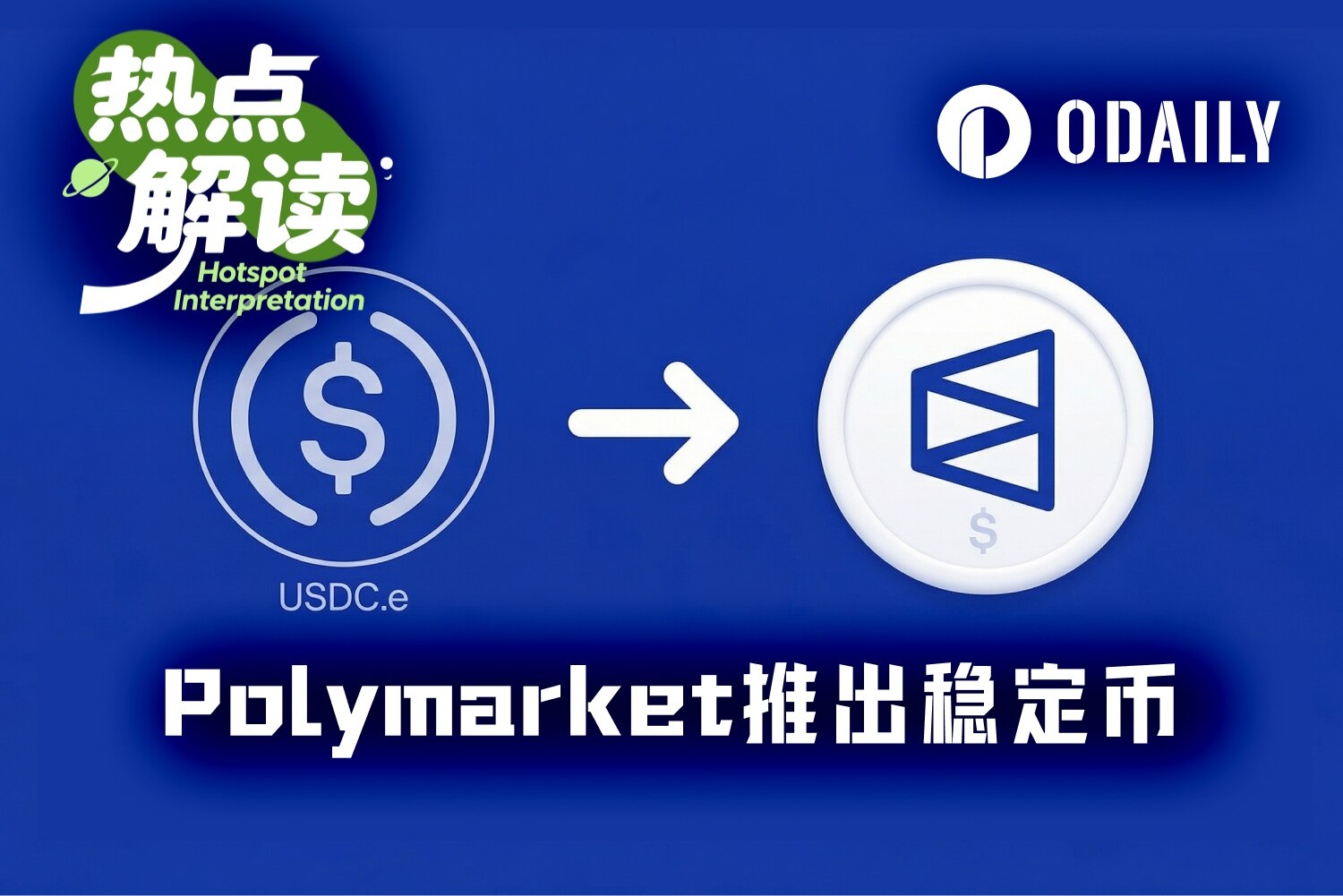
Polymarket, a leading prediction market platform, has announced a major upgrade involving the launch of its own native stablecoin, Polymarket USD (pegged 1:1 to USDC), replacing USDC.e as the platform's collateral. While the transition is designed to be seamless for most users, this move represents a strategic shift beyond a simple technical update. The introduction of Polymarket USD allows the platform to consolidate user funds within its own ecosystem, effectively creating a captive pool of capital. This transforms Polymarket from a pure transaction facilitator into an entity that holds and controls significant reserves. With over $400 million in open interest, these dormant funds present a major new revenue opportunity. By investing the underlying USDC reserves into instruments like U.S. Treasuries, Polymarket could generate tens of millions annually in risk-free yield, drastically expanding its business model beyond transaction fees. This evolution signifies Polymarket's ambition to become a chain-based bank, leveraging its position as a major distribution channel for stablecoins to capture more value from the financial infrastructure it operates on, fundamentally altering its identity from a prediction market to a financial orchestrator.

Original | Odaily Planet Daily (@OdailyChina)

Author | Golem (@web3_golem)

On April 6, Polymarket announced a major upgrade to the platform in the next 2 to 3 weeks, including upgrading both CTF and CLOB to V2, and replacing the platform collateral from USDC.e to the native stablecoin Polymarket USD.

According to the official introduction, Polymarket USD is 1:1 backed by USDC. For most users, the transition from USDC.e to Polymarket USD is seamless, with the frontend handling it automatically—users only need to confirm once. For advanced users and API-only traders, the transition process might be a bit more complex but still not difficult; they need to wrap their USDC or USDC.e into Polymarket USD through the wrap() function of the collateral access contract.

On the surface, Polymarket is merely changing the trading collateral in the backend. As the platform grows, continuing to use USDC.e is indeed a potential issue. Back in February, Circle and Polymarket had already announced plans to migrate bridged USDC.e to native USDC, and this is just a normal progression of that cooperation.

However, Polymarket did not choose to directly introduce native USDC to replace USDC.e; instead, it added an extra layer, aiming to pool USDC within its own treasury. The name of this layer is Polymarket USD. Therefore, the emergence of Polymarket USD is definitely a "One more thing" (Odaily Note: "One more thing" is a classic tradition of Apple keynotes, now symbolizing a company's finale move or industry-disrupting actions).

Polymarket Gains the Right to Mint Currency

The first layer of significance is that Polymarket can pool user funds.

Previously, money deposited by users into Polymarket would become USDC.e. You can think of it as Polymarket being a huge trading venue—it only handles matching, pricing, and清算; the money flows through it, but the money itself does not belong to its system. Polymarket is not a treasury.

But that's about to change. When USDC.e is replaced with Polymarket USD, Polymarket can reach out to that money which was originally just "passing through." As Polymarket officially stated, the daily user experience is unaffected, but the actual on-chain settlement path behind the scenes has been altered. This transformation is no less significant than an exchange transitioning from relying on third-party清算机构 to building its own清算 center.

Polymarket USD is 1:1 backed by USDC, meaning that for every Polymarket USD in the market, there will be a corresponding USDC in Polymarket treasury. Currently, every Yes/No share pair on Polymarket is backed by USDC.e. When players place bets or settle, USDC.e also moves on-chain. But after switching to Polymarket USD, although it will also move on-chain with user operations, the USDC in Polymarket treasury won't experience any movement because of it. Therefore, as long as users don't come to redeem, this money is essentially属于 Polymarket.

Polymarket has gone from being a use case for a stablecoin to反过来掌握ing the on-chain minting right. Polymarket USD diverts user assets from the "open sea" to Polymarket's "internal lake." Once funds begin to pool, Polymarket is no longer just a prediction trading platform, and its business model doesn't have to rely solely on trading fees, because it can start playing the oldest "money makes money" game in finance.

Increasing Polymarket's Revenue Channels

The second layer of significance is the expansion of Polymarket's business.

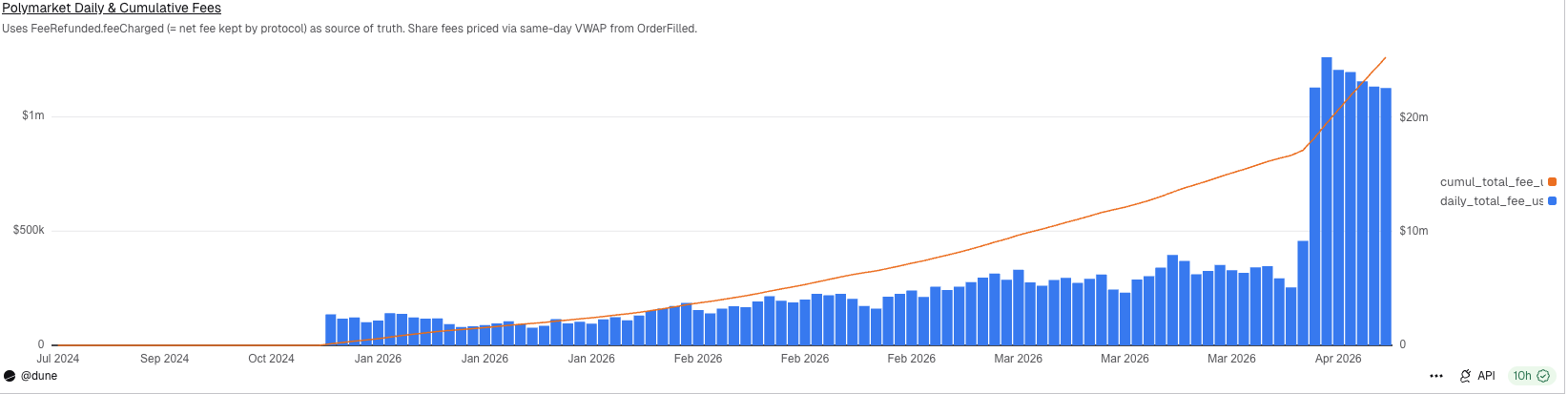
The current business model of prediction markets is simple: charging transaction fees. After Polymarket adjusted its fee mechanism on March 30 (Odaily Note: Expanding the taker fee scope to include Finance, Politics, Economics, Culture, Weather, and other market categories, in addition to the original Crypto and Sports categories), its daily fee revenue has surpassed $1 million.

Polymarket's Daily Fee Revenue

Although impressive, it's not enough to satisfy Polymarket's ambitions. Prediction markets, while currently the most sought-after sector, have a business model with a relatively low ceiling, a single moat (regulatory approval), and not exceptionally high user stickiness. In the current landscape where everyone is doing prediction markets, how can Polymarket ensure it won't be surpassed by competitors in the future?

The answer it gives is: I don't just match trades; I can also put players' money to work.

From a business essence perspective, the most attractive aspect of stablecoins over the years has never been fast payments and transfers, but the low-profile yet highly profitable money-printing machine behind them—reserve asset yield. In 2025, the vast majority of Circle's revenue still came from reserve income. Polymarket understood this model, so it launched Polymarket USD.

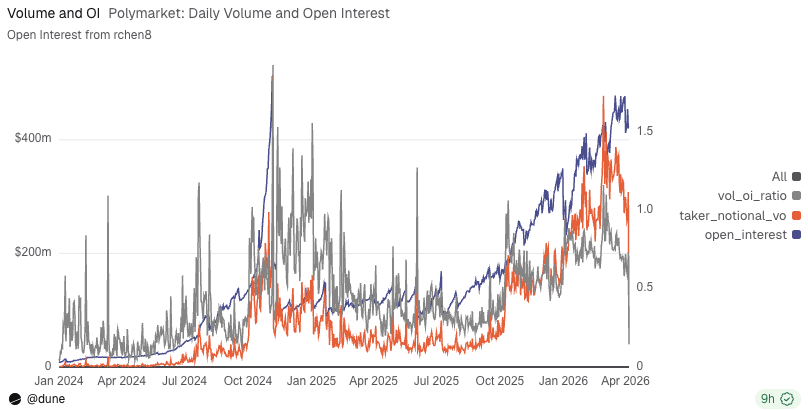
According to Dune data, the value of open interest on the Polymarket platform has exceeded $400 million. If all this money is converted into Polymarket USD, Polymarket只需要把底层抵押的 USDC 都存进 Circle 的机构账户或者放到美债协议里,按 4%-5% 的无风险利率算,每年坐着不动就能收几千万美金的“利息税”。

Defillama founder 0xngmi even directly stated that Polymarket user wallets hold approximately $1.25 billion. If they keep this interest income, at current rates, they would earn an additional $54 million annually. Polymarket could even participate in DeFi yield farming with higher APYs, turning the idle funds on the prediction platform into active leverage, and then returning the maturity proceeds to users, effectively hedging for them.

Polymarket's Daily OI and Trading Volume Curve

Prediction markets naturally have two characteristics: first, fund滞留, and second, high-frequency reallocation driven by events. Users' money doesn't truly enter and exit instantly like in a casino; it's either already in a position or sitting in an account waiting for the next event, the next odds change. This type of money is most suitable for financial reprocessing, and for users, there's also a beautiful excuse: improving capital efficiency.

Of course, Polymarket hasn't publicly stated yet that it will definitely engage in yield extraction or on-chain wealth management after launching the stablecoin. But this path is almost a natural next step. As long as the scale of Polymarket USD grows larger in the future, it naturally gains the space to do yield management, collateral expansion, and financial combinations within the platform.

Some time ago, the 《CLARITY Act》 faced resistance for potentially prohibiting crypto companies from offering interest on stablecoins to users. If the outcome of the dispute remains a prohibition, all the above演绎 of Polymarket USD's potential will come to naught. However, on April 6, according to US media reports, the core disagreement between the US crypto industry and banks over the stablecoin yield mechanism may be接近解决. Although details have not been disclosed, the overall expectation is optimistic, and the 《CLARITY Act》 may enter the deliberation stage in committee in late April.

So, don't think Polymarket is far from this.

Polymarket Gains USDC Distribution Rights

The launch of the stablecoin by Polymarket has a third layer of significance: gaining USDC distribution rights.

From today's perspective, Polymarket is still a major distribution scenario within the USDC ecosystem. Circle provides native USDC, Polymarket distributes USDC, and both sides are harmonious. Polymarket is currently experiencing strong growth. Undoubtedly, the USDC reserves pooled within its platform will become larger in the future, potentially even becoming a distribution channel as important as Coinbase. When that time truly comes, the relationship between Polymarket and Circle might also sour.

A reality in the stablecoin world is that distribution rights are as important as issuance rights, which is why Coinbase can take away over half of Circle's reserve income. Therefore, in the future, when Polymarket becomes an important distributor of USDC, it will also inevitably grow bargaining power and will be entitled to take a large share of the reserve收益.甚至, when Polymarket USD is mature enough, it can explore multi-collateral backed stablecoins, not just putting all its eggs in the USDC basket.

This is also why I believe Polymarket USD is not an ordinary upgrade for Polymarket, but an identity update. Polymarket will evolve from a "platform collecting fees围绕事件波动" to one that also兼具 "platform organizing and清算围绕美元".

The former is casino logic, while the latter is bank logic.

Polymarket's moat has thus gained another layer. It still maintains the beautiful narrative of information as a market and pricing facts early. But in terms of its business model, it is quietly moving itself towards a more important position—no longer satisfied with being surface-level market traffic, no longer satisfied with仅仅靠赔率吸引用户, and no longer satisfied with continuing to leave the fattest part of the industry chain (asset reserve收益) to others.

Связанные с этим вопросы

QWhat is the primary significance of Polymarket launching its native stablecoin, Polymarket USD?

AThe primary significance is that Polymarket can now pool user funds, moving from being a mere transaction platform to controlling the minting power of its own stablecoin. This allows it to retain USDC reserves in its own treasury, enabling potential revenue from reserve assets and expanding its business model beyond just transaction fees.

QHow does the transition from USDC.e to Polymarket USD affect the average user on the platform?

AFor the average user, the transition is seamless and handled automatically on the frontend with a single confirmation click. The change is largely imperceptible in their user experience, as the platform manages the conversion process behind the scenes.

QWhat new revenue stream does Polymarket potentially gain by introducing its own stablecoin?

APolymarket gains the potential to earn significant revenue from the interest on the USDC reserves backing Polymarket USD. With over $400 million in open interest, it could generate millions annually from low-risk yields like U.S. Treasury bonds or DeFi protocols, diversifying beyond transaction fees.

QWhy is the move to Polymarket USD compared to a shift from a 'gambling logic' to a 'banking logic'?

AThe shift is made because Polymarket is evolving from merely collecting fees on event-based transactions (gambling logic) to managing and清算 user assets, controlling stablecoin issuance, and earning from reserve yields—functions akin to a bank's role in financial systems (banking logic).

QWhat regulatory consideration could impact Polymarket's ability to generate yield from its stablecoin reserves?

AThe CLARITY Act in the U.S., which may prohibit crypto firms from providing interest on stablecoins, could hinder this revenue stream. However, recent reports suggest potential resolutions are being discussed, with the act expected to enter committee review soon, indicating cautious regulatory progress.

Похожее

Silicon Valley 'Startup Guru' Steve Hoffman: Web3 + AI Could Be a Trap

Silicon Valley investor and "Godfather of Startups" Steve Hoffman warns that combining Web3 with AI is likely a trap, not a promising venture. In an interview, Hoffman argues that while AI is a foundational technology touching all industries, Web3 adds complexity, friction, and regulatory risk without solving mainstream consumer or business needs. He advises founders to focus on deep, specialized applications where startups can out-iterate giants, rather than on generic features easily replicated by large tech companies. Hoffman observes that Silicon Valley will lead foundational AI research, while China excels at rapid, large-scale application and commercialization, particularly in robotics. He stresses that AI-driven autonomous agents capable of collaborative, multi-step tasks are 2-4 years away, which will cause significant job displacement. The solution is not to slow AI but to redesign business models around human-AI collaboration and reform social systems like education and retraining. For startups, Hoffman recommends focusing on vertical, expertise-heavy domains to build defensibility. He sees major opportunities in AI fraud detection and cybersecurity. Key founder mindsets include systemic thinking over feature-focus, relentless customer centricity, building adaptive teams, and deeply understanding AI's capabilities and limits. Hoffman is also leading a non-profit initiative to establish university centers aimed at training future leaders in responsible, human-value-aligned AI innovation.

marsbit1 ч. назад

Silicon Valley 'Startup Guru' Steve Hoffman: Web3 + AI Could Be a Trap

marsbit1 ч. назад

Token Inefficient, Economy Tokenless

The article "Tokens Aren't Economical, Economics Aren't Tokenized" analyzes a pivotal shift in the AI industry from a technology-driven narrative to one dominated by capital efficiency. It highlights two concurrent trends: a severe capital shortage due to the exorbitant and recurring costs of compute (e.g., OpenAI's high burn rate) and a wave of corporate spin-offs where major tech companies are separating their AI units (like Kuaishou's Kling and Baidu's Kunlunxin). The core argument is that AI's "anti-internet" business model, where user growth increases costs rather than profits, has created a disconnect between high valuations and actual cash flow. Spin-offs address this by allowing AI assets to be valued independently. Within a parent company, they are seen as cost centers, but as standalone entities, they are priced based on their growth potential and scarcity in the primary market, leading to massive valuation premiums (e.g., Kling's estimated value tripling post-spin-off). The industry is at an inflection point, moving from "model worship" to "value realization." The competition is evolving from a pure compute (GPU) race to a broader focus on systemic efficiency and full-stack engineering (involving CPUs and orchestration) to achieve viable commercialization. The year 2026 is framed as a critical moment where the industry must definitively answer how to economically translate AI capability into tangible business value, reshaping the sector's future power structure.

marsbit1 ч. назад

Token Inefficient, Economy Tokenless

marsbit1 ч. назад

Crossing the 'Memory Wall': The Wafer-Level Revolution and Computing Power Routes in the AI Inference Era

In 2026, a historic shift occurred in AI as major cloud providers' inference spending surpassed training spending for the first time, signaling a move from "building large models" to "using large models." This shifts the core challenge from computing power to the "memory wall"—the bottleneck of data movement (model weights, activations, KV Cache) between external DRAM and processors, where energy and latency from data transfer far exceed computation itself. Companies like Nvidia face GPU idle time due to bandwidth limits. In contrast, Cerebras Systems adopts a radical "wafer-scale" approach with its Wafer-Scale Engine (WSE). Instead of cutting a silicon wafer into many chips, Cerebras uses almost the entire wafer as one massive chip (WSE-3). This design provides 44GB of on-chip SRAM, delivering memory bandwidth thousands of times higher than traditional HBM (e.g., 21 PB/s vs. Nvidia B200). For LLM inference, weights are streamed layer-by-layer from external MemoryX storage to the chip, avoiding HBM bottlenecks. This results in token generation speeds 1.5–5 times faster than Nvidia's B200 in some models and significant advantages in first-token latency and long-context tasks. Additionally, Cerebras's architecture offers much lower interconnect power consumption (0.15 pJ/bit vs. GPU's ~10 pJ/bit). However, Cerebras faces challenges: SRAM scaling has slowed with advanced nodes, limiting future capacity gains; the chip requires specialized liquid cooling and custom software stacks; and its external I/O bandwidth (150 GB/s) is low compared to NVLink, hindering multi-system scaling for very large models. Competition is intensifying. Major players are pursuing three paths: 1) Developing proprietary inference ASICs (e.g., Google TPU, Microsoft Maia), 2) Leveraging advanced packaging (e.g., TSMC's SoW) to democratize wafer-scale-like integration, potentially eroding Cerebras's process advantage within a few years, and 3) Exploring optical interconnects for ultimate bandwidth. Commercially, Cerebras is transitioning from a hardware vendor to a service provider, facing the immense challenge of building high-power, specialized data centers to meet large contracts (e.g., 250MW/year from 2026–2028). In conclusion, the AI inference era presents a fundamental architectural trade-off. Cerebras opts for extreme physical optimization for low-latency, single-task performance, while Nvidia prioritizes versatility and massive cluster throughput. The path forward remains uncertain, with technology and business models still evolving in the race toward advanced AI.

marsbit1 ч. назад

Crossing the 'Memory Wall': The Wafer-Level Revolution and Computing Power Routes in the AI Inference Era

marsbit1 ч. назад

Has Bitcoin's 'Rebound Ended', Officially Entering the Late Bear Market Phase?

**Title: Has Bitcoin's Rebound Ended, Entering the Late Bear Market Phase?** **Summary:** Bitcoin's price has declined by 13% this week, signaling a potential return to late-stage bear market conditions. The price fell to around $67k, positioned between the Realized Price and Realized Cap Weighted Average. For the first time since early 2022, the Short-Term Holder cost basis has dropped below this key average, confirming a hallmark of late-cycle bear markets. Profitability metrics have collapsed sharply. The 7-day average of the Realized Profit/Loss ratio plummeted from a local high of 3.16 to 0.29, mirroring the February panic sell-off. Critically, the 90-day average never breached the threshold of 2, indicating the recent rally to $82k was a bear market bounce, not a structural shift. Realized losses surged to $1.35 billion daily, with $770 million coming from Long-Term Holders selling at a loss. This accelerating redistribution of supply from weak to strong hands is a necessary but ongoing process for a market bottom. The rally stalled almost precisely at the aggregate cost basis (~$83k) of US spot Bitcoin ETF investors, turning that level into strong resistance and leaving the average ETF holder underwater again. Spot market flows have turned decisively negative, showing sellers are dominating order books despite the price drop. While a significant futures long liquidation event cleared over $400 million in leverage, providing a potential reset, sustained spot demand is yet to materialize. Options markets continue to price in higher future volatility (Implied Volatility) than recent price action (Realized Volatility) has shown, with a persistent skew towards put options, indicating ongoing demand for downside protection. In conclusion, multiple metrics point to a fragile market structure. Resistance at the ETF cost basis, accelerating realized losses, dominant spot selling, and cautious options pricing all suggest the bear market trend persists. A sustainable recovery likely requires a resurgence of spot demand, ETF holders returning to profit, and a clear reduction in selling pressure.

marsbit1 ч. назад

Has Bitcoin's 'Rebound Ended', Officially Entering the Late Bear Market Phase?

marsbit1 ч. назад

Торговля

Спот
Фьючерсы

Популярные статьи

Что такое $BANK

Банк ИИ: Революционный шаг в будущее банковского дела Введение В эпоху, отмеченную быстрыми темпами технологического прогресса, Банк ИИ находится на пересечении искусственного интеллекта (ИИ) и банковских услуг. Этот инновационный проект стремится переопределить финансовый ландшафт, повышая операционную эффективность, меры безопасности и качество обслуживания клиентов с помощью ИИ. Приступая к этому изучению Банка ИИ, мы углубимся в то, что включает в себя проект, его операционную динамику, его исторический контекст и значительные вехи. Что такое Банк ИИ? В своей основе Банк ИИ представляет собой преобразовательную инициативу, направленную на интеграцию искусственного интеллекта в различные банковские операции. Этот проект использует возможности ИИ для автоматизации процессов, улучшения протоколов управления рисками иEnhancing взаимодействия с клиентами через персонализированные услуги. Основные цели Банка ИИ включают: Автоматизация банковских функций: Используя технологии ИИ, Банк ИИ стремится автоматизировать рутинные задачи, снижая нагрузку на человеческие ресурсы и повышая эффективность. Улучшение управления рисками: Проект использует алгоритмы ИИ для прогнозирования и выявления рисков, тем самым укрепляя меры безопасности против мошенничества и других угроз. Персонализация банковских услуг: Банк ИИ сосредоточен на предложении индивидуально подобранных финансовых продуктов и услуг, анализируя данные и поведение клиентов. Улучшение клиентского опыта: Внедрение решений на базе ИИ, таких как чат-боты и виртуальные помощники, направлено на предоставление пользователям более человеческого взаимодействия, революционизируя способ, которым клиенты взаимодействуют с банками. С этими целями Банк ИИ позиционирует себя как ключевого игрока в сделании банковских услуг более эффективными, безопасными и ориентированными на пользователей. Кто создатель Банка ИИ? Детали, касающиеся создателя Банка ИИ, остаются неизвестными. Таким образом, ни одно конкретное лицо или организация не были идентифицированы в доступной информации. Анонимность, окружающая начало проекта, поднимает вопросы, но не умаляет его амбициозного видения и целей. Кто инвесторы Банка ИИ? Подобно создателю проекта, конкретная информация о инвесторах или поддерживающих организациях Банка ИИ не была раскрыта. Без этой информации трудно описать финансовую поддержку и институциональную поддержку, которая может продвигать проект вперед. Тем не менее, важность наличия прочной инвестиционной базы является ключевой для поддержания развития в такой инновационной сфере. Как работает Банк ИИ? Банк ИИ работает на нескольких инновационных фронтах, сосредотачиваясь на уникальных факторах, которые отличают его от традиционных банковских рамок. Ниже приведены ключевые операционные особенности: Автоматизация: Применяя алгоритмы машинного обучения, Банк ИИ автоматизирует различные ручные процессы внутри банков. Это приводит к снижению операционных затрат и позволяет работникам перераспределять свои усилия на более стратегические деятельности. Совершенное управление рисками: Интеграция ИИ в практики управления рисками обеспечивает банки инструментами для точного прогнозирования потенциальных угроз, таких как мошенничество, обеспечивая безопасность информации и активов клиентов. Индивидуализированные финансовые рекомендации: Путем непрерывного обучения на основе взаимодействия с клиентами, системы ИИ развивают тонкое понимание потребностей пользователей, позволяя им предлагать персонализированные советы по финансовым решениям. Улучшенные взаимодействия с клиентами: Используя чат-боты и виртуальных помощников на базе ИИ, Банк ИИ обеспечивает более увлекательный клиентский опыт, позволяя пользователям быстро получать ответы на свои запросы, тем самым сокращая время ожидания и повышая уровень удовлетворенности. Все вместе эти операционные особенности позиционируют Банк ИИ как пионера в банковском секторе, устанавливающего новые эталоны для предоставления услуг и операционного совершенства. Хронология Банка ИИ Понимание траектории Банка ИИ требует взгляда на его исторический контекст. Ниже представлена хронология, подчеркивающая важные вехи и события: Начало 2010-х: Концепция интеграции ИИ в банковские услуги начала привлекать внимание, когда банковские учреждения осознали потенциальные преимущества. 2018: Произошел заметный рост внедрения технологий ИИ, когда банки начали использовать инструменты ИИ, такие как чат-боты, для базового обслуживания клиентов и системы управления рисками для улучшения безопасности. 2023: Сложность ИИ продолжала развиваться, при этом генеративный ИИ был представлен для выполнения более сложных задач, таких как обработка документов и анализ инвестиций в реальном времени. Этот год стал значительным шагом вперед в возможностях, которые ИИ-технологии предоставили банкам. 2024-Настоящее состояние: На данный момент Банк ИИ находится на восходящей траектории, с продолжающимися исследованиями и разработками, которые расширяют возможности в банковских операциях. Продолжение изучения приложений ИИ намекает на захватывающие события, которые еще предстоят. Ключевые моменты о Банке ИИ Интеграция ИИ в банковское дело: Банк ИИ сосредоточен на принятии искусственного интеллекта для оптимизации банковских процессов и улучшения пользовательского опыта. Автоматизация и фокус на управлении рисками: Проект сильно акцентирует внимание на этих областях, стремясь сместить бремя рутинных задач, одновременно усиливая системы безопасности с помощью предсказательной аналитики. Персонализированные банковские решения: Используя данные клиентов, Банк ИИ предоставляет индивидуально подобранные банковские услуги, которые учитывают потребности отдельных пользователей. Обязанность по развитию: Банк ИИ остается приверженным постоянным исследовательским и развивающим усилиям, обеспечивая свою адаптируемость и постоянную актуальность по мере того, как технологии продолжают развиваться. Заключение В заключение, Банк ИИ является важным шагом вперед в банковской индустрии, использующим искусственный интеллект для изменения операционных парадигм, повышения безопасности и повышения удовлетворенности клиентов. Несмотря на пробелы в информации о создателе и инвесторах, четкие цели и функциональные механизмы Банка ИИ обеспечивают прочную основу для его постоянной эволюции. Поскольку технологии ИИ продолжают развиваться и сливаться с банковским сектором, Банк ИИ хорошо позиционирован, чтобы существенно повлиять на будущее финансовых услуг, улучшая наш подход к пониманию и взаимодействию с банковским делом.

148 просмотров всегоОпубликовано 2024.04.06Обновлено 2024.12.03

Что такое $BANK

Как купить BANK

Добро пожаловать на HTX.com! Мы сделали приобретение Lorenzo Protocol (BANK) простым и удобным. Следуйте нашему пошаговому руководству и отправляйтесь в свое крипто-путешествие.Шаг 1: Создайте аккаунт на HTXИспользуйте свой адрес электронной почты или номер телефона, чтобы зарегистрироваться и бесплатно создать аккаунт на HTX. Пройдите удобную регистрацию и откройте для себя весь функционал.Создать аккаунтШаг 2: Перейдите в Купить криптовалюту и выберите свой способ оплатыКредитная/Дебетовая Карта: Используйте свою карту Visa или Mastercard для мгновенной покупки Lorenzo Protocol (BANK).Баланс: Используйте средства с баланса вашего аккаунта HTX для простой торговли.Третьи Лица: Мы добавили популярные способы оплаты, такие как Google Pay и Apple Pay, для повышения удобства.P2P: Торгуйте напрямую с другими пользователями на HTX.Внебиржевая Торговля (OTC): Мы предлагаем индивидуальные услуги и конкурентоспособные обменные курсы для трейдеров.Шаг 3: Хранение Lorenzo Protocol (BANK)После приобретения вами Lorenzo Protocol (BANK) храните их в своем аккаунте на HTX. В качестве альтернативы вы можете отправить их куда-либо с помощью перевода в блокчейне или использовать для торговли с другими криптовалютами.Шаг 4: Торговля Lorenzo Protocol (BANK)С легкостью торгуйте Lorenzo Protocol (BANK) на спотовом рынке HTX. Просто зайдите в свой аккаунт, выберите торговую пару, совершайте сделки и следите за ними в режиме реального времени. Мы предлагаем удобный интерфейс как для начинающих, так и для опытных трейдеров.

996 просмотров всегоОпубликовано 2025.05.09Обновлено 2026.06.02

Как купить BANK

Обсуждения

Добро пожаловать в Сообщество HTX. Здесь вы сможете быть в курсе последних новостей о развитии платформы и получить доступ к профессиональной аналитической информации о рынке. Мнения пользователей о цене на BANK (BANK) представлены ниже.

活动图片