The Era of On-Chain Voting Is Here: Do Your Stocks Truly 'Belong' to You?

marsbitОпубликовано 2026-04-10Обновлено 2026-04-10

Введение

The era of on-chain shareholder voting is approaching, as Galaxy Digital (GLXY) pioneers the first-ever on-chain voting for a public company, scheduled for its 2026 annual meeting. This initiative, developed in partnership with fintech firm Broadridge on the Avalanche blockchain, aims to transform tokenized stocks from mere "digital IOUs" into full-fledged equity with complete voting and dividend rights. The move addresses a critical flaw in traditional finance exposed during the 2021 GameStop saga: the disconnect between nominal ownership and actual shareholder rights due to multi-layered intermediation. Broadridge’s solution enables direct, transparent, and immutable voting via digital wallets, eliminating inefficiencies and opacity in the current proxy system. Key features include multi-chain auditability, a streamlined voting interface, and real-time transparency, which could empower retail and institutional investors alike. While this innovation promises greater shareholder engagement and governance transparency, the IMF warns of potential risks, such as accelerated crisis propagation due to blockchain’s settlement speed. Widespread adoption still faces hurdles, including regulatory uncertainty, resistance from traditional financial intermediaries, and technical barriers for users. However, with major players like Nasdaq and Blackrock advancing tokenization efforts, on-chain voting could mark a significant step toward authentic ownership and shareholder-centric cap...

Remember the轰轰烈烈的"GameStop (GME) retail investors versus Wall Street" battle in 2021? At that time, countless retail investors bought GME through platforms like Robinhood, aiming to counter short-selling institutions. But a dramatic scene unfolded: multiple brokerages temporarily restricted buying, allowing only selling. Many angry investors questioned: I paid for these stocks, why can't I decide how to trade them? This exposed the rights gap between retail investors as "nominal holders" and "actual beneficiaries" in the traditional financial system.

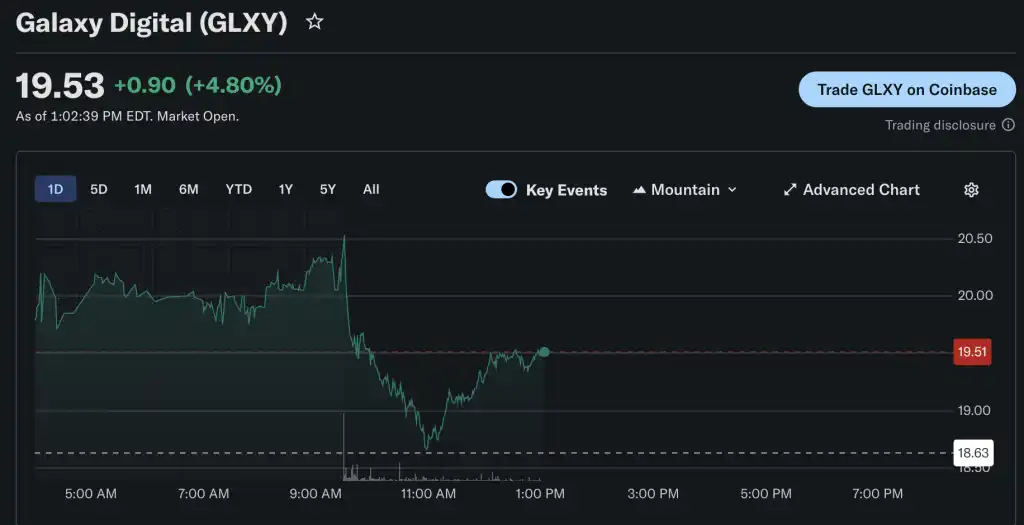
Today, a deeper transformation is taking place, one that could fundamentally solve this problem. Recently, led by cryptocurrency investment bank Galaxy Digital (GLXY), the world's first on-chain shareholder voting for a publicly traded company is set to occur at its annual meeting in May 2026. This is not just a technical experiment; it signifies that tokenized stocks are evolving from "digital replicas" into "true equity" with full shareholder rights, potentially reshaping the corporate governance landscape for decades to come.

From "Digital IOU" to "True Equity": The Coming of Age for Tokenized Assets

Over the past few years, we have witnessed the evolution of tokenized real-world assets (RWA) from concept to infrastructure. From U.S. Treasury bonds to real estate funds, various assets have been "moved" onto the blockchain. But tokenized stocks have long had an awkward "original sin": many were more like "digital IOUs" tracking stock prices or synthetic derivatives, with holders not enjoying core shareholder rights such as voting rights and dividend rights.

This might be unimportant for retail investors seeking stable returns, but for institutional investors bound by fiduciary duties (such as pension funds, mutual funds), it is a fatal flaw. They cannot invest client funds into a "pseudo-equity" without a voice. Therefore, tokenized stocks have long remained in niche trading scenarios, struggling to gain favor from mainstream institutions.

Galaxy Digital's collaboration with fintech giant Broadridge aims to pierce through this layer. Through a dedicated platform built on the Avalanche blockchain, holders of tokenized GLXY stock will be able to receive meeting materials and submit votes directly from their digital wallets. As Galaxy CEO and Wall Street legend Mike Novogratz stated: "Proxy voting is a core function of equity ownership. Enabling on-chain proxy voting for public companies is no longer a theoretical discussion."

This reminds me of my experience investing in certain Stock Connect (Hong Kong) targets. As a mainland investor, the process for participating in shareholder meeting votes was so cumbersome that it made one give up. The directness, transparency, and immutability brought by on-chain voting are the perfect remedy for such pain points.

Dissecting the "On-Chain Voting" Engine: How Transparency Defeats the "Black Box"?

Broadridge's solution is crucial because it directly addresses the core chronic problems of the traditional proxy voting system: opacity and inefficiency.

Under the current "street name" holding system centered around the Depository Trust Company (DTC), your stock may pass through multiple intermediaries like brokers, custodian banks, and clearinghouses before being registered. Your voting instruction is like a letter needing to be forwarded through multiple post offices; delays or losses at any point could prevent your voice from being heard at the shareholder meeting. Historically, cases of "vote reconciliation failure" due to this are not uncommon.

Broadridge's on-chain platform does three smart things:

  1. Direct Wallet Voting: Voting materials go directly to your digital wallet, and the voting action is completed on-chain. The path is the shortest, with no intermediaries to "cause trouble".
  2. Multi-Chain Auditing: Voting records are not stored on a single chain but are distributed across multiple chains for auditing. This is like storing meeting minutes simultaneously in a bank vault, a court archive, and the cloud. Anyone can trace and verify, greatly enhancing credibility.
  3. Unified Interface: Regardless of whether your stock is held via direct registration, through a broker, or in tokenized form, all voting data is aggregated in one interface. This solves the problem of rights fragmentation due to different holding methods.

According to data disclosed by Broadridge, its platform currently handles a monthly volume of tokenized assets reaching $8 trillion, processing over 70 billion investor communications annually. This is no longer a "small-scale test" but financial-grade infrastructure tested by massive transaction volumes. Its CEO Tim Gokey views precise and low-cost governance tools as a prerequisite for the large-scale institutional adoption of tokenized stocks, not an afterthought.

Opportunities and Undercurrents: When Corporate Governance Enters the "Live Broadcast Era"

The proliferation of on-chain voting will push corporate governance from "black box meetings" towards "transparent live broadcasts." Imagine the voting process for all major resolutions (like board elections, M&A deals, executive compensation) being real-time queryable and immutable. This would greatly reduce the information asymmetry that currently exists between registered shareholders and beneficial owners.

For active investors and activist shareholders, this is undoubtedly good news. They can more precisely aggregate voting power to drive strategic changes in companies. For listed companies, this is also a spur, forcing management to pay more attention to communication with all shareholders (especially small shareholders).

However, the International Monetary Fund (IMF) issued a sober warning in a recent report. It pointed out that tokenized finance could amplify financial crises by accelerating the transmission of market stress, as blockchain settlement speeds could outpace regulators' response times. This risk channel becomes more relevant when both governance and settlement functions migrate to shared blockchain infrastructure.

This is not alarmist. If a company's controversial resolution is quickly passed and executed via on-chain voting, market panic and selling could also spread at the speed of light. Therefore, programmable regulation (such as setting voting cooling-off periods, delayed settlement for large transactions) must develop in sync with technological innovation.

Future Outlook: Who Will Follow? What Are the Obstacles?

Galaxy Digital fired the first shot, but who is next? This is key to determining whether this transformation will be a "solo performance" or a "grand chorus."

Broadridge's platform is designed from the outset to support multiple issuers; it's not tailor-made for Galaxy. Nasdaq has received SEC approval to pilot a tokenized securities trading program, and the New York Stock Exchange is also partnering with Securitize to prepare for launching a digital trading platform. The infrastructure is falling into place.

But widespread adoption still faces obstacles:

  • Regulatory Clarity: Despite pilots, a comprehensive regulatory framework for on-chain securities issuance, trading, and governance is still under construction.
  • Traditional Interest Structures: The existing proxy voting, clearing, and settlement systems involve vast networks of interests, and change will inevitably meet resistance.
  • Technical Threshold and Security: Ordinary investors still need to learn to manage private keys and use wallets; security risks like smart contract vulnerabilities and wallet theft cannot be ignored.

From my personal market observation, since 2024, the scale of tokenized funds issued by asset management giants like BlackRock and Fidelity has continued to grow, indicating institutional capital is quietly entering the market in the form of "asset tokenization." This paves the way for "equity tokenization." Once a few benchmark tech or financial companies follow Galaxy's lead, creating a cluster effect, a tipping point could arrive quickly.

Conclusion: Your Investment, Your Rights

Ultimately, Galaxy Digital's on-chain voting experiment is about a most fundamental principle: the authenticity of ownership. In the digital age, what we invest in is not just a string of price codes, but should also be a clear, complete, and executable certificate of rights.

This transformation will not happen overnight; it will advance amidst applause, controversy, and磨合. But for every investor, it means that in the future, we might truly be able to participate more directly in the fate of the companies we invest in, as "owners." When every vote you cast is clearly recorded on-chain like an inscription, the capital market will have taken a major step towards the ideal of "shareholder primacy." Of course, while embracing new technology, we must also remain清醒 about the new risks that come with it—this is always the unerring rule of investing.

Связанные с этим вопросы

QWhat is the core issue exposed by the GameStop (GME) event in 2021 regarding retail investors?

AThe event exposed the rights gap between retail investors as 'nominal holders' and 'beneficial owners' in the traditional financial system, where their ability to trade was restricted despite owning the shares.

QWhat significant milestone is Galaxy Digital (GLXY) achieving in 2026, and why is it important?

AGalaxy Digital is conducting the world's first on-chain shareholder voting for a public company in May 2026. This is important because it evolves tokenized stocks from mere 'digital replicas' into 'true equity' with full shareholder rights, potentially reshaping corporate governance.

QHow does Broadridge's on-chain voting platform address the problems of traditional proxy voting systems?

AIt addresses opacity and inefficiency by enabling direct voting from digital wallets (shortest path, no intermediaries), distributing voting records across multiple chains for auditability, and providing a unified interface to aggregate votes from different holding methods.

QWhat potential downside or risk does the IMF report highlight regarding tokenized finance and on-chain governance?

AThe IMF warns that tokenized finance could amplify financial crises by accelerating the transmission of market stress, as blockchain settlement speeds may outpace regulatory responses, especially when governance and settlement functions share the same infrastructure.

QWhat are some key obstacles to the widespread adoption of on-chain voting and tokenized securities?

AKey obstacles include the need for clearer comprehensive regulatory frameworks, resistance from existing traditional financial利益格局 (interest networks), and challenges like technical barriers for investors (e.g., managing private keys) and security risks (e.g., smart contract vulnerabilities).

Похожее

South Korean Exchanges 'Battle' Regulators, Challenging the Boundaries of Enforcement and Legislation

South Korea's cryptocurrency industry is engaged in a rare, direct confrontation with regulators. The Financial Intelligence Unit (FIU), the primary anti-money laundering (AML) watchdog, has recently imposed heavy penalties on major exchanges like Upbit and Bithumb for alleged violations involving unregistered overseas VASPs and AML procedures. However, exchanges are now actively challenging these actions in court and through industry associations. In a significant shift, the Seoul Administrative Court ruled in favor of Upbit's operator, Dunamu, overturning part of an FIU-ordered business suspension. The court found the FIU's penalty criteria and justification insufficiently clear. Similarly, the court suspended the enforcement of a six-month business suspension against Bithumb pending a final ruling, citing potential irreversible harm to the exchange. Beyond legal battles, the industry is contesting proposed legislative amendments. The Digital Asset eXchange Alliance (DAXA) strongly opposes a draft rule that would mandate Suspicious Transaction Reports (STRs) for all crypto transfers over 10 million KRW (~$6,800). DAXA argues this "poison pill" clause violates legal principles and would overwhelm the STR system, increasing reports from 63,000 to an estimated 5.45 million annually for major exchanges, thereby crippling effective AML monitoring. This conflict highlights a structural tension in South Korea's crypto governance: comprehensive digital asset laws are still developing, while regulators rely heavily on AML enforcement. The industry's move from passive compliance to active legal and legislative challenges signifies a new phase, pressing for clearer rules and more proportionate enforcement. While short-term disputes may intensify, this clash could ultimately lead to a more mature and sustainable regulatory framework for South Korea's vibrant crypto market.

marsbit34 мин. назад

South Korean Exchanges 'Battle' Regulators, Challenging the Boundaries of Enforcement and Legislation

marsbit34 мин. назад

After 50x Storage Surge, Justin Sun Always Looks to the Next Decade

Sun Yuchen, known for his controversial stunts like a $30 million lunch with Warren Buffett (canceled due to a kidney stone) and eating a $6.2 million duct-taped banana, is often overshadowed by a significant fact: his decade-long track record of spotting major investment trends. In 2016, he famously advised young people to invest in Bitcoin, Nvidia, Tesla, and Tencent instead of buying property. A hypothetical $20,000 investment in Nvidia and Tesla from that list would now be worth over 50 million RMB. His latest major call was on November 6, 2025, predicting a "50x storage opportunity" tied to the AI boom, which materialized with Sandisk's stock surging nearly 50-fold by 2026. Looking ahead, Sun now focuses on the next frontier: Physical AI. He identifies four key areas: 1. **Embodied AI/Robotics**: He sees this reaching its "iPhone moment," with companies like UBTech and Galaxy General leading in commercialization. 2. **Drones**: Viewed as the first commercially viable form of Physical AI, revolutionizing sectors from warfare (e.g., AeroVironment's Switchblade) to logistics. 3. **Spatial Computing**: Beyond VR, it's about AI understanding physical space, a foundational technology for robotics and autonomous systems, exemplified by Apple's Vision Pro. 4. **Space Exploration**: After a 2025 suborbital flight with Blue Origin, Sun advocates for space as the ultimate frontier, discussing blockchain's potential role in space asset management and data transactions. His investment philosophy involves betting on entire, inevitable trends rather than single companies. For robotics, he sees Tesla (the body/manufacturer) and Nvidia (the brain/AI platform) as complementary plays. In defense drones, he highlights companies making tanks obsolete (AeroVironment) and those augmenting fighter jets (Kratos). For space, he participated in Blue Origin's flight and anticipates SpaceX's potential IPO to redefine the sector's valuation. Sun Yuchen's vision frames the next two decades not as a revolution in information flow (like the internet), but in the fundamental operation of the physical world through AI-powered robots, autonomous systems, and spatial intelligence, ultimately extending human and AI activity into space. While many still focus on conventional assets, he continues to look toward the next technological horizon.

marsbit1 ч. назад

After 50x Storage Surge, Justin Sun Always Looks to the Next Decade

marsbit1 ч. назад

The Billionaires Behind the Most Expensive Midterm Election in History

"The Most Expensive Midterm Elections and Their Billionaire Backers" This analysis details the unprecedented scale of spending in the 2026 midterm elections, highlighting the key billionaire donors shaping the political landscape. Jeff Yass, founder of Susquehanna International Group, has contributed over $81 million, ranking third among individual donors behind George Soros ($102.6M) and Elon Musk ($84.8M). Yass is a major donor to Trump's MAGA Inc. and supports school choice and various candidates. Overall, federal committees have raised over $4.7 billion this cycle, with political ad spending projected to reach $10.8 billion. Republican-aligned groups are significantly out-raising their Democratic counterparts. "Dark money" from undisclosed sources continues to grow. The core stakes involve control of Congress and policy direction for Trump's final term. Donors are also motivated by specific issues: Sergey Brin and Chris Larsen are funding opposition to a proposed California wealth tax and supporting crypto-friendly policies. Other top donors include OpenAI's Greg Brockman and his wife Anna ($50M total to MAGA Inc. and an AI-focused PAC), Richard Uihlein ($45.3M to conservative causes), venture capitalists Marc Andreessen and Ben Horowitz (each over $44M to crypto/AI PACs and MAGA Inc.), Miriam Adelson ($42.6M to GOP leadership PACs), Paul Singer ($33.9M), and Diane Hendricks ($25.8M to MAGA Inc.). The article notes that the peak fundraising period is still ahead, with major primaries approaching.

marsbit1 ч. назад

The Billionaires Behind the Most Expensive Midterm Election in History

marsbit1 ч. назад

The Largest IPO in History Is Approaching, Surpassing SpaceX, 28 Years of AI Self-Iteration, Countdown to Intelligence Explosion

"Anthropic Nears Trillion-Dollar IPO, Fueled by Explosive Growth and 2028 'Intelligence Explosion' Warning Anthropic is considering a deal valuing the AI company near $1 trillion, potentially leading to one of the largest IPOs ever and surpassing SpaceX. Its revenue has skyrocketed, with Annual Recurring Revenue (ARR) reaching $45 billion in May 2026—a 500% increase in just five months. This vertical growth curve is attributed to its key products, Claude Code and Cowork, dominating AI coding and enterprise collaboration. Beyond commercial success, co-founder Jack Clark issued a pivotal warning in an interview: there is a greater than 50% chance that by the end of 2028, AI systems will achieve recursive self-improvement—the ability to autonomously build a 'better version' of themselves, initiating an 'intelligence explosion.' This prophecy underpins the company's astronomical valuation, as the market prices in the potential for transformative and disruptive AI. Further signaling its ambition, Anthropic formed a $1.5 billion joint venture with Goldman Sachs and Blackstone, aiming to disrupt traditional consulting firms like McKinsey by deploying Claude AI for complex strategic work. This move tests AI's capacity to replace high-level cognitive labor, a precursor to its predicted autonomous evolution. The narrative presents a dual future: unprecedented economic opportunity alongside significant risks like economic restructuring and security threats. Anthropic's meteoric rise and Clark's 2028 prediction frame the coming years as a countdown to a potential technological singularity."

marsbit1 ч. назад

The Largest IPO in History Is Approaching, Surpassing SpaceX, 28 Years of AI Self-Iteration, Countdown to Intelligence Explosion

marsbit1 ч. назад

Торговля

Спот
Фьючерсы

Популярные статьи

Как купить ERA

Добро пожаловать на HTX.com! Мы сделали приобретение Caldera (ERA) простым и удобным. Следуйте нашему пошаговому руководству и отправляйтесь в свое крипто-путешествие.Шаг 1: Создайте аккаунт на HTXИспользуйте свой адрес электронной почты или номер телефона, чтобы зарегистрироваться и бесплатно создать аккаунт на HTX. Пройдите удобную регистрацию и откройте для себя весь функционал.Создать аккаунтШаг 2: Перейдите в Купить криптовалюту и выберите свой способ оплатыКредитная/Дебетовая Карта: Используйте свою карту Visa или Mastercard для мгновенной покупки Caldera (ERA).Баланс: Используйте средства с баланса вашего аккаунта HTX для простой торговли.Третьи Лица: Мы добавили популярные способы оплаты, такие как Google Pay и Apple Pay, для повышения удобства.P2P: Торгуйте напрямую с другими пользователями на HTX.Внебиржевая Торговля (OTC): Мы предлагаем индивидуальные услуги и конкурентоспособные обменные курсы для трейдеров.Шаг 3: Хранение Caldera (ERA)После приобретения вами Caldera (ERA) храните их в своем аккаунте на HTX. В качестве альтернативы вы можете отправить их куда-либо с помощью перевода в блокчейне или использовать для торговли с другими криптовалютами.Шаг 4: Торговля Caldera (ERA)С легкостью торгуйте Caldera (ERA) на спотовом рынке HTX. Просто зайдите в свой аккаунт, выберите торговую пару, совершайте сделки и следите за ними в режиме реального времени. Мы предлагаем удобный интерфейс как для начинающих, так и для опытных трейдеров.

616 просмотров всегоОпубликовано 2025.07.17Обновлено 2025.07.17

Как купить ERA

Обсуждения

Добро пожаловать в Сообщество HTX. Здесь вы сможете быть в курсе последних новостей о развитии платформы и получить доступ к профессиональной аналитической информации о рынке. Мнения пользователей о цене на ERA (ERA) представлены ниже.

活动图片