The Endgame of DATs: Liquidation or Self-Rescue

比推Опубликовано 2026-02-17Обновлено 2026-02-17

Введение

The article "When DAT Wrapper Cracks" examines the crisis facing Digital Asset Trusts (DATs), which were once popular for boosting stock prices by holding cryptocurrencies. Initially, DATs operated a "financial flywheel": they bought crypto, issued overvalued shares at a premium to NAV (Net Asset Value), used proceeds to buy more crypto, and repeated the cycle. However, with the crypto market down over 45% in four months, most DATs now trade at a discount to their crypto holdings, breaking this mechanism. DATs face operational costs, financing expenses, and legal fees. Without the premium, they can't raise cheap capital by issuing shares, and investors question why they should pay for indirect crypto exposure when direct options are cheaper. While some, like MicroStrategy, have cash reserves and operational businesses to weather the downturn, newer DATs (e.g., BitMine Immersion, Forward Industries) lack sufficient reserves or revenue streams. They rely on staking income, but this doesn't cover fiat obligations like salaries and interest payments. The survival of DATs now depends on their ability to manage dilution, debt, and operational efficiency. Some may need to diversify into cash-generating assets or face liquidation. The bear market will test which DATs can adapt and survive without the premium narrative.

Original Title: When DAT Wrapper Cracks

Author: Prathik Desai

Compiled and Edited by: BitpushNews


Over a year ago, becoming a digital asset treasury seemed like an easy decision for many companies seeking to boost their stock prices.

Some Microsoft shareholders rallied, urging the board to evaluate the benefits of incorporating some Bitcoin into its balance sheet. They even mentioned Strategy (formerly MicroStrategy), the largest publicly traded Bitcoin DAT.

At that time, there was a financial flywheel attracting everyone to follow suit.

Buy large amounts of BTC/ETH/SOL. Watch the stock price exceed the value of these assets. Issue more shares at a premium. Use the proceeds to buy more cryptocurrency. Rinse and repeat. This financial flywheel supporting publicly traded stocks seemed nearly perfect, enough to tempt investors. They paid over two dollars for just one dollar's worth of indirect Bitcoin exposure. Those were crazy times.

But time tests the best strategies and flywheels.

Today, as the total crypto market capitalization has evaporated over 45% in the past four months, the market cap to net asset value ratio for most of these wrapper companies has fallen below 1. This indicates the market values these DAT companies below the value of their crypto treasuries. This changes how the financial flywheel operates.

Because a DAT is not just a wrapper for assets. In most cases, it is a company with operational overhead, financing costs, legal and operational expenses. In the era of mNAV premiums, DATs funded their cryptocurrency purchases and operational costs by selling more shares or raising more debt. But in the era of mNAV discounts, this flywheel breaks down.

In today's analysis, I will show you what sustained mNAV discounts mean for DATs and whether they can survive the crypto bear market.
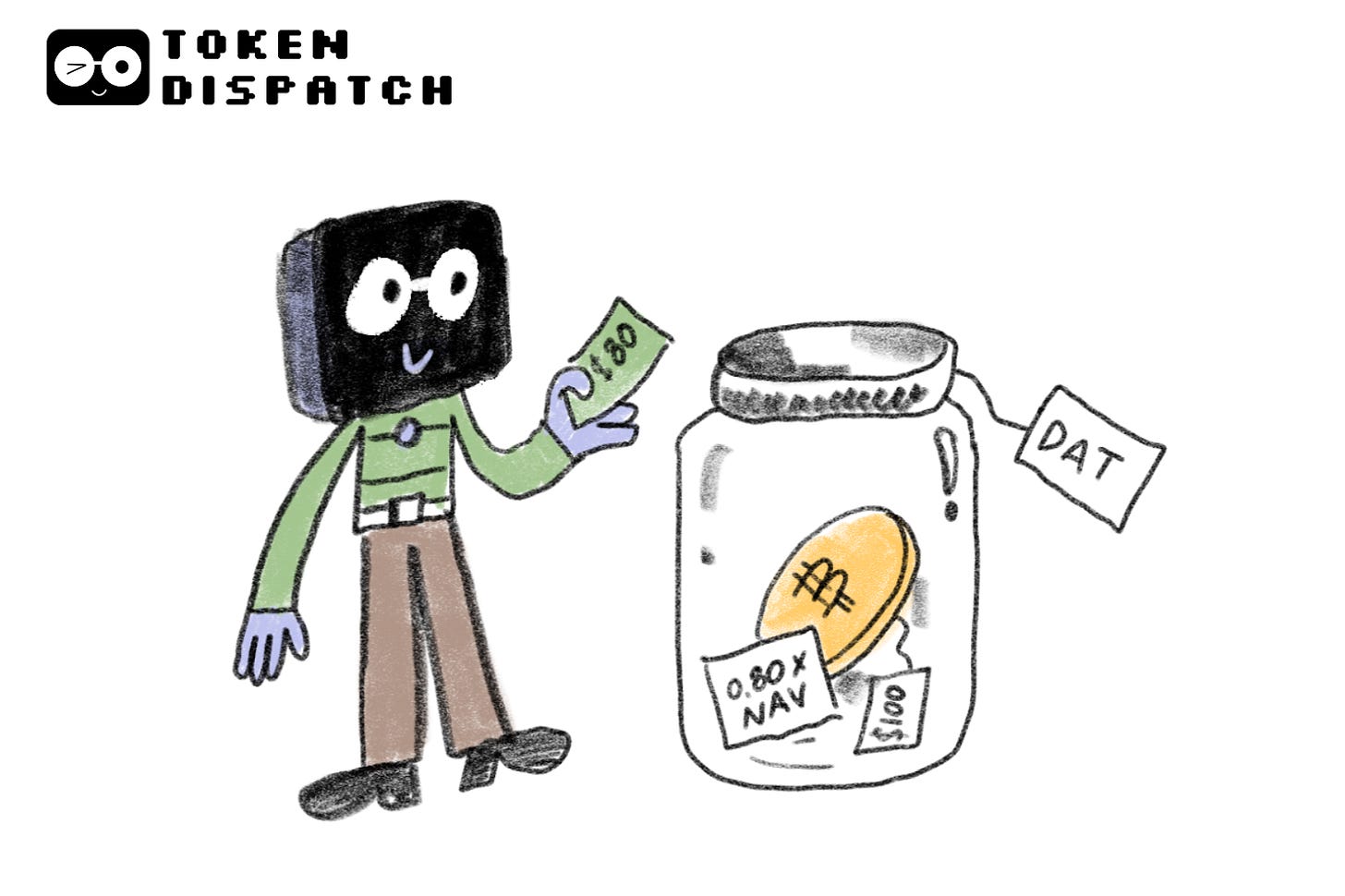
Between 2024 and 2025, over 30 companies rushed to transform into DATs. They built treasuries around blue-chip coins like Bitcoin, ETH, and SOL, and even meme coins.

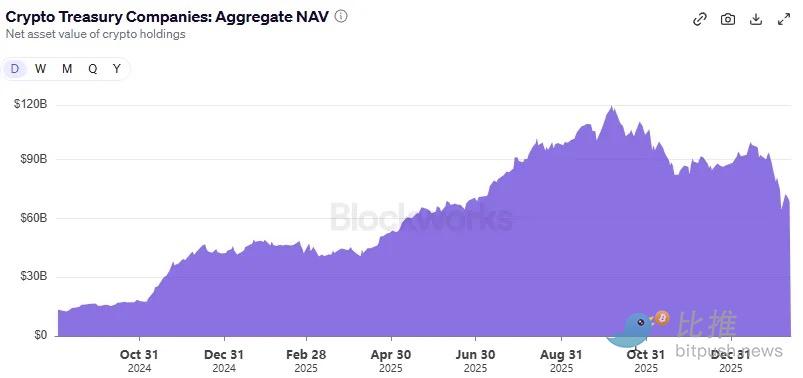
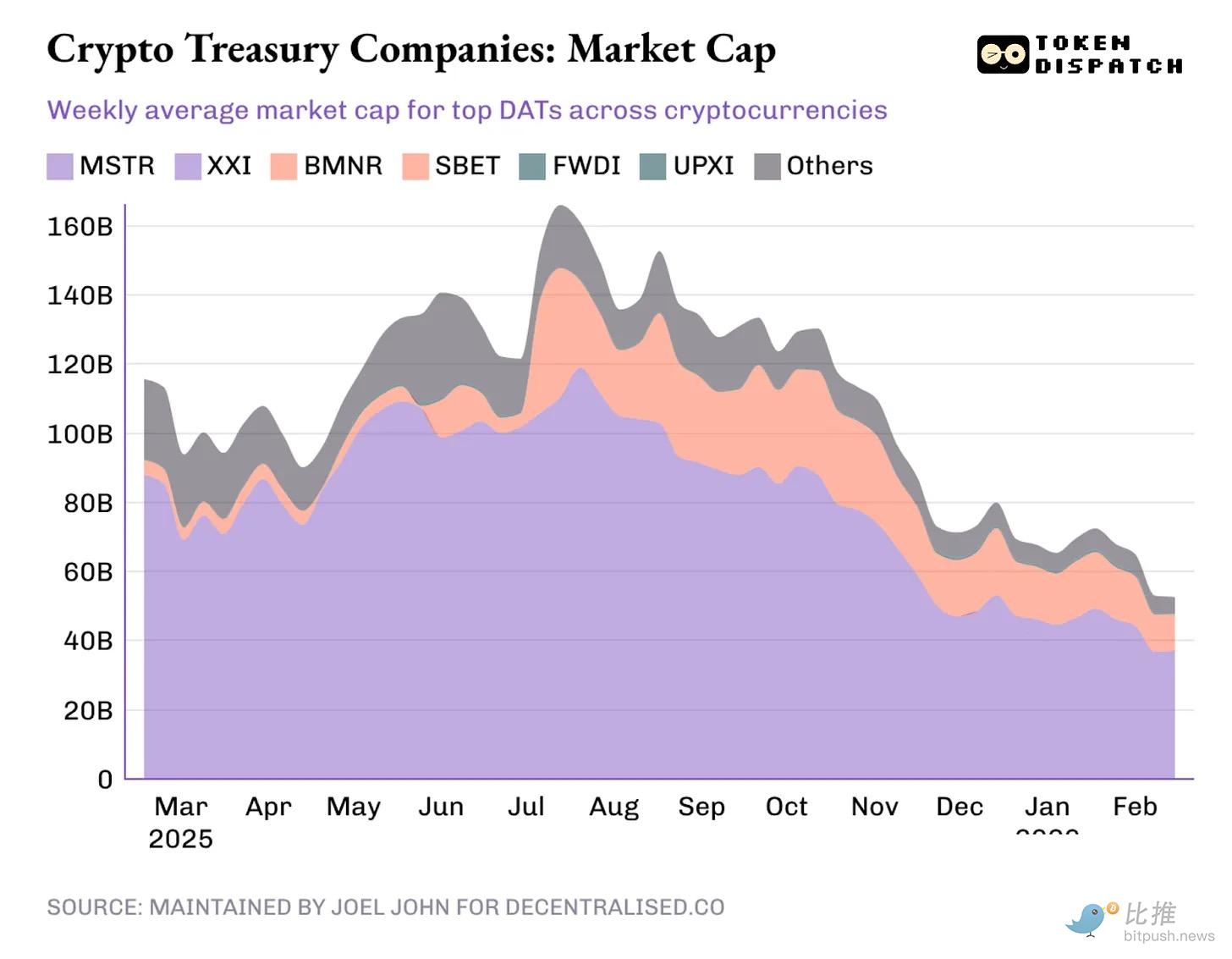
At their peak on October 7, 2025, DATs held cryptocurrencies worth $118 billion, with a total market capitalization of over $160 billion for these companies. Today, DATs hold cryptocurrencies worth $68 billion, while their discounted total market cap is just over $50 billion.
All their fates hinge on one thing: their ability to wrap assets and weave a story that makes the wrapper's value exceed the asset's value. This difference becomes the premium.

The premium itself became the product. If the stock traded at 1.5 times mNAV, a DAT could sell $1 worth of stock, then buy $1.5 worth of crypto asset exposure, and describe the transaction as "value-accretive." Investors were willing to pay the premium because they believed the DAT could continue selling shares at a premium and use the proceeds to accumulate more cryptocurrency, thereby increasing the crypto assets per share over time.
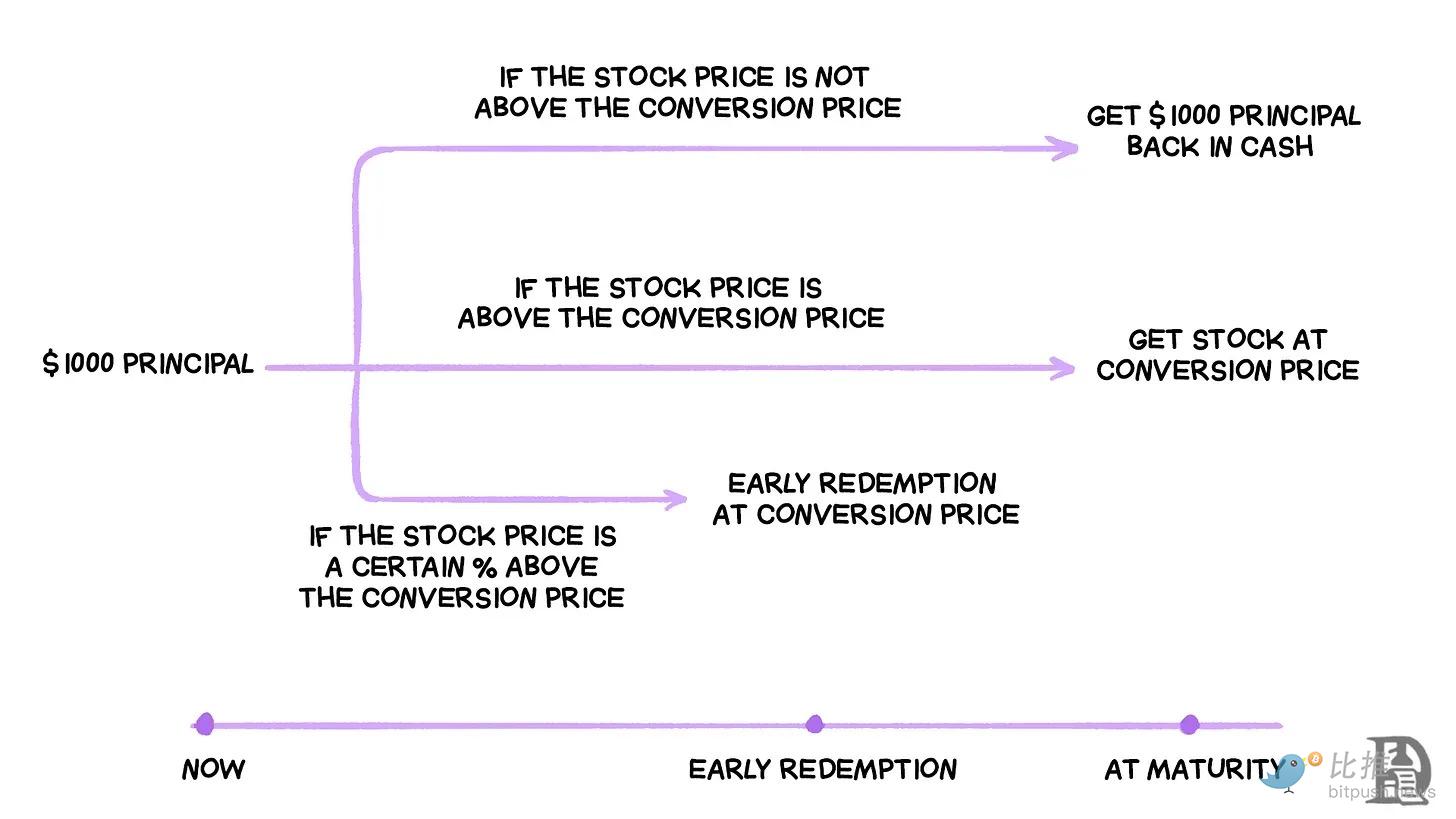
@Decentralised.Co

The problem is, the premium doesn't last forever. Once the market stops paying extra for this wrapper, the "sell stock to buy more crypto" flywheel gets stuck.

When the stock no longer trades at 1.5 times its asset value, each new share issued buys less cryptocurrency. The premium is no longer a tailwind but becomes a discount.

Over the past year, the stock prices of leading BTC, ETH, and SOL DATs have fallen more than the cryptocurrencies themselves.
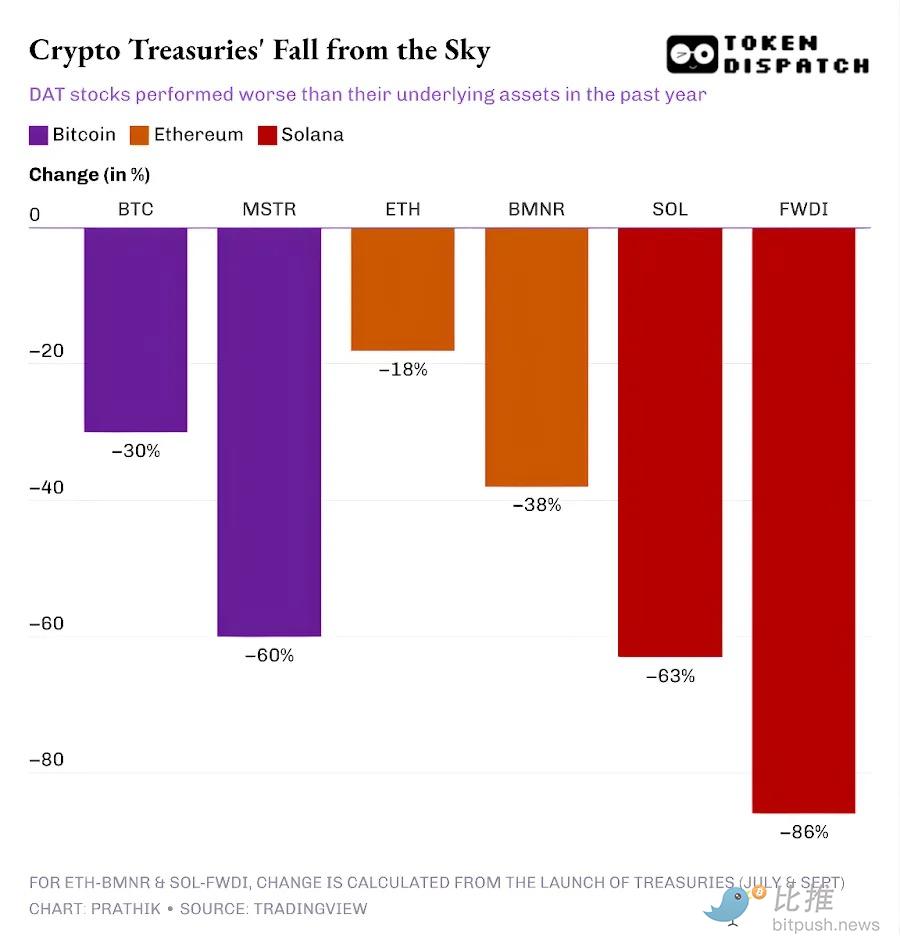
Once the premium of the stock relative to the underlying asset disappears, investors naturally ask why they shouldn't just buy the cryptocurrency directly elsewhere, such as on decentralized or centralized exchanges, or through exchange-traded funds, at a cheaper price.

Matt Levine from Bloomberg raised an important question: If DATs are trading below net asset value, let alone at a premium, why don't investors force the company to liquidate its crypto treasury or buy back shares?

Many DATs, including the sector leader Strategy, have tried to convince investors that they will hold the cryptocurrency through the bear market cycle, waiting for the return of the premium era. But I see a more critical issue. If DATs cannot raise additional funds for the foreseeable long term, where do they get the money to sustain operations? These DATs have bills and salaries to pay.

Strategy is an exception for two reasons.

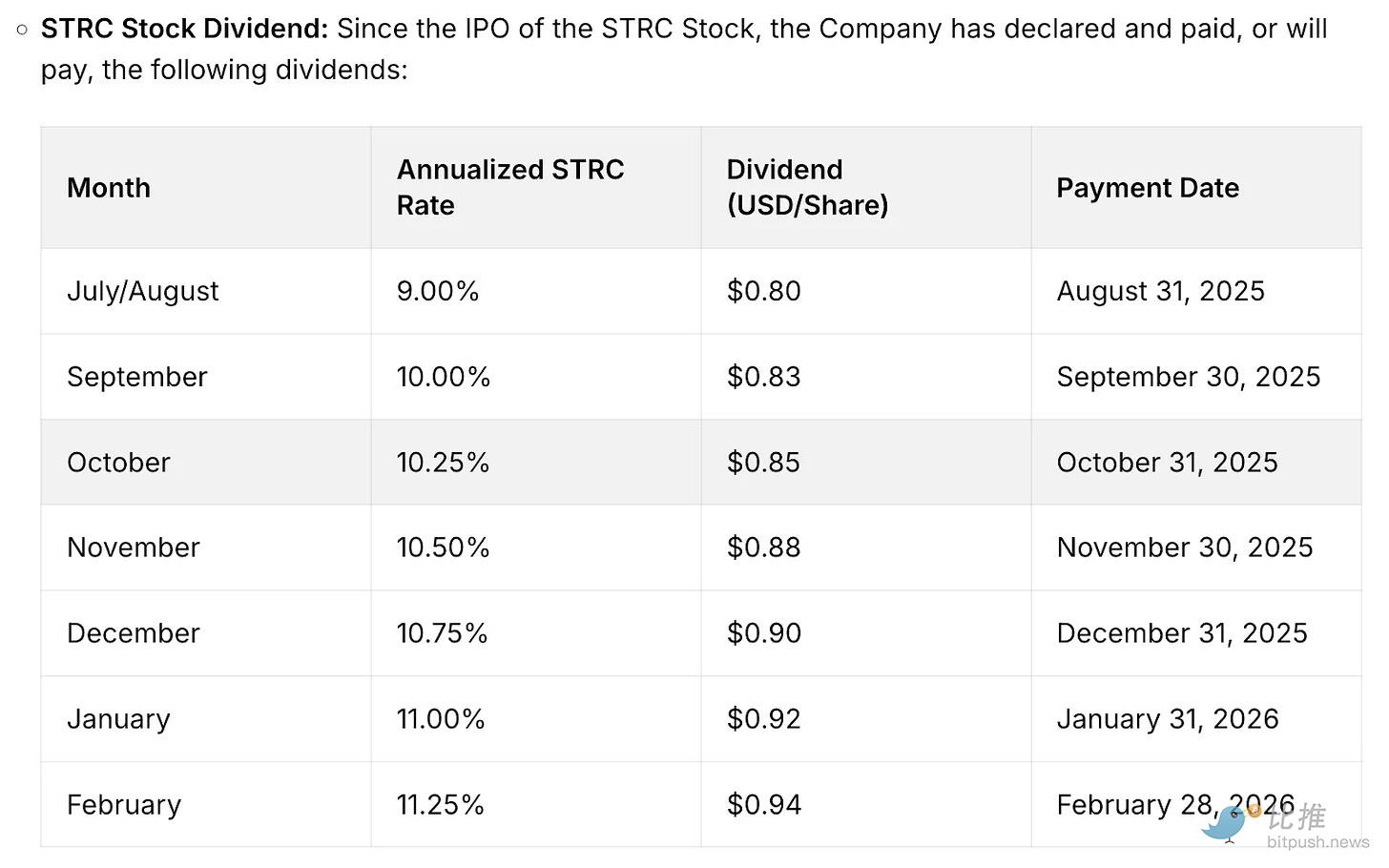
  • It reportedly holds $2.25 billion in reserves, enough to cover its dividend and interest obligations for about 2.5 years. This is important because Strategy no longer relies solely on zero-coupon convertible bonds to raise funds. It has also issued preferred instruments that require paying substantial dividends.
  • It also has an operating business, however small, that still generates recurring revenue. In Q4 2025, Strategy reported total revenue of $123 million and gross profit of $81 million. Although Strategy's net profit can fluctuate significantly due to mark-to-market changes in crypto asset prices each quarter, its business intelligence division is its only tangible source of cash flow.

But this still doesn't make Strategy's strategy foolproof. The market can still punish its stock—as has happened over the past year—and weaken Strategy's ability to continue raising funds at low cost.

While Strategy might weather the crypto bear market, the newer DATs that lack sufficient reserves or operating businesses to cover their inevitable expenses will feel the pressure.

This distinction is even more pronounced among ETH DATs.

The largest Ethereum-based DAT—BitMine Immersion, has a marginal operating business supporting its ETH treasury. In the quarter ended November 30, 2025, BMNR reported total revenue of $2.293 million, including consulting, leasing, and staking revenue.

Its balance sheet shows the company holds digital assets worth $10.56 billion and cash equivalents of $887.7 million. BMNR's operations resulted in a net negative cash flow of $228 million. All its cash needs were met by issuing new shares.

Last year, as BMNR's stock traded at an mNAV premium for most of the year, raising funds was relatively easy. But over the past six months, its mNAV has dropped from 1.5 to about 1.

So what happens when the stock no longer trades at a premium? Issuing more shares at a discount could lower the ETH price per share, making it less attractive to investors than buying ETH directly from the market.

This explains why BitMine said last month it would invest $200 million to acquire shares in Beast Industries, a private company owned by YouTube creator Jimmy "MrBeast" Donaldson. The company said it would "explore ways to collaborate on DeFi initiatives."

ETH and SOL DATs might also argue that staking income—something BTC DATs cannot boast—could help them sustain operations during a market crash. But this still doesn't solve the problem of meeting the company's cash flow obligations.

Even with staking rewards (accrued in cryptocurrencies like ETH or SOL), as long as these rewards are not converted into fiat currency, DATs cannot use them to pay salaries, audit fees, listing costs, and interest. Companies must either have sufficient fiat revenue or sell or re-mortgage their treasury assets to meet cash needs.

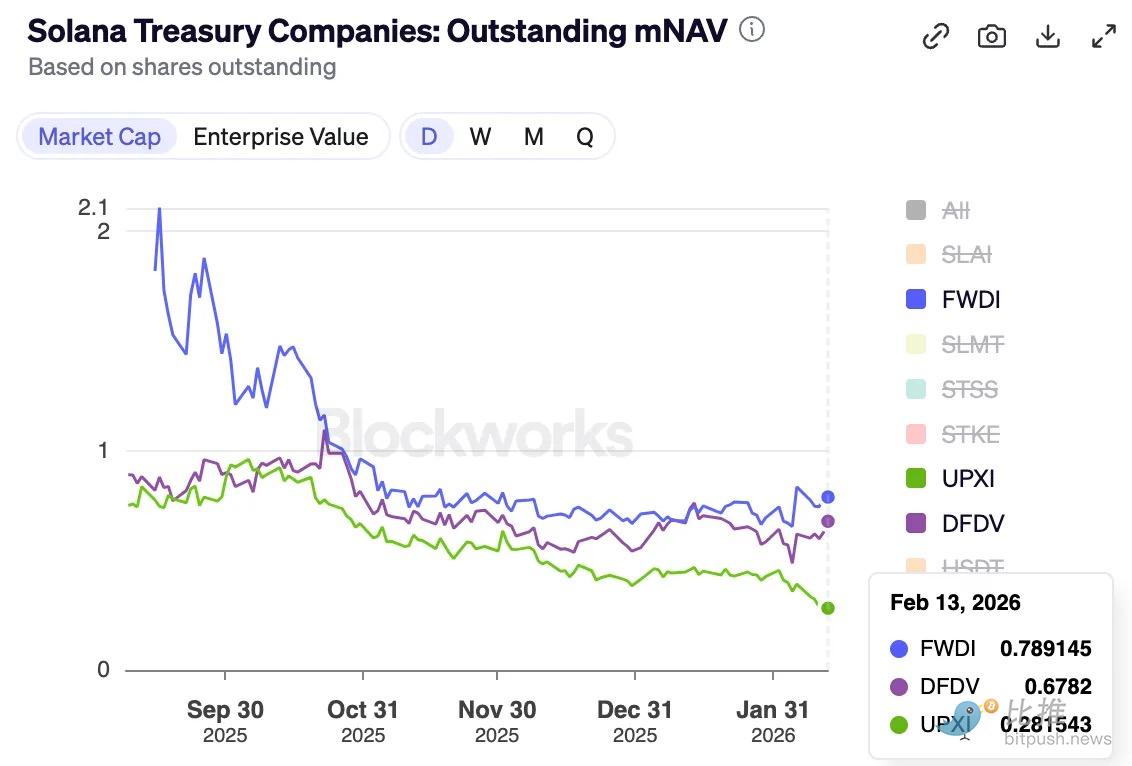
This is evident in the largest SOL-holding DAT—Forward Industries.

FWDI reported a net loss of $586 million in Q4 2025, despite earning $17.381 million in staking and related income.

Management clearly stated that its "existing cash balance and working capital are sufficient to meet our liquidity needs for at least until February 2027."

FWDI also disclosed an active capital raising strategy, including at-the-market stock offerings, buybacks, and a tokenization experiment. However, if the mNAV premium does not exist long-term, all these attempts may fail to manage its wrapper price.
The Path Forward

At the core of last year's DAT frenzy was the speed of asset accumulation and the ability to raise funds by issuing shares at a premium. As long as the wrapper could trade at a premium, DATs could continue converting expensive equity into more crypto assets per share and call it "beta." Investors also pretended the only risk was the asset price itself.

But the premium doesn't last forever. Crypto cycles can turn it into a discount. I wrote about this issue shortly after the 10/10 liquidation event last year, when I first observed the premium decline.

However, this bear market will prompt DATs to assess whether they should continue to exist once their wrapper no longer trades at a premium.

One way to resolve this dilemma is for companies to enhance their operational efficiency, supplementing their DAT strategy with a business that generates positive cash flow or surplus reserves. This is because when the DAT story can no longer attract investors in a bear market, a regular corporate story will determine its survival.

If you've read the article "Strategy & Marathon: Belief and Power," you'll recall why Strategy has remained standing through multiple crypto cycles. However, the new batch of companies, including BitMine, Forward Industries, SharpLink, and Upexi, cannot rely on the same strength.

Their current attempts with staking yields and weak operating businesses might crumble under market pressure unless they consider other options to cover real-world obligations.

We observed this with ETHZilla, an Ethereum treasury company that sold about $115 million worth of ETH holdings last month and bought two jet engines. The DAT then leased the engines to a major airline and hired Aero Engine Solutions to manage them for a monthly fee.

Going forward, people will evaluate not only the digital asset accumulation strategy but also the conditions under which it can survive. In the ongoing DAT cycle, only companies that can manage dilution, liabilities, fixed obligations, and trading liquidity will weather the market downturn.


Twitter:https://twitter.com/BitpushNewsCN

Bitpush TG Discussion Group:https://t.me/BitPushCommunity

Bitpush TG Subscription: https://t.me/bitpush

Original article link:https://www.bitpush.news/articles/7612658

Связанные с этим вопросы

QWhat is the core financial mechanism that initially drove the success of Digital Asset Treasuries (DATs), and why has it broken down?

AThe core mechanism was a financial flywheel where DATs bought cryptocurrencies, saw their stock trade at a premium to the asset value (mNAV > 1), issued more stock at that premium, and used the proceeds to buy more crypto, repeating the cycle. This broke down because the crypto bear market caused the mNAV for most DATs to fall below 1 (a discount), making it dilutive and unattractive to issue new shares to raise funds.

QAccording to the analysis, what are the two key reasons that make MicroStrategy an exception among DATs and potentially able to survive a prolonged crypto bear market?

AFirst, it reported holding $2.25 billion in reserves, enough to cover its dividend and interest obligations for about 2.5 years. Second, it has an operational business (its commercial intelligence division) that generates recurring revenue and positive gross profit, providing a tangible source of cash flow separate from its crypto holdings.

QHow does the article differentiate between the challenges faced by BTC DATs and those holding ETH or SOL?

AWhile all DATs face the core problem of the broken financial flywheel, ETH and SOL DATs can point to staking rewards as a potential source of income, which BTC DATs cannot. However, the article argues that this is insufficient because staking rewards are earned in crypto and cannot directly pay for real-world operating expenses like salaries and fees unless converted to fiat, which may require selling assets.

QWhat potential solution does the article suggest for DATs to survive when their shares trade at a discount to their net asset value (mNAV < 1)?

AThe article suggests that DATs need to improve their operational efficiency by supplementing their crypto strategy with a business that generates positive cash flow or a surplus of reserve funds. This shifts the investment story from purely being a crypto wrapper to being a conventional company that can survive based on its operational merits during a bear market.

QWhat specific real-world example does the article provide of a DAT attempting to pivot its strategy to generate cash flow beyond crypto staking?

AThe article cites the example of ETHZilla, an Ethereum treasury company that sold approximately $115 million worth of ETH and used the proceeds to purchase two jet engines. It then leased these engines to a major airline and hired a management company to handle them for a monthly fee, creating a new stream of operational, fiat-based revenue.

Похожее

KOL's Perspective: Why Is SOL Set to Rise from This Point?

**Summary: Why SOL is Positioned for Growth at This Level** The article argues that SOL is poised for an upward move from its current price point, citing several key factors. Primarily, SOL has just broken out of a 4-month consolidation phase. This breakout signals a return of risk appetite to the broader crypto market, as SOL is seen as a key indicator of overall crypto health. The token's ownership has reportedly shifted from short-term traders and tourists to long-term accumulators, leading to low volume. Any meaningful increase in trading activity could thus trigger significant upward momentum. Fundamental strengths include strong institutional adoption, integration with DeFi and RWAs (Real-World Assets), and the potential benefits from the Clarity Act. Despite its high volatility—having dropped 70% from its all-time high but still up 12x from its bear market low—SOL is highlighted as one of the few tokens from the last cycle to reach new highs. It boasts a robust ecosystem of applications, users, and protocols. Future catalysts include the expected influx of AI developers following the Miami Accelerate conference, which focused on AI on Solana. Furthermore, Solana is positioned as the premier chain for memecoin activity, a trend expected to continue and drive network usage and fees. The article concludes that recent price action reflects a healthy transfer to long-term holders, setting the stage for growth.

marsbit49 мин. назад

KOL's Perspective: Why Is SOL Set to Rise from This Point?

marsbit49 мин. назад

Those Pre-Bitcoin PoW Protocols Have Recently Been Reimplemented

This article details a recent surge in replicating pre-Bitcoin Proof-of-Work (PoW) protocols, specifically focusing on Hal Finney's 2004 RPOW (Reusable Proofs of Work). Within five days in May 2026, multiple independent builders in the Bitcoin/cypherpunk community launched projects inspired by this early electronic cash proposal. The initiative began with Fred Krueger's `rpow2.com`, a centralized but auditable system that replaced RPOW's original IBM 4758 hardware with Ed25519 signatures. Initially a faithful replica, it later adopted Bitcoin-like features (21M supply cap, difficulty adjustment) and a controversial 5.24% founder allocation. This sparked rapid forks, including `rpow4.com` which incorporated full Bitcoin parameters, a prediction market (`rpowmarket.com`), and a DEX (`rpow2swap.com`). Concurrently, Mike In Space created a prototype of Wei Dai's 1998 b-money proposal (`b-money.replit.app`), pushing the historical exploration even further back. The article contrasts these centralized, server-dependent experiments with Bitcoin's core innovation of decentralized, trustless consensus. It also highlights a parallel development: the `HASH` project on Ethereum, which uses smart contract hooks to enable a purely fair-launch, browser-mineable PoW token with 0% allocations to team or VCs. The collective activity is framed as a meme-driven, educational exploration of cypherpunk history rather than a serious financial movement, with all projects heavily disclaiming any investment value.

marsbit54 мин. назад

Those Pre-Bitcoin PoW Protocols Have Recently Been Reimplemented

marsbit54 мин. назад

South Korean Exchanges 'Battle' Regulators, Challenging the Boundaries of Enforcement and Legislation

South Korea's cryptocurrency industry is engaged in a rare, direct confrontation with regulators. The Financial Intelligence Unit (FIU), the primary anti-money laundering (AML) watchdog, has recently imposed heavy penalties on major exchanges like Upbit and Bithumb for alleged violations involving unregistered overseas VASPs and AML procedures. However, exchanges are now actively challenging these actions in court and through industry associations. In a significant shift, the Seoul Administrative Court ruled in favor of Upbit's operator, Dunamu, overturning part of an FIU-ordered business suspension. The court found the FIU's penalty criteria and justification insufficiently clear. Similarly, the court suspended the enforcement of a six-month business suspension against Bithumb pending a final ruling, citing potential irreversible harm to the exchange. Beyond legal battles, the industry is contesting proposed legislative amendments. The Digital Asset eXchange Alliance (DAXA) strongly opposes a draft rule that would mandate Suspicious Transaction Reports (STRs) for all crypto transfers over 10 million KRW (~$6,800). DAXA argues this "poison pill" clause violates legal principles and would overwhelm the STR system, increasing reports from 63,000 to an estimated 5.45 million annually for major exchanges, thereby crippling effective AML monitoring. This conflict highlights a structural tension in South Korea's crypto governance: comprehensive digital asset laws are still developing, while regulators rely heavily on AML enforcement. The industry's move from passive compliance to active legal and legislative challenges signifies a new phase, pressing for clearer rules and more proportionate enforcement. While short-term disputes may intensify, this clash could ultimately lead to a more mature and sustainable regulatory framework for South Korea's vibrant crypto market.

marsbit1 ч. назад

South Korean Exchanges 'Battle' Regulators, Challenging the Boundaries of Enforcement and Legislation

marsbit1 ч. назад

After 50x Storage Surge, Justin Sun Always Looks to the Next Decade

Sun Yuchen, known for his controversial stunts like a $30 million lunch with Warren Buffett (canceled due to a kidney stone) and eating a $6.2 million duct-taped banana, is often overshadowed by a significant fact: his decade-long track record of spotting major investment trends. In 2016, he famously advised young people to invest in Bitcoin, Nvidia, Tesla, and Tencent instead of buying property. A hypothetical $20,000 investment in Nvidia and Tesla from that list would now be worth over 50 million RMB. His latest major call was on November 6, 2025, predicting a "50x storage opportunity" tied to the AI boom, which materialized with Sandisk's stock surging nearly 50-fold by 2026. Looking ahead, Sun now focuses on the next frontier: Physical AI. He identifies four key areas: 1. **Embodied AI/Robotics**: He sees this reaching its "iPhone moment," with companies like UBTech and Galaxy General leading in commercialization. 2. **Drones**: Viewed as the first commercially viable form of Physical AI, revolutionizing sectors from warfare (e.g., AeroVironment's Switchblade) to logistics. 3. **Spatial Computing**: Beyond VR, it's about AI understanding physical space, a foundational technology for robotics and autonomous systems, exemplified by Apple's Vision Pro. 4. **Space Exploration**: After a 2025 suborbital flight with Blue Origin, Sun advocates for space as the ultimate frontier, discussing blockchain's potential role in space asset management and data transactions. His investment philosophy involves betting on entire, inevitable trends rather than single companies. For robotics, he sees Tesla (the body/manufacturer) and Nvidia (the brain/AI platform) as complementary plays. In defense drones, he highlights companies making tanks obsolete (AeroVironment) and those augmenting fighter jets (Kratos). For space, he participated in Blue Origin's flight and anticipates SpaceX's potential IPO to redefine the sector's valuation. Sun Yuchen's vision frames the next two decades not as a revolution in information flow (like the internet), but in the fundamental operation of the physical world through AI-powered robots, autonomous systems, and spatial intelligence, ultimately extending human and AI activity into space. While many still focus on conventional assets, he continues to look toward the next technological horizon.

marsbit2 ч. назад

After 50x Storage Surge, Justin Sun Always Looks to the Next Decade

marsbit2 ч. назад

Торговля

Спот
Фьючерсы
活动图片