The Economic Calculus Behind Polymarket's Exit from Polygon

marsbitОпубликовано 2025-12-23Обновлено 2025-12-23

Введение

Polymarket, a leading prediction market platform, has announced plans to migrate from the Polygon network to its own Ethereum Layer 2 solution, named POLY. This move, confirmed by a team member on Discord, is driven by both product and economic motivations. Product-wise, the migration aims to provide a more stable and customizable infrastructure tailored to Polymarket’s specific needs, addressing limitations posed by Polygon’s occasional network instability. Economically, Polymarket seeks to capture and retain the full value of its ecosystem, preventing economic spillover to external networks. Data highlights Polymarket’s significant contribution to Polygon’s ecosystem: it accounts for approximately one-quarter of Polygon’s total value locked (~$326M vs. $1.19B) and around 23% of its gas consumption. The platform also drives substantial USDC liquidity and user activity on Polygon. The timing of the migration appears strategic, coinciding with Polymarket’s anticipated token generation event (TGE). Moving before token issuance reduces complexity and allows the project to reposition itself as a full-stack “app + chain” system, potentially unlocking higher valuation and narrative appeal. This shift reflects a broader trend where top-tier applications, having achieved scale and economic independence, may choose to decouple from underlying networks that no longer provide sufficient added value.

Author|Azuma(@azuma_eth)

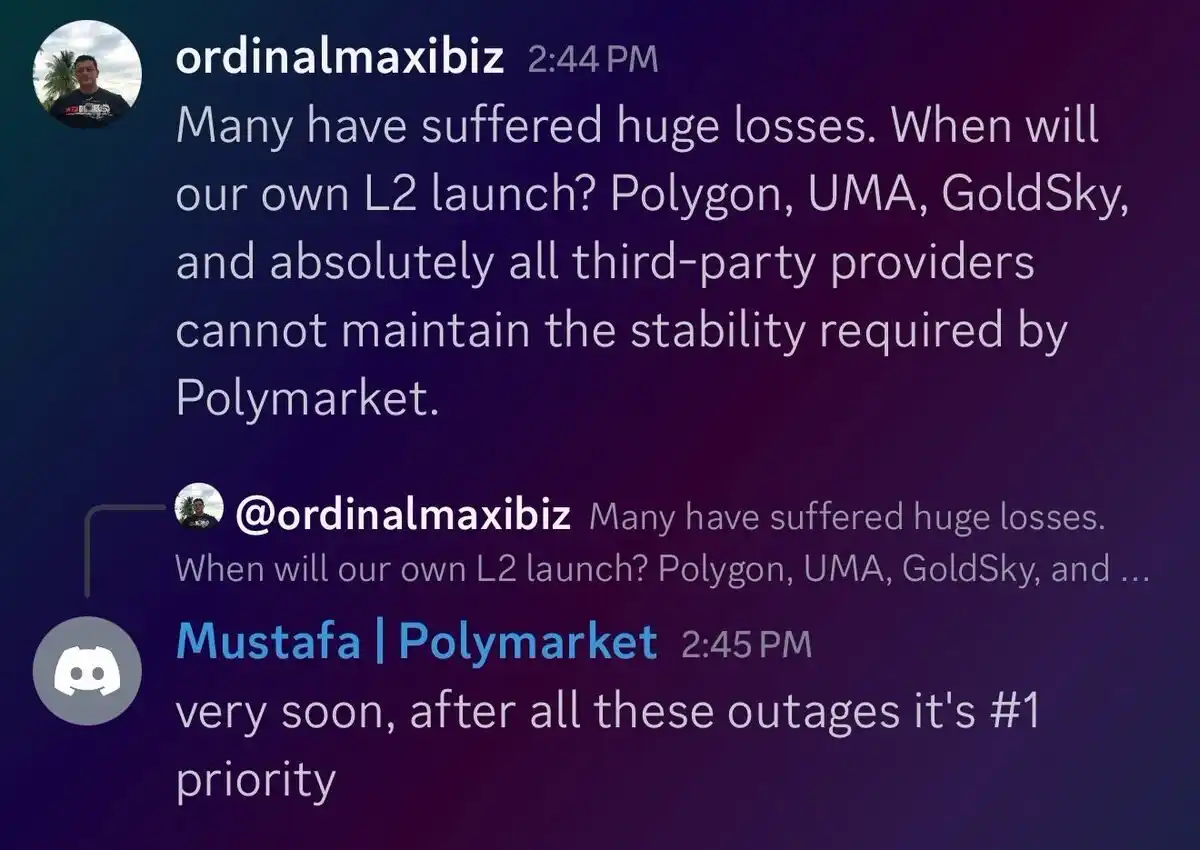
On December 22, news about the prediction market leader Polymarket sparked widespread attention — Mustafa, a team member of Polymarket, confirmed in the Discord community that Polymarket plans to migrate from Polygon and launch an Ethereum Layer2 network named POLY, which is the project's current top priority.

A Not-So-Surprising "Breakup"

Polymarket's decision to leave Polygon is not entirely unexpected. One is a red-hot application layer representative, the other is a gradually declining old infrastructure; the market heat and value expectations between the two were somewhat mismatched. As Polymarket gradually grows into a new behemoth, Polygon's relatively unstable network performance (the latest outage occurred on December 18) and relatively weak ecosystem have objectively become limitations for the former.

For Polymarket, building its own portal means a win-win choice in both product and economic dimensions.

In terms of product, besides seeking a more stable operating environment, building its own Layer2 network can help Polymarket tailor underlying features according to its platform needs, thereby more flexibly adapting to future upgrades and iterations of the platform.

The more significant meaning, however, lies in the economic aspect. Building its own network means Polymarket can bring the economic activities and peripheral services derived from its platform into its own system, preventing related value from spilling over to external networks, and instead gradually solidifying it into its own systemic advantages.

Explicit and Implicit Economic Contributions

As an application layer, Polymarket's explosive growth once brought substantial direct economic contributions to Polygon. Data history compiled by analyst dash on Dune shows:

  • Polymarket's monthly active users this month were 419,309, with a historical total of 1,766,193 users;
  • Total transactions this month were 19.63 million, with a historical total of 115 million transactions;
  • Total trading volume this month was $1.538 billion, with a historical total of $14.3 billion.

As for how to assess the proportion of Polymarket's contribution to the Polygon ecosystem's economy, Odaily Planet Daily discovered a rather coincidental ratio when compiling data from both.

  • First, in terms of deposited funds, Defillama data shows that the total value of positions on the Polymarket platform is currently about $326 million, accounting for about a quarter of Polygon's total network TVL of $1.19 billion;
  • Second, regarding gas consumption, Coin Metrics reported last October that transactions related to Polymarket were estimated to consume 25% of Polygon's total network gas;
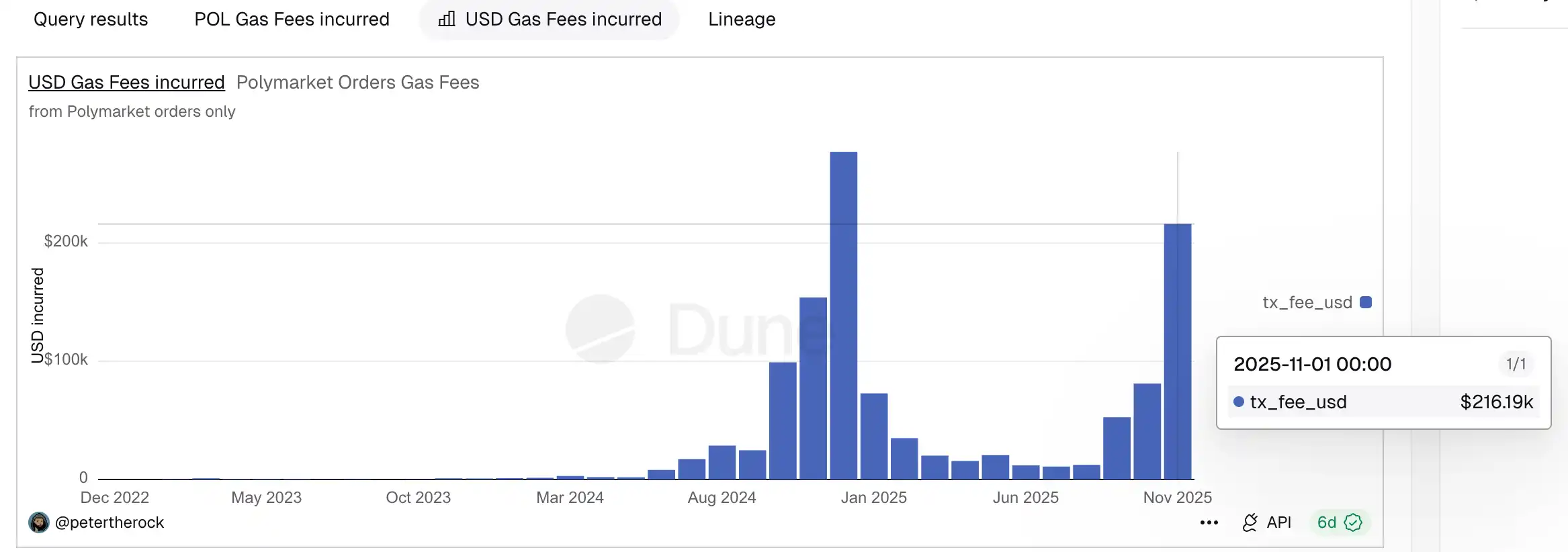
  • Considering this data is relatively old, we checked recent changes. Statistics charted by analyst petertherock on Dune show that in November, transactions related to Polymarket consumed about $216,000 in gas, while Token Terminal statistics show that Polygon's total network gas consumption that month was about $939,000, a ratio also close to a quarter (about 23%).

While this might be a coincidence due to statistical calibers and time windows, similar results across dimensions can serve as an estimated reference for measuring Polymarket's economic significance to Polygon.

Beyond quantifiable metrics like active users, deposited funds, transaction volume, and gas contributions, Polymarket's economic significance to Polygon is also reflected in a series of implicit contributions that are harder to measure directly but equally real.

First is the activation of stablecoin liquidity. All Polymarket transactions are settled in USDC. Its high-frequency, continuous trading behavior objectively significantly increases the circulation demand and usage scenarios for USDC on the Polygon network. Second is the附带价值 (fùdài jiàzhí -附带价值) of retained users'附带行为. Beyond the prediction market itself, these users might also turn to using other products on the Polygon ecosystem, such as DeFi, for convenience, thereby enhancing the overall ecological value of the Polygon network. These contributions are difficult to quantify with specific data but constitute the "real demand" that underlying networks value most and find most scarce.

Why Now? The Answer Isn't Hard to Guess

In fact, judging solely by user scale, data performance, and market presence, Polymarket is already fully confident to stand on its own. This is no longer a question of "should we leave," but rather "when to leave."

The core reason for choosing this particular moment to initiate the migration likely lies in the approaching Polymarket TGE (Token Generation Event). On one hand, once Polymarket completes its token issuance, its governance structure, incentive system, and economic model will become relatively solidified, making the cost and complexity of a subsequent底层迁移 (dǐcéng qiānyí - underlying migration) significantly higher; on the other hand, upgrading from a "single application" to a "application + infrastructure" full-stack system itself implies a change in valuation logic. Building its own Layer2 undoubtedly opens a higher ceiling for Polymarket in terms of narrative and capital.

In summary, Polymarket's departure from Polygon is essentially not just a simple underlying migration, but a microcosm of structural changes in the crypto industry. When top-tier applications begin to possess the ability to independently carry users, traffic, and economic activity, underlying networks that cannot provide additional value will inevitably be "betrayed."

Nothing more, just profit-seeking nature.

Связанные с этим вопросы

QWhy is Polymarket planning to migrate from Polygon to its own Layer2 network?

APolymarket is migrating to its own Layer2 network, named POLY, to achieve a more stable operating environment, customize the underlying infrastructure to better suit its platform's needs, and capture the economic value generated by its activities within its own ecosystem rather than allowing it to spill over to an external network like Polygon.

QWhat were some of the key economic contributions Polymarket made to the Polygon ecosystem?

APolymarket contributed significantly to Polygon's economy, accounting for approximately one-quarter of its total value locked (TVL) and gas consumption. It also drove substantial user activity, transaction volume, and helped vitalize USDC liquidity on the network.

QWhat specific data points illustrate Polymarket's user and transaction scale?

AAs of the article's data, Polymarket had 419,309 monthly active users and over 1.76 million historical users. It processed 19.63 million transactions in a month, with a total historical transaction count of 115 million, and a monthly transaction volume of $1.538 billion, accumulating to $14.3 billion historically.

QWhat is a major reason cited for Polymarket's decision to migrate at this particular time?

AA core reason for the timing of the migration is the impending Token Generation Event (TGE). Migrating before the token launch avoids the increased complexity and cost of doing so afterward and allows Polymarket to upgrade its valuation narrative from a single application to a full-stack 'app + chain' system.

QWhat does the author suggest is the broader implication of Polymarket's move for the crypto industry?

AThe author suggests that Polymarket's move is a microcosm of structural change in the crypto industry, where top-tier applications with the ability to independently support users, traffic, and economic activity will migrate away from underlying networks if those networks fail to provide additional value, driven primarily by the pursuit of greater economic benefit.

Похожее

Silicon Valley 'Startup Guru' Steve Hoffman: Web3 + AI Could Be a Trap

Silicon Valley investor and "Godfather of Startups" Steve Hoffman warns that combining Web3 with AI is likely a trap, not a promising venture. In an interview, Hoffman argues that while AI is a foundational technology touching all industries, Web3 adds complexity, friction, and regulatory risk without solving mainstream consumer or business needs. He advises founders to focus on deep, specialized applications where startups can out-iterate giants, rather than on generic features easily replicated by large tech companies. Hoffman observes that Silicon Valley will lead foundational AI research, while China excels at rapid, large-scale application and commercialization, particularly in robotics. He stresses that AI-driven autonomous agents capable of collaborative, multi-step tasks are 2-4 years away, which will cause significant job displacement. The solution is not to slow AI but to redesign business models around human-AI collaboration and reform social systems like education and retraining. For startups, Hoffman recommends focusing on vertical, expertise-heavy domains to build defensibility. He sees major opportunities in AI fraud detection and cybersecurity. Key founder mindsets include systemic thinking over feature-focus, relentless customer centricity, building adaptive teams, and deeply understanding AI's capabilities and limits. Hoffman is also leading a non-profit initiative to establish university centers aimed at training future leaders in responsible, human-value-aligned AI innovation.

marsbit1 ч. назад

Silicon Valley 'Startup Guru' Steve Hoffman: Web3 + AI Could Be a Trap

marsbit1 ч. назад

Token Inefficient, Economy Tokenless

The article "Tokens Aren't Economical, Economics Aren't Tokenized" analyzes a pivotal shift in the AI industry from a technology-driven narrative to one dominated by capital efficiency. It highlights two concurrent trends: a severe capital shortage due to the exorbitant and recurring costs of compute (e.g., OpenAI's high burn rate) and a wave of corporate spin-offs where major tech companies are separating their AI units (like Kuaishou's Kling and Baidu's Kunlunxin). The core argument is that AI's "anti-internet" business model, where user growth increases costs rather than profits, has created a disconnect between high valuations and actual cash flow. Spin-offs address this by allowing AI assets to be valued independently. Within a parent company, they are seen as cost centers, but as standalone entities, they are priced based on their growth potential and scarcity in the primary market, leading to massive valuation premiums (e.g., Kling's estimated value tripling post-spin-off). The industry is at an inflection point, moving from "model worship" to "value realization." The competition is evolving from a pure compute (GPU) race to a broader focus on systemic efficiency and full-stack engineering (involving CPUs and orchestration) to achieve viable commercialization. The year 2026 is framed as a critical moment where the industry must definitively answer how to economically translate AI capability into tangible business value, reshaping the sector's future power structure.

marsbit1 ч. назад

Token Inefficient, Economy Tokenless

marsbit1 ч. назад

Crossing the 'Memory Wall': The Wafer-Level Revolution and Computing Power Routes in the AI Inference Era

In 2026, a historic shift occurred in AI as major cloud providers' inference spending surpassed training spending for the first time, signaling a move from "building large models" to "using large models." This shifts the core challenge from computing power to the "memory wall"—the bottleneck of data movement (model weights, activations, KV Cache) between external DRAM and processors, where energy and latency from data transfer far exceed computation itself. Companies like Nvidia face GPU idle time due to bandwidth limits. In contrast, Cerebras Systems adopts a radical "wafer-scale" approach with its Wafer-Scale Engine (WSE). Instead of cutting a silicon wafer into many chips, Cerebras uses almost the entire wafer as one massive chip (WSE-3). This design provides 44GB of on-chip SRAM, delivering memory bandwidth thousands of times higher than traditional HBM (e.g., 21 PB/s vs. Nvidia B200). For LLM inference, weights are streamed layer-by-layer from external MemoryX storage to the chip, avoiding HBM bottlenecks. This results in token generation speeds 1.5–5 times faster than Nvidia's B200 in some models and significant advantages in first-token latency and long-context tasks. Additionally, Cerebras's architecture offers much lower interconnect power consumption (0.15 pJ/bit vs. GPU's ~10 pJ/bit). However, Cerebras faces challenges: SRAM scaling has slowed with advanced nodes, limiting future capacity gains; the chip requires specialized liquid cooling and custom software stacks; and its external I/O bandwidth (150 GB/s) is low compared to NVLink, hindering multi-system scaling for very large models. Competition is intensifying. Major players are pursuing three paths: 1) Developing proprietary inference ASICs (e.g., Google TPU, Microsoft Maia), 2) Leveraging advanced packaging (e.g., TSMC's SoW) to democratize wafer-scale-like integration, potentially eroding Cerebras's process advantage within a few years, and 3) Exploring optical interconnects for ultimate bandwidth. Commercially, Cerebras is transitioning from a hardware vendor to a service provider, facing the immense challenge of building high-power, specialized data centers to meet large contracts (e.g., 250MW/year from 2026–2028). In conclusion, the AI inference era presents a fundamental architectural trade-off. Cerebras opts for extreme physical optimization for low-latency, single-task performance, while Nvidia prioritizes versatility and massive cluster throughput. The path forward remains uncertain, with technology and business models still evolving in the race toward advanced AI.

marsbit1 ч. назад

Crossing the 'Memory Wall': The Wafer-Level Revolution and Computing Power Routes in the AI Inference Era

marsbit1 ч. назад

Has Bitcoin's 'Rebound Ended', Officially Entering the Late Bear Market Phase?

**Title: Has Bitcoin's Rebound Ended, Entering the Late Bear Market Phase?** **Summary:** Bitcoin's price has declined by 13% this week, signaling a potential return to late-stage bear market conditions. The price fell to around $67k, positioned between the Realized Price and Realized Cap Weighted Average. For the first time since early 2022, the Short-Term Holder cost basis has dropped below this key average, confirming a hallmark of late-cycle bear markets. Profitability metrics have collapsed sharply. The 7-day average of the Realized Profit/Loss ratio plummeted from a local high of 3.16 to 0.29, mirroring the February panic sell-off. Critically, the 90-day average never breached the threshold of 2, indicating the recent rally to $82k was a bear market bounce, not a structural shift. Realized losses surged to $1.35 billion daily, with $770 million coming from Long-Term Holders selling at a loss. This accelerating redistribution of supply from weak to strong hands is a necessary but ongoing process for a market bottom. The rally stalled almost precisely at the aggregate cost basis (~$83k) of US spot Bitcoin ETF investors, turning that level into strong resistance and leaving the average ETF holder underwater again. Spot market flows have turned decisively negative, showing sellers are dominating order books despite the price drop. While a significant futures long liquidation event cleared over $400 million in leverage, providing a potential reset, sustained spot demand is yet to materialize. Options markets continue to price in higher future volatility (Implied Volatility) than recent price action (Realized Volatility) has shown, with a persistent skew towards put options, indicating ongoing demand for downside protection. In conclusion, multiple metrics point to a fragile market structure. Resistance at the ETF cost basis, accelerating realized losses, dominant spot selling, and cautious options pricing all suggest the bear market trend persists. A sustainable recovery likely requires a resurgence of spot demand, ETF holders returning to profit, and a clear reduction in selling pressure.

marsbit1 ч. назад

Has Bitcoin's 'Rebound Ended', Officially Entering the Late Bear Market Phase?

marsbit1 ч. назад

Торговля

Спот
Фьючерсы

Популярные статьи

Как купить S

Добро пожаловать на HTX.com! Мы сделали приобретение Sonic (S) простым и удобным. Следуйте нашему пошаговому руководству и отправляйтесь в свое крипто-путешествие.Шаг 1: Создайте аккаунт на HTXИспользуйте свой адрес электронной почты или номер телефона, чтобы зарегистрироваться и бесплатно создать аккаунт на HTX. Пройдите удобную регистрацию и откройте для себя весь функционал.Создать аккаунтШаг 2: Перейдите в Купить криптовалюту и выберите свой способ оплатыКредитная/Дебетовая Карта: Используйте свою карту Visa или Mastercard для мгновенной покупки Sonic (S).Баланс: Используйте средства с баланса вашего аккаунта HTX для простой торговли.Третьи Лица: Мы добавили популярные способы оплаты, такие как Google Pay и Apple Pay, для повышения удобства.P2P: Торгуйте напрямую с другими пользователями на HTX.Внебиржевая Торговля (OTC): Мы предлагаем индивидуальные услуги и конкурентоспособные обменные курсы для трейдеров.Шаг 3: Хранение Sonic (S)После приобретения вами Sonic (S) храните их в своем аккаунте на HTX. В качестве альтернативы вы можете отправить их куда-либо с помощью перевода в блокчейне или использовать для торговли с другими криптовалютами.Шаг 4: Торговля Sonic (S)С легкостью торгуйте Sonic (S) на спотовом рынке HTX. Просто зайдите в свой аккаунт, выберите торговую пару, совершайте сделки и следите за ними в режиме реального времени. Мы предлагаем удобный интерфейс как для начинающих, так и для опытных трейдеров.

1.4k просмотров всегоОпубликовано 2025.01.15Обновлено 2026.06.02

Как купить S

Sonic: Обновления под руководством Андре Кронье – новая звезда Layer-1 на фоне спада рынка

Он решает проблемы масштабируемости, совместимости между блокчейнами и стимулов для разработчиков с помощью технологических инноваций.

2.3k просмотров всегоОпубликовано 2025.04.09Обновлено 2025.04.09

Sonic: Обновления под руководством Андре Кронье – новая звезда Layer-1 на фоне спада рынка

HTX Learn: Пройдите обучение по "Sonic" и разделите 1000 USDT

HTX Learn — ваш проводник в мир перспективных проектов, и мы запускаем специальное мероприятие "Учитесь и Зарабатывайте", посвящённое этим проектам. Наше новое направление .

1.8k просмотров всегоОпубликовано 2025.04.10Обновлено 2025.04.10

HTX Learn: Пройдите обучение по "Sonic" и разделите 1000 USDT

Обсуждения

Добро пожаловать в Сообщество HTX. Здесь вы сможете быть в курсе последних новостей о развитии платформы и получить доступ к профессиональной аналитической информации о рынке. Мнения пользователей о цене на S (S) представлены ниже.

活动图片