The answer could be revealed as soon as today; the entire internet is awaiting the 'AI stock god'’s playbook.

marsbitОпубликовано 2026-05-18Обновлено 2026-05-18

Введение

The article discusses the highly anticipated Q1 2026 13F filing from 24-year-old "AI stock guru" Leopold Aschenbrenner's fund, Situational Awareness LP. The fund gained fame after its publicly disclosed holdings skyrocketed from $225 million in Q4 2024 to $5.5 billion in Q4 2025. The market is eagerly awaiting the fund's latest portfolio, seen as a key indicator for AI investment trends. The filing was due by May 15 but has not yet been published. Three potential reasons are explored: 1) A late Friday submission causing an SEC processing delay, with the filing expected imminently. 2) The fund requested confidential treatment from the SEC, suggesting it is building a large, sensitive position. 3) The unlikely scenario that the fund's holdings dropped below the $100 million reporting threshold. The outcome is expected within days. If the filing is released, it will be analyzed for portfolio shifts. If confidential treatment was requested, it will intensify speculation about what major asset Aschenbrenner is accumulating.

Original | Odaily Planet Daily(@OdailyChina)

Author | Azuma(@azuma_eth)

Remember Leopold Aschenbrenner? The 24-year-old “New AI Stock God” we introduced in our article “SBF's Underling Turns $225 Million into $5.5 Billion in One Year”.

Leopold Aschenbrenner worked at FTX's Future Fund in 2022 and remained with the team until FTX's collapse. In 2024, Leopold Aschenbrenner wrote a 165-page super-paper titled “Situational Awareness: The Decade Ahead” and founded a fund of the same name, Situational Awareness LP, the same year, where he serves as Chief Investment Officer.

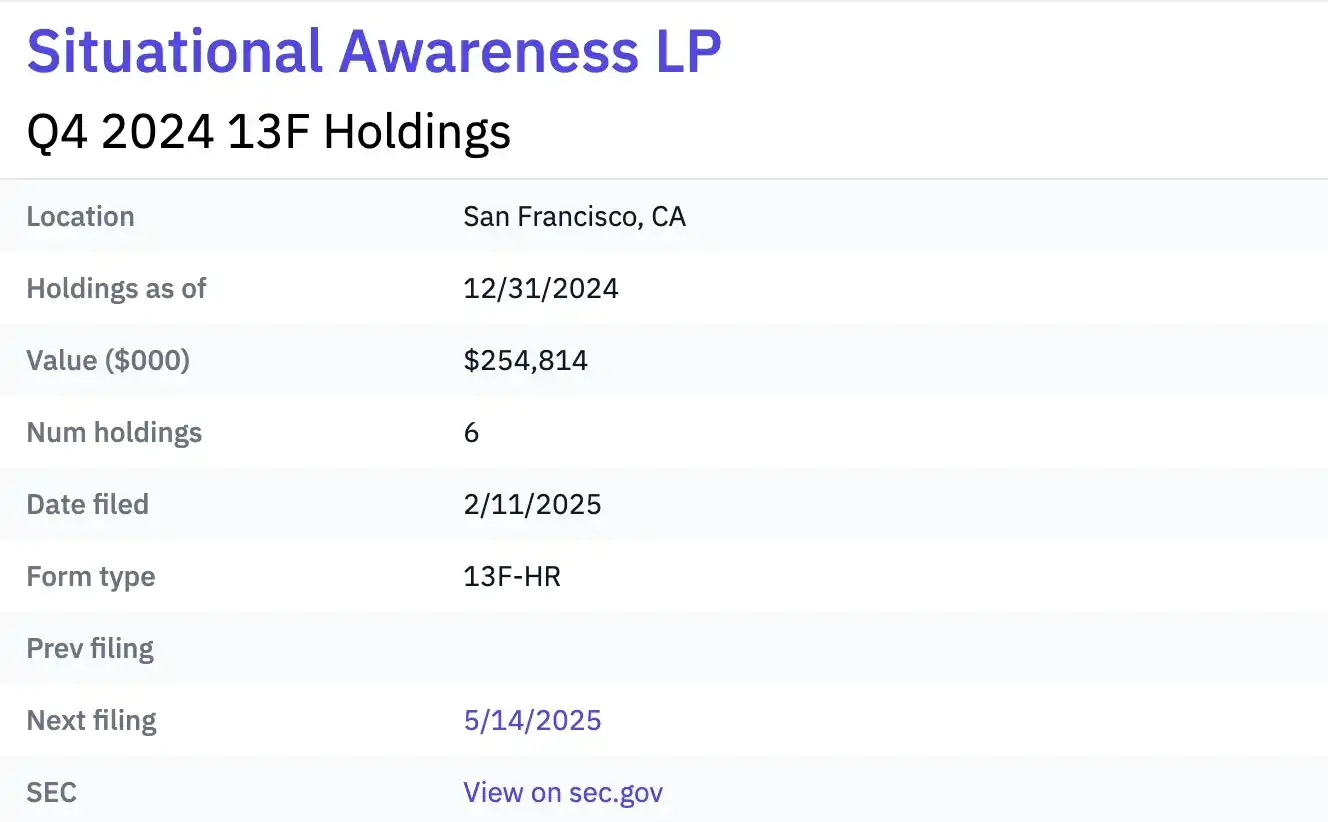
Situational Awareness LP focuses on investment opportunities in the AI industry chain. The fund's publicly disclosed holdings were “only” $225 million in Q4 2024, but by the Q4 2025 holdings disclosure released this February, that number had skyrocketed to $5.5 billion. This explosive investment performance has greatly boosted the reputation of Leopold Aschenbrenner and Situational Awareness LP, making it one of the most closely watched AI investment trends online.

Now, it's once again the critical window for Situational Awareness LP to disclose its holdings (13F). Starting last week, the entire internet has been eagerly waiting for the fund to reveal the current AI investment playbook, but as of publishing, the disclosure from Situational Awareness LP is still awaited.

The so-called 13F is a quarterly disclosure document required by the U.S. Securities and Exchange Commission (SEC) from funds with assets under management exceeding $100 million. The SEC mandates that funds meeting the disclosure requirements must submit this document within 45 days after the end of each calendar quarter. The fund is required to disclose its holdings of U.S. listed stocks, call/put options, convertible bonds, and specific ETF positions as of the end of the previous quarter.

Today is May 18th, three days past the Q1 2026 disclosure deadline of May 15th. Over the past few days, numerous sovereign wealth funds, university endowment funds, and traditional financial institutions have already disclosed their Q1 13F holdings reports, but the market is still waiting for Situational Awareness LP's disclosure.

Based on various market analyses, the following three scenarios may have affected Situational Awareness LP's 13F disclosure progress.

The first possibility is that Situational Awareness LP may have submitted the document to the SEC after 5:30 PM on May 15th. Since that day was a Friday, the SEC may not have had time to process it, so the document would need to be published on the SEC website the following Monday, after which the public could see it.

This is the mainstream market view. If this is the case, we can expect to see Situational Awareness LP's 13F file later today (or tomorrow at the latest).

The second possibility is that Situational Awareness LP has applied to the SEC for confidential treatment. This is a legal mechanism provided by the SEC that allows large funds to delay public disclosure of their holdings information while they are still actively building positions, with delays of up to one year.

Generally, the only reason a fund applies for confidential treatment is that they are building a position large enough that if the market were to learn about it prematurely, it would move the price against them before they finish building. If this is the case, it would mean Leopold Aschenbrenner is quietly accumulating a significant asset and temporarily does not want the market to know. This would undoubtedly warrant even closer market attention.

The third scenario is highly unlikely: Situational Awareness LP significantly reduced its holdings in the past quarter, bringing its portfolio size below the 13F disclosure threshold ($100 million). Considering the fund held $5.5 billion last quarter, the probability of this is extremely low.

In short, we only need to wait another 1 to 2 days to know the real reason for Situational Awareness LP's disclosure delay this time.

If it's the first scenario, we will bring you an analysis of the portfolio changes as soon as the 13F is released. If it's the second reason, the entire internet will truly be on edge—what exactly is Leopold Aschenbrenner hoarding? That would be the moment for internet investigators to shine.

Связанные с этим вопросы

QWhat is the name of the 24-year-old AI investment prodigy featured in the article and his fund?

AThe 24-year-old AI investment prodigy is Leopold Aschenbrenner. The fund he founded and serves as the Chief Investment Officer for is called Situational Awareness LP.

QWhat is a 13F filing according to the U.S. SEC, as explained in the article?

AA 13F filing is a quarterly report mandated by the U.S. Securities and Exchange Commission (SEC) for investment funds managing over $100 million in assets. It requires the fund to disclose its holdings of U.S. exchange-traded stocks, options, convertible bonds, and certain ETFs at the end of the quarter.

QWhat was the extraordinary growth in Situational Awareness LP's publicly disclosed portfolio value between Q4 2024 and Q4 2025?

ASituational Awareness LP's publicly disclosed portfolio value grew from $225 million in Q4 2024 to $5.5 billion in Q4 2025.

QWhat are the three possible reasons suggested in the article for Situational Awareness LP's delayed 13F filing for Q1 2026?

A1. The fund submitted the filing after 5:30 PM on the May 15th deadline (a Friday), and the SEC simply hasn't processed and published it yet. 2. The fund requested confidential treatment from the SEC to delay public disclosure, possibly because it is building a large position and wants to avoid price impact. 3. It's highly improbable, but the fund's holdings may have fallen below the $100 million reporting threshold.

QWhat significant action did Leopold Aschenbrenner take in 2024 besides founding his investment fund?

AIn 2024, besides founding Situational Awareness LP, Leopold Aschenbrenner wrote a 165-page paper titled 'Situational Awareness: The Decade Ahead,' which shares its name with his fund.

Похожее

a16z: How Tokenization is Transforming the Nature of Assets in 7 Charts

"Tokenized Assets: How Tokenization Changes the Nature of Assets" by a16z Crypto The market for tokenized assets, excluding stablecoins, has grown from under $3 billion two years ago to over $340 billion today. US Treasury bonds are the primary growth driver, allowing investors to hold yield-bearing assets digitally and enabling more efficient settlement. Other key sectors include private credit (growing fastest), commodities (dominated by gold), and niche financial assets. However, the market remains concentrated in tokenized US Treasuries and gold. A critical insight is that most tokenized assets currently lack "composability." While the total market is large, only a small fraction is actively used within DeFi protocols. For instance, only about 5% of tokenized bonds and a low percentage of tokenized gold are utilized on-chain. In contrast, assets like reinsurance and private credit tokens show much higher on-chain usage rates (84% and 33%, respectively). This highlights a divide: many tokenized assets are merely digital records on a blockchain without enabling new, programmable financial applications. The Pantera Capital Token Native Index indicates over 70% of tokenized assets have minimal on-chain native functionality. Ethereum remains the dominant blockchain for tokenized assets (over $150B), but the ecosystem is diversifying across chains like BNB Chain, Solana, and Stellar, based on factors like cost and compliance. Major institutions forecast massive future growth, with predictions for the tokenized asset market ranging from $2 trillion to over $30 trillion by the early 2030s. However, compared to the global financial system (e.g., ~$140T bonds, multi-trillion dollar gold market), tokenized assets currently represent a tiny fraction (0.01% or less). The conclusion is that while tokenization has begun by digitizing and streamlining settlement for simpler assets, the next phase involves bringing more complex financial instruments on-chain and deeply integrating them into composable, internet-native financial infrastructure.

Odaily星球日报29 мин. назад

a16z: How Tokenization is Transforming the Nature of Assets in 7 Charts

Odaily星球日报29 мин. назад

The Revived Codex, Carrying OpenAI's Hopes for IPO

This article analyzes the intense recent development of OpenAI's Codex, positioning it as a crucial component for OpenAI's impending IPO. Over the past two months, Codex has seen a rapid series of major updates focused on integrating into real enterprise workflows. Key new features include enhanced context capture (Appshots, file previews, built-in browser), long-running task execution ("Goal Mode"), remote operation (phone control, lock-screen access), and enterprise management tools (plugin sharing, access tokens, automated risk review). These updates aim to make Codex a comprehensive AI workbench that can "see the scene, push tasks, and manage risks." The author argues that while ChatGPT proves OpenAI's massive user base and API provides foundational revenue, Codex represents OpenAI's clearest path to demonstrating tangible, high-value commercial viability. It targets developers and engineering teams—a segment already accustomed to paying for efficiency gains in costly software development cycles. This is critical because, despite higher overall revenue, OpenAI's adjusted operating margins remain deeply negative, highlighting the challenge of outrunning immense compute costs. The pressure is amplified by competitor Anthropic's success with Claude Code, which has shown that a focused approach on high-value enterprise and developer workflows can lead to a path toward profitability. Codex's aggressive evolution is thus seen as OpenAI's strategic move to capture a similar enterprise-ready, revenue-generating narrative essential for its market debut. In essence, "ChatGPT proved OpenAI has users. Codex needs to prove OpenAI is a business that can make money."

marsbit1 ч. назад

The Revived Codex, Carrying OpenAI's Hopes for IPO

marsbit1 ч. назад

a16z: 7 Charts to Understand How Tokenization Is Changing the Nature of Assets

a16z: 7 Charts on How Tokenization is Transforming the Nature of Assets Tokenized Assets, often referred to as "real-world assets" (RWA), are altering the form, flow, and structure of the financial system. The market recently surpassed $30 billion (excluding stablecoins), driven largely by tokenized U.S. Treasuries. These offer investors digital, yield-bearing assets with efficient settlement. Growth varies significantly by asset class. Asset-backed credit leads in speed, followed by niche financial assets, while venture capital and active strategies took longer to scale. U.S. Treasuries and commodities dominate, holding about two-thirds of the current market share. Within commodities, gold tokenization dominates entirely due to its standardization and historical appeal in crypto. The ecosystem is spread across multiple blockchains. Ethereum holds over half the market, with others like BNB Chain, Solana, and Stellar holding significant shares. However, a key insight is that most tokenized assets currently lack "composability." While the total market is large, only a small fraction (e.g., 5% of tokenized bonds) is used within DeFi protocols. Many tokens are simply digital records of off-chain assets, not natively programmable financial building blocks. In contrast, smaller categories like reinsurance tokens see very high on-chain usage. Looking ahead, forecasts for the tokenized asset market by 2030 range from $2 trillion to over $30 trillion, representing immense potential growth from today's ~$340 billion base. Yet, relative to global markets (e.g., $140T+ in bonds), tokenization's penetration remains minuscule (<0.02%). The current phase focuses on digitizing straightforward assets for efficiency. The next major challenge is bringing more complex financial instruments on-chain and integrating tokenized assets into truly composable, internet-native financial infrastructure.

marsbit1 ч. назад

a16z: 7 Charts to Understand How Tokenization Is Changing the Nature of Assets

marsbit1 ч. назад

Data Theft at Will! Major Vulnerability Exposed in This Popular AI Programming Tool

A critical vulnerability in Anthropic's Claude Code AI programming tool allowed attackers to bypass its network sandbox for over five months, enabling potential data exfiltration. Independent researcher Aonan Guan discovered a second complete bypass exploiting a null-byte injection in the SOCKS5 proxy. This flaw, present since the sandbox's launch in October 2025, let processes inside the sandbox access any host, contrary to user-configured domain whitelists. The attack chain involved manipulating hostnames (e.g., `attacker.com\x00.google.com`). JavaScript's `endsWith()` check would pass `.google.com`, while the underlying C `getaddrinfo()` function would only parse `attacker.com` due to the null byte, creating a parser discrepancy. Combined with a previously disclosed prompt injection method, this could leak API keys, credentials, and internal data. Anthropic silently fixed the issue in April 2026 without a security advisory, CVE, or user notification. The researcher noted that Claude Code itself confirmed the vulnerability's severity when tested. This incident highlights broader industry issues, as similar vulnerabilities found in Google's Gemini CLI and GitHub's Copilot Agent also lacked public disclosures. The report criticizes the false sense of security created by a broken sandbox and emphasizes the need for defense-in-depth and transparency in AI tool security.

marsbit5 ч. назад

Data Theft at Will! Major Vulnerability Exposed in This Popular AI Programming Tool

marsbit5 ч. назад

Торговля

Спот
Фьючерсы

Популярные статьи

Неделя обучения по популярным токенам (2): 2026 может стать годом приложений реального времени, сектор AI продолжает оставаться в тренде

2025 год — год институциональных инвесторов, в будущем он будет доминировать в приложениях реального времени.

1.8k просмотров всегоОпубликовано 2025.12.16Обновлено 2025.12.16

Неделя обучения по популярным токенам (2): 2026 может стать годом приложений реального времени, сектор AI продолжает оставаться в тренде

Обсуждения

Добро пожаловать в Сообщество HTX. Здесь вы сможете быть в курсе последних новостей о развитии платформы и получить доступ к профессиональной аналитической информации о рынке. Мнения пользователей о цене на AI (AI) представлены ниже.

活动图片