The Advancing MM 1: Market Maker Inventory Quoting System

marsbitОпубликовано 2025-12-28Обновлено 2025-12-28

Введение

The article "Advancing MM 1: Market Maker Inventory Quoting System" explains why retail traders often experience price movements against their positions after buying altcoins. It argues this is not due to market manipulation but is a result of automated market maker (MM) systems responding to inventory risk and toxic order flow. When traders place large buy orders, MMs sell inventory, creating a short exposure. To mitigate this risk, MMs adjust their pricing using the Avellaneda-Stoikov model. They skew quotes lower to attract sellers and widen spreads to reduce transaction probability, aiming to return inventory to a balanced state while protecting against adverse selection. The reservation price, central to this model, is calculated as the mid-price adjusted by inventory levels and risk aversion. The article notes that retail traders are particularly affected because their orders are often large, concentrated, and not hedged—especially in low-liquidity altcoins. A suggested strategy for traders is to break large orders into smaller, less detectable increments, allowing them to buy at progressively better prices as the MM’s quoting system reacts. The post teasers follow-up articles on order book dynamics and toxic flow.

Author: Dave

Have you ever experienced a situation where, after buying some altcoins, the price keeps moving in the opposite direction in a short time, as if the "whales" are targeting you? Why does this happen? Is it really a conspiracy by the whales?

This post will introduce the market maker's quoting system and unveil the mystery behind the "whale conspiracy." The conclusion is: prices often move against us not due to subjective manipulation, but rather due to Inventory-based pricing quote skew under the Avellaneda–Stoikov model and the protective mechanisms for handling toxic flow. How exactly? Once upon a time...

First, let's understand the concept of inventory. Everyone knows that market makers are not directional investors. Under strict hedging, spot price changes should not affect the total P&L. At this point, holding inventory is a "passive" behavior. Changes in inventory lead to an expansion of positions—the more positions you hold, the greater your risk exposure to adverse price movements. At this time, retail buying and selling orders cause changes, and market makers react to the risks brought by these inventory changes.

In a nutshell: you break their balance, and the MM has to protect themselves and try to return to equilibrium. The means of protection is the quoting system.

1. Quote Skew

When the MM is heavily bought by you, it is equivalent to: the MM has sold heavily, and the inventory becomes a short exposure. What does the MM hope to do at this time: (1) Replenish the inventory as soon as possible. (2) Protect the exposed short position.

The MM's reaction is: lower the price to attract selling, prevent further buying, and ensure that their net short position remains temporarily non-loss-making, giving them time to hedge.

2. Spread Widening

When the inventory continues to deteriorate, the MM not only skews the price but also widens the spread to reduce the probability of execution.

Their goal is to reduce the risk of execution per unit time while earning more through spread profits to protect against price losses.

While writing this article, every additional mathematical formula reduces the number of readers by 10%, but in case some小伙伴们 want to see something substantial, I'll briefly introduce the formation of quotes (which is also the mathematical mechanism behind the above quote changes).

The price at which we trade with the market maker is called the Reservation Price, which comes from the Inventory-based pricing model:

Reservation Price = Mid price − γ⋅q

q: current inventory

gamma γ: risk aversion coefficient

Actually, the Reservation Price looks like the following, but I don't want to gross you out, so just take a glance:

When retail traders buy or sell heavily, q changes significantly, causing the Reservation Price to change significantly. The exact amount of change comes from the Avellaneda–Stoikov model. As you might guess, since buying and selling cause small changes in inventory, this model is a partial differential equation. Guess what? I'm not interested in deriving this equation either, so we only need to know the core conclusion:

The optimal quote is symmetrically spread around the Reservation Price. Inventory must mean-revert to 0. The optimal spread widens with risk.

If you don't understand the above, it's okay. Just know that after retail buying, prices often move against the bullish direction, essentially because our flow changes the market's risk pricing. The reasons retail traders often encounter this situation are:

• Retail traders are almost always takers.

• Concentrated size, non-stealthy timing.

• No hedging.

• No time slicing, no order splitting.

In small altcoins, this situation is even more severe because altcoin liquidity is poor. Often, your order is one of the few aggressive orders in a 5-minute window. In large-cap assets, natural hedging might occur, but in small coins, you are the whale's counterparty.

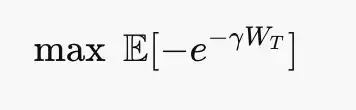
So professional MMs are not trying to crush you; they are maxE[Spread Capture]−Inventory Risk−Adverse Selection. Actually, their objective function looks like this, with inventory risk being exponentially penalized:
Readers who have made it this far must be韭菜 with dreams of becoming whales. So, to激励 the brave, here's a little trick to利用 the quoting mechanism. We said retail traders often have concentrated size and non-stealthy timing—so just do the opposite. Suppose Dave wants to go long 1000U. Instead of going all in at once, using the whale's method, first buy 100U. The quoting system will lower the price, allowing me to build a position at a cheaper level. Then I buy another 100U, and the price will continue to drop, so my average entry cost will be much cheaper than going all in at once.

The story of retail misfortune is only half told here. Besides inventory management and quoting factors, the MM's handling of order flow is another element causing price divergence—the toxic flow mentioned at the beginning. In the next part, I will introduce the market maker's order book and order flow, and I will also speculate on the micro-market reasons behind the 1011惨案.

To find out what happens next, stay tuned for the next episode.

"The Advancing MM 2: Market Maker Order Book and Order Flow"

"The Advancing MM 3: Statistical Edge and Signal Design"

Связанные с этим вопросы

QWhat is the main reason why altcoin prices often move against retail traders after they buy, according to the article?

AIt is not due to subjective manipulation, but rather the result of the Avellaneda-Stoikov model's Inventory-based pricing quote skew and protection mechanisms against toxic order flow.

QHow does a market maker (MM) react when its inventory becomes short due to large retail buying?

AThe MM will lower its prices to attract sell orders and discourage further buying, while also widening the bid-ask spread to reduce the probability of execution and protect its exposed short position.

QWhat is the 'Reservation Price' in the context of the market maker's pricing model?

AThe Reservation Price is the price at which trades occur with the market maker, and it is calculated as the Mid Price minus the product of the risk aversion coefficient (γ) and the current inventory (q).

QWhat are the characteristics of retail trader orders that make them particularly vulnerable to adverse price movements in illiquid altcoins?

ARetail orders are often aggressive (taking liquidity), concentrated in size, not stealthy in timing, unhedged, and not split or timed strategically.

QWhat practical tip does the article suggest for a trader who wants to buy a large position to get a better average entry price?

AInstead of buying the entire position at once, the trader should split the order into smaller parts. Buying a small amount first causes the MM's pricing system to lower the price, allowing subsequent buys to be executed at cheaper levels, resulting in a lower average cost.

Похожее

How Many Tokens Away Is Yang Zhilin from the 'Moon Chasing the Light'?

The article explores the intense competition between two leading Chinese AI companies, DeepSeek and Kimi (Moon Dark Side), and the mounting pressure on Yang Zhilin, the founder of Kimi. While DeepSeek re-emerged after 15 months of silence with its powerful V4 model—boasting 1.6 trillion parameters and low-cost, long-context capabilities—Kimi has been focusing on long-context processing and multi-agent systems with its K2.6 model. Yang faces a threefold challenge: technological rivalry, commercialization pressure, and investor expectations. Despite Kimi’s high valuation (reaching $18 billion), its revenue heavily relies on a single product with low paid conversion rates, while DeepSeek’s strategic silence and open-source influence have strengthened its market position and valuation prospects, now targeting over $20 billion. Both companies reflect broader trends in China’s AI ecosystem: Kimi aims for global influence through open-source contributions and agent-based advancements, while DeepSeek prioritizes foundational innovation and hardware independence, notably shifting to Huawei’s chips. Their competition is seen as vital for China’s AI progress, with the gap between top Chinese and U.S. models narrowing to just 2.7% on the Elo rating scale. Ultimately, the article argues that this rivalry, though anxiety-inducing for leaders like Zhilin, is essential for driving innovation and solidifying China’s role in the global AI landscape.

marsbit55 мин. назад

How Many Tokens Away Is Yang Zhilin from the 'Moon Chasing the Light'?

marsbit55 мин. назад

TechFlow Intelligence Bureau: ChatGPT Helps Amateur Mathematician Crack 60-Year-Old Problem, CFTC Sues New York Regulator Over Coinbase and Gemini

An amateur mathematician, with the assistance of ChatGPT, has solved a combinatorial mathematics puzzle originally proposed by Hungarian mathematician Paul Erdős in the 1960s. This marks another milestone in AI-aided mathematical research, demonstrating the evolving capabilities of large language models in formal reasoning. In other AI developments, OpenAI introduced a new privacy filter tool for enterprise API usage, automatically screening sensitive data. Meanwhile, the Qwen3.6-27B model achieved 100 tokens per second on a single RTX 5090 GPU using quantization, significantly lowering the cost barrier for local AI deployment. In crypto and Web3, the U.S. CFTC sued New York’s financial regulator, challenging its oversight of Coinbase and Gemini—a first-of-its-kind federal-state regulatory clash. Following a vulnerability, KelpDAO and major DeFi protocols established a recovery fund. Tether froze $344 million in assets linked to Iran’s central bank upon U.S. Treasury request, highlighting the centralized control risks in stablecoins. Separately, Litecoin underwent a 3-hour chain reorganization to undo a privacy-layer exploit. In the U.S., former President Trump invoked the Defense Production Act to address power grid bottlenecks affecting AI data centers and dismissed the entire National Science Board, raising concerns over research independence. A retail trader gained 250% on a $600k Intel options bet amid AI-related speculation. Xiaomi announced its first performance electric vehicle, targeting rivals like Tesla. Meanwhile, iPhone users reported devices automatically reinstalling a hidden app daily, suspected to be MDM-related. A Chinese securities report noted that A-share institutional crowding has reached its second-longest streak since 2007, signaling high valuations and potential style rotation. The day’s developments reflect a dual narrative: AI is enabling unprecedented individual breakthroughs, while centralized power structures—whether governmental or corporate—are becoming more assertive, underscoring that decentralization is as much a political-economic challenge as a technical one.

marsbit1 ч. назад

TechFlow Intelligence Bureau: ChatGPT Helps Amateur Mathematician Crack 60-Year-Old Problem, CFTC Sues New York Regulator Over Coinbase and Gemini

marsbit1 ч. назад

Торговля

Спот
Фьючерсы

Популярные статьи

Как купить USDS

Добро пожаловать на HTX.com! Мы сделали приобретение USDS (USDS) простым и удобным. Следуйте нашему пошаговому руководству и отправляйтесь в свое крипто-путешествие.Шаг 1: Создайте аккаунт на HTXИспользуйте свой адрес электронной почты или номер телефона, чтобы зарегистрироваться и бесплатно создать аккаунт на HTX. Пройдите удобную регистрацию и откройте для себя весь функционал.Создать аккаунтШаг 2: Перейдите в Купить криптовалюту и выберите свой способ оплатыКредитная/Дебетовая Карта: Используйте свою карту Visa или Mastercard для мгновенной покупки USDS (USDS).Баланс: Используйте средства с баланса вашего аккаунта HTX для простой торговли.Третьи Лица: Мы добавили популярные способы оплаты, такие как Google Pay и Apple Pay, для повышения удобства.P2P: Торгуйте напрямую с другими пользователями на HTX.Внебиржевая Торговля (OTC): Мы предлагаем индивидуальные услуги и конкурентоспособные обменные курсы для трейдеров.Шаг 3: Хранение USDS (USDS)После приобретения вами USDS (USDS) храните их в своем аккаунте на HTX. В качестве альтернативы вы можете отправить их куда-либо с помощью перевода в блокчейне или использовать для торговли с другими криптовалютами.Шаг 4: Торговля USDS (USDS)С легкостью торгуйте USDS (USDS) на спотовом рынке HTX. Просто зайдите в свой аккаунт, выберите торговую пару, совершайте сделки и следите за ними в режиме реального времени. Мы предлагаем удобный интерфейс как для начинающих, так и для опытных трейдеров.

82 просмотров всегоОпубликовано 2026.04.13Обновлено 2026.04.13

Как купить USDS

Неделя обучения по популярным токенам 12: Крипто-конференция на 25 апреля 2026 года в Mar-a-Lago привлекает внимание, волна мем-монет вновь поднимается

Сообщество с большим нетерпением ожидает крипто-конференцию на 25 апреля 2026 года в Mar-a-Lago, многие рассматривают это как возможность «купить монету = приблизиться к президенту».

948 просмотров всегоОпубликовано 2026.04.14Обновлено 2026.04.14

Неделя обучения по популярным токенам 12: Крипто-конференция на 25 апреля 2026 года в Mar-a-Lago привлекает внимание, волна мем-монет вновь поднимается

Обсуждения

Добро пожаловать в Сообщество HTX. Здесь вы сможете быть в курсе последних новостей о развитии платформы и получить доступ к профессиональной аналитической информации о рынке. Мнения пользователей о цене на A (A) представлены ниже.

活动图片