Tether Launches Bitcoin Mining OS, Fueling $HYPER’s $31.2M Presale

bitcoinistОпубликовано 2026-02-03Обновлено 2026-02-03

Введение

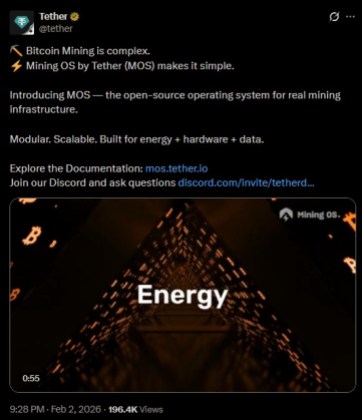
Tether, the major stablecoin issuer, is expanding its influence in Bitcoin infrastructure by launching MOS, a proprietary mining operating system that integrates IoT technology to optimize energy efficiency. This move signals a strong institutional commitment to Bitcoin's foundational growth. However, Bitcoin's inherent limitations in transaction speed and scalability for DeFi applications remain a challenge. Addressing this, Bitcoin Hyper ($HYPER) is gaining attention as a Bitcoin Layer 2 solution that combines Bitcoin's security with the high-speed performance of the Solana Virtual Machine (SVM). It enables fast, low-cost transactions and smart contracts in Rust, making Bitcoin more usable for DeFi. The project's presale has raised over $31.2 million, indicating significant investor interest, particularly from larger entities, ahead of its Token Generation Event (TGE). The tokenomics include immediate staking post-TGE with a 7-day vesting period to reduce sell pressure. This development represents a growing trend to enhance Bitcoin's utility alongside infrastructure improvements.

Tether isn’t just a stablecoin issuer anymore. It’s rapidly becoming a dominant force in Bitcoin infrastructure.

The company’s recent launch of MOS, its proprietary mining operating system, marks a massive shift in how institutional capital interacts with the network.

By fusing Internet of Things (IoT) technology with mining hardware, Tether is optimizing energy efficiency in a way that screams long-term commitment. It’s not just about holding $BTC; it’s about building the rails.

That validates the ‘Bitcoin as infrastructure’ thesis. When the world’s largest stablecoin issuer, sitting on over $100B in liquidity, pivots to mining logistics, it de-risks the network for everyone else. But while Tether tackles hardware inefficiencies, a glaring gap remains on the software side: Bitcoin simply can’t handle complex, high-speed transactions natively.

Consequently, focus is shifting toward solutions that can unlock Bitcoin’s $1T+ capital for decentralized finance (DeFi). The liquidity is there. The rails? Too slow. This search for scalability has pushed massive capital toward Layer 2 protocols.

Right now, smart money is circling Bitcoin Hyper ($HYPER), a project merging Bitcoin’s security with the Solana Virtual Machine’s (SVM) speed to bridge institutional security with retail velocity.

You can buy $HYPER here.

Bitcoin Hyper Bridges the Gap Between Security and SVM Speed

Bitcoin’s core limitation has always been the ‘trilemma’ trade-off: it sacrifices speed for absolute decentralization. While reliable for settlement, frankly, it’s functionally useless for modern DeFi applications that require sub-second finality.

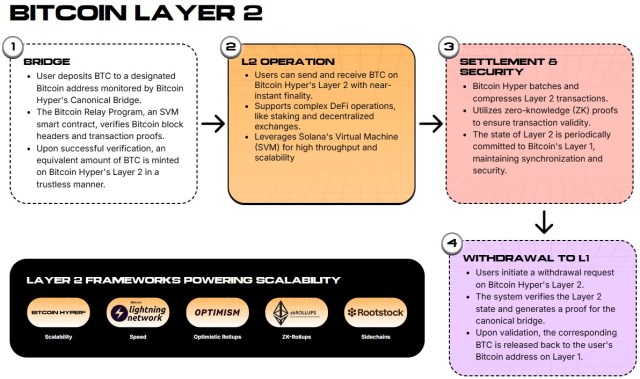
Bitcoin Hyper ($HYPER) tackles this by integrating the Solana Virtual Machine (SVM) directly as a Layer 2 execution environment.

This isn’t just narrative fluff, it’s a technical leap. By using the SVM, Bitcoin Hyper lets developers write smart contracts in Rust (the language powering Solana’s ecosystem) while anchoring the final state to Bitcoin’s Layer 1. This modular approach separates execution from settlement.

Transactions happen in real-time on the SVM layer, delivering the snappy, low-cost experience users expect, while security remains tied to Bitcoin.

For developers, this removes the friction of learning archaic scripting languages like Bitcoin Script. For users, it means interacting with Bitcoin DeFi without exorbitant fees or 10-minute waits. The protocol includes a Decentralized Canonical Bridge to keep value transfers trust-minimized.

That infrastructure is crucial for high-frequency trading and gaming dApps, stuff that was previously impossible on the Bitcoin network.

Explore the Bitcoin Hyper ecosystem.

Whale Accumulation Signals Confidence as Presale Clears $31M

The appetite for high-performance Bitcoin Layer 2s is real. Just look at the capital flows surrounding the Bitcoin Hyper presale. Official data shows the project has raised over $31.2M, a figure that underscores demand despite market chop. With tokens priced at $0.013675, the valuation offers an early-stage entry point compared to established competitors like Stacks.

Sophisticated actors appear to be positioning themselves ahead of the Token Generation Event (TGE). The implication? Larger entities are betting the “SVM on Bitcoin” narrative will outperform standard EVM-based Layer 2s.

The tokenomics look designed for the long haul. Bitcoin Hyper offers immediate staking after TGE (though APY rates are still under wraps). There’s a catch: a 7-day vesting period for presale stakers. But that’s likely a feature, not a bug, intended to mitigate immediate sell pressure.

As Tether industrializes Bitcoin mining, projects like Bitcoin Hyper are industrializing Bitcoin utility, creating a dual engine for the network’s next growth phase.

Check out the Bitcoin Hyper presale.

Disclaimer: This article is for informational purposes only and does not constitute financial advice. Cryptocurrency investments, including presales and Layer 2 tokens, carry high risks. Always perform your own due diligence before investing.

Связанные с этим вопросы

QWhat is the main focus of Tether's new initiative mentioned in the article?

ATether is expanding beyond stablecoin issuance by launching its proprietary Bitcoin mining operating system (MOS), focusing on optimizing energy efficiency and becoming a dominant force in Bitcoin infrastructure.

QHow does Bitcoin Hyper ($HYPER) aim to solve Bitcoin's scalability issue?

ABitcoin Hyper integrates the Solana Virtual Machine (SVM) as a Layer 2 execution environment, enabling high-speed, low-cost transactions while anchoring security to Bitcoin's Layer 1, thus addressing Bitcoin's limitations for DeFi applications.

QWhat technical advantage does Bitcoin Hyper offer to developers?

AIt allows developers to write smart contracts in Rust (the language used in Solana's ecosystem) instead of Bitcoin Script, reducing friction and enabling the creation of high-frequency trading and gaming dApps on Bitcoin.

QHow much capital has the Bitcoin Hyper presale raised, and what does it indicate?

AThe Bitcoin Hyper presale has raised over $31.2 million, indicating strong demand and confidence in the 'SVM on Bitcoin' narrative, with whale accumulation signaling institutional interest.

QWhat is one key feature of Bitcoin Hyper's tokenomics designed for long-term stability?

AThe tokenomics include immediate staking after the Token Generation Event (TGE) with a 7-day vesting period for presale stakers to mitigate immediate sell pressure and encourage long-term holding.

Похожее

From Robinhood to Polymarket: Is the Era of Integrating All Assets on a Single Platform Coming?

From Robinhood to Polymarket: The Era of All-in-One Asset Platforms Is Coming Asset classes are rapidly converging. Platforms that once specialized in single categories—such as stocks, cryptocurrencies, or prediction markets—are now moving toward offering all three. Robinhood pioneered this model, starting with equities, adding crypto in 2018, and prediction markets in 2025. This strategy has proven resilient: when crypto revenues fell, other segments like options and stocks filled the gap. Now, prediction market leaders Polymarket and Kalshi are moving in the same direction, both announcing perpetual futures trading on April 21, 2026, pending regulatory approval. These futures will cover assets like Bitcoin, gold, and stocks such as Nvidia. This trend mirrors the consolidation seen in consumer tech, like smartphones replacing dedicated cameras and MP3 players. Younger users, accustomed to interacting with multiple asset types from an early age, will increasingly demand unified platforms. A key competitive advantage in prediction markets is collateral utilization—idle assets locked during betting periods. Polymarket’s move into perpetuals may be a strategy to generate yield from that capital, similar to earlier DeFi integrations like PolyAave. As the regulatory landscape evolves, traditional finance is also likely to incorporate crypto and prediction markets, further accelerating this convergence.

marsbit13 мин. назад

From Robinhood to Polymarket: Is the Era of Integrating All Assets on a Single Platform Coming?

marsbit13 мин. назад

OpenAI Goes Left, DeepSeek Goes Right

On April 24, 2026, DeepSeek released V4, a Chinese large language model offering a free "million-token context window," enabling it to process vast amounts of data like entire books or years of corporate documents in one go. In contrast, OpenAI’s GPT-5.5, released around the same time, is more powerful but significantly more expensive, charging up to $180 per million output tokens. DeepSeek’s strategy represents a shift from a pure AI research firm to a heavy-infrastructure player, building data centers in Inner Mongolia’s Ulanqab to bypass U.S. chip export restrictions. This move, supported by Huawei’s Ascend chips and China’s cheap green electricity, highlights a fundamental divergence in AI development models: U.S. firms focus on high-cost, high-margin services, while Chinese players like DeepSeek prioritize accessibility and affordability. Facing intense talent poaching from tech giants, DeepSeek is seeking a $44 billion valuation funding round to retain researchers and scale infrastructure. Meanwhile, Chinese manufacturers are compressing AI models to run on smartphones, making AI accessible offline and across the Global South. Through open-source models and localized solutions, Chinese AI is empowering non-English speakers and low-income users, driving a form of "digital equality." While Silicon Valley builds walled gardens, DeepSeek and others are turning AI into a public utility—like tap water—flowing freely to those previously left behind.

marsbit39 мин. назад

OpenAI Goes Left, DeepSeek Goes Right

marsbit39 мин. назад

$292 Million KelpDAO Cross-Chain Bridge Hack: Who Should Foot the Bill?

On April 18, 2026, an attacker stole 116,500 rsETH (worth ~$292M) from KelpDAO’s cross-chain bridge in 46 minutes—the largest DeFi exploit of 2026. The stolen assets were deposited into Aave V3 as collateral, causing $177–200M in bad debt and triggering a cascade of losses across nine DeFi protocols. Aave’s TVL dropped by ~$6B overnight. This legal analysis argues that KelpDAO and LayerZero Labs share concurrent liability, with fault apportioned 60%/40%. KelpDAO negligently configured its bridge with a 1-of-1 decentralized verifier network (DVN)—a single point of failure—despite LayerZero’s explicit recommendation of a 2-of-3 setup. LayerZero, which operated the compromised DVN, failed to secure its RPC infrastructure against a known poisoning attack vector. Both protocols’ terms of service cap liability at $200 (KelpDAO) or $50 (LayerZero), but these limits are likely unenforceable due to unconscionability, gross negligence exceptions, and potential securities law invalidation (if rsETH is deemed a security under the Howey test). Aave’s governance also faces fiduciary duty claims for raising rsETH’s loan-to-value ratio to 93%—far above competitors’ 72–75%—without adequately assessing bridge risks, amplifying the systemic fallout. Practical recovery targets include LayerZero Labs (a registered Canadian entity), KelpDAO’s founders, auditors, and identifiable Aave governance delegates. The incident underscores escalating legal risks for DeFi protocols, infrastructure providers, and governance participants.

marsbit1 ч. назад

$292 Million KelpDAO Cross-Chain Bridge Hack: Who Should Foot the Bill?

marsbit1 ч. назад

Торговля

Спот
Фьючерсы
活动图片