Tether Invests $100M In Anchorage Digital While HYPER Gains Momentum

bitcoinistОпубликовано 2026-02-05Обновлено 2026-02-05

Введение

Stablecoin issuer Tether has invested $100 million in the federally chartered crypto custodian Anchorage Digital. This strategic move aims to support the launch of a new U.S.-focused stablecoin, $USAT, leveraging Anchorage’s regulatory compliance to attract institutional interest. Simultaneously, Bitcoin Hyper ($HYPER) is gaining traction as a Bitcoin Layer 2 solution integrating the Solana Virtual Machine (SVM) to solve Bitcoin’s scalability issues. It enables high-speed transactions and complex DeFi applications while settling on Bitcoin’s secure base layer. The project has raised over $31 million in its presale, with significant whale activity indicating strong investor confidence. $HYPER aims to unlock Bitcoin’s dormant capital by offering high-yield DeFi opportunities with Solana-like speed.

Stablecoin titan Tether has officially deployed $100M into Anchorage Digital, the San Francisco-based crypto custodian. It’s a strategic pivot.

Instead of just providing liquidity, the $USDT issuer is buying its way into the bedrock of regulated digital asset infrastructure. The capital is largely aimed at backing $USAT, a new stablecoin tailored for the US market, using Anchorage’s status as a federally chartered crypto bank as leverage.

Tether is effectively buying regulatory air cover and institutional rails. By partnering with Anchorage (which holds a charter from the Office of the Comptroller of the Currency), Tether is signaling a hard shift toward compliance-first expansion. It comes right as traditional finance firms are scrambling for ‘safe’ entry points into the digital asset economy.

But while institutions fortify the custody layers, the real infrastructure revolution is happening on the Bitcoin network itself. As Tether locks down banking rails, smart money is rotating into execution layers designed to unlock Bitcoin’s dormant capital.

This search for yield has directed massive volume toward Bitcoin Hyper ($HYPER), a project fixing the ecosystem’s single biggest flaw: Bitcoin’s inability to scale for DeFi.

SVM Integration Answers The Bitcoin Scalability Trilemma

For years, the bottleneck preventing Bitcoin from moving beyond ‘digital gold’ was technical. The network is secure, sure, but it’s notoriously slow and can’t handle complex contracts.

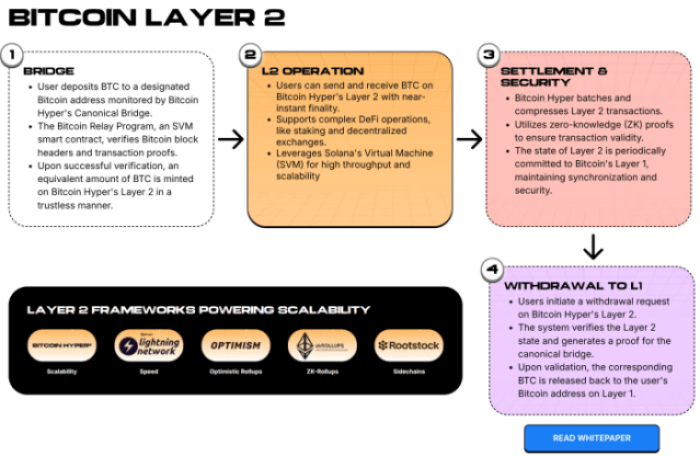
Bitcoin Hyper ($HYPER) is dismantling that barrier by integrating the Solana Virtual Machine (SVM) directly as a Layer 2 solution. It’s a massive architectural shift. By using the SVM, Bitcoin Hyper delivers sub-second finality and Solana-grade throughput, all while settling on the Bitcoin network.

It’s the best of both worlds scenario that developers have chased for a decade. Previous Bitcoin L2 attempts usually suffered from high latency or centralization risks. By employing a decentralized canonical bridge and a modular structure, Bitcoin Hyper allows high-speed payments and complex apps, swaps, lending, and gaming to run on Bitcoin without clogging the main chain.

The implications are massive. If holders can deploy assets into high-yield DeFi protocols with Solana’s speed, trillions in dormant $BTC capital could be unlocked. The architecture mirrors the modular scaling thesis that dominated Ethereum’s roadmap, finally applying it effectively to the Bitcoin ecosystem.

EXPLORE THE $HYPER ECOSYSTEM

High Project Conviction Signal – Whales

The market’s appetite for this solution is visible in the on-chain data surrounding the $HYPER presale. According to live metrics, it has already raised over $31M, a figure that suggests validation from both retail and sophisticated investors.

With the token currently priced at $0.0136751, early positioning is aggressive before the protocol hits its Token Generation Event (TGE).

It’s also worth noting that a big signal of conviction in the project is bellowing – whales. Etherscan data reveals high-net-worth wallets have spent over $1M. The largest transaction was for $500K. That type of accumulation during a presale shows whales hedging against listing volatility by securing an entry price well below projected market value.

The $HYPER incentive structure is designed to lock in long-term liquidity. The protocol offers high APY staking immediately after TGE, with a modest 7-day vesting period for presale stakers. This reduces immediate sell pressure and aligns investor interests with the network’s stability.

As Tether creates a regulated environment for stablecoins, Bitcoin Hyper is building the high-velocity rails where those assets can actually be used.

BUY YOUR $HYPER ON THE OFFICIAL PRESALE PAGE

The information provided in this article is not financial advice. Cryptocurrency investments carry inherent risks, including high volatility and potential loss of capital. Always conduct your own research (DYOR) before making any investment decisions.

Связанные с этим вопросы

QWhat is the strategic significance of Tether's $100 million investment in Anchorage Digital?

ATether's investment represents a strategic pivot toward compliance-first expansion, leveraging Anchorage Digital's status as a federally chartered crypto bank to gain regulatory approval and institutional infrastructure for its new US-focused stablecoin, $USAT.

QHow does Bitcoin Hyper ($HYPER) aim to solve Bitcoin's scalability issues?

ABitcoin Hyper integrates the Solana Virtual Machine (SVM) as a Layer 2 solution, providing sub-second finality and high throughput while settling on the Bitcoin network, enabling complex DeFi applications without congesting the main chain.

QWhat evidence suggests strong market confidence in the $HYPER project during its presale?

AThe presale has raised over $31 million, with on-chain data showing significant whale activity, including a $500,000 transaction, indicating high conviction from both retail and sophisticated investors.

QHow does the article contrast Tether's approach with Bitcoin Hyper's role in the crypto ecosystem?

ATether is focusing on building regulated infrastructure for stablecoins, while Bitcoin Hyper is creating high-speed execution layers to unlock Bitcoin's dormant capital for DeFi and other applications.

QWhat mechanism does $HYPER use to reduce immediate sell pressure after its Token Generation Event (TGE)?

AThe protocol offers high APY staking immediately after TGE with a 7-day vesting period for presale stakers, aligning investor interests with network stability and reducing sell pressure.

Похожее

Huawei Cloud Rejects Token Price War, Zhou Yuefeng Seeks a New Winning Formula for AI Cloud

At the 2026 Huawei Cloud INSPIRE Creator Conference, CEO Zhou Yuefeng outlined Huawei Cloud's distinct strategy in the competitive AI cloud market. Instead of engaging in price wars based on token volume or Maas revenue—a common focus for rivals like Alibaba Cloud and ByteDance's Volcano Engine—Huawei Cloud is shifting the competition towards real-world productivity gains. Zhou highlighted three core differentiators: a fully domestic computing stack (Ascend, Kunpeng), a focus on government and enterprise clients rather than consumer internet, and a deep commitment to open-source ecosystems. To this end, Huawei Cloud launched a suite of new products under the "Agentic Infra" paradigm, including the AICS Lingqu computing cluster, AMS memory storage, and the ModelArts Next platform. These aim to solve enterprise challenges in deploying AI agents, such as latency, memory, scheduling, and security. The strategy further involves creating specialized industry zones ("AI Dream Factories") for sectors like healthcare and embodied intelligence. For example, a smart medical zone developed with Shanghai Ruijin Hospital aims to democratize expert-level diagnostic capabilities. In essence, Huawei Cloud is positioning itself not as a commodity token provider, but as the foundational infrastructure for industrial AI, leveraging its domestic supply chain and hybrid cloud solutions to serve sectors where productivity, not just scale, is the ultimate measure of value.

marsbit1 мин. назад

Huawei Cloud Rejects Token Price War, Zhou Yuefeng Seeks a New Winning Formula for AI Cloud

marsbit1 мин. назад

70% of the Public Opposes AI, Americans Hope the U.S. Loses the AI War

70% of Americans believe AI development is moving too fast, with growing public resistance evolving from online criticism to real-world protests and violence. This widespread anti-AI sentiment stems from fears of job losses, rising utility costs, environmental damage, threats to democracy, and financial instability. Key incidents illustrate the backlash: Google's former CEO Eric Schmidt was loudly booed at a graduation for promoting AI; AI company ads are vandalized; protests and even violent attacks target AI firms and data centers. Polls show deep public pessimism and strong local opposition to data center construction, often surpassing resistance to nuclear power plants. The core grievances are economic and practical: AI is seen as automating jobs, concentrating wealth, and increasing household electricity and water bills due to massive data center resource demands. Environmentalists also oppose AI's high energy use and carbon emissions. This opposition has turned AI into a major political issue in the US. While the Trump administration prioritizes AI innovation for global competition, bipartisan pushback is growing. Democrats and factions within the MAGA movement are forming temporary alliances to support stricter regulations and local bans on new data centers, pressuring the administration to choose between its tech industry backers and its voter base. The situation highlights a profound national divide over AI's future.

marsbit35 мин. назад

70% of the Public Opposes AI, Americans Hope the U.S. Loses the AI War

marsbit35 мин. назад

Agents Take Over Traffic Distribution Power: What Are Tencent, ByteDance, and Alibaba Competing For?

In the race to dominate the AI era's entry point, China's tech giants—Tencent, ByteDance, and Alibaba—are aggressively deploying AI Agents to control the future of traffic distribution. Alibaba is pursuing a dual-track "closed loop + openness" strategy. Its Qianwen app is evolving into a super-Agent integrated across its ecosystem (Taobao, Alipay, etc.) to handle complex tasks like travel planning. Concurrently, it is opening its platform to external brands (Luckin Coffee, KFC) and has launched a B2B Agent platform, "Wukong," targeting enterprise automation. Its other flagship, Quark, aims to be an "AI super search box" for information and tasks. ByteDance is executing an omnipresent "sprawl strategy." Its Doubao app boasts over 300 million monthly active users and is evolving into a default AI entry point for daily life, with plans for paid versions and e-commerce integration. Its core weapon is the Kouzi platform, a visual "AI assembly factory" for developers to build custom Agents. ByteDance is also pushing hardware integration, collaborating on AI phones and developing smart glasses to embed Doubao everywhere. Tencent is playing its long-held "ultimate card" by quietly embedding an AI Agent directly into WeChat. This Agent, accessible via a swipe, can understand user commands and automatically execute tasks by calling upon WeChat's millions of mini-programs (e.g., finding and ordering coffee). This leverages WeChat's unparalleled 1.4-billion-user ecosystem to position the app as an AI-powered "service operating system," a move that could dramatically reshape the competitive landscape. The core battleground is shifting from competing for "user screen time" to competing to be the "default execution layer" for user intent. The business model is evolving from an "attention economy" to an "intent economy," where the Agent that can most efficiently fulfill a user's need gains control over service access and token flow. This represents a fundamental change in how users connect with digital services, making the fight for the Agent入口 (entry point) a pivotal moment for redefining industry leadership in the AI age.

marsbit2 ч. назад

Agents Take Over Traffic Distribution Power: What Are Tencent, ByteDance, and Alibaba Competing For?

marsbit2 ч. назад

Торговля

Спот
Фьючерсы
活动图片