Tether Engages Big Four Audit In Major Transparency Push

bitcoinistОпубликовано 2026-03-25Обновлено 2026-03-25

Введение

Tether, the issuer of the world's largest stablecoin USDT, has engaged a Big Four accounting firm to conduct its first independent audit. This move follows years of scrutiny, including a $41 million fine from the CFTC in 2021 for misrepresenting its reserves. The audit is described as a major step towards transparency and meeting the highest global finance standards. While the specific firm (KPMG, EY, Deloitte, or PwC) was not named, it was selected through a competitive process. USDT, with a market cap of $184 billion, dominates the stablecoin sector, which remains near its all-time high despite broader market conditions.

Tether, the issuer of the biggest stablecoin, has signed on a Big Four accounting firm to complete its first independent audit after years of scrutiny.

Tether Signs Big Four Firm To Provide Assurance That USDT Is Fully Backed

According to a website announcement, Tether has entered a formal engagement with a Big Four audit firm for what the stablecoin issuer describes as the biggest inaugural audit of all time in financial markets. “This audit represents years of work to strengthen our systems so that Tether can meet the highest standards applied in global finance,” noted Paolo Ardoino, Tether CEO.

Tether is a cryptocurrency company that’s most popularly known for being the issuer of the stablecoin USDT. The firm’s token is the largest stablecoin in the sector by market cap and ranks third overall behind Bitcoin and Ethereum.

Over the years, Tether has faced criticism over the lack of transparency and how its stablecoin is backed. Back in 2021, the United States Commodity Futures Trading Commission (CFTC) fined the firm $41 million for falsely claiming that USDT was fully backed by US dollar reserves.

Now, with the audit, it seems the company wants to upgrade on this front. “For the hundreds of millions of people and businesses who rely on USD₮ every day, this audit is not just a compliance exercise; it is about accountability, resilience, and confidence in the infrastructure they depend on,” said Ardoino.

As for who the company that’s going to audit Tether is, the exact name is currently unknown. The announcement has just noted that it’s a Big Four firm, which means that it’s one of KPMG, EY, Deloitte, or PwC. Simon McWilliams, Tether Chief Financial Officer, noted:

The Big Four Firm was selected through a competitive process because the organisation is already operating at Big Four audit standard; the audit will be delivered.

Earlier this year, Tether launched a new stablecoin called USAT, specifically aimed at the US market. The company had previously stepped away from the nation following regulatory scrutiny. The new token, backed by dollars, complies fully with the country’s newly established stablecoin framework following the passage of the GENIUS Act last year.

As mentioned earlier, USDT is the largest stablecoin in the sector. Its market cap of $184 billion alone accounts for nearly 60% of the total stablecoin market cap. Meanwhile, the closest competitor, USDC, has a market cap of $78 billion.

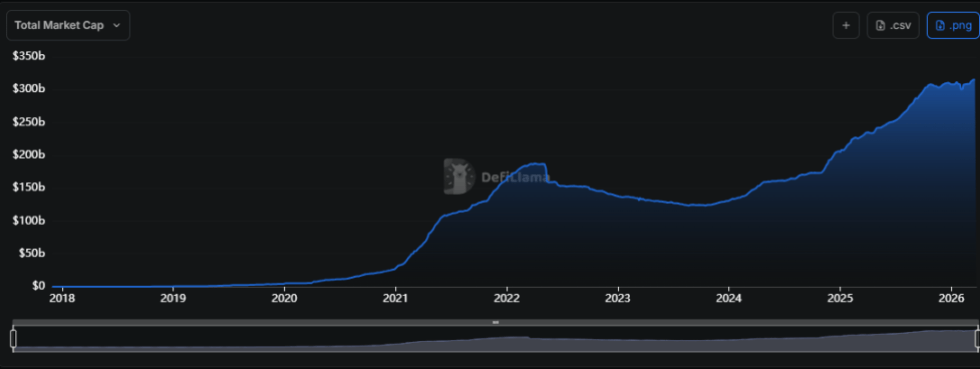
Overall, the stablecoin sector has done relatively well during the last few months despite a bearish shift in the wider digital assets market, with its combined market cap currently sitting around an all-time high (ATH), according to data from DefiLlama.

Looks like the value of the metric has been moving sideways in recent months | Source: DefiLlama

Bitcoin Price

Bitcoin recovered above $71,000 earlier in the day, but the coin has seen another setback as its price has now returned to $69,300.

The trend in the price of the coin over the last five days | Source: BTCUSDT on TradingView

Связанные с этим вопросы

QWhat is the main reason Tether has engaged a Big Four accounting firm?

ATether has engaged a Big Four firm to complete its first independent audit to provide assurance that its USDT is fully backed and to meet the highest standards in global finance after years of scrutiny.

QWhich regulatory body fined Tether $41 million in 2021 and why?

AThe United States Commodity Futures Trading Commission (CFTC) fined Tether $41 million for falsely claiming that its USDT stablecoin was fully backed by US dollar reserves.

QWhat is the names of the four potential accounting firms that could be auditing Tether?

AThe potential firms are KPMG, EY, Deloitte, and PwC, as these are the companies that make up the 'Big Four'.

QWhat is the market capitalization of USDT and how does it compare to its closest competitor, USDC?

AUSDT has a market cap of $184 billion, which accounts for nearly 60% of the total stablecoin market. Its closest competitor, USDC, has a market cap of $78 billion.

QWhat new stablecoin did Tether launch for the US market and what legislation does it comply with?

ATether launched a new stablecoin called USAT that is backed by dollars and fully complies with the US's newly established stablecoin framework following the passage of the GENIUS Act.

Похожее

Is AI Creating a New Class of 'Information Poor'?

AI is generating a new kind of "information poverty." The core issue isn't that AI denies answers to the poor; it's that it provides abundant, cheap, and plausible-sounding answers to everyone. This availability shifts the true scarcity from obtaining answers to possessing the **judgment to evaluate them** and the access to turn them into real-world opportunities. New information poverty thus describes those who have AI tools and outputs, but lack the complementary skills, authorization, and contextual experience to critically assess and act on them. Research reveals a multi-layered divide: access to AI is stratified by income and platform design (e.g., premium vs. free, embedded tools). In workplaces, usage heavily favors higher-paid, more experienced, or formally trained employees, with AI often automating entry-level tasks that were traditional stepping stones. Crucially, the heaviest users are often mid-career professionals whose existing expertise allows them to effectively judge and leverage AI outputs, while novices risk over-relying on them without building judgment. While controlled experiments show AI can significantly boost low-skilled workers' performance, real-world adoption and benefit are constrained by unequal social and organizational structures. Historically, general-purpose technologies first reward those with existing complementary capital. AI, by affecting judgment-based work, may accelerate and deepen this initial inequality gap, even if it narrows over decades. The danger lies in the illusion of competence it creates, potentially stunting the very critical thinking needed in an era where judgment is paramount.

marsbit19 мин. назад

Is AI Creating a New Class of 'Information Poor'?

marsbit19 мин. назад

Jensen Huang 'Saves' South Korean Stock Market: Locks In SK Hynix Memory, Chip Shortage to Continue

On June 5th, South Korea's stock market experienced a sharp decline, with major chipmakers like Samsung and SK Hynix dropping nearly 10%. Amidst the turmoil, NVIDIA CEO Jensen Huang's visit to Seoul played a dramatic role in boosting market sentiment. Following a dinner meeting with SK Group Chairman Chey Tae-won and SK Hynix CEO Kwak Noh-Jung, Huang confirmed that NVIDIA's new Vera CPU will utilize SK Hynix DRAM. The companies announced a multi-year technical partnership to co-develop next-generation memory for NVIDIA's AI infrastructure, covering products from data centers to personal AI and robotics. This collaboration extends beyond memory supply. SK Hynix is integrating NVIDIA's AI and Omniverse platform into its own semiconductor design and manufacturing processes, including computational lithography and creating digital twins of its fabrication plants for autonomous operation. While strengthening ties with SK Hynix, NVIDIA is diversifying its supply chain for the upcoming HBM4 memory, with Samsung, SK Hynix, and Micron all certified as suppliers for its Vera Rubin platform. Despite this, Huang warned that the global chip shortage, driven by relentless demand from AI factory construction, is expected to persist for several years across the entire supply chain. His visit underscores NVIDIA's systematic effort to deepen integration with South Korea's broader tech industry.

marsbit1 ч. назад

Jensen Huang 'Saves' South Korean Stock Market: Locks In SK Hynix Memory, Chip Shortage to Continue

marsbit1 ч. назад

Nasdaq Plunges 4.2% in a Single Day: Does "Black Friday" Burst the U.S. Stock Market Bubble?

The Nasdaq plunged 4.18% on June 5, 2026, its worst single-day drop in over a year, as a much stronger-than-expected US jobs report triggered fears of economic overheating and delayed Federal Reserve interest rate cuts. The selloff, centered on high-valuation tech and AI stocks like Nvidia and Broadcom, spread across major indices. The article examines whether this signals a market top. The strong May non-farm payrolls data, nearly double expectations, pushed bond yields higher, directly hurting rate-sensitive tech stocks. This exposed vulnerabilities in the crowded AI trade, where valuations had soared on narratives of infinite growth, despite emerging signs of slowing order momentum and corporate AI monetization challenges. Prior to the drop, market indicators flashed warning signs: historically high valuations (e.g., Shiller CAPE ratio near 39.5), extreme bullish sentiment, and high levels of leverage. Technical charts showed key support levels being breached. Wall Street is divided on the outlook. Bears, citing risks of "stagflation" and AI bubble comparisons to the dot-com era, warn of a potential significant correction. Bulls view the drop as a healthy correction within a bull market, underpinned by a strong economy and expected corporate earnings growth of around 7% in 2026. The immediate future hinges on upcoming key events: the May CPI inflation data and the mid-June FOMC meeting. Their outcomes will critically shape market expectations for the Fed's rate path. The article concludes that conditions for a major market top are aligning, marking a fragile transition from narrative-driven gains to a phase demanding validation from macroeconomic data and corporate fundamentals. Caution is advised.

marsbit1 ч. назад

Nasdaq Plunges 4.2% in a Single Day: Does "Black Friday" Burst the U.S. Stock Market Bubble?

marsbit1 ч. назад

Nasdaq Plunges 4.2% in a Single Day, Did 'Black Friday' Pop the U.S. Stock Bubble?

The Nasdaq Composite plummeted 4.18% on June 5, its biggest single-day drop since April 2025, triggering widespread debate over whether the U.S. stock market has peaked. The sell-off was sparked by a stronger-than-expected U.S. non-farm payrolls report, which fueled fears of economic overheating and pushed back market expectations for Federal Reserve rate cuts, leading to a sharp rise in Treasury yields. The AI sector, the primary driver of the recent bull market, suffered severe losses, with the Philadelphia Semiconductor Index crashing over 10%. Stocks like Nvidia, Broadcom, and Micron led the decline. Concerns are mounting about the sustainability of AI capital expenditures and high valuations, with signs of order cuts for next-generation chips emerging. Analyses point to several warning signs: historically high market valuations (e.g., elevated Shiller CAPE ratio, Buffett Indicator), extreme bullish sentiment indicators, and significant insider selling. The sell-off also caused a key technical breakdown, with the S&P 500 breaking below its short-term moving average and testing its 200-day moving average. Wall Street is divided on the outlook. Bears warn this could be the start of a bubble deflation or a "stagflation" scenario, while bulls view it as a healthy, overdue correction within a bull market driven by solid corporate earnings growth. A more moderate view suggests the easy liquidity-driven rally is over, and markets are entering a phase of fundamental stock-picking with potential for consolidation. The immediate future hinges on key upcoming events: the May CPI report and the mid-June FOMC meeting. Their outcomes will be critical in determining whether this is a temporary pullback or the beginning of a more significant trend reversal. The consensus is that the era of one-directional market gains may be ending, requiring increased investor caution.

Odaily星球日报1 ч. назад

Nasdaq Plunges 4.2% in a Single Day, Did 'Black Friday' Pop the U.S. Stock Bubble?

Odaily星球日报1 ч. назад

The First Case on AI Agents: What Was Adjudicated?

"The First 'Agent' Ruling: What Was Decided?" On April 30, the Guangzhou Internet Court issued a ruling—China's first behavior preservation order in the intelligent agent (AI agent) field. The defendant, an open-source AI agent software, was ordered to stop downloads, cease actions that bypassed a platform's technical protection measures, and delete related tutorials and data. The core issue: the software used the operating system's "accessibility service" permissions to automate user interactions within other apps without those platforms' authorization. This mirrors a recent US case where Amazon sued Perplexity for similar reasons—bypassing Amazon's API to directly scrape and interact with its pages—and won a preliminary injunction. Both rulings establish a crucial legal boundary for the AI agent era: agents cannot operate unchecked. The article argues the fundamental legal principle emerging is one of **dual authorization**. An AI agent requires both **user consent** AND **platform consent** to operate legitimately within that platform's ecosystem. Bypassing platform rules through system-level permissions, even with user permission, undermines platform responsibilities for content moderation, data security, and user privacy, creating liability issues. The piece uses the evolution of "Doubao Phone" (an AI-integrated smartphone) as a case study. Its initial, aggressive version that bypassed platform controls faced roadblocks. Its upcoming 2.0 version is reportedly pivoting to negotiate API access and authorization deals with major platforms (like Alibaba's ecosystem), seen as a strategic adaptation to the new regulatory reality. A global trend is identified: the era of unregulated, "wild west" growth for AI agents is ending, replaced by a **compliance race**. This raises barriers to entry, as securing platform authorizations becomes a new cost. Open-source status is also not a legal shield if the code facilitates bypassing technical protections. In conclusion, these first rulings target not the largest, but the most **aggressive and representative** cases. By setting precedent with them, regulators are efficiently steering the entire industry towards a new, more regulated operating paradigm defined by dual authorization and platform cooperation.

marsbit1 ч. назад

The First Case on AI Agents: What Was Adjudicated?

marsbit1 ч. назад

Торговля

Спот
Фьючерсы

Популярные статьи

Как купить PUSH

Добро пожаловать на HTX.com! Мы сделали приобретение Push Protocol (PUSH) простым и удобным. Следуйте нашему пошаговому руководству и отправляйтесь в свое крипто-путешествие.Шаг 1: Создайте аккаунт на HTXИспользуйте свой адрес электронной почты или номер телефона, чтобы зарегистрироваться и бесплатно создать аккаунт на HTX. Пройдите удобную регистрацию и откройте для себя весь функционал.Создать аккаунтШаг 2: Перейдите в Купить криптовалюту и выберите свой способ оплатыКредитная/Дебетовая Карта: Используйте свою карту Visa или Mastercard для мгновенной покупки Push Protocol (PUSH).Баланс: Используйте средства с баланса вашего аккаунта HTX для простой торговли.Третьи Лица: Мы добавили популярные способы оплаты, такие как Google Pay и Apple Pay, для повышения удобства.P2P: Торгуйте напрямую с другими пользователями на HTX.Внебиржевая Торговля (OTC): Мы предлагаем индивидуальные услуги и конкурентоспособные обменные курсы для трейдеров.Шаг 3: Хранение Push Protocol (PUSH)После приобретения вами Push Protocol (PUSH) храните их в своем аккаунте на HTX. В качестве альтернативы вы можете отправить их куда-либо с помощью перевода в блокчейне или использовать для торговли с другими криптовалютами.Шаг 4: Торговля Push Protocol (PUSH)С легкостью торгуйте Push Protocol (PUSH) на спотовом рынке HTX. Просто зайдите в свой аккаунт, выберите торговую пару, совершайте сделки и следите за ними в режиме реального времени. Мы предлагаем удобный интерфейс как для начинающих, так и для опытных трейдеров.

859 просмотров всегоОпубликовано 2024.03.29Обновлено 2026.06.02

Как купить PUSH

Обсуждения

Добро пожаловать в Сообщество HTX. Здесь вы сможете быть в курсе последних новостей о развитии платформы и получить доступ к профессиональной аналитической информации о рынке. Мнения пользователей о цене на PUSH (PUSH) представлены ниже.

活动图片