# Сопутствующие статьи по теме Bitcoin

Новостной центр HTX предлагает последние статьи и углубленный анализ по "Bitcoin", охватывающие рыночные тренды, новости проектов, развитие технологий и политику регулирования в криптоиндустрии.

Short-Term Rebound or Bull Market Return? What Do Traders Think?

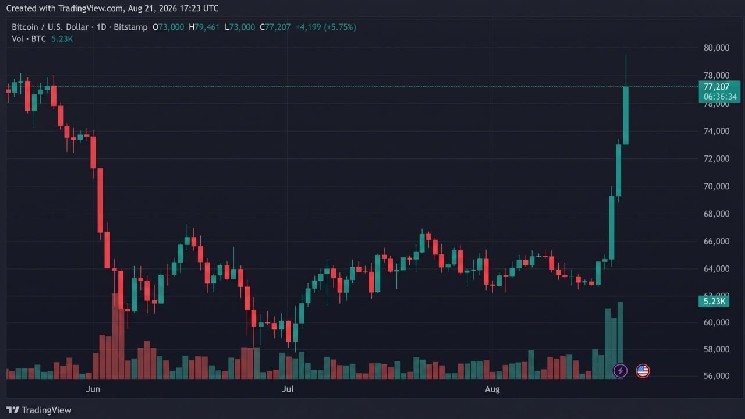
The S&P 500 has rebounded nearly 10% from its March 27 low, with the Nasdaq posting a 10-day winning streak—its longest since 2021. Bitcoin surged past $76,000, and crypto-related stocks rallied. The market is showing a V-shaped recovery, but the question remains: is this a true bull market return or just a short-term rebound? Bullish analysts, including Tom Lee and Ed Yardeni, argue the bottom is in. Lee cites the U.S.-Iran ceasefire as a key factor, while Yardeni maintains a year-end S&P 500 target of 7700, stating "pessimism is now out of style." Goldman Sachs labels this a "marathon expansion," expecting a 12% earnings growth to form a "fundamental bottom," with AI driving nearly 40% of S&P 500 earnings growth. Morgan Stanley notes that bull markets in their fourth year historically deliver positive returns, with AI-driven productivity gains yet to fully diffuse. Bearish voices, led by Bank of America’s Michael Hartnett, caution that true market lows require extreme pessimism, which is absent now. Cash levels are low at 4.3%, and institutional investors remain overweight on stocks. Hartnett warns that oil’s 60% rise since the Iran war could hurt profits more than inflation data suggests. Goldman’s trading desk also views the rally as a technical rebound, not a trend, pending real-world oil shipping data from the Strait of Hormuz. Piper Sandler’s Michael Kantrowitz has stopped issuing year-end targets due to high uncertainty. The divide is clear: bulls see a fundamentals-driven bull run with earnings growth and geopolitical de-escalation, while bears see a sentiment-driven bounce with weak inflows—equity funds saw $15.4 billion in outflows last week. The key variable is the U.S.-Iran talks; a ceasefire extension could solidify the rally, but failure may trigger a drop. As Hartnett warns, "investors should not mistake a relief rally for a solution."

marsbitВчера 07:48

Short-Term Rebound or Bull Market Return? What Do Traders Think?

marsbitВчера 07:48

Supported by 20+ Institutions: How Does Sui's New Primitive Hashi Rewrite the Rules of Bitcoin Financial Trust?

Sui has introduced Hashi, a new decentralized Bitcoin (BTC)抵押原语 (primitive) designed to enable trust-minimized and secure use of native BTC in DeFi on the Sui blockchain, backed by over 20 major institutions. Hashi allows users to抵押 Bitcoin without transferring custody to centralized entities. BTC remains on the Bitcoin network in a dedicated address, while a抵押凭证 is generated on Sui. This凭证, representing the locked BTC, can be used in Sui's smart contracts for lending, borrowing, and other DeFi activities. The system relies on Sui validators for security, with a Guardian Layer for additional protection against risks like validator collusion. Key to Hashi is its role as a "primitive"—a foundational building block for developers. It provides a standardized interface to integrate native BTC抵押 capabilities into applications like lending protocols, structured products, and RWA strategies, reducing development barriers. Institutional support spans custody (e.g., BitGo, Cobo), trading (e.g., FalconX, Bullish), security (e.g., OtterSec, Certora), and protocols (e.g., Suilend, Scallop). This ecosystem support aims to facilitate large-scale institutional BTC adoption into DeFi upon mainnet launch. Hashi addresses core trust issues in Bitcoin金融 by prioritizing non-custodial security, transparency, and composability, potentially unlocking Bitcoin's $1.4 trillion market cap for decentralized finance without sacrificing user control.

marsbitВчера 06:33

Supported by 20+ Institutions: How Does Sui's New Primitive Hashi Rewrite the Rules of Bitcoin Financial Trust?

marsbitВчера 06:33

活动图片