Synthetix returns to Ethereum mainnet after 3 years: ‘We can run it back’

cointelegraphОпубликовано 2025-12-18Обновлено 2025-12-18

Введение

Synthetix, a perpetuals trading platform, is returning to Ethereum's mainnet after three years, citing significantly improved network conditions. Founder Kain Warwick stated that high gas fees and congestion previously made it impractical to run complex trading infrastructure on Ethereum, leading many platforms, including Synthetix, to migrate to Layer-2 solutions. However, reduced demand and ongoing scaling improvements have now made Ethereum Layer-1 viable again. Warwick emphasized that Ethereum mainnet hosts most of crypto's liquidity, assets, and margin, making it the most efficient onchain market. He expects other perpetual DEXs to follow suit, leveraging Ethereum's enhanced capacity and lower transaction costs.

Perpetuals trading platform Synthetix is returning to Ethereum’s mainnet, with its founder arguing the network is now more than capable of supporting high-frequency financial applications after years of network congestion drove derivatives activity elsewhere.

“By the time perp DEXs became a thing, the mainnet was too congested, but now we can run it back,” Synthetix founder Kain Warwick told Cointelegraph during an interview on Wednesday.

“It’s kind of crazy that there really hasn’t been a Perp DEX on mainnet,” he added, explaining that reduced demand after the perp DEX exodus, combined with ongoing scaling improvements, has made Ethereum layer 1 more viable again.

“It’s definitely the best place to run a perp DEX,” he said.
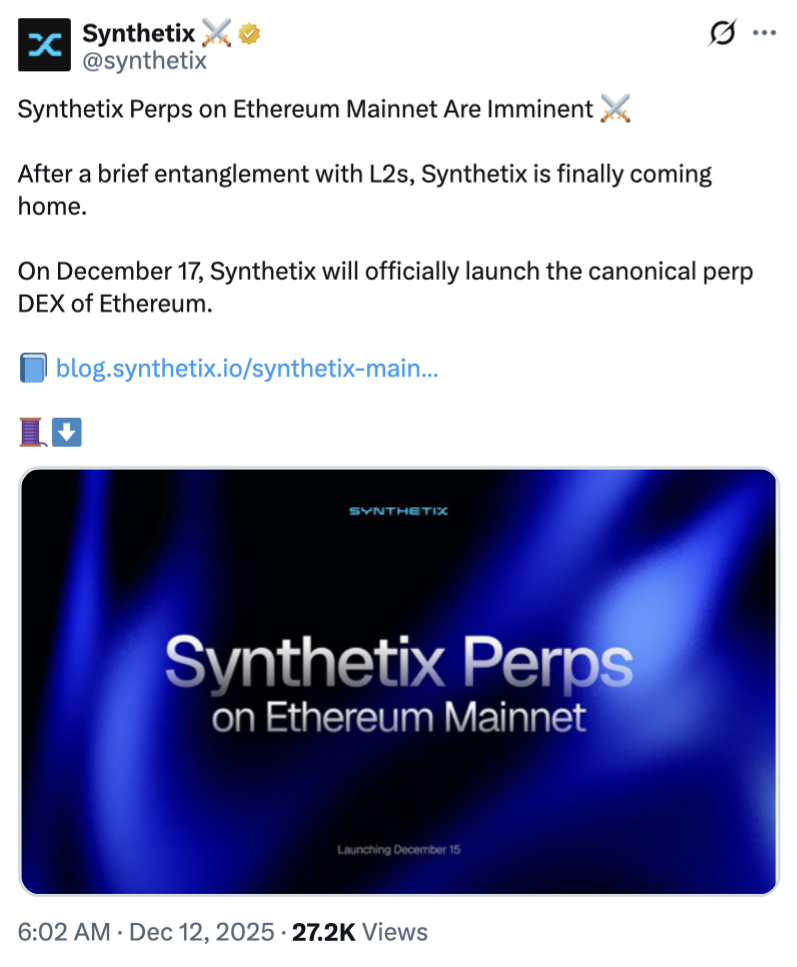
Source: Synthetix

Warwick said that high gas fees and network congestion previously made it impractical to operate complex trading infrastructure on the network.

For several years, many perpetual platforms migrated to layer-2 networks or alternative blockchains, and Synthetix followed a similar path, he said, moving to the Ethereum layer-2 network Optimism in 2022 and later expanding to Arbitrum and Base.

Around the same time, decentralized derivatives exchange dYdX transitioned from mainnet to StarkWare layer-2 solution StarkEx.

Warwick says fees were “just too high” to make it feasible

Warwick said it wasn’t feasible to run critical infrastructure because the costs were “just too high.”

“The cost per transaction and therefore the efficiency of the markets on the chain really degraded,” Warwick said. On Wednesday, Ethereum’s average gas fee stood at approximately 0.71 gwei, nearly 26 times lower than on the same day twelve months ago, when it averaged 18.85 gwei, according to Etherscan.
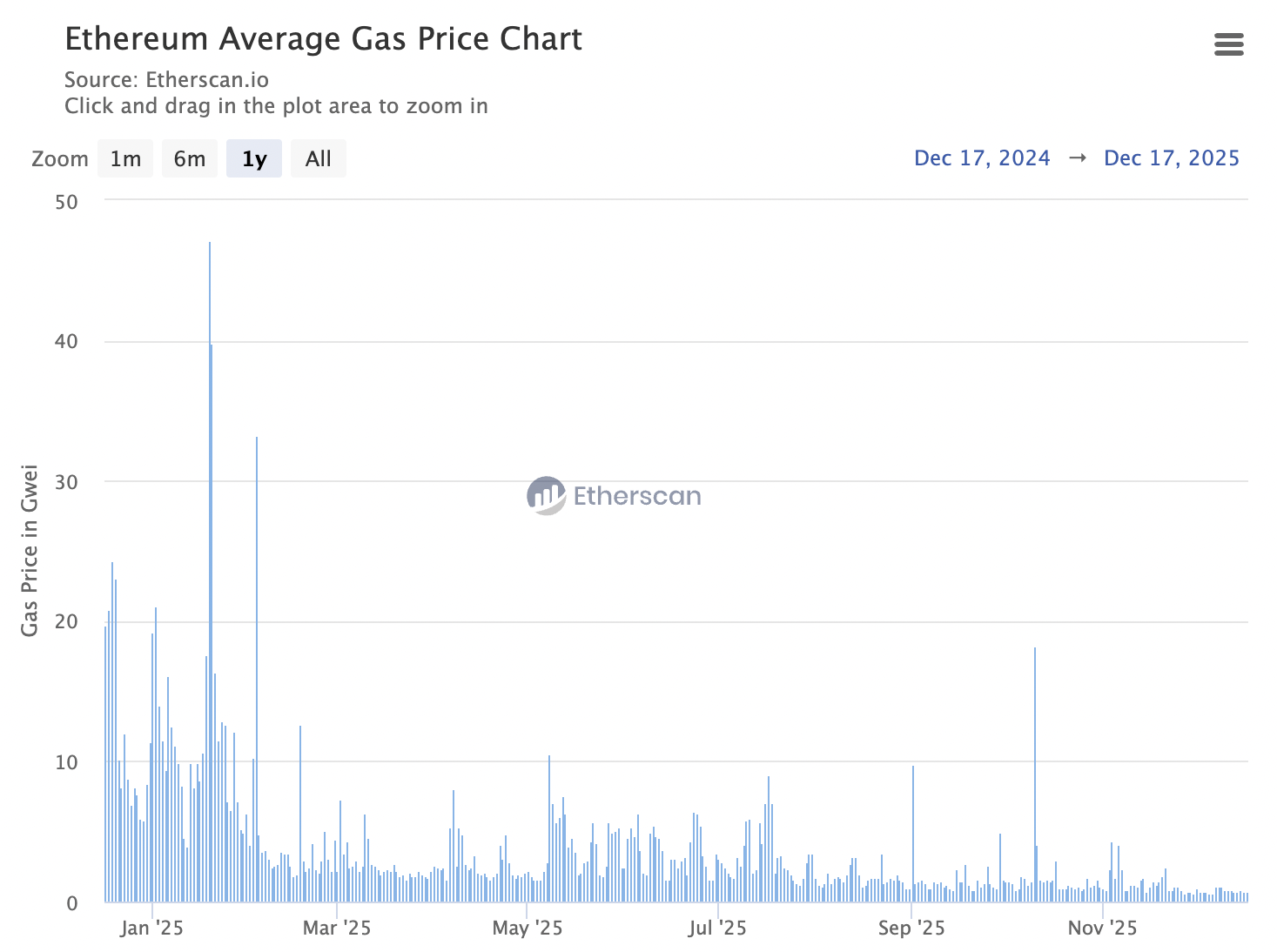
Ethereum gas fees are significantly lower than they were twelve months ago. Source: Ether Scan

Warwick said that the combination of layer-2 and layer-1 scaling means that ”you can actually run critical infrastructure on mainnet again.”

Some Ethereum proponents have predicted further improvements toward network capacity in 2026. Ethereum educator Anthony Sassano recently said the goal to significantly increase Ethereum’s gas limit to 180 million next year is a baseline rather than a best-case scenario.

Warwick expects other perpetual exchanges to follow Synthetix

Warwick expects other perpetual DEXs to follow Synthetix back to mainnet, arguing Ethereum now has the capacity to support multiple perp DEXs simultaneously.

Related: Ripple pilots RLUSD on Ethereum L2s in multichain push

“It wouldn’t be a Synthetix launch if someone didn’t try and, you know, follow us within 20 minutes,” Warwick said.

“The main advantage is most of the liquidity in the crypto world is on Ethereum mainnet; most of the assets, most of the margin, most liquidity, almost everything is there. It is the most efficient onchain market,” he said.

Warwick added that Ethereum’s development has improved significantly in 2025, and it has potentially been the best year for the network since the Merge in September 2022.

“There’s been a renewed kind of focus on, like, the needs of builders, in a way that I think in the past, maybe it was much more focused on the network itself,” he said.

Magazine: Big questions: Would Bitcoin survive a 10-year power outage?

Связанные с этим вопросы

QWhy is Synthetix returning to the Ethereum mainnet after three years?

ASynthetix is returning to the Ethereum mainnet because the network is now more capable of supporting high-frequency financial applications, with significantly lower gas fees and reduced congestion compared to the past.

QWhat was the main reason that originally drove Synthetix and other perpetual DEXs away from the Ethereum mainnet?

AHigh gas fees and network congestion made it impractical and too costly to operate complex trading infrastructure on the Ethereum mainnet, leading many platforms to migrate to layer-2 networks or alternative blockchains.

QAccording to the founder, what is the current state of Ethereum gas fees compared to a year ago?

AAs of the interview, the average Ethereum gas fee was approximately 0.71 gwei, which is nearly 26 times lower than the average of 18.85 gwei on the same day twelve months prior.

QWhat does Kain Warwick predict will happen after Synthetix moves back to the mainnet?

AKain Warwick predicts that other perpetual DEXs will follow Synthetix back to the Ethereum mainnet, as the network now has the capability to support multiple perp DEXs simultaneously.

QWhat does Warwick cite as the main advantage of running a perp DEX on Ethereum mainnet?

AThe main advantage is that most of the liquidity, assets, and margin in the crypto world are on the Ethereum mainnet, making it the most efficient onchain market.

Похожее

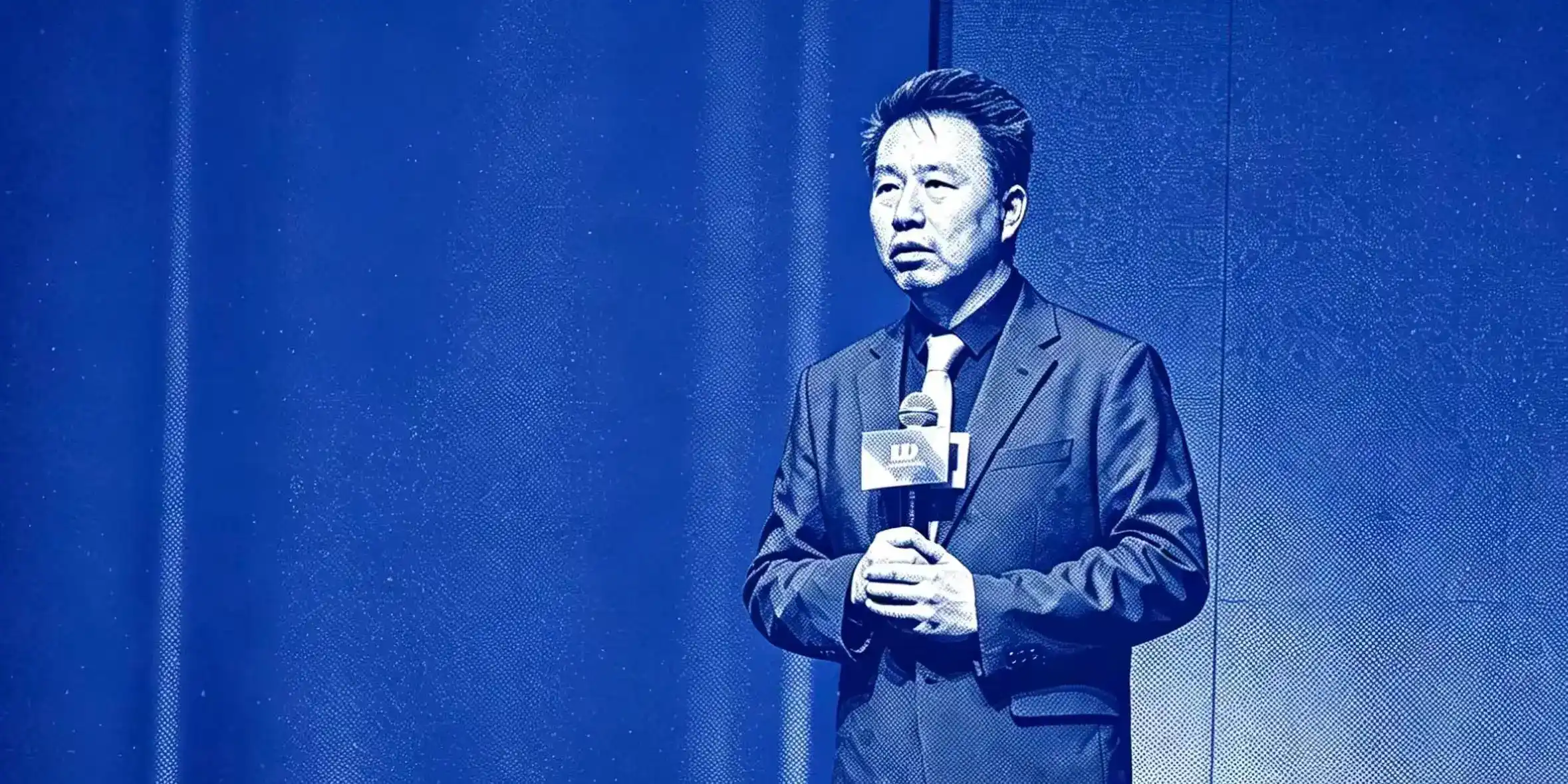
Fu Peng's First Public Speech in 2026: What Exactly Are Crypto Assets? Why Did I Join the Crypto Asset Industry?

Fu Peng, a renowned macroeconomist and now Chief Economist at New火 Group, delivered his first public speech of 2026 at the Hong Kong Web3 Festival. He explained his perspective on crypto assets and why he joined the industry, framing it within the context of macroeconomic trends and financial evolution. Fu emphasized that crypto assets are transitioning from an early, belief-driven phase to a mature, institutionally integrated asset class. He drew parallels to the 1970s-80s, when technological advances (like computing) revolutionized traditional finance, leading to the rise of FICC (Fixed Income, Currencies, and Commodities). Similarly, current advancements in AI, data, and blockchain are reshaping finance, with crypto assets becoming part of a new "FICC + C" (C for Crypto) framework. He noted that institutional capital, including traditional hedge funds, avoided early crypto due to its speculative nature but are now engaging as regulatory clarity emerges (e.g., stablecoin laws, CFTC classifying crypto as a commodity). Fu predicted that 2025-2026 marks a turning point where crypto becomes a standardized, financially viable asset for diversified portfolios, akin to commodities or derivatives in traditional finance. Fu defined Bitcoin not as "digital gold" in a simplistic sense but as a value-preserving, financially tradable asset. He highlighted that crypto's future lies in regulated, institutional adoption, moving away from retail-dominated trading. His entry into crypto signals this maturation, where traditional finance integrates crypto into mainstream asset management.

marsbit3 мин. назад

Fu Peng's First Public Speech in 2026: What Exactly Are Crypto Assets? Why Did I Join the Crypto Asset Industry?

marsbit3 мин. назад

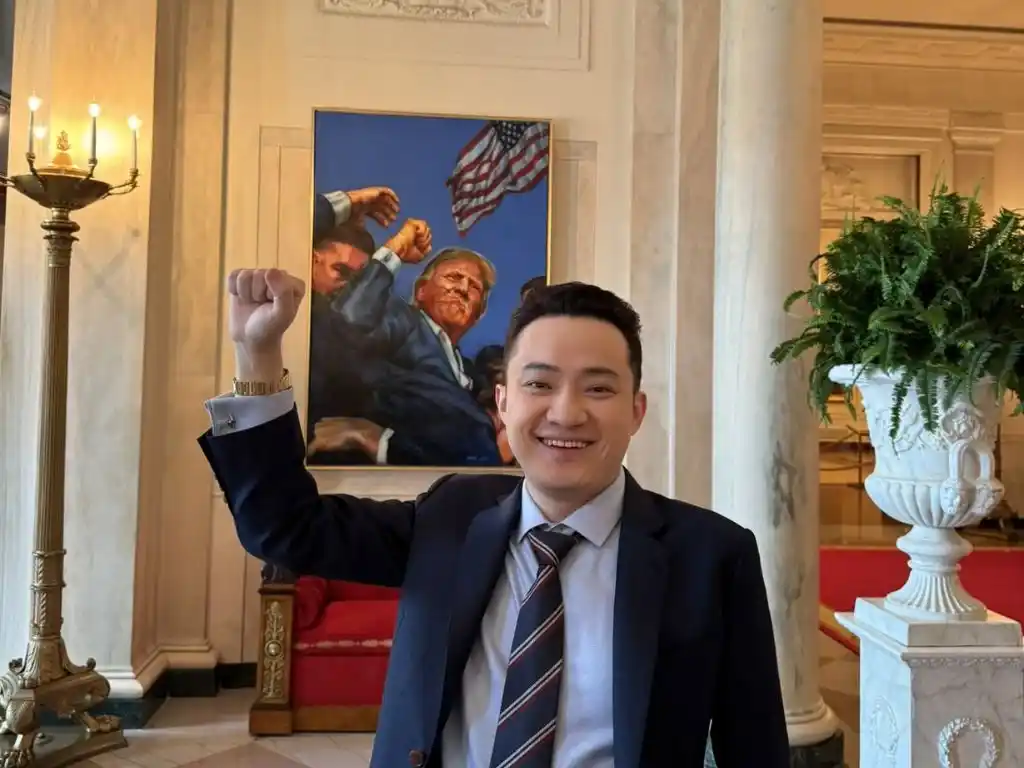
Justin Sun Sues Trump Family: What $75 Million Bought Was Only a Blacklist

Justin Sun, founder of Tron, has filed a lawsuit in federal court against World Liberty Financial (WLF), alleging he was made the "primary target of a fraudulent scheme" after investing $75 million. Sun claims the investment secured him an advisor title and WLFI tokens, which were later frozen by WLF, causing "hundreds of millions in losses." The dispute began in late 2024 when Sun's investment helped revive WLF's struggling token sale, which ultimately raised $550 million. Shortly after, the SEC dropped its lawsuit against Sun following Donald Trump's inauguration. However, relations soured when Sun refused WLF's demands for additional funding. In August 2025, WLF added a "blacklist" function to its smart contract, allowing it to unilaterally freeze tokens. Sun's holdings, worth approximately $107 million, were frozen, and he was threatened with token destruction. The lawsuit highlights WLF's structure, which directs 75% of token sale profits to the Trump family, who had earned $1 billion by December 2025. WLF's CEO is Zach Witkoff, son of U.S. Middle East envoy Steve Witkoff. The project faces scrutiny for opaque operations, including a controversial loan arrangement on the Dolomite platform, co-founded by a WLF advisor. Despite Sun's history with the SEC, the case underscores centralization risks within DeFi, as WLF controls governance and holds powers to freeze assets arbitrarily. Sun's tokens remain frozen as legal proceedings begin.

marsbit11 мин. назад

Justin Sun Sues Trump Family: What $75 Million Bought Was Only a Blacklist

marsbit11 мин. назад

$500 to Buy OpenAI Stock: Silicon Valley's Most Respectable Liquidity Invitation

Silicon Valley's largest venture capital platform, AngelList, has launched a new fund called USVC, allowing U.S. retail investors to buy into high-profile AI companies like OpenAI, Anthropic, and xAI with a minimum investment of $500—no accredited investor status required. Promoted by AngelList co-founder Naval Ravikant, the fund is framed as an opportunity for ordinary people to access high-growth private tech investments traditionally reserved for VCs. However, critics argue it functions more like an exit vehicle for early insiders. USVC acquires shares not through primary rounds but largely via secondary transactions—purchasing stakes from early investors, VC funds, and employees looking to cash out at peak valuations. With companies like xAI heavily weighted in the portfolio, the fund effectively channels retail money into providing liquidity for insiders who entered at much lower valuations. The fund’s structure raises concerns: shares are illiquid, with no secondary market, and buybacks are limited and discretionary. The actual annual fee reaches 3.61%, far above the advertised 1% management fee. This model parallels the "low float, high fully diluted valuation" strategy seen in crypto, where early investors profit by selling to latecomers at inflated prices. The timing—alongside similar moves by platforms like Robinhood—suggests that Silicon Valley’s sudden interest in retail inclusion may be less about democratizing access and more about securing exits for insiders.

marsbit42 мин. назад

$500 to Buy OpenAI Stock: Silicon Valley's Most Respectable Liquidity Invitation

marsbit42 мин. назад

Торговля

Спот
Фьючерсы

Популярные статьи

Manyu: восходящая мем-звезда на Ethereum, готовая открыть новую эру культуры Shiba

Manyu - это мемтокен на Ethereum, который приносит децентрализованную культурную и развлекательную ценность через вирусное влияние в соцсетях и вовлечённость сообщества.

1.9k просмотров всегоОпубликовано 2025.11.27Обновлено 2025.11.27

Manyu: восходящая мем-звезда на Ethereum, готовая открыть новую эру культуры Shiba

Обсуждения

Добро пожаловать в Сообщество HTX. Здесь вы сможете быть в курсе последних новостей о развитии платформы и получить доступ к профессиональной аналитической информации о рынке. Мнения пользователей о цене на ETH (ETH) представлены ниже.

活动图片