Superstate brings stablecoin-settled stock offerings to Ethereum and Solana

cointelegraphОпубликовано 2025-12-10Обновлено 2025-12-10

Введение

Superstate has launched Direct Issuance Programs (DIPs), enabling SEC-registered public companies to raise capital directly on Ethereum and Solana. Investors can pay in stablecoins and receive tokenized shares instantly at real-time market prices. This onchain model uses Superstate’s SEC-registered transfer-agent infrastructure to update shareholder registries automatically, ensuring compliance with securities laws. The system allows companies to reduce financing costs and reach global investors, while providing instant settlement and regulatory safeguards. Superstate’s initiative builds on its growing onchain infrastructure, which has already attracted firms like SharpLink Gaming and Galaxy Digital. The tokenized real-world asset market has surpassed $24 billion, with Ethereum and Solana leading much of the activity.

Financial technology firm Superstate has rolled out a new way for US Securities and Exchange Commission (SEC)-registered public companies to raise capital directly onchain.

Through its Direct Issuance Programs (DIPs), any issuer registered with the SEC can now offer new shares on Ethereum and Solana, with investors paying in stablecoins and receiving tokenized shares instantly at real‐time market prices, according to a Wednesday announcement from Superstate shared with Cointelegraph.

Jim Hiltner, co-founder and head of business development at Superstate, told Cointelegraph, “The regulatory ability to directly issue registered shares isn’t new. What is new is that issuers can now conduct these offerings onchain, which changes what’s possible operationally and economically.”

The launch of DIPs is part of Superstate’s mission to bring compliant public‐market infrastructure onchain. The model uses Superstate’s SEC‐registered transfer‐agent infrastructure to update shareholder registries automatically as tokenized shares move between verified wallets, ensuring issuances comply with existing securities laws.

“Any SEC‐registered public company is able to run an issuer‐led primary offering onchain using this structure,” said Hiltner. “Our infrastructure is live now. Issuers can begin preparing and filing their programs immediately. The first public company offerings are expected to go live in 2026.”

Related: Spark marks first major rotation from US Treasurys into regulated DeFi

Expanding Superstate’s onchain ambitions

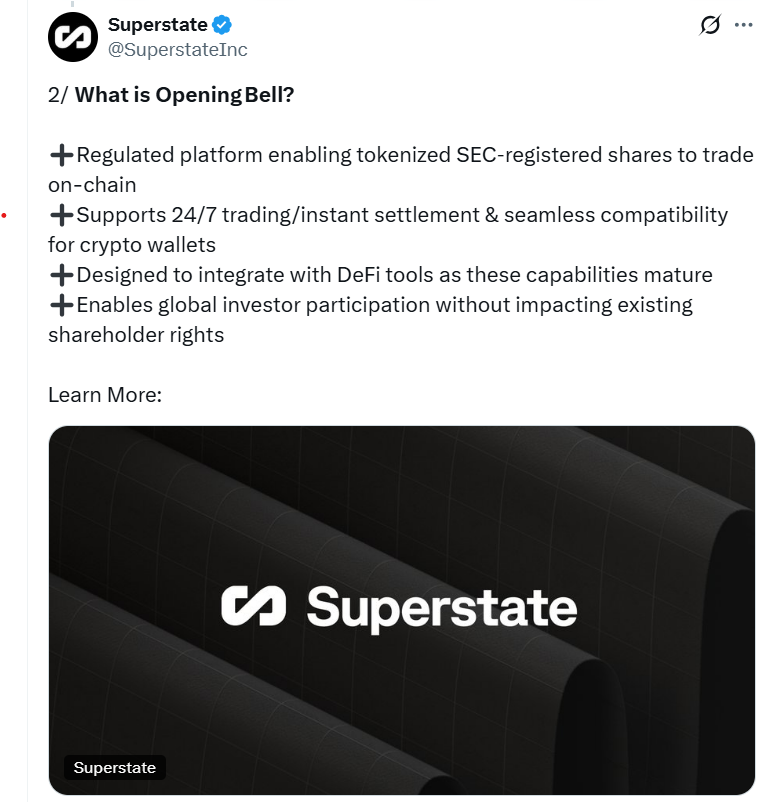
DIPs build on a year of onchain expansion for the fintech startup. In May, Superstate launched Opening Bell, a platform designed to tokenize and enable compliant onchain activity for SEC‐registered equities.

Source: Superstate

In September, SharpLink Gaming, one of the world’s biggest public holders of Ether (ETH), revealed plans to tokenize its common stock through Superstate’s platform. In the same month, Galaxy Digital announced its tokenized public shares on Solana using Superstate’s transfer-agent infrastructure.

The launch of DIPs also lands in a year when other tokenization initiatives are expanding across Ethereum and Solana, such as Franklin Templeton’s move from tokenized money funds to multi‐asset real‐world‐asset (RWA) platforms.

The tokenized real‐world asset market had surged to over $24 billion on public blockchains by Q3, 2025, with Ethereum and Solana accounting for well over half of all RWA activity.

Related: US Treasurys lead tokenization wave as CoinShares predicts 2026 growth

A new channel for issuers and investors

Hiltner said that DIPs allow companies to structure their offerings under standard SEC registrations, receive stablecoin proceeds directly into their wallets, and distribute tokenized shares instantly to verified investors.

Each transaction updates the issuer’s shareholder registry in real time, preserving the integrity of ownership records while enabling instant settlement. According to Hiltner, issuers can achieve lower financing costs through reduced underwriting and distribution fees and broader global reach to eligible investors.

For investors, the system allows retail and institutional participants to purchase newly issued stock directly from companies (sometimes below exchange prices), with shares settling to their wallets immediately.

“This combines regulatory compliance with onchain execution,” said Hiltner. “If an investor meets all requirements, they can participate; if not, the system blocks the transaction.”

Superstate’s model blends established securities law with crypto’s instant settlement rails and aims to bring traditional financial regulation to onchain capital markets infrastructure.

Magazine: Solana vs Ethereum ETFs, Facebook’s influence on Bitwise — Hunter Horsley

Похожее

The Largest IPO in History Is Approaching, Surpassing SpaceX, 28 Years of AI Self-Iteration, Countdown to Intelligence Explosion

"Anthropic Nears Trillion-Dollar IPO, Fueled by Explosive Growth and 2028 'Intelligence Explosion' Warning Anthropic is considering a deal valuing the AI company near $1 trillion, potentially leading to one of the largest IPOs ever and surpassing SpaceX. Its revenue has skyrocketed, with Annual Recurring Revenue (ARR) reaching $45 billion in May 2026—a 500% increase in just five months. This vertical growth curve is attributed to its key products, Claude Code and Cowork, dominating AI coding and enterprise collaboration. Beyond commercial success, co-founder Jack Clark issued a pivotal warning in an interview: there is a greater than 50% chance that by the end of 2028, AI systems will achieve recursive self-improvement—the ability to autonomously build a 'better version' of themselves, initiating an 'intelligence explosion.' This prophecy underpins the company's astronomical valuation, as the market prices in the potential for transformative and disruptive AI. Further signaling its ambition, Anthropic formed a $1.5 billion joint venture with Goldman Sachs and Blackstone, aiming to disrupt traditional consulting firms like McKinsey by deploying Claude AI for complex strategic work. This move tests AI's capacity to replace high-level cognitive labor, a precursor to its predicted autonomous evolution. The narrative presents a dual future: unprecedented economic opportunity alongside significant risks like economic restructuring and security threats. Anthropic's meteoric rise and Clark's 2028 prediction frame the coming years as a countdown to a potential technological singularity."

marsbit10 мин. назад

The Largest IPO in History Is Approaching, Surpassing SpaceX, 28 Years of AI Self-Iteration, Countdown to Intelligence Explosion

marsbit10 мин. назад

Has Hook Summer Really Arrived? sato, Lo0p, FLOOD Ignite the New Narrative of Uniswap v4

"Hook Summer" Arrives? Sato, Lo0p, FLOOD Ignite Uniswap v4 Narrative Amidst a slight market recovery, attention within the Ethereum ecosystem has shifted to Meme coins built on Uniswap v4's Hook protocol. Following ASTEROID, tokens like sato, sat1, Lo0p, and FLOOD have become market focal points, with market caps ranging from millions to tens of millions, bringing concentrated liquidity to a narrative-dry market. Uniswap v4 Hooks are "plugin smart contracts" that allow developers to inject custom logic at key points in a liquidity pool's lifecycle (initialization, adding/removing liquidity, swaps, etc.), making the AMM programmable. Recent representative projects include: * **sato**: Market cap peaked over $38M; uses a v4 curve mechanism for minting/burning, locking ETH as reserve. * **sat1**: Market cap briefly exceeded $10M, positioning as an "optimized sato," but later declined significantly. * **Lo0p**: Market cap neared $6.6M; a "lending AMM protocol" allowing users to borrow ETH against deposited LO0P tokens without immediate selling pressure. * **FLOOD**: Market cap approached $6M; channels trading reserves into Aave v3 to generate yield, which is retained in the pool. The emergence of these Hook-based tokens could drive long-term growth for the Uniswap ecosystem by attracting users and liquidity to v4 pools. Combined with Uniswap's activated fee switch (partially used to burn UNI), the long-term outlook for UNI appears positive. However, short-term UNI price appreciation is not directly guaranteed. Factors include the sustainability and lifecycle of these new tokens, their price volatility, overall market conditions, and regulatory pressures. Currently, Uniswap v4's TVL ($595M) lags behind v3 and v2, indicating Hook adoption still requires time to mature. In summary, the Hook ecosystem serves as "long-term nourishment" for UNI, but acts more as a "catalyst" than a direct "booster" in the short term. Note: These are early-stage experimental tokens and may carry unknown risks.

marsbit36 мин. назад

Has Hook Summer Really Arrived? sato, Lo0p, FLOOD Ignite the New Narrative of Uniswap v4

marsbit36 мин. назад

Has Hook Summer Truly Arrived? sato, Lo0p, FLOOD Ignite the New Uniswap v4 Narrative

With the broader market showing signs of recovery, a new wave of interest has emerged around Ethereum-based meme coins. Following ASTEROID, tokens like sato, sat1, Lo0p, and FLOOD, built upon the Uniswap v4 Hook protocol, are capturing market attention. Their market capitalizations range from millions to tens of millions of dollars, injecting much-needed focused liquidity into a market lacking narratives. This article explores whether this trend signifies an incoming "Hook Summer" and its potential impact on UNI's price. Hooks are essentially plug-in smart contracts for Uniswap v4 liquidity pools, allowing developers to inject custom logic at key points in a pool's lifecycle (like initialization, adding/removing liquidity, swaps). This transforms the AMM into programmable building blocks. Key highlighted projects include: * **sato**: Peaked over $38M market cap. It utilizes a v4 curve for minting/burning; buying locks ETH as reserve to mint new tokens, while selling redeems ETH from the reserve and burns tokens. * **sat1**: Market cap briefly exceeded $10M, promoted as an "optimized sato," but later declined significantly. * **Lo0p**: Reached nearly $6.6M. It's a lending AMM protocol where buying LO0P tokens locks them as collateral, allowing users to borrow ETH from the pool reserve at 40% LTV, aiming to improve capital efficiency for idle ETH in LPs. * **FLOOD**: Peaked near $6M. Its mechanism directs asset reserves from buys into Aave v3 to generate yield, with fees and interest retained in the pool to potentially influence the token's price long-term. In the long term, the development of the Hook ecosystem can attract users and liquidity to Uniswap v4, benefiting UNI's fundamentals—especially combined with the recent activation of the protocol fee switch, where a portion of fees is used to burn UNI. However, in the short term, these Hook-based tokens are unlikely to directly drive significant UNI price appreciation. Their impact is moderated by factors like token sustainability, price volatility, and broader market and regulatory conditions. Currently, Uniswap v4's TVL ($595M) still trails behind v2 and v3, indicating adoption and growth will take time. The article concludes that while the Hook ecosystem provides long-term "nourishment" for UNI, its short-term role is more of a "catalyst" than a "booster." Readers are cautioned that these are early-stage experimental tokens and may carry unknown risks.

Odaily星球日报48 мин. назад

Has Hook Summer Truly Arrived? sato, Lo0p, FLOOD Ignite the New Uniswap v4 Narrative

Odaily星球日报48 мин. назад

Торговля

Спот
Фьючерсы

Популярные статьи

Обсуждения

Добро пожаловать в Сообщество HTX. Здесь вы сможете быть в курсе последних новостей о развитии платформы и получить доступ к профессиональной аналитической информации о рынке. Мнения пользователей о цене на SOL (SOL) представлены ниже.

活动图片