Strategy Watch #3

insights.glassnodeОпубликовано 2026-04-23Обновлено 2026-04-23

Введение

Strategy Watch #3 provides institutional analysis of digital asset fund performance and allocation trends. Key findings show gradual stabilization in capital flows, with Bitcoin and ETH outflows improving from February lows but remaining negative. BTC ETF and DAT flows turned positive mid-March before moderating, while Ethereum flows followed more cautiously. DeFi TVL on Ethereum recovered significantly, nearing neutral by month-end. However, BTC CME basis yield turned negative, eliminating carry trade opportunities. The report also covers performance dispersion among strategies, a deep dive into quant trend following, on-chain vault yields, manager sentiment, and new institutional entries, including a $6B pension fund increasing crypto exposure.

The full report is freely available in PDF format.

Download PDF version

Welcome to Strategy Watch #3

Strategy Watch was built to address a clear demand for high-signal, impartial analysis of fund-level performance and allocation trends in digital assets.

Our objective is straightforward — to make Strategy Watch a must-read monthly publication for the digital asset investment community.

Funds and allocators that contribute data and insights help shape a more complete and valuable view of the landscape. If you have insights, data, or allocation updates worth sharing, we welcome your contribution.

Present your latest initiatives and updates to a curated audience of institutional allocators.

Share updates ↗

Inside the Latest Strategy Watch

The report is structured across six core sections, each focused on a distinct dimension of institutional activity in digital assets:

01 Institutional Flow Monitor | Early stabilization as BTC/ETH outflows improve and ETF demand recovers, but conviction in spot markets remains under pressure.

02 Fund and SMA Performance | Market-neutral strategies delivered consistent gains; directional performance remains highly dispersed.

03 Strategy Deep Dive: Quant Trend Following | What’s driving quant trend performance in a difficult environment for directional strategies? Hear directly from a fund manager.

04 On-chain Vault Performance | Are ETH curators underperforming ETH staking yield?

05 Manager Monitor | Find out how more than 300 managers are expecting the crypto market to perform over the next three months.

06 Allocation Updates | A $6B pension fund increases crypto exposure as new funds and institutional strategies continue to launch.

in partnership with

The Premier Digital Assets Allocator Platform. Learn more


Institutional Flow Monitor

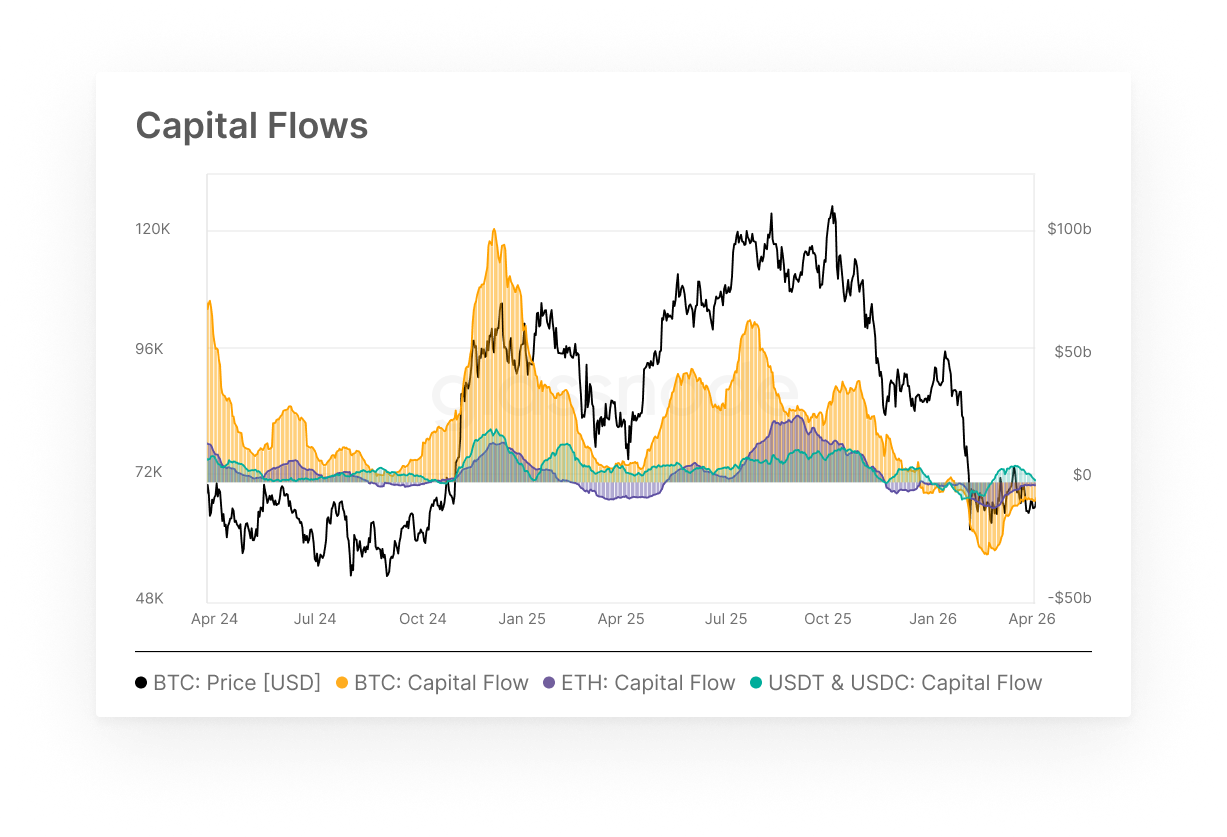
  • BTC and ETH capital flows remained negative through March but continued to recover from February lows, while stablecoin inflows moderated alongside the broader stabilization.

Bitcoin and Ethereum continued to register net outflows through March, with capital flows closing the month at -$7.0B and -$1.6B respectively, a notable improvement from the -$9.6B and -$3.2B readings seen in mid-February. Stablecoin inflows also moderated to +$2.6B by month-end, easing from the +$6.2B peak earlier in March. The overall picture is one of gradual stabilization rather than recovery, with the acute phase of institutional de-risking losing momentum but conviction in spot assets remaining under pressure.
ETF & DAT Net Flows

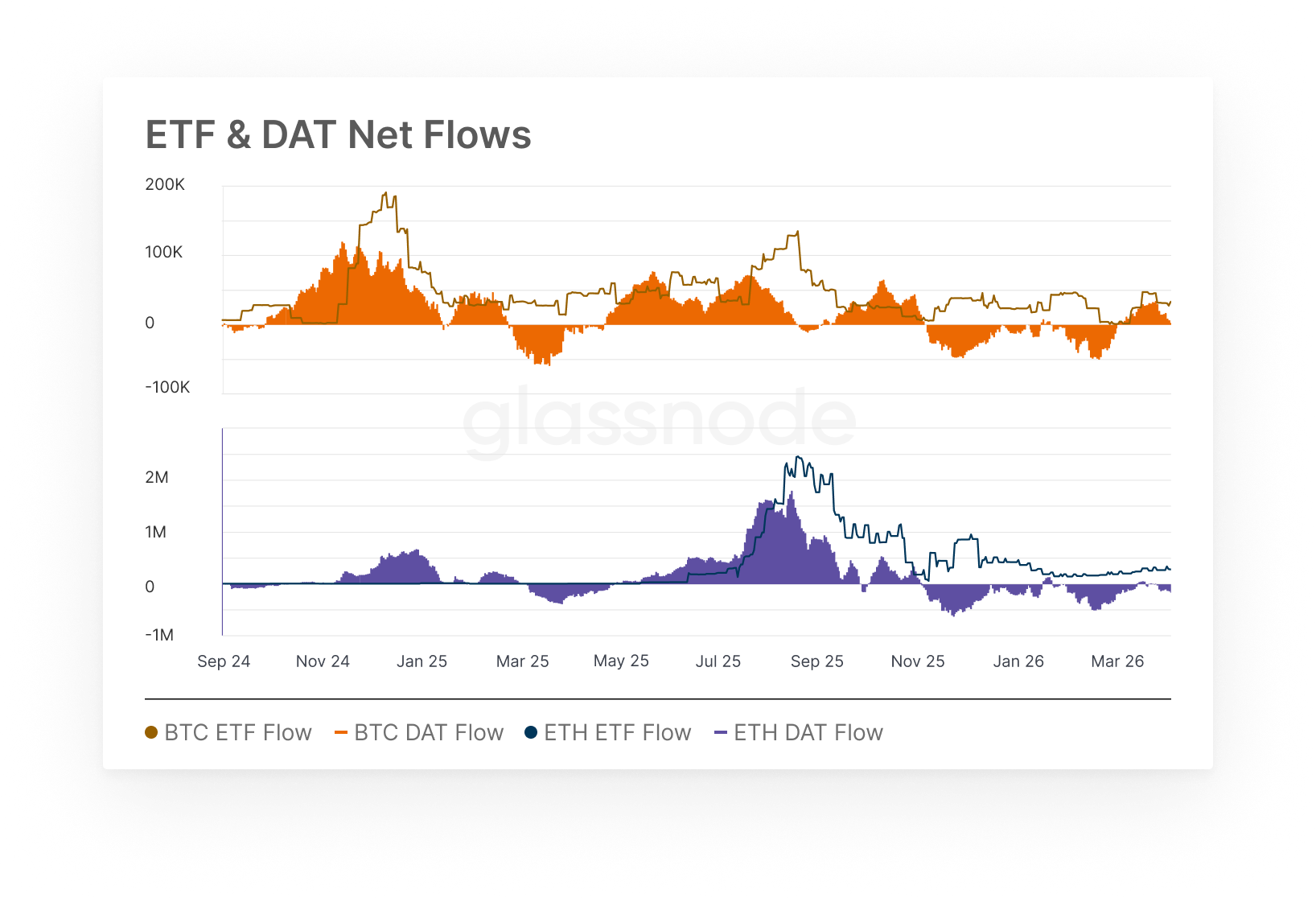
  • BTC ETF and DAT flows swung decisively positive through March, with ETH channels following at a more measured pace before both eased into month-end.

Bitcoin ETF and DAT flows finally turned positive through March, reaching intra-month highs of +30.6k BTC and +46.8k BTC respectively mid-month before settling back to +17.6k BTC and +30.9k BTC by month-end. Ethereum flows mirrored the directional shift with less intensity, as ETF flows reached +46.6k ETH and DAT flows peaked at +295.9k ETH before easing to +261.9k ETH at close. The mid-month surge followed by minor pullback, suggests demand remains sensitive to wider market conditions, rather than a true sustained structural shift in institutional positioning.
DeFi TVL & Stablecoin Cap

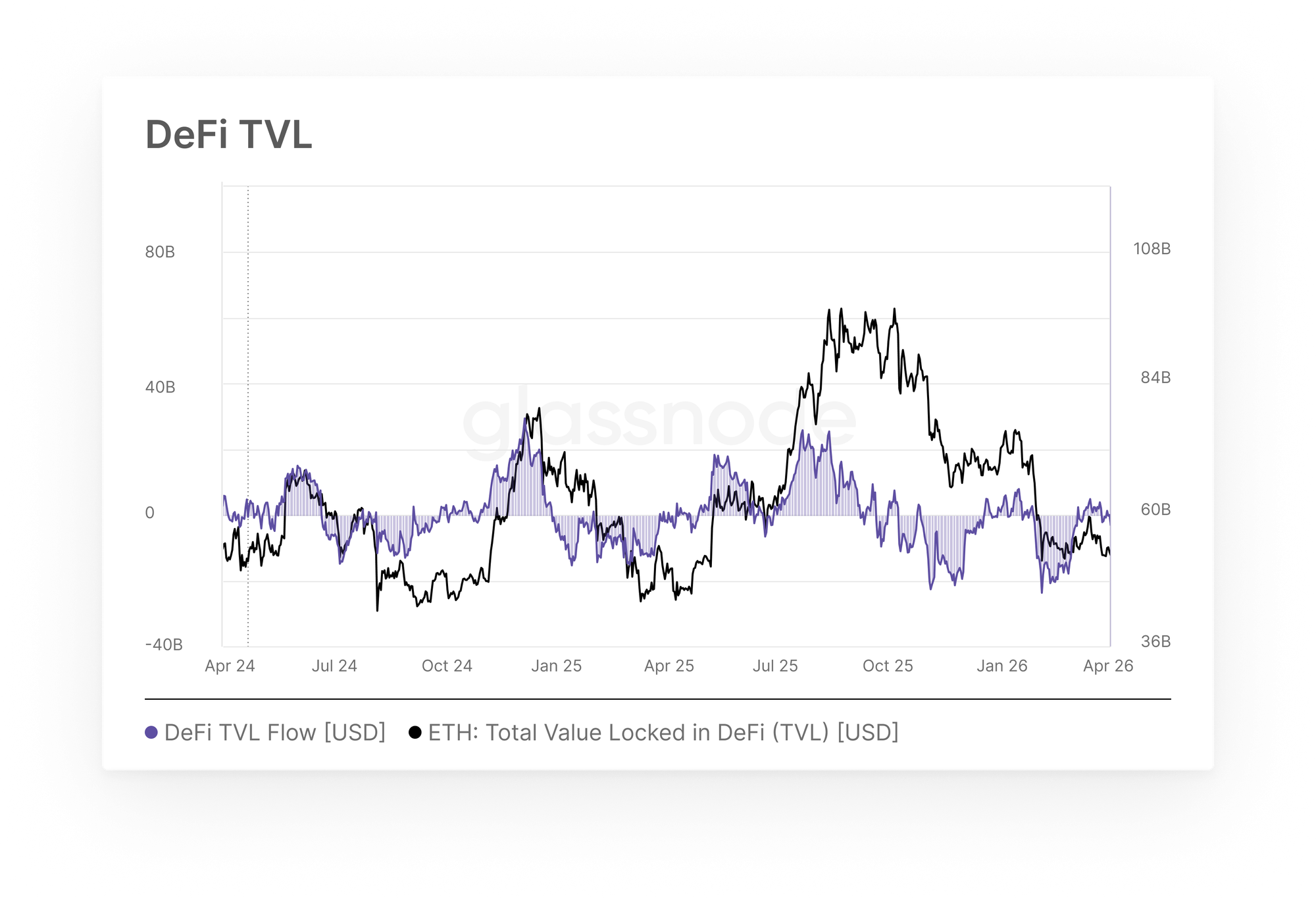
  • DeFi TVL flows on Ethereum staged a significant recovery through March, reversing from peak February outflows to near-neutral territory by month-end.

After registering peak monthly outflows of $17.8B at end of February, Ethereum DeFi TVL flows recovered sharply through March, turning positive in mid-month and closing the period near neutral at -$0.75B. The pace of recovery was notable, with flows moving from double-digit outflows in early March to briefly positive readings around $4.9B by mid-month before settling back. While the trend shift is meaningful, a single month of stabilization is insufficient to declare a reversal of the broader contraction that has persisted since August 2025, and sustained inflows would be required to confirm a genuine return of allocator conviction in on-chain yield strategies.
CME Basis Yield

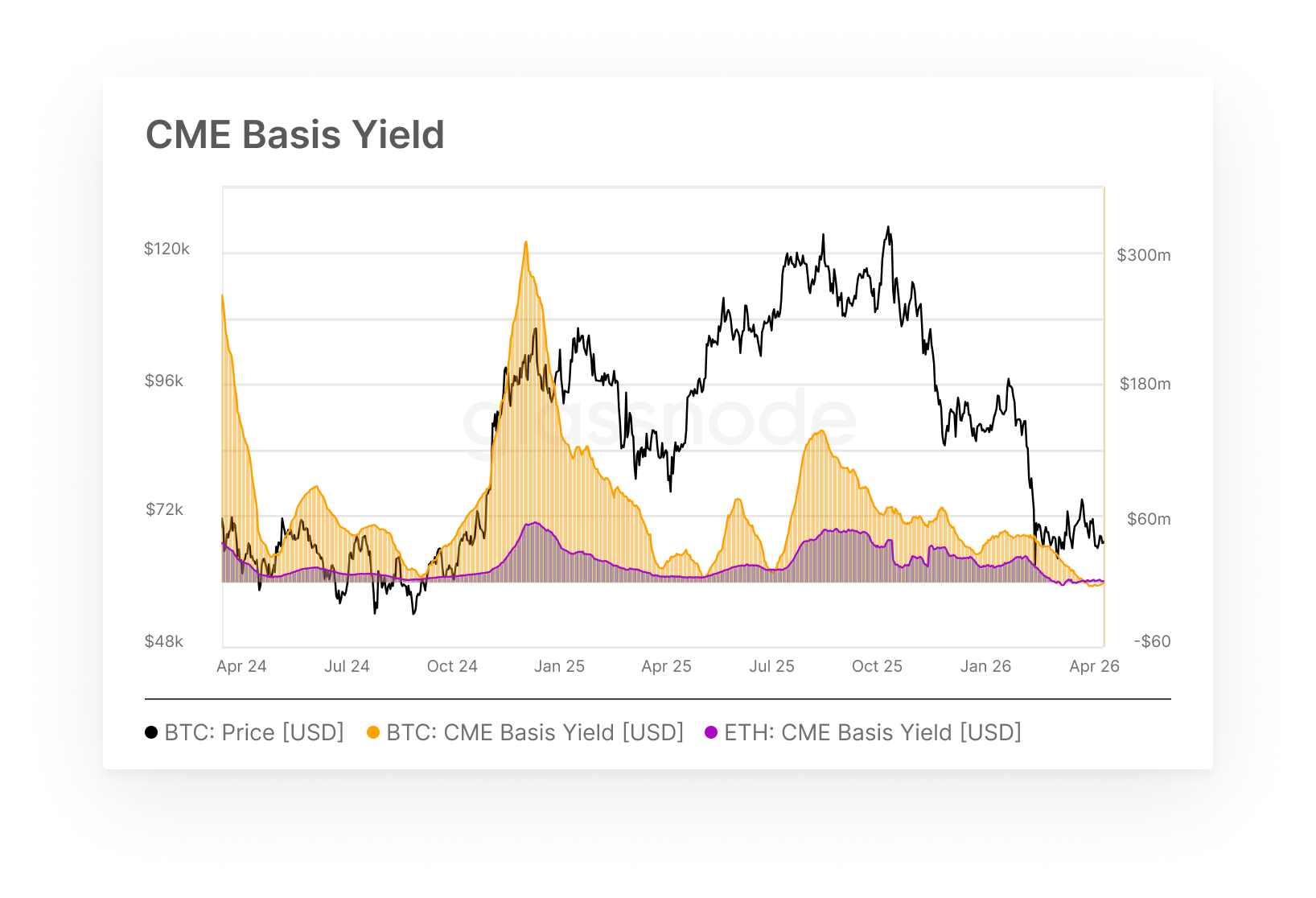
  • BTC CME basis yield turned negative through March, erasing the carry trade entirely, while ETH basis yield remained subdued but showed tentative signs of recovery by month-end.

Here we measure return available to institutions running cash-and-carry trades. After compressing through February to $17.3M/month, BTC basis yield crossed into negative territory mid-March and closed the month at -$3.9M, reflecting a full inversion of the carry premium. This signals futures are trading at a discount to spot, removing the economic rationale for market-neutral strategies entirely. ETH basis yield, already negative at end of February, oscillated in a narrow range before recovering modestly to +0.9M by month-end. Taken together, the carry environment for both assets remains structurally challenged, with meaningful recovery contingent on a sustained rebuilding of futures premium above spot.


Disclaimer: This report does not provide any investment advice. All data is provided for information and educational purposes only. No investment decision shall be based on the information provided here and you are solely responsible for your own investment decisions.
Exchange balances presented are derived from Glassnode’s comprehensive database of address labels, which are amassed through both officially published exchange information and proprietary clustering algorithms. While we strive to ensure the utmost accuracy in representing exchange balances, it is important to note that these figures might not always encapsulate the entirety of an exchange’s reserves, particularly when exchanges refrain from disclosing their official addresses. We urge users to exercise caution and discretion when utilizing these metrics. Glassnode shall not be held responsible for any discrepancies or potential inaccuracies. Please read our Transparency Notice when using exchange data.

Связанные с этим вопросы

QWhat is the main objective of the Strategy Watch publication?

AThe objective is to make Strategy Watch a must-read monthly publication for the digital asset investment community by providing high-signal, impartial analysis of fund-level performance and allocation trends.

QWhat was the trend in Bitcoin and Ethereum capital flows through March as reported?

ABitcoin and Ethereum continued to register net outflows through March, closing at -$7.0B and -$1.6B respectively, which was an improvement from the -$9.6B and -$3.2B readings seen in mid-February.

QHow did the performance of market-neutral strategies compare to directional strategies?

AMarket-neutral strategies delivered consistent gains, while directional performance remained highly dispersed.

QWhat happened to the BTC CME basis yield in March?

AThe BTC CME basis yield turned negative through March, erasing the carry trade entirely and closing the month at -$3.9M, indicating futures were trading at a discount to spot.

QWhich section of the report discusses the performance of on-chain ETH vaults compared to staking yield?

ASection 04, titled 'On-chain Vault Performance', addresses whether ETH curators are underperforming ETH staking yield.

Похожее

The Merger of Codex and ChatGPT Marks the Beginning of a Major Reshuffle in Programming Tools

OpenAI is shifting its strategic focus from ChatGPT to Codex, merging them along with the browser tool Atlas into a unified desktop super-app. This move signals an internal belief that Codex, originally a programming tool, represents the next evolution of AI more than conversational models like ChatGPT. Over the past year, Codex's weekly active users have surged past 5 million. The key distinction is that while ChatGPT answers questions, Codex executes tasks. Enterprises increasingly value this ability to get work done over simply receiving advice. Consequently, Codex is attracting professionals beyond developers, including analysts, bankers, marketers, and product managers. OpenAI's reorganization and increased investment in Codex stem from recognizing that the future of AI competition lies in execution capabilities, not just conversation. The company is launching role-specific plugins (e.g., for data analysis, sales, design) to transform Codex into a broad knowledge work platform that automates and redefines white-collar workflows. Beyond being a tool, Codex reflects OpenAI's ambition to redefine software. New features like "Sites"—which generates interactive websites from documents—and collaborative "Annotations" aim to create a paradigm where the AI understands the goal and handles the tools and steps, functioning more like a digital colleague than traditional software. The ultimate goal is a unified experience where the user cares only about the completed task.

marsbit11 мин. назад

The Merger of Codex and ChatGPT Marks the Beginning of a Major Reshuffle in Programming Tools

marsbit11 мин. назад

Interpreting Investment Opportunities in the Age of Great Navigation, Invesco Great Wall Fund Releases '2026 Report on Chinese Enterprises Going Global'

Invesco Great Wall Fund has released its "2026 China Corporate Globalization Report," titled "The 'Great Navigation Era' of Chinese Enterprises." The report analyzes the new trends and investment opportunities as Chinese companies expand globally, moving from simple product exports to comprehensive overseas operations involving services, branding, and local production. Driven by factors like trade friction, the pursuit of higher profit margins abroad, and policy support, globalization is becoming essential for Chinese companies. The report outlines an evolution: from early product export ("Globalization 1.0") to the current "Globalization 2.0," characterized by overseas capacity, capital goods investment, consumer brand expansion, and service exports. Chinese firms' competitive advantages are highlighted, including a vast engineer talent pool, low-cost and robust infrastructure, and complete industrial clusters. Specific sectors with significant出海 potential are identified: * **Capital Goods** (e.g., engineering machinery, power equipment): Benefiting from global demand, especially in Belt & Road markets and the AI-driven power grid upgrade cycle. * **Consumer Brands**: Transitioning from cost to brand advantage, leveraging供应链 efficiency. * **Technology & Innovation**: Including AI applications, optical modules within global tech supply chains, and new energy vehicles focusing on local production. * **Pharmaceuticals**: Chinese biotech firms are becoming preferred partners for global pharma, with potential for breakthrough drugs in areas like oncology and weight loss. The report concludes that corporate globalization represents a sustained, core theme for China's capital markets, though companies must navigate challenges like geopolitics and localization.

marsbit23 мин. назад

Interpreting Investment Opportunities in the Age of Great Navigation, Invesco Great Wall Fund Releases '2026 Report on Chinese Enterprises Going Global'

marsbit23 мин. назад

GitHub, Transfixed by AI

On the night of February 9th, GitHub suffered a major outage caused by a simple configuration change—reducing a cache refresh interval from 12 to 2 hours—that triggered a cascade of failures. This was not an isolated event, but part of a broader pattern. In early 2026, GitHub experienced at least 8 major incidents, failing to meet its promised 99.9% availability. These outages stemmed from structural issues: explosive growth in load, tight service coupling, and insufficient protection against abnormal traffic. This unprecedented load is driven by AI Agents. In 2025, GitHub handled ~1 billion commits. By 2026, weekly commits reached 275 million, projecting to ~14 billion for the year—a 14x increase. AI tools like Claude Code now contribute 4.5% of all public repository commits, with weekly submissions surging 25x in just three months. AI-generated pull requests jumped from 4 million to 17 million per month in half a year. Unlike human developers, AI Agents work continuously, generating commits at a scale that overwhelms infrastructure designed for human rhythms. The surge also shattered GitHub's business model. Copilot's flat-rate pricing, based on assisting human developers, became unsustainable as Agentic AI sessions consumed resources worth hundreds of dollars for a few dollars in fees. In response, GitHub imposed usage limits and, by June 1st, shifted to a pay-per-use "AI Credits" system. Facing this new reality, GitHub realized a 10x scaling plan was insufficient. It announced a need to *redesign* its architecture for 30x current scale—decoupling services, adding fault isolation, and improving change management to prevent cascading failures. Other platforms like Stripe and AWS are facing similar challenges with AI Agents. Fundamentally, GitHub is transitioning from a human collaboration platform to an "exhaust pipe" for automated AI workflows. Its detailed post-mortem reports aim to maintain trust during this turbulent rebuild. The February outage was not just a technical glitch, but a signal of the software industry's entry into a new, AI-driven era.

marsbit1 ч. назад

GitHub, Transfixed by AI

marsbit1 ч. назад

Торговля

Спот
Фьючерсы
活动图片