Strategy Takes a Hard Line Against MSCI: The Ultimate Defense of DAT

深潮Опубликовано 2025-12-11Обновлено 2025-12-11

Введение

In a significant industry clash, digital asset treasury company Strategy has issued a forceful 12-page public letter to MSCI opposing its proposal to exclude companies with over 50% digital asset holdings from its global investable market indices. Strategy argues the move is discriminatory, misleading, and threatens billions in capital flow, potentially causing up to $2.8 billion in passive outflows from its stock alone. The company defends its business model, asserting that digital asset treasuries (DATs) are operational companies—not passive funds—with active strategies like issuing digital debt instruments to fund Bitcoin acquisitions and generate shareholder returns. It compares its role to historic infrastructure builders like Standard Oil and AT&T, emphasizing Bitcoin’s transformative potential in finance. Strategy highlights four key objections: the proposal is arbitrarily discriminatory against digital assets; it violates index providers' neutrality principles; it is impractical due to Bitcoin's volatility and accounting disparities; and it contradicts the U.S. government’s pro-digital asset strategy. The firm demands MSCI withdraw the proposal or extend consultations. Backed by industry advocates and data showing over 200 public companies hold more than 5% of Bitcoin’s supply, Strategy urges MSCI to let markets—not biased rules—determine the value of digital asset companies. The decision, expected by January 2026, could redefine the role of crypto-native firms in ...

Author: KarenZ, Foresight News

The博弈 concerning the development of the Digital Asset Treasury (DAT) industry continues to intensify.

In October, global index provider MSCI put forward a proposal to exclude companies with digital asset holdings accounting for 50% or more of their total assets from its Global Investable Market Indexes. This move directly threatens the market position of companies like Strategy, representative of digital asset treasury companies, and could potentially redirect capital flows for the entire DAT sector.

According to statistics from Bitcoin for Corporations, 39 companies risk exclusion from the MSCI Global Investable Market Indexes. J.P. Morgan analysts previously warned that the exclusion of Strategy alone could lead to nearly $2.8 billion in passive fund outflows. If other index providers follow suit with similar rules, outflows could reach as high as $8.8 billion.
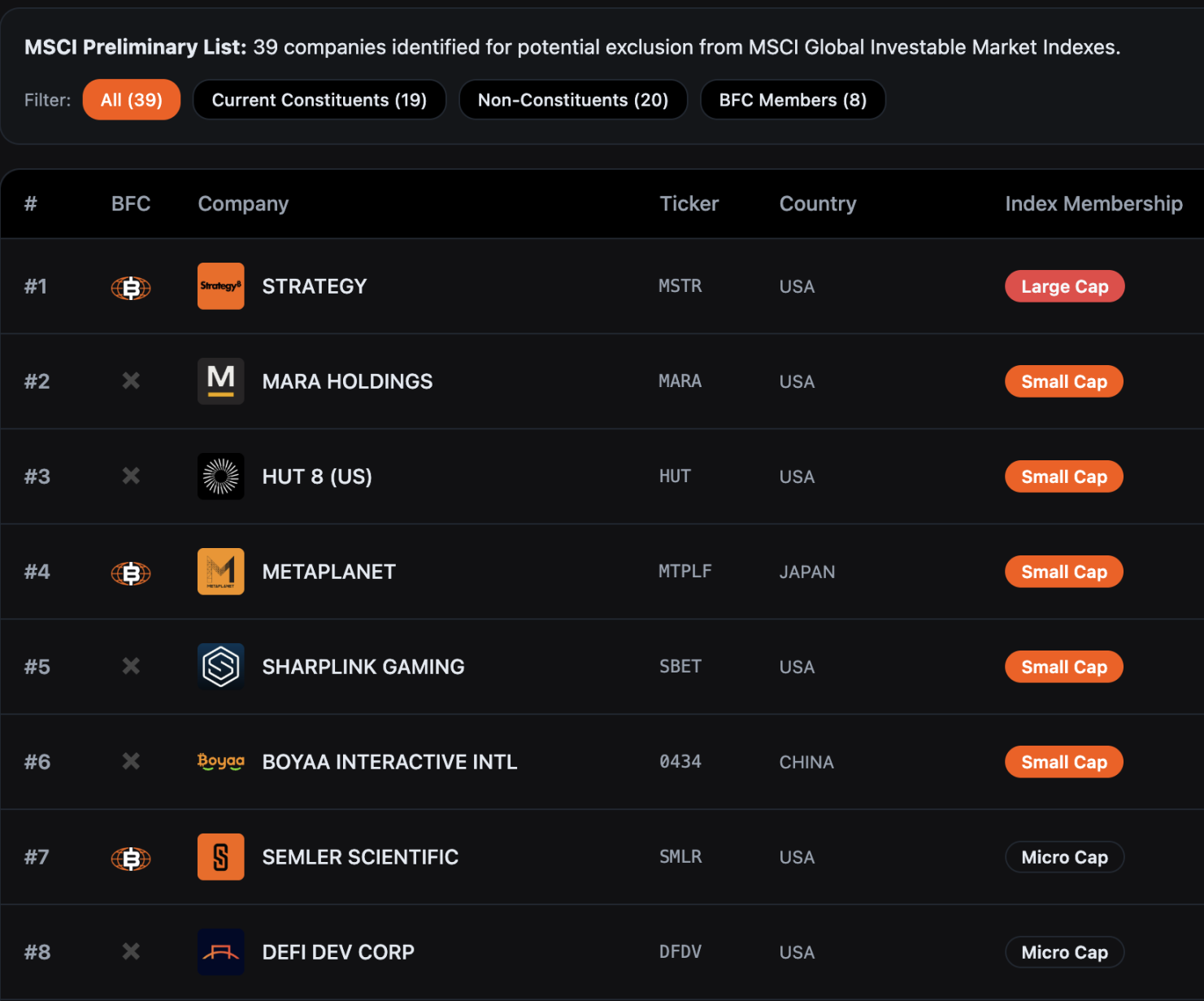
The consultation period for this MSCI proposal is currently open until December 31, 2025, with a final conclusion expected by January 15, 2026. Any adjustments would be formally implemented during the February 2026 index review.

Faced with this urgent situation, Strategy submitted a strongly worded 12-page public letter to the MSCI Equity Index Committee on December 10th. Signed jointly by Executive Chairman and Founder Michael Saylor and President & CEO Phong Le, the letter clearly expressed firm opposition to the proposal. It stated unequivocally: "This proposal is seriously misleading and will have far-reaching destructive consequences for the interests of global investors and the development of the digital asset industry. We strongly urge MSCI to completely withdraw this plan."

Strategy's Four Core Arguments

Digital Assets Are a Revolutionary Foundational Technology Reshaping the Financial System

Strategy believes MSCI's proposal underestimates the strategic value of Bitcoin and other digital assets. Since Satoshi Nakamoto introduced Bitcoin 16 years ago, this digital asset has gradually grown into a key component of the global economy, with a current total market value of approximately $1.85 trillion.

In Strategy's view, digital assets are far more than simple financial instruments; they represent a fundamental technological innovation capable of reshaping the global financial system — companies investing in Bitcoin-related infrastructure are building a new financial ecosystem, much like leading companies that deeply invested in single emerging technologies throughout history.

Just as Standard Oil focused on oil well extraction in the 19th century and AT&T全力 built telephone networks in the 20th century, these companies laid a solid foundation for subsequent economic transformations through前瞻性 investment in core infrastructure, ultimately becoming industry benchmarks. Strategy argues that companies focusing on digital assets today are following this path of "technology pioneers" and should not be simply dismissed by traditional index rules.

DATs Are Operating Companies, Not Passive Funds

This is the core of Strategy's argument — Digital Asset Treasury companies (DATs) are operating companies with complete business models, not merely investment funds passively holding Bitcoin. Although Strategy currently holds over 600,000 Bitcoin, its core value does not rely solely on Bitcoin's price fluctuations. Instead, it creates sustainable returns for shareholders by designing and offering unique "digital credit" instruments.

Specifically, Strategy issues "digital credit" instruments including various types of preferred stock with fixed dividend rates, floating dividend rates, different priority levels, and credit protection terms. It uses the funds raised from selling these instruments to acquire more Bitcoin. As long as the long-term investment return on Bitcoin exceeds Strategy's USD-denominated financing costs, it can generate stable returns for shareholders and clients. Strategy emphasizes that this model of "active operation + asset appreciation" is fundamentally different from the passive management logic of traditional investment funds or ETFs and should be regarded as a normal operating company.

Furthermore, Strategy questions in the letter: Why can oil giants, Real Estate Investment Trusts (REITs), timber companies, etc., concentrate holdings in a single asset class without being classified as investment funds and excluded from indexes? Imposing special restrictions only on digital asset companies clearly violates the principle of industry equity.

The 50% Digital Asset Threshold is Arbitrary, Discriminatory, and Impractical

Strategy points out that MSCI's proposal employs discriminatory standards. Many large companies in traditional industries also hold a highly concentrated single asset class in their portfolios, including oil and gas companies, REITs, timber companies, and power infrastructure firms. Yet, MSCI has set special exclusion criteria only for digital asset companies, constituting obvious unfair treatment.

From an implementation feasibility perspective, the proposal also has serious issues. Due to the high volatility of digital asset prices, the same company could frequently enter and exit MSCI indexes within days due to changes in asset value, causing market chaos. Additionally, differences between accounting standards (the treatment of digital assets differs under US GAAP and international IFRS standards) will lead to differential treatment for companies with the same business model based on their jurisdiction of incorporation.

Violates Index Neutrality Principle, Introduces Policy Bias

Strategy argues that MSCI's proposal is essentially a value judgment on a certain asset class, violating the fundamental principle that index providers should remain neutral. MSCI claims to markets and regulators that its indexes provide "exhaustive" coverage, aiming to reflect the "evolution of the underlying equity market," and should not "make judgments about the goodness or appropriateness of any market, company, strategy, or investment."

By selectively excluding digital asset companies, MSCI is effectively making a policy judgment on behalf of the market, which is precisely what index providers should avoid.

Contradicts US Digital Asset Strategy

Strategy specifically emphasizes that this proposal conflicts with the strategic goals of the Trump administration to advance US leadership in digital assets. The Trump administration signed an executive order in its first week to promote growth in digital financial technology and established a strategic Bitcoin reserve, aiming to make the US the global leader in digital assets.

However, if MSCI's proposal is implemented, it would directly prevent long-term US capital, such as pension funds and 401(k) plans, from investing in digital asset companies, leading to tens of billions of dollars flowing out of the sector. This would not only hinder the development of US digital asset innovation companies but could also weaken US competitiveness in this strategic field, running counter to the government's stated policy direction.

Citing analyst estimates, Strategy states that it alone could face up to $2.8 billion in passive stock liquidation due to MSCI's proposal. This harms not only Strategy itself but will also have a chilling effect on the entire digital asset ecosystem. For example, it might force Bitcoin mining companies to sell assets prematurely to adjust their asset structure, thereby distorting the normal supply and demand dynamics of the digital asset market.

Strategy's Ultimate Demands

Strategy puts forward two main demands in its public letter:

First, it hopes MSCI will completely withdraw the exclusion proposal, allowing the market to test the value of Digital Asset Treasury companies (DATs) through free competition, enabling indexes to neutrally and faithfully reflect the development trends of next-generation financial technology.

Second, if MSCI still insists on "special treatment" for digital asset companies, it must expand the scope of industry consultation, extend the consultation period, and provide more substantial logical support to explain the rationality of the rules.

Strategy Is Not Fighting Alone

Strategy is not fighting alone. According to data from BitcoinTreasuries.NET, as of December 11th, 208 publicly listed companies globally hold over 1.07 million Bitcoin, exceeding 5% of Bitcoin's total supply, currently worth approximately $100 billion.
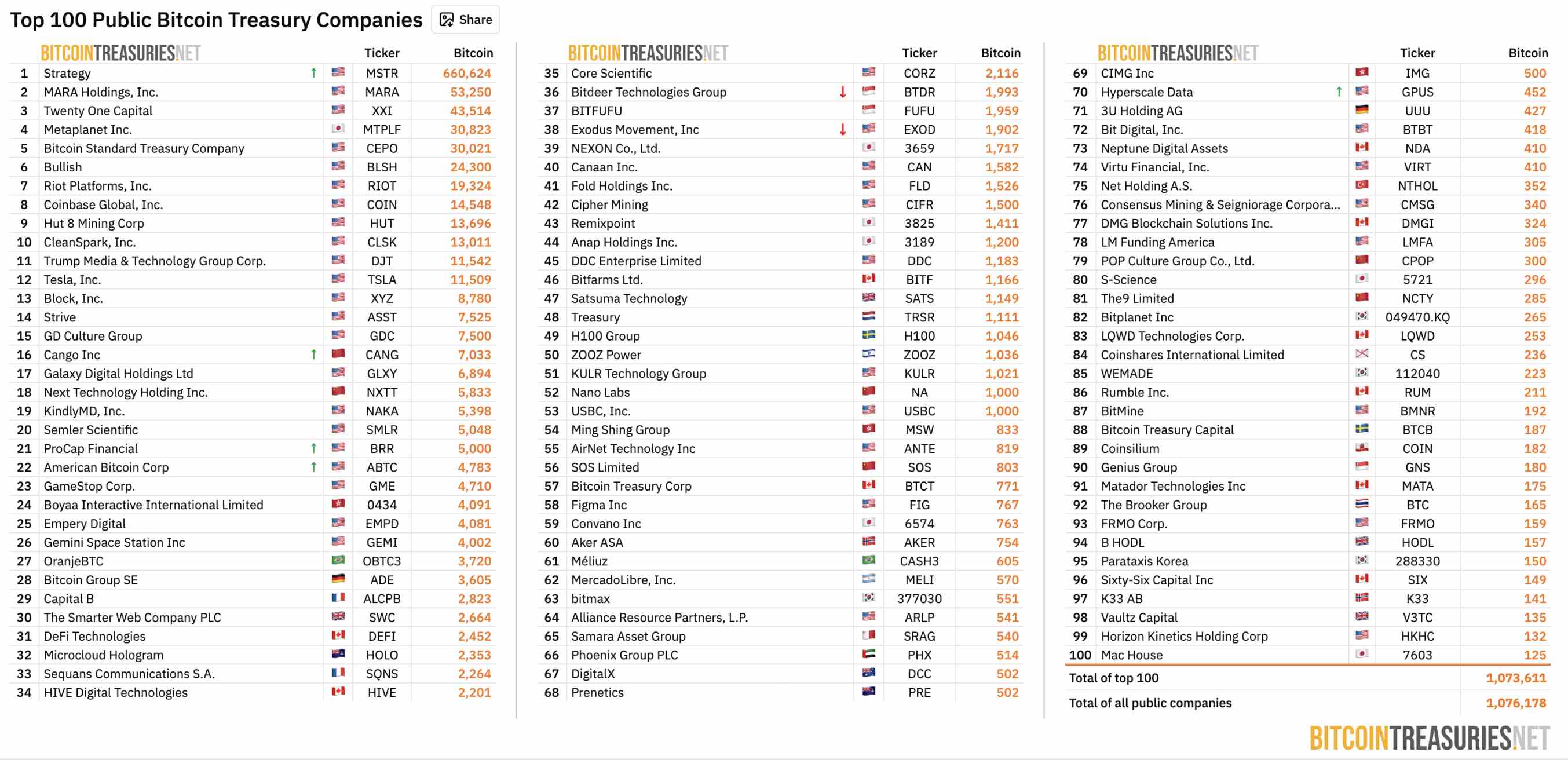
Source: BitcoinTreasuries.NET

These digital asset treasury companies have become important bridge for institutional adoption of cryptocurrency, providing compliant indirect exposure for traditional financial institutions like pension funds and endowments.

Previously, Strive, a Bitcoin-holding public company, suggested that MSCI should leave the "choice" regarding digital asset companies to the market. A simple and direct solution would be to create "ex-Digital Asset Treasury" versions of existing indexes, such as the MSCI USA ex Digital Asset Treasuries Index and the MSCI ACWI ex Digital Asset Treasuries Index. A transparent screening mechanism would allow investors to choose their tracking benchmark independently, preserving index integrity while meeting the needs of different investors.

Additionally, the industry organization Bitcoin for Corporations has initiated a joint petition calling on MSCI to withdraw the digital asset proposal. It advocates that classification should be based on a company's actual business model, financial performance, and operational characteristics, rather than simply drawing a line based on asset percentage. According to the organization's website, 309 companies or investors have currently signed the joint letter. Signatories, besides Strategy, include executives from industry-known firms like Strive, BitGo, Redwood Digital Group, 21MIL, Btc inc, DeFi Development Corp, as well as numerous individual developers and investors.

Summary

The standoff between Strategy and MSCI is essentially a fundamental debate about "how emerging financial innovations integrate into the traditional system." Digital Asset Treasury companies (DATs), as "cross-border" entities between traditional finance and the cryptocurrency world, are neither pure technology companies nor simple investment funds, but represent a new business model built upon digital assets.

MSCI's proposal attempts to use a "50% asset threshold" to classify these complex entities as "investment funds" and exclude them from indexes; Strategy insists that this simplified treatment is a serious misunderstanding of their business essence and a departure from the principle of index neutrality. As the January 15, 2026 decision date approaches, the outcome of this博弈 will not only determine the index "eligibility" of several Bitcoin-holding public companies but will also delineate a critical "survival boundary" for the future position of the digital asset industry within the global traditional financial system.


Связанные с этим вопросы

QWhat is the core argument that Strategy uses to defend its classification as an operational company rather than a passive fund?

AStrategy argues that it is an operational company with a complete business model, not a passive investment fund. Its core value is not derived from Bitcoin's price fluctuations but from creating sustainable returns for shareholders through its unique 'digital credit' instruments, such as preferred shares with fixed or floating dividend rates, which it sells to raise capital for acquiring more Bitcoin. This active operational model is fundamentally different from the passive management of ETFs or funds.

QWhat potential financial impact does Strategy claim the MSCI proposal could have on it and the broader digital asset market?

AStrategy, citing analyst estimates, claims that its exclusion from the MSCI index alone could trigger nearly $2.8 billion in passive fund outflows. If other index providers adopt similar rules, the outflows could reach as high as $8.8 billion. This would not only harm Strategy but also create a chilling effect on the entire digital asset ecosystem, potentially forcing companies like Bitcoin miners to sell assets prematurely and distorting market supply and demand.

QHow does Strategy's public letter justify the strategic value of Bitcoin and digital assets?

AStrategy's letter argues that Bitcoin and digital assets represent a revolutionary foundational technology reshaping the financial system, not merely financial instruments. It compares companies investing in Bitcoin infrastructure to historical pioneers like Standard Oil and AT&T, which made foundational investments in oil and telephone networks. These companies laid the groundwork for economic transformation and became industry benchmarks, a path Strategy believes digital asset companies are now following.

QWhat alternative solution does the industry group Bitcoin for Corporations suggest to MSCI's proposal?

AThe industry group Bitcoin for Corporations, along with companies like Strive, suggests that MSCI should create new versions of its existing indices that explicitly exclude Digital Asset Treasury companies, such as 'MSCI USA ex Digital Asset Treasuries' and 'MSCI ACWI ex Digital Asset Treasuries'. This would give investors the transparent choice of which benchmark to follow, preserving the integrity of the main indices while catering to different investor preferences.

QWhat is Strategy's ultimate request to MSCI regarding the proposed rule change?

AStrategy's primary request is for MSCI to completely withdraw the proposal to exclude companies based on their digital asset holdings. It argues the market should freely compete to validate the value of Digital Asset Treasury companies (DATs) and that the index should neutrally reflect the evolution of next-generation fintech. If MSCI insists on special treatment for these companies, Strategy demands a broader industry consultation, an extended consultation period, and a more robust logical justification for the rule.

Похожее

South Korean Exchanges 'Battle' Regulators, Challenging the Boundaries of Enforcement and Legislation

South Korea's cryptocurrency industry is engaged in a rare, direct confrontation with regulators. The Financial Intelligence Unit (FIU), the primary anti-money laundering (AML) watchdog, has recently imposed heavy penalties on major exchanges like Upbit and Bithumb for alleged violations involving unregistered overseas VASPs and AML procedures. However, exchanges are now actively challenging these actions in court and through industry associations. In a significant shift, the Seoul Administrative Court ruled in favor of Upbit's operator, Dunamu, overturning part of an FIU-ordered business suspension. The court found the FIU's penalty criteria and justification insufficiently clear. Similarly, the court suspended the enforcement of a six-month business suspension against Bithumb pending a final ruling, citing potential irreversible harm to the exchange. Beyond legal battles, the industry is contesting proposed legislative amendments. The Digital Asset eXchange Alliance (DAXA) strongly opposes a draft rule that would mandate Suspicious Transaction Reports (STRs) for all crypto transfers over 10 million KRW (~$6,800). DAXA argues this "poison pill" clause violates legal principles and would overwhelm the STR system, increasing reports from 63,000 to an estimated 5.45 million annually for major exchanges, thereby crippling effective AML monitoring. This conflict highlights a structural tension in South Korea's crypto governance: comprehensive digital asset laws are still developing, while regulators rely heavily on AML enforcement. The industry's move from passive compliance to active legal and legislative challenges signifies a new phase, pressing for clearer rules and more proportionate enforcement. While short-term disputes may intensify, this clash could ultimately lead to a more mature and sustainable regulatory framework for South Korea's vibrant crypto market.

marsbit49 мин. назад

South Korean Exchanges 'Battle' Regulators, Challenging the Boundaries of Enforcement and Legislation

marsbit49 мин. назад

After 50x Storage Surge, Justin Sun Always Looks to the Next Decade

Sun Yuchen, known for his controversial stunts like a $30 million lunch with Warren Buffett (canceled due to a kidney stone) and eating a $6.2 million duct-taped banana, is often overshadowed by a significant fact: his decade-long track record of spotting major investment trends. In 2016, he famously advised young people to invest in Bitcoin, Nvidia, Tesla, and Tencent instead of buying property. A hypothetical $20,000 investment in Nvidia and Tesla from that list would now be worth over 50 million RMB. His latest major call was on November 6, 2025, predicting a "50x storage opportunity" tied to the AI boom, which materialized with Sandisk's stock surging nearly 50-fold by 2026. Looking ahead, Sun now focuses on the next frontier: Physical AI. He identifies four key areas: 1. **Embodied AI/Robotics**: He sees this reaching its "iPhone moment," with companies like UBTech and Galaxy General leading in commercialization. 2. **Drones**: Viewed as the first commercially viable form of Physical AI, revolutionizing sectors from warfare (e.g., AeroVironment's Switchblade) to logistics. 3. **Spatial Computing**: Beyond VR, it's about AI understanding physical space, a foundational technology for robotics and autonomous systems, exemplified by Apple's Vision Pro. 4. **Space Exploration**: After a 2025 suborbital flight with Blue Origin, Sun advocates for space as the ultimate frontier, discussing blockchain's potential role in space asset management and data transactions. His investment philosophy involves betting on entire, inevitable trends rather than single companies. For robotics, he sees Tesla (the body/manufacturer) and Nvidia (the brain/AI platform) as complementary plays. In defense drones, he highlights companies making tanks obsolete (AeroVironment) and those augmenting fighter jets (Kratos). For space, he participated in Blue Origin's flight and anticipates SpaceX's potential IPO to redefine the sector's valuation. Sun Yuchen's vision frames the next two decades not as a revolution in information flow (like the internet), but in the fundamental operation of the physical world through AI-powered robots, autonomous systems, and spatial intelligence, ultimately extending human and AI activity into space. While many still focus on conventional assets, he continues to look toward the next technological horizon.

marsbit1 ч. назад

After 50x Storage Surge, Justin Sun Always Looks to the Next Decade

marsbit1 ч. назад

The Billionaires Behind the Most Expensive Midterm Election in History

"The Most Expensive Midterm Elections and Their Billionaire Backers" This analysis details the unprecedented scale of spending in the 2026 midterm elections, highlighting the key billionaire donors shaping the political landscape. Jeff Yass, founder of Susquehanna International Group, has contributed over $81 million, ranking third among individual donors behind George Soros ($102.6M) and Elon Musk ($84.8M). Yass is a major donor to Trump's MAGA Inc. and supports school choice and various candidates. Overall, federal committees have raised over $4.7 billion this cycle, with political ad spending projected to reach $10.8 billion. Republican-aligned groups are significantly out-raising their Democratic counterparts. "Dark money" from undisclosed sources continues to grow. The core stakes involve control of Congress and policy direction for Trump's final term. Donors are also motivated by specific issues: Sergey Brin and Chris Larsen are funding opposition to a proposed California wealth tax and supporting crypto-friendly policies. Other top donors include OpenAI's Greg Brockman and his wife Anna ($50M total to MAGA Inc. and an AI-focused PAC), Richard Uihlein ($45.3M to conservative causes), venture capitalists Marc Andreessen and Ben Horowitz (each over $44M to crypto/AI PACs and MAGA Inc.), Miriam Adelson ($42.6M to GOP leadership PACs), Paul Singer ($33.9M), and Diane Hendricks ($25.8M to MAGA Inc.). The article notes that the peak fundraising period is still ahead, with major primaries approaching.

marsbit1 ч. назад

The Billionaires Behind the Most Expensive Midterm Election in History

marsbit1 ч. назад

The Largest IPO in History Is Approaching, Surpassing SpaceX, 28 Years of AI Self-Iteration, Countdown to Intelligence Explosion

"Anthropic Nears Trillion-Dollar IPO, Fueled by Explosive Growth and 2028 'Intelligence Explosion' Warning Anthropic is considering a deal valuing the AI company near $1 trillion, potentially leading to one of the largest IPOs ever and surpassing SpaceX. Its revenue has skyrocketed, with Annual Recurring Revenue (ARR) reaching $45 billion in May 2026—a 500% increase in just five months. This vertical growth curve is attributed to its key products, Claude Code and Cowork, dominating AI coding and enterprise collaboration. Beyond commercial success, co-founder Jack Clark issued a pivotal warning in an interview: there is a greater than 50% chance that by the end of 2028, AI systems will achieve recursive self-improvement—the ability to autonomously build a 'better version' of themselves, initiating an 'intelligence explosion.' This prophecy underpins the company's astronomical valuation, as the market prices in the potential for transformative and disruptive AI. Further signaling its ambition, Anthropic formed a $1.5 billion joint venture with Goldman Sachs and Blackstone, aiming to disrupt traditional consulting firms like McKinsey by deploying Claude AI for complex strategic work. This move tests AI's capacity to replace high-level cognitive labor, a precursor to its predicted autonomous evolution. The narrative presents a dual future: unprecedented economic opportunity alongside significant risks like economic restructuring and security threats. Anthropic's meteoric rise and Clark's 2028 prediction frame the coming years as a countdown to a potential technological singularity."

marsbit2 ч. назад

The Largest IPO in History Is Approaching, Surpassing SpaceX, 28 Years of AI Self-Iteration, Countdown to Intelligence Explosion

marsbit2 ч. назад

Торговля

Спот
Фьючерсы

Популярные статьи

Как купить ACN

Добро пожаловать на HTX.com! Мы сделали приобретение AITECH CLOUD NETWORK (ACN) простым и удобным. Следуйте нашему пошаговому руководству и отправляйтесь в свое крипто-путешествие.Шаг 1: Создайте аккаунт на HTXИспользуйте свой адрес электронной почты или номер телефона, чтобы зарегистрироваться и бесплатно создать аккаунт на HTX. Пройдите удобную регистрацию и откройте для себя весь функционал.Создать аккаунтШаг 2: Перейдите в Купить криптовалюту и выберите свой способ оплатыКредитная/Дебетовая Карта: Используйте свою карту Visa или Mastercard для мгновенной покупки AITECH CLOUD NETWORK (ACN).Баланс: Используйте средства с баланса вашего аккаунта HTX для простой торговли.Третьи Лица: Мы добавили популярные способы оплаты, такие как Google Pay и Apple Pay, для повышения удобства.P2P: Торгуйте напрямую с другими пользователями на HTX.Внебиржевая Торговля (OTC): Мы предлагаем индивидуальные услуги и конкурентоспособные обменные курсы для трейдеров.Шаг 3: Хранение AITECH CLOUD NETWORK (ACN)После приобретения вами AITECH CLOUD NETWORK (ACN) храните их в своем аккаунте на HTX. В качестве альтернативы вы можете отправить их куда-либо с помощью перевода в блокчейне или использовать для торговли с другими криптовалютами.Шаг 4: Торговля AITECH CLOUD NETWORK (ACN)С легкостью торгуйте AITECH CLOUD NETWORK (ACN) на спотовом рынке HTX. Просто зайдите в свой аккаунт, выберите торговую пару, совершайте сделки и следите за ними в режиме реального времени. Мы предлагаем удобный интерфейс как для начинающих, так и для опытных трейдеров.

276 просмотров всегоОпубликовано 2026.04.28Обновлено 2026.04.28

Как купить ACN

Что такое HPP

И. Введение в проектСозданный как уровень 2 на Arbitrum и развивающий проверенное наследие Aergo, HPP предоставляет инфраструктуру, необходимую современным AI-приложениям — масштабируемую, бездоверительную и готовую к корпоративному использованию.II. Информация о криптовалюте1) Основная информацияНазвание: Протокол Домашней Вечеринки (HPP)III. Связанные ссылкиОфициальный сайт:https://www.hpp.io/Белая книга:https://www.hpp.io/assets/HPP%20Whitepaper_ENG_vF_20250725-Bb-xX5Yd.pdfБлокчейн-эксплорер:https://explorer.hpp.io/Социальные сети:Twitter: https://x.com/aergo_ioMedium: https://medium.com/aergoTelegram: https://t.me/aergoofficial%22Примечание: Введение в проект основано на материалах, опубликованных или предоставленных официальной командой проекта, и предназначено только для справки и не является инвестиционным советом. HTX не несет ответственности за любые прямые или косвенные убытки, возникшие в результате.

143 просмотров всегоОпубликовано 2026.04.29Обновлено 2026.04.29

Что такое HPP

Как купить HPP

Добро пожаловать на HTX.com! Мы сделали приобретение House Party Protocol (HPP) простым и удобным. Следуйте нашему пошаговому руководству и отправляйтесь в свое крипто-путешествие.Шаг 1: Создайте аккаунт на HTXИспользуйте свой адрес электронной почты или номер телефона, чтобы зарегистрироваться и бесплатно создать аккаунт на HTX. Пройдите удобную регистрацию и откройте для себя весь функционал.Создать аккаунтШаг 2: Перейдите в Купить криптовалюту и выберите свой способ оплатыКредитная/Дебетовая Карта: Используйте свою карту Visa или Mastercard для мгновенной покупки House Party Protocol (HPP).Баланс: Используйте средства с баланса вашего аккаунта HTX для простой торговли.Третьи Лица: Мы добавили популярные способы оплаты, такие как Google Pay и Apple Pay, для повышения удобства.P2P: Торгуйте напрямую с другими пользователями на HTX.Внебиржевая Торговля (OTC): Мы предлагаем индивидуальные услуги и конкурентоспособные обменные курсы для трейдеров.Шаг 3: Хранение House Party Protocol (HPP)После приобретения вами House Party Protocol (HPP) храните их в своем аккаунте на HTX. В качестве альтернативы вы можете отправить их куда-либо с помощью перевода в блокчейне или использовать для торговли с другими криптовалютами.Шаг 4: Торговля House Party Protocol (HPP)С легкостью торгуйте House Party Protocol (HPP) на спотовом рынке HTX. Просто зайдите в свой аккаунт, выберите торговую пару, совершайте сделки и следите за ними в режиме реального времени. Мы предлагаем удобный интерфейс как для начинающих, так и для опытных трейдеров.

77 просмотров всегоОпубликовано 2026.04.29Обновлено 2026.04.29

Как купить HPP

Обсуждения

Добро пожаловать в Сообщество HTX. Здесь вы сможете быть в курсе последних новостей о развитии платформы и получить доступ к профессиональной аналитической информации о рынке. Мнения пользователей о цене на A (A) представлены ниже.

活动图片