Stop Staring at GPUs: CPUs Are Becoming the 'New Bottleneck' in the AI Era

marsbitОпубликовано 2026-04-13Обновлено 2026-04-13

Введение

In the AI era, while GPUs have long been the focus for computational power, the narrative is shifting as CPUs are increasingly becoming the new bottleneck. By 2026, system performance is more dependent on execution and scheduling capabilities, with CPUs playing a critical role in enabling AI operations. A supply crisis is emerging, with server CPU prices rising about 30% in Q4 2025 due to high demand and production constraints, as GPU orders compete for limited semiconductor capacity. Companies like Google and Intel have deepened collaborations, and Elon Musk is investing in custom CPU solutions for his ventures, highlighting the strategic importance of CPU infrastructure. The shift is driven by the rise of agentic AI, where CPUs handle tasks such as multi-step reasoning, API calls, and data I/O, accounting for 50–90.6% of total latency in intelligent workloads. Expanding context windows in AI models further strain GPU memory, necessitating CPU offloading for key-value cache management. Major players are adopting varied strategies: Intel is strengthening its Xeon processor line and partnerships; AMD is benefiting from increased demand, with server CPU revenue surpassing 40%; and NVIDIA is designing CPUs like Grace to optimize GPU-CPU synergy through high-speed interconnects. The industry is witnessing a rebalancing of compute infrastructure, with CPUs gaining prominence as essential enablers of scalable AI agent systems. By 2030, the CPU market is projected to double to ...

In the years of AI's rapid advancement, the industry has been largely dominated by one logic: computing power determines the ceiling, and GPUs are the core of that computing power.

However, entering 2026, this logic is beginning to shift: model inference is no longer the sole bottleneck; system performance increasingly depends on execution and scheduling capabilities. GPUs remain important, but the key factor determining whether AI can 'run' is gradually shifting to the long-overlooked CPU.

On April 9th, US local time, Google and Intel reached a multi-year agreement to deploy Intel's 'Xeon processors' at scale in global AI data centers, precisely to break this bottleneck. Intel CEO Pat Gelsinger (Note: The original Chinese name 陈立武 is likely a misattribution; the current CEO is Pat Gelsinger) stated bluntly that AI runs on the entire system, and CPUs and IPUs are the key to performance, efficiency, and flexibility. In other words, the CPU, which has been treated as a 'supporting role' for the past two years, is now choking the 'neck' of AI scaling.

Intel CEO Pat Gelsinger stated on social media: Intel is deepening its collaboration with Google, expanding from traditional CPUs to AI infrastructure (such as IPUs), to jointly advance AI and cloud computing capabilities.

The CPU is no longer just a passive supporting component but is becoming one of the key variables in AI infrastructure.

01

A 'Silent' Supply Crisis

While everyone was watching GPU delivery cycles, the tension in the CPU market had already quietly peaked.

According to the latest reports from multiple IT distributors, in the fourth quarter of 2025, the average selling price of server CPUs increased by about 30%. Such an increase is very rare in the relatively mature CPU market.

AMD's Data Center Group head, Forrest Norrod, revealed that CPU demand growth over the past three quarters has been beyond imagination. Currently, AMD's delivery lead times have extended from the original eight weeks to over ten weeks, with some models even facing delays of up to six months.

This shortage is primarily caused by a 'secondary effect' triggering a resource crunch. Industry insiders indicate that due to the extreme tightness of TSMC's 3nm production lines, wafer capacity originally allocated for CPUs is constantly being squeezed out by more profitable GPU orders. This has led to an ironic situation: AI labs have enough GPUs but find they cannot buy enough top-tier CPUs on the market to 'drive' these graphics cards.

Among those caught in this wave of CPU buying frenzy is Elon Musk.

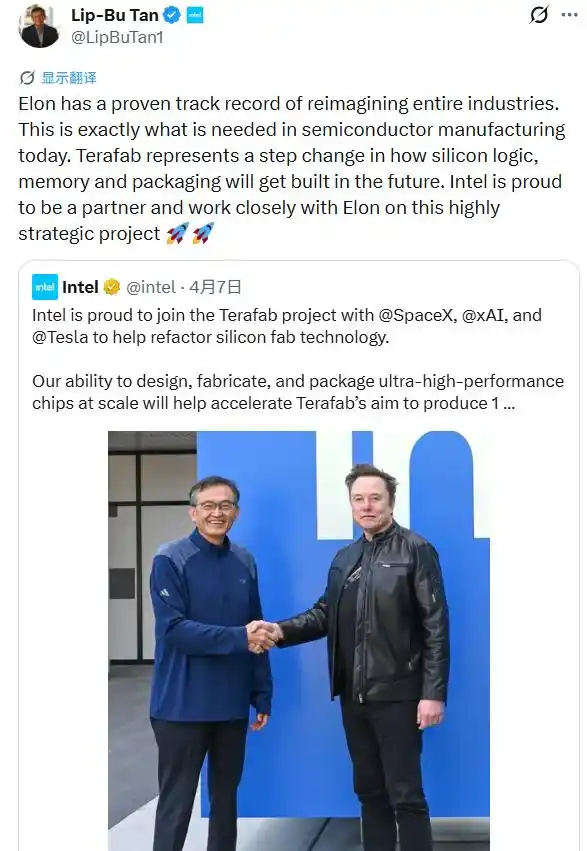
Intel CEO Pat Gelsinger confirmed on social platforms that Musk has commissioned Intel to design and manufacture custom chips for his 'Terafab' project in Texas. This massive project aims to provide a unified computing base for xAI, SpaceX, and Tesla.

Musk's trust in Intel is largely because Intel is trying to embed itself into every layer, from ground-based data centers to orbital computing in space.

For Intel, this is undoubtedly a shot in the arm. Some industry analysts predicted that AMD's revenue share in the server CPU market would surpass Intel's in 2026, but Intel's deep inertia and manufacturing capabilities within the x86 ecosystem remain chips that major customers like Musk cannot ignore.

This kind of deep cross-industry bundling is elevating the competition in the CPU market from a pure parameter contest to a game of ecosystem and supply chain stability.

02

Why Has the CPU Become the 'Bottleneck'?

The core reason the CPU has suddenly become a bottleneck is that the work it needs to handle has fundamentally changed in the age of agents.

In the traditional chatbot model, the CPU is primarily responsible for scheduling and data processing, while the GPU handles the core inference computation. Since compute-intensive tasks are concentrated on the GPU side, overall latency is usually dominated by the GPU, and the CPU rarely becomes a performance bottleneck.

But agent workloads are completely different. An agent needs to perform multi-step reasoning, call APIs, read and write databases, orchestrate complex business flows, and integrate intermediate results into a final output. Tasks like search, API calls, code execution, file I/O, and result orchestration mostly fall on the CPU and host system side. The GPU is responsible for token generation (i.e., 'thinking'), while the CPU is responsible for translating the 'thoughts' into actual actions.

A paper published by Georgia Tech scholars in November 2025, 'A CPU-Centric Perspective on Agentic AI,' quantified the latency distribution in agent workloads. The study found that the time consumed by tool processing on the CPU side accounts for 50% to 90.6% of the total latency. In some scenarios, the GPU is ready to process the next batch of tasks while the CPU is still waiting for tool calls to return.

Another key factor is the rapid expansion of context windows. In 2024, mainstream models mostly supported 128K to 200K tokens. Entering 2025, models like Gemini 2.5 Pro, GPT-4.1, and Llama 4 Maverick began supporting over 1 million tokens. The KV cache (Key-Value Cache, used to accelerate the Transformer model inference process) grows linearly with the number of tokens, reaching about 200GB at 1 million tokens, far exceeding the 80GB VRAM capacity of a single H100.

One solution to this problem is to offload part of the KV cache to CPU memory. This means the CPU must not only manage orchestration and tool calls but also help bear data that doesn't fit in VRAM. CPU memory capacity, memory bandwidth, and the interconnect speed between the CPU and GPU thus become critical to system performance.

Therefore, CPUs suited for the agent era require low latency, consistent memory access capabilities, and stronger system-level协同 capabilities, rather than单纯 core count expansion.

03

What Are the Vendors Doing? Some Grab Territory, Others Change Designs

Faced with this sudden surge in CPU demand, the major players have completely different strategies.

Intel is the traditional leader in server CPUs. Data from Mercury Research shows that in Q4 2025, Intel still held a 60% share of the server CPU market, AMD had 24.3%, and Nvidia had 6.2%. But Intel has been playing catch-up with new technologies in recent years; this CPU demand explosion is both an opportunity and a test for them.

Intel's current strategy is a two-pronged approach. On one hand, continue selling Xeon processors, deeply绑定 with hyperscale customers like Google; on the other hand, partner with SambaNova to launch a combined solution based on Xeon processors and their self-developed RDU accelerators,主打 the selling point of 'running agent inference without GPUs'. The roadmap for Xeon 6 Granite Rapids and the 18A process will be key tests of whether Intel can turn the tables.

AMD is one of the biggest beneficiaries of this CPU demand surge. In Q4 2025, AMD's Data Center revenue was $5.4 billion, a year-on-year increase of 39%. Fifth-gen EPYC Turin accounted for over half of server CPU revenue, and deployments of cloud instances running EPYC grew over 50% year-on-year. AMD's server CPU revenue share exceeded 40% for the first time.

AMD CEO Lisa Su directly attributed the growth to the development of 'agents'—agent workloads push tasks 'back' to traditional CPU tasks.

In February 2026, AMD also announced a potential deal with Meta worth over $100 billion to supply MI450 GPUs and Venice EPYC CPUs.

However, AMD still has room for improvement in system-level协同, lacking a mature high-speed CPU-GPU interconnect capability类似 NVLink C2C. As agent (Agent) systems place increasing demands on data interaction and协同 efficiency, the importance of this aspect is also gradually rising.

Nvidia's approach to CPU design is completely different from Intel's and AMD's.

The Nvidia Grace CPU has only 72 cores, while AMD EPYC and Intel Xeon typically have 128. Nvidia's AI Infrastructure VP, Dion Harris, explained: 'If you're a hyperscaler, you want to maximize the number of cores per CPU, which basically drives down the cost, the dollar-per-core cost. So it's a business model.'

In other words, in the AI computing体系, the CPU's role is no longer that of a general-purpose workhorse but rather a 'scheduling hub' serving the GPU. If the CPU can't keep up, the expensive GPUs are forced to wait, and overall efficiency drops.

Therefore, Nvidia prioritizes efficient协同 between the CPU and GPU in its design. For example, through the NVLink C2C interconnect, the bandwidth between the CPU and GPU is boosted to about 1.8TB/s, far higher than traditional PCIe, and the CPU can directly access GPU memory, greatly simplifying KV cache management.

Currently, Nvidia sells the Vera CPU as a standalone product. CoreWeave was the first customer. The deal with Meta is even more夸张; this is its first large-scale 'pure Grace deployment,' meaning CPUs deployed大规模 independently without GPUs paired.

Ben Bajarin, Principal Analyst at Creative Strategies, pointed out that in high-intensity system collaboration, the CPU's processing power must keep pace with the accelerator's iteration speed. If there is even a one percent delay in the data通道, the entire AI cluster's economic efficiency suffers significantly. This pursuit of极致 system efficiency is forcing all major players to re-evaluate CPU performance metrics.

Holger Mueller, VP and Principal Analyst at Constellation Research, stated that as AI workloads shift towards agent-driven architectures, the CPU's position is becoming more central. He noted: 'In the agent world, agents need to call APIs and various business applications, tasks most suitable for CPUs to complete.'

He added: 'Currently, there is no consensus on whether GPUs or CPUs are more suitable for handling inference tasks. GPUs have an advantage in model training, and custom ASICs like TPUs have their specialties. But one thing is clear: Google needs to adopt a hybrid processor architecture. Therefore, Google's choice to partner with Intel is reasonable.'

04

Conclusion: In the Agent Era, the Computing Power Balance is Swinging Back

In the latest industry observations, one data point deserves attention. In the massive $38 billion合作协议 between Amazon AWS and OpenAI, the official announcement also explicitly mentioned scaling 'tens of millions of CPUs'.

In recent years, the industry's focus has typically been on those 'hundreds of thousands of GPUs'. However, the fact that cutting-edge labs like OpenAI are proactively treating CPU scale as a key planning variable sends a clear signal: scaling agent workloads must be built upon a massive CPU infrastructure.

Bank of America predicts that by 2030, the global CPU market size could double from the current $27 billion to $60 billion. Almost all of this additional share will be driven by AI.

We are witnessing the expansion of a全新的 infrastructure: big tech is no longer just stacking GPUs but is simultaneously expanding an entire layer of 'CPU scheduling infrastructure' specifically to support the operation of AI agents.

The alliance between Intel and Google, as well as Musk's heavy investment in custom chips, all prove one fact: the winning point in the AI race is moving forward. When computing power is no longer scarce, whoever can solve the system-level 'bottleneck' first will have the last laugh in this trillion-dollar game.

*Special contributor Jin Lu also contributed to this article.

This article is from the WeChat public account 'Tencent Technology', author: Li Hailun, editor: Xu Qingyang

Связанные с этим вопросы

QWhy is CPU becoming the new bottleneck in the AI era according to the article?

ACPU is becoming the bottleneck because AI workloads, especially in the agentic AI era, require extensive multi-step reasoning, API calls, database operations, and complex task orchestration. These tasks are primarily handled by the CPU, and studies show that CPU-side tool processing can account for 50% to 90.6% of total latency. Additionally, the expansion of context windows in models requires KV cache offloading to CPU memory, making CPU memory capacity, bandwidth, and interconnect speed critical.

QWhat significant partnership is mentioned in the article to address the CPU bottleneck?

AGoogle and Intel have entered into a multi-year agreement to deploy Intel's Xeon processors globally in AI data centers. This partnership aims to enhance system performance, efficiency, and flexibility by leveraging CPUs and IPUs (Infrastructure Processing Units) as key components in AI infrastructure.

QHow did the CPU market change in Q4 2025 as reported?

AIn Q4 2025, the average selling price of server CPUs increased by approximately 30%, which is rare in the mature CPU market. Delivery cycles extended, with AMD's wait times increasing from eight to over ten weeks, and some models facing delays of up to six months due to supply constraints and competition for wafer capacity from GPU production.

QWhat role does CPU play in agentic AI workloads compared to traditional AI models?

AIn traditional AI models, CPUs mainly handle scheduling and data processing while GPUs perform core inference tasks. In agentic AI, CPUs are responsible for executing multi-step reasoning, calling APIs, reading/writing databases, orchestrating complex workflows, and integrating results—tasks that constitute the majority of the latency. The GPU generates tokens ('thinking'), but the CPU turns those results into actionable outputs.

QHow are major companies like Intel, AMD, and NVIDIA adapting to the increased importance of CPUs in AI?

AIntel is deepening partnerships (e.g., with Google) and developing combinations like Xeon processors with accelerators. AMD is benefiting from increased demand, with its EPYC CPUs seeing significant growth and new large deals (e.g., with Meta). NVIDIA is designing CPUs like Grace with a focus on high-efficiency coordination with GPUs through technologies like NVLink C2C, prioritizing system-level synergy over core count.

Похожее

Has the 'Digital Gold' Narrative for BTC Failed?

**Title: Has the "Digital Gold" Narrative for Bitcoin Failed?** The article argues that Bitcoin's "digital gold" narrative remains valid despite a recent sharp price decline (from a peak near $126k in Oct 2025 to briefly under $61k in Feb 2026). It presents a long-term investment framework based on three core points: **1. Viewing Bitcoin as an Asset:** Bitcoin is presented as a superior potential store of value compared to gold. Key arguments are its absolute scarcity (21 million cap), superior portability, and transparent auditability via its public ledger. While acknowledging its current use in early, volatile stages (~3-4% global adoption), the author draws parallels to the early, disruptive phases of the internet and e-commerce. **2. Understanding the Recent Downturn:** The current ~50% correction is framed as a predictable, consensus-driven cycle following its post-halving peak (the 2024 halving preceded the Oct 2025 high). A crucial factor is a historic "changing of hands": the influx of new institutional buyers via ETFs allowed early, low-cost holders (miners, OG believers) to take profits. The author notes that while severe, Bitcoin's historical drawdowns (e.g., 93% in 2011, 77% in 2021-22) have been progressively smaller, suggesting maturing holder structure and decreasing volatility over time. **3. The Long-Term Perspective:** The long-term thesis hinges on Bitcoin capturing a portion of gold's market value. With Bitcoin's market cap at ~$1.4 trillion (at $70k) versus gold's ~$20 trillion, significant upside potential exists if the "digital gold" narrative is partially realized. However, the author strongly cautions that short-term risks remain, the bottom is unpredictable, and high volatility is inherent. The real risk is not Bitcoin failing but poor personal position management (over-leverage, wrong capital) and a lack of deep understanding, which can force investors out during severe downturns. The conclusion uses Amazon's 95% crash post-2000 dot-com bubble and subsequent 42x recovery as an analogy. The ultimate question is not if Bitcoin's price will rise, but if an investor's strategy and conviction can withstand the volatility to see the long-term play out. The recent divergence (gold up, Bitcoin down) is posed not as a narrative failure, but as potential evidence of this ongoing, painful transition from a speculative asset to a mainstream allocation.

marsbit1 ч. назад

Has the 'Digital Gold' Narrative for BTC Failed?

marsbit1 ч. назад

Has BTC's 'Digital Gold' Narrative Failed?

The article discusses Bitcoin's "digital gold" narrative, its recent price drop, and long-term outlook through the perspective of "Jason". It argues the narrative is not a failure but that Bitcoin represents a superior, new asset class due to its fixed supply (21 million), portability, and auditability. The piece compares its current ~3-4% global adoption rate to early internet/e-commerce, suggesting significant growth potential. Regarding the 2025-2026 price decline (from ~$126k to briefly under $61k), the author views it as a predictable, consensus-driven sell-off within Bitcoin's ~4-year cycle post-halving, exacerbated by a major "handover" from early, low-cost holders to new institutional buyers via ETFs. A key observation is that historical peak-to-trough drawdowns have lessened over time (e.g., 93% in 2011 to ~50% in 2026), indicating maturing volatility as holder structure changes. For the long term, the author uses a simple framework: Bitcoin's total market cap (~$1.4T at $70k) is only about 7% of gold's (~$20T). Even capturing 30-50% of gold's value would imply substantial upside. However, the article strongly cautions against viewing this as investment advice, emphasizing extreme volatility and the critical importance of risk management, position sizing, and deep fundamental understanding to survive severe drawdowns. It concludes by drawing a parallel to Amazon's 95% crash in 2000 and subsequent 42x recovery, stressing that the key is surviving market cycles to realize long-term potential.

链捕手1 ч. назад

Has BTC's 'Digital Gold' Narrative Failed?

链捕手1 ч. назад

From Code to Cognition: A Ten-Thousand-Word Guide to the Evolution of the Robot Brain

"From Code to Cognition: The Evolution of Robot Brains" The journey of robotic intelligence has shifted dramatically from manually coded systems to AI-driven brains. For decades, robots relied on layered software stacks—perception, state estimation, planning, control—each handcrafted. While predictable, they lacked adaptability. The 2010s saw deep learning revolutionize perception (e.g., object detection) and control (via reinforcement learning), but learned skills remained narrow. The arrival of Large Language Models (LLMs) marked a turning point. LLMs acted as high-level planners, interpreting natural language instructions and generating sequences of actions for traditional robotic systems to execute. However, true integration came with Visual-Language-Action (VLA) models, which fused vision, language, and motion prediction into a single network. Pioneered by models like RT-2 and open-source projects like OpenVLA, VLAs enable robots to reason and act directly from visual input and commands. The most advanced humanoid robots now employ a "dual-brain" architecture: a slow-thinking, large VLA (System 2) for reasoning and planning, and a fast-reacting, small network (System 1) for high-frequency motion control, sometimes with an even lower-level System 0 for balance. This split balances cognition with the physics of real-time movement. Computation is split between onboard hardware (e.g., NVIDIA Jetson) for safety-critical control loops and cloud/edge servers for non-critical tasks like learning and interfaces. A crucial driver is the open-source ecosystem—models like GR00T and OpenVLA allow startups to build upon pre-trained brains and fine-tune them with their own data, accelerating development. Despite progress, current systems struggle with recovery from errors, sample inefficiency, and long-horizon tasks. This has spurred the rise of **World Models**—neural networks that predict the consequences of actions. By simulating possible futures before acting (like NVIDIA Cosmos or Meta V-JEPA), robots can plan, recover, and generalize better. This represents the next frontier: shifting intelligence from learned reactions to an internal model of physics and cause-and-effect. The field is rapidly evolving. While not yet at its "ChatGPT moment," the convergence of cheaper hardware, scalable simulation, and world models points toward robots that are increasingly capable, adaptive, and useful. The question is shifting from "what can robots do?" to "what *should* they do?"

marsbit2 ч. назад

From Code to Cognition: A Ten-Thousand-Word Guide to the Evolution of the Robot Brain

marsbit2 ч. назад

AI Bubble Is Bursting

The AI Bubble is Bursting: A Necessary Purge on the Path to Ubiquitous Intelligence Market volatility has reignited debates about an AI bubble, with figures like Ray Dalio pointing to high valuations. However, this parallels the dot-com bubble, which, despite its crash, laid the physical infrastructure for today's internet era. The current AI investment frenzy, with tech giants planning trillions in infrastructure spending far outstripping current AI application revenues, appears similarly imbalanced. This 'bubble' is seen as an inevitable phase for a disruptive technology, paying the "innovation tax." Critically, AI inference costs have plummeted over 99.7% since 2023, making intelligence nearly free at the margin. This hasn't reduced spending but has instead unlocked massive new demand, as seen in enterprise AI cloud expenditure tripling. This follows the Jevons Paradox: efficiency gains lead to greater total consumption. The market is now entering a cleansing phase, weeding out speculative ventures lacking real moats. The deeper shift is a move from capital expenditure (CapEx) on hardware to value creation in operational expenditure (OpEx) through AI applications that solve real industry problems. While infrastructure valuations are high, rapid earnings growth from widespread AI adoption across sectors—from manufacturing and finance to law and healthcare—may digest these valuations over time. Ultimately, this creative destruction will leave behind robust infrastructure and optimized models, cheaply powering an AI-augmented future for all industries, much as the internet became indispensable after its own bubble burst. The core productive potential remains undiminished.

链捕手2 ч. назад

AI Bubble Is Bursting

链捕手2 ч. назад

Торговля

Спот
Фьючерсы

Популярные статьи

Как купить ERA

Добро пожаловать на HTX.com! Мы сделали приобретение Caldera (ERA) простым и удобным. Следуйте нашему пошаговому руководству и отправляйтесь в свое крипто-путешествие.Шаг 1: Создайте аккаунт на HTXИспользуйте свой адрес электронной почты или номер телефона, чтобы зарегистрироваться и бесплатно создать аккаунт на HTX. Пройдите удобную регистрацию и откройте для себя весь функционал.Создать аккаунтШаг 2: Перейдите в Купить криптовалюту и выберите свой способ оплатыКредитная/Дебетовая Карта: Используйте свою карту Visa или Mastercard для мгновенной покупки Caldera (ERA).Баланс: Используйте средства с баланса вашего аккаунта HTX для простой торговли.Третьи Лица: Мы добавили популярные способы оплаты, такие как Google Pay и Apple Pay, для повышения удобства.P2P: Торгуйте напрямую с другими пользователями на HTX.Внебиржевая Торговля (OTC): Мы предлагаем индивидуальные услуги и конкурентоспособные обменные курсы для трейдеров.Шаг 3: Хранение Caldera (ERA)После приобретения вами Caldera (ERA) храните их в своем аккаунте на HTX. В качестве альтернативы вы можете отправить их куда-либо с помощью перевода в блокчейне или использовать для торговли с другими криптовалютами.Шаг 4: Торговля Caldera (ERA)С легкостью торгуйте Caldera (ERA) на спотовом рынке HTX. Просто зайдите в свой аккаунт, выберите торговую пару, совершайте сделки и следите за ними в режиме реального времени. Мы предлагаем удобный интерфейс как для начинающих, так и для опытных трейдеров.

733 просмотров всегоОпубликовано 2025.07.17Обновлено 2026.06.02

Как купить ERA

Обсуждения

Добро пожаловать в Сообщество HTX. Здесь вы сможете быть в курсе последних новостей о развитии платформы и получить доступ к профессиональной аналитической информации о рынке. Мнения пользователей о цене на ERA (ERA) представлены ниже.

活动图片