Stop Paying Attention to These Zombie Projects

marsbitОпубликовано 2026-02-11Обновлено 2026-02-11

Введение

The crypto market in 2025 is marked by extreme contradictions: while over 20 million tokens have been launched, more than 57% have failed. A new wave of "zombie projects"—backed by top VCs and listed on major exchanges—continues to operate with minimal product development or real-world utility. This analysis highlights several疑似僵尸化 projects: - **Sleepless AI**: Once a Binance Labs incubator star, its token fell 99% from its peak. It promises AI-driven emotional companions but shows no substantial technical updates or iOS/Android app launches, raising suspicions of being a repackaged Web2 product. - **Hooked Protocol**: Its Learn-to-Earn model initially attracted users through subsidies, but token value collapsed 99% after incentives faded. Its shift to "AI-powered education" appears more like marketing than tangible tech progress. - **Saga**: Positioned as a "one-click chain launch" solution, it pivoted repeatedly between gaming and AI narratives due to lack of adoption. A $7M security breach and 99% token drop further eroded trust. - **Dymension**: Despite claiming 10,000+ RollApps, most show no activity. TVL remains low at $1.3M, and the token price dropped 99%, reflecting a ghost ecosystem. Zombie projects persist due to: 1. Capital-driven listings prioritizing narrative over substance. 2. Opaque team backgrounds enabling low-exit accountability. 3. "Narrative parasitism"—rebranding to chase trends without real development. In 2026, investors must pr...

Author: Chloe, ChainCatcher

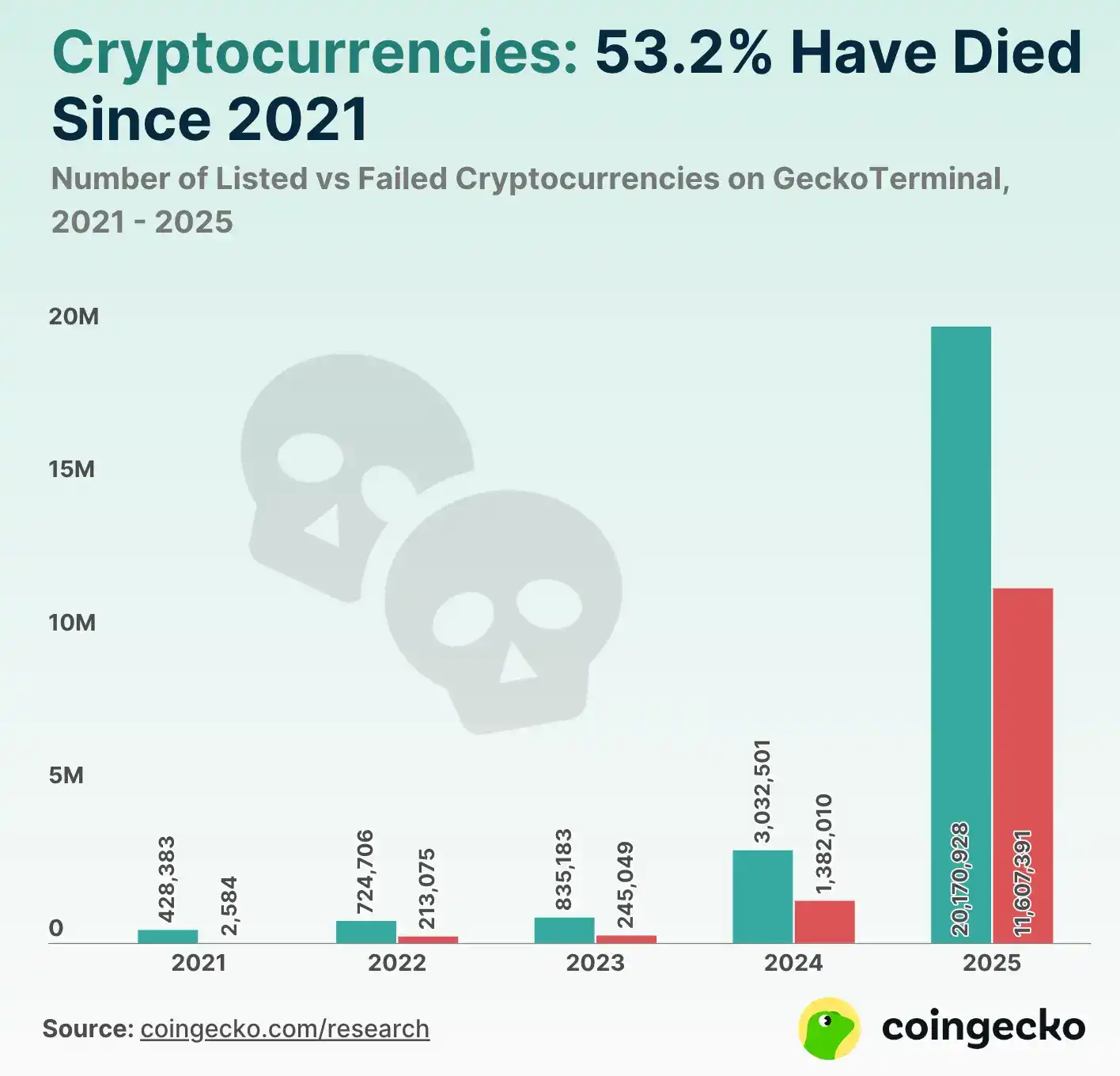
The crypto market in 2025 witnessed an extreme industry contradiction: according to GeckoTerminal statistics, while the total number of token-launching projects surpassed the 20 million mark, over 57% of them met their demise. Amid this brutal elimination race, a more insidious type of "zombie project" is spreading. They boast backing from top-tier capital and leading exchanges, frequently pivot their narratives to chase hot trends, yet are nearly stagnant in terms of actual product delivery, technological development, and ecosystem building.

This article will deeply analyze疑似 zombie-fying projects like Sleepless AI, Hooked Protocol, Saga, and Dymension, examining their operational characteristics. In 2026, the ability to see through narrative fog and identify signs of zombification has become a essential survival skill for investors.

Launching a Token Means "Job Done"? Project Decline and Zombification Phenomenon

In the early stages of blockchain development, the definition of "Zombie Coins" was relatively straightforward: long-term dormancy, loss of trading liquidity, vanished development teams, lack of community participation, etc. However, with the maturation of capital markets and the deep involvement of venture capital, a more隐蔽 absurd phenomenon has emerged in recent years.

Data shows that in 2021, the number of token-launching projects on GeckoTerminal was only 428,000, but by the end of 2025, this number had skyrocketed to 20.17 million. Behind this explosive growth, a staggering 53% of projects met their end. Simultaneously, hidden within this high turnover, high淘汰 rate are大量 "zombified" projects. They trade on exchanges, post social media announcements daily, but there exists a huge gap in actual product delivery, on-chain activity, and ecosystem development.
Sleepless AI: Parasitizing the AI Narrative? R&D and Delivery Disconnect

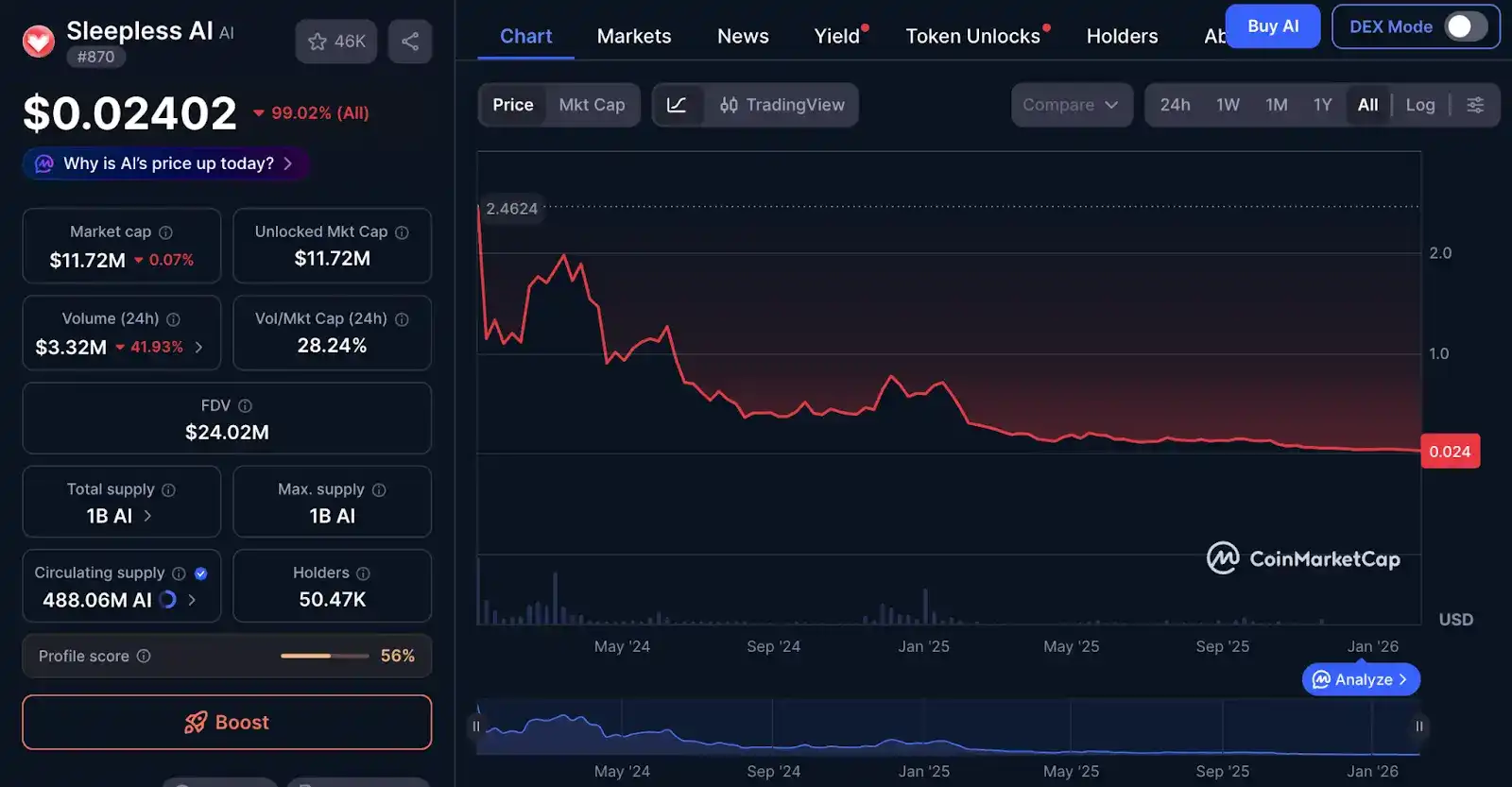
Sleepless AI was once a market darling, not only selected as a standout in Binance Labs' sixth season incubation program but also debuted gloriously on Binance Launchpool's 42nd edition under the光环 of "Web3+AI Virtual Companion." However, entering 2026, its market performance has diverged sharply from its initial热度: the token price has retreated from its historical high of $2.46 to around $0.024, a drop of 99%.
1. Technical Transparency and R&D Progress Disconnect: Although the project touts the use of AIGC and large language models (LLM) to create a deep emotional support experience, its technical transparency is lacking. Observing through public channels, the project almost lacks trackable code update records or iterative versions of core algorithms. More concerning for investors is that the Web Dapp originally scheduled for Q2 2025 has an unclear progress status至今.

2. Inefficient Execution of Mobile Strategy: In the "mobile-first" application era, Sleepless AI's product落地 process appears relatively lagging. Its flagship product "HIM" as of early 2026 still hasn't successfully launched on the iOS App Store or Google Play Store; the official website still only offers Android APK downloads. For a project aiming for mass adoption, this development efficiency severely limits user growth and market trust.

3. Narrative Rebranding and Insider Doubts: Accompanying the product stagnation are deep market doubts about the project's本质. Market observers have put forward the view that the project is疑似 a "narrative rebranding" of an old Web2 game, meaning it repackaged itself with AI concepts and leveraged capital connections to强行 latch onto the AI trend's热度 to secure Binance Labs' investment and Launchpool's流量红利. Although such claims are often anonymous, combined with its weak technical delivery and token price collapse, this phenomenon of "narrative parasitism" has become an important reference indicator for investors in 2026 to identify疑似 zombie projects.

Hooked Protocol: Ecological Dilemma After Incentives Dry Up

Hooked Protocol once emerged rapidly in the Web3 social learning track with its Learn-to-Earn model, securing investment from Binance Labs and Sequoia China, and launching as Binance's 29th Launchpad project. However, as token distribution entered its mid-to-late stages and subsidy红利 gradually faded, the project now faces severe tests of "real user retention" and "ecological substance".

1. From Learn-to-Earn to Incentive Dependency Dilemma: Hooked Protocol's initial success relied heavily on the流量 effect of Binance Launchpad and a strong token subsidy mechanism. This model can quickly换取 huge user numbers initially, but when the HOOK token price fell nearly 99% from its high, the growth game sustained by subsidies loses its appeal. History has repeatedly shown: after TGE, when incentives disappear, "massive user numbers" lacking rigid demand often rapidly shrink.

2. "Marketing-Oriented" Tendency in Narrative Transformation: Entering 2025, Hooked attempted to transform into an "AI-driven learning ecosystem" and "educational infrastructure." Although officially stated to be co-developing courses with 3-7 top universities and launching the Hooked Coursera Hub in August 2025 in collaboration with over 74 Web3 projects, these moves seem more like "brand endorsements" at the marketing level. Compared to the impressive list of partners, its substantive breakthroughs at the technical底层 appear lackluster.

Hooked Protocol's current state reveals a core challenge for Web3 application projects to a certain extent: if a project's vitality relies on token incentives and cannot transform into原生 demand with business resilience, it will struggle to escape the fate of大幅 token price decline, even zombification. The current low币价 and potentially shrinking ecological activity are the negative feedback after subsidy-driven prosperity.

Saga: Dual Blows of Lack of Market Demand and Security Vulnerabilities

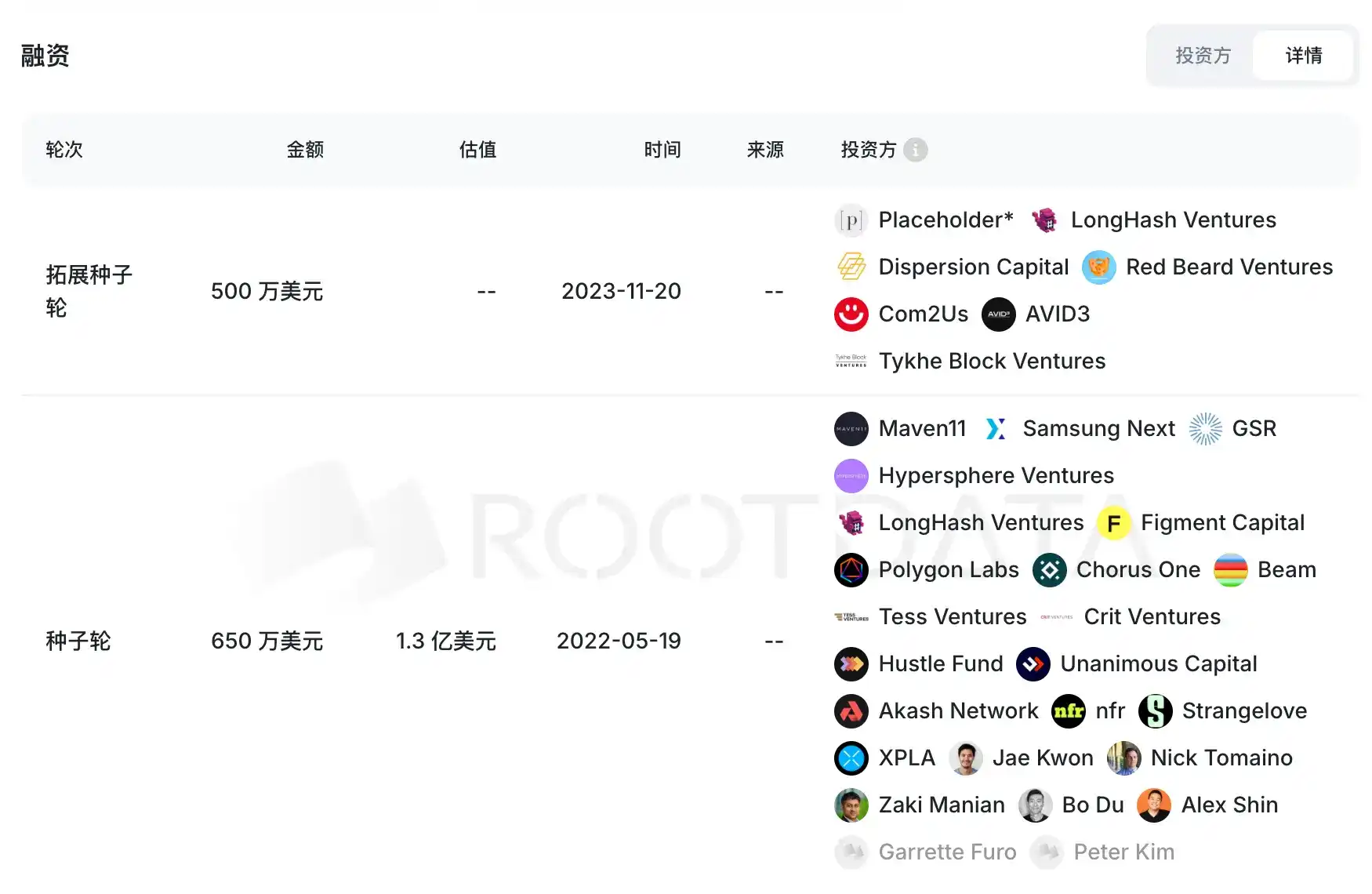
Saga represents another path to zombification: the shovel seller can't find miners. With the grand vision of "one-click chain launch," Saga successfully attracted over $1000 in financing from top institutions like Placeholder, GSR, and Samsung Next, and also successfully launched as the 51st project on Binance Launchpool. However, this powerful automated chain-launching tool seems somewhat misplaced when tested against real market demand.
1. Frequent "Pivoting" Exposes Ecological Anxiety: Over the past two years, Saga has shown极高的 narrative flexibility, but also暴露出其生态核心缺陷. From initially promoting itself as a gaming-specific chain with over 350 partner projects, to later pivoting to an AI infrastructure narrative, this frequent narrative shifting essentially reflects the growth anxiety arising from the lack of落地 applications in its old ecosystem.

If its core technology "Chainlet" had genuine market demand, it should theoretically drive token buybacks through developers' continuous renewals. However, the reality is that Saga's partner list, though long,始终 lacks blockbuster project support. Most partners remain in the early exploration stage, unable to contribute substantial economic driving force to the protocol.

2. Fatal Blow to Security Credibility: For infrastructure, technical security is its bottom line. SagaEVM suffered a $7 million vulnerability attack in January this year, with the stablecoin $D depegging to $0.75, and TVL evaporating from approximately $37 million to $12 million. This is undoubtedly a severe blow for a project positioning itself as infrastructure.

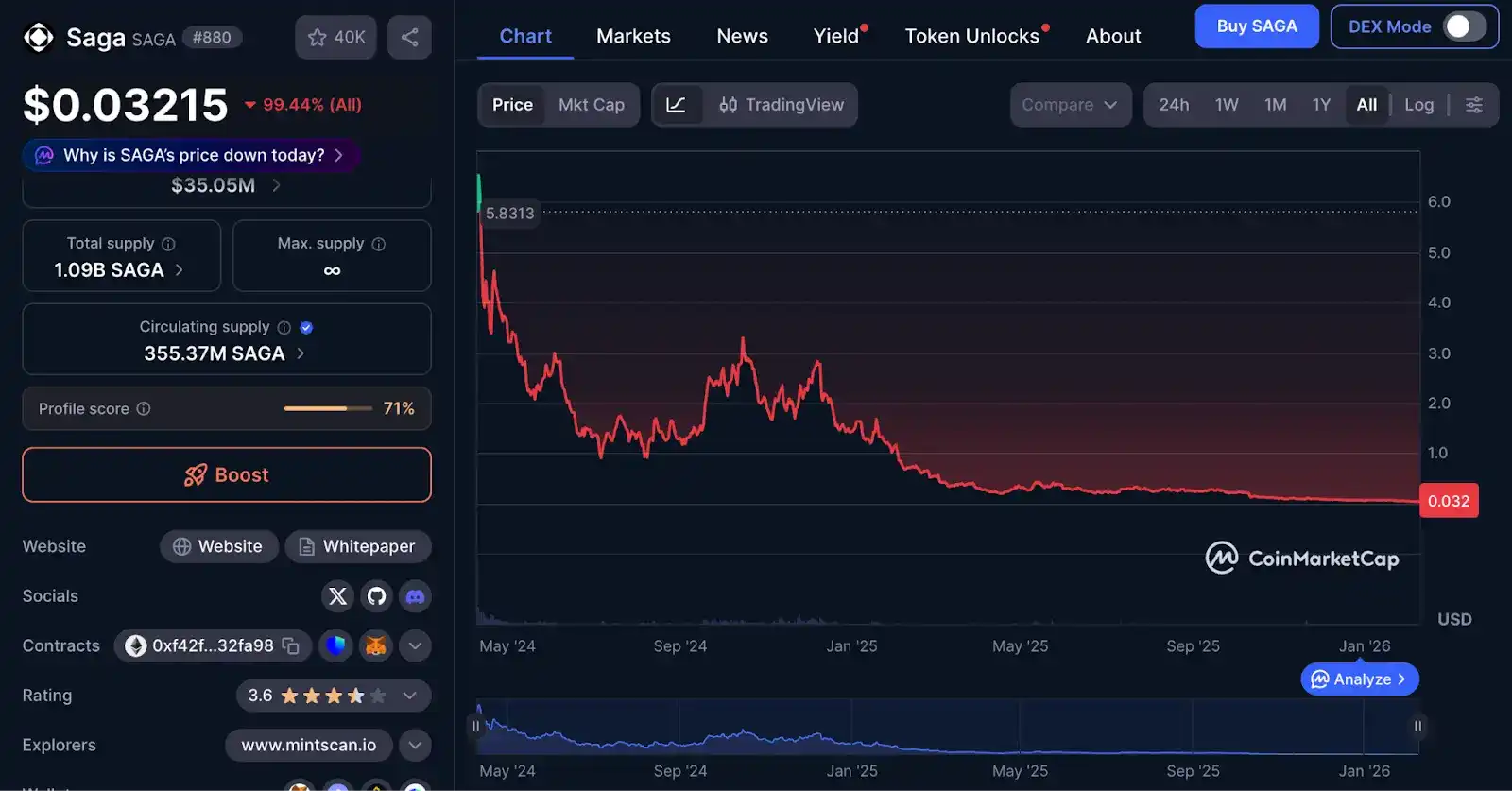
When grand narratives fail to translate into ecological data, and technical security is flawed, the market's feedback is often merciless. The native token SAGA price has fallen from its 2024 high of $6 to around $0.032 currently.
Dymension: Data Ghost Town Under a Grand Architecture

Dymension's script is highly similar to Saga's. Its proposed RollApp concept is quite attractive in theoretical architecture, but in the face of actual data in 2026, it更像是一座宏伟的鬼城 (a grand ghost town). Although Dymension attempts to establish a benchmark for a modular settlement layer, the real vitality of its ecosystem falls far short of expectations.

1. RollApp Network Activity Disconnect: Dymension once claimed to have deployed over 10,000 RollApps within its ecosystem. However, this data prosperity essentially stems from the lowered barriers to "issuing tokens and launching chains." The vast majority of deployed RollApps have no sustained on-chain transactions or substantial output beyond the initial token issuance, and many have even disappeared.
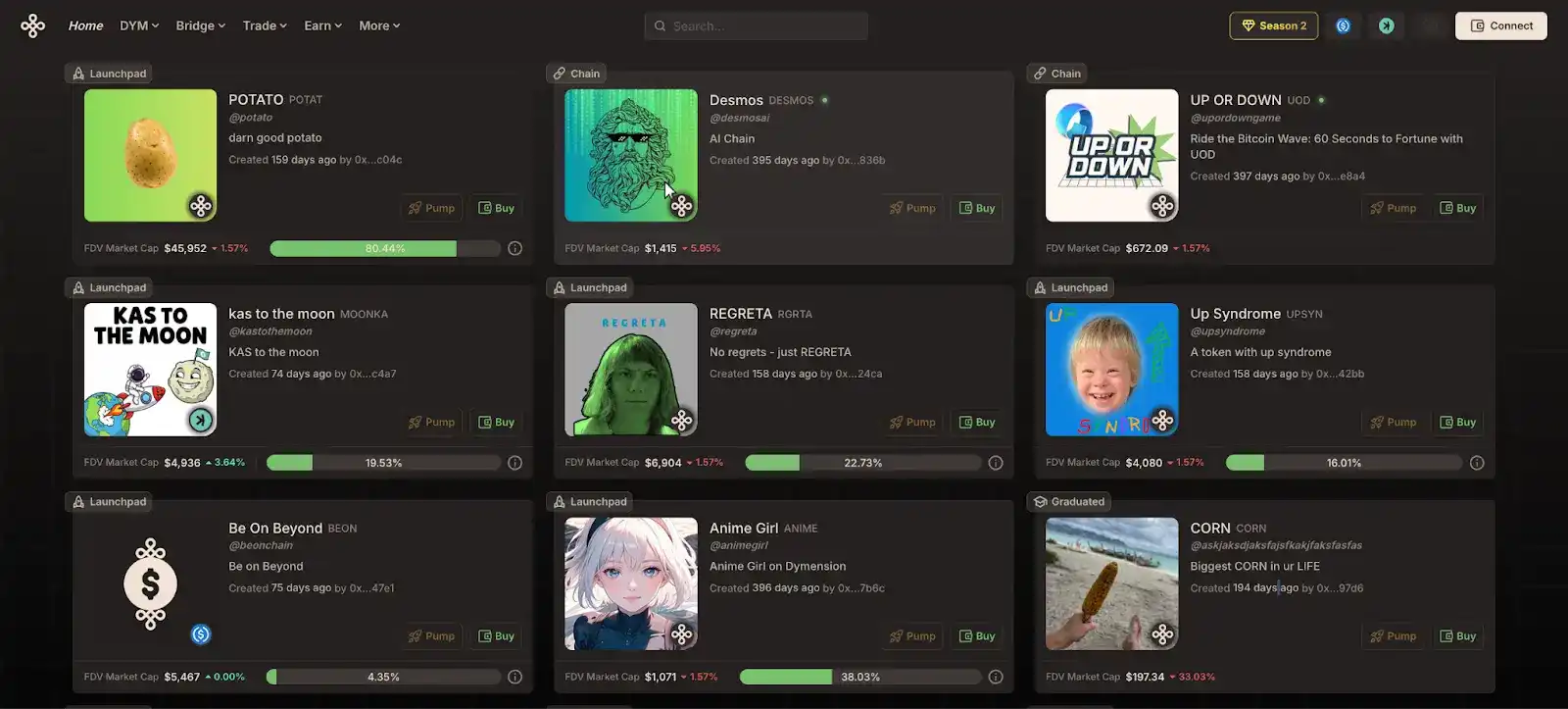
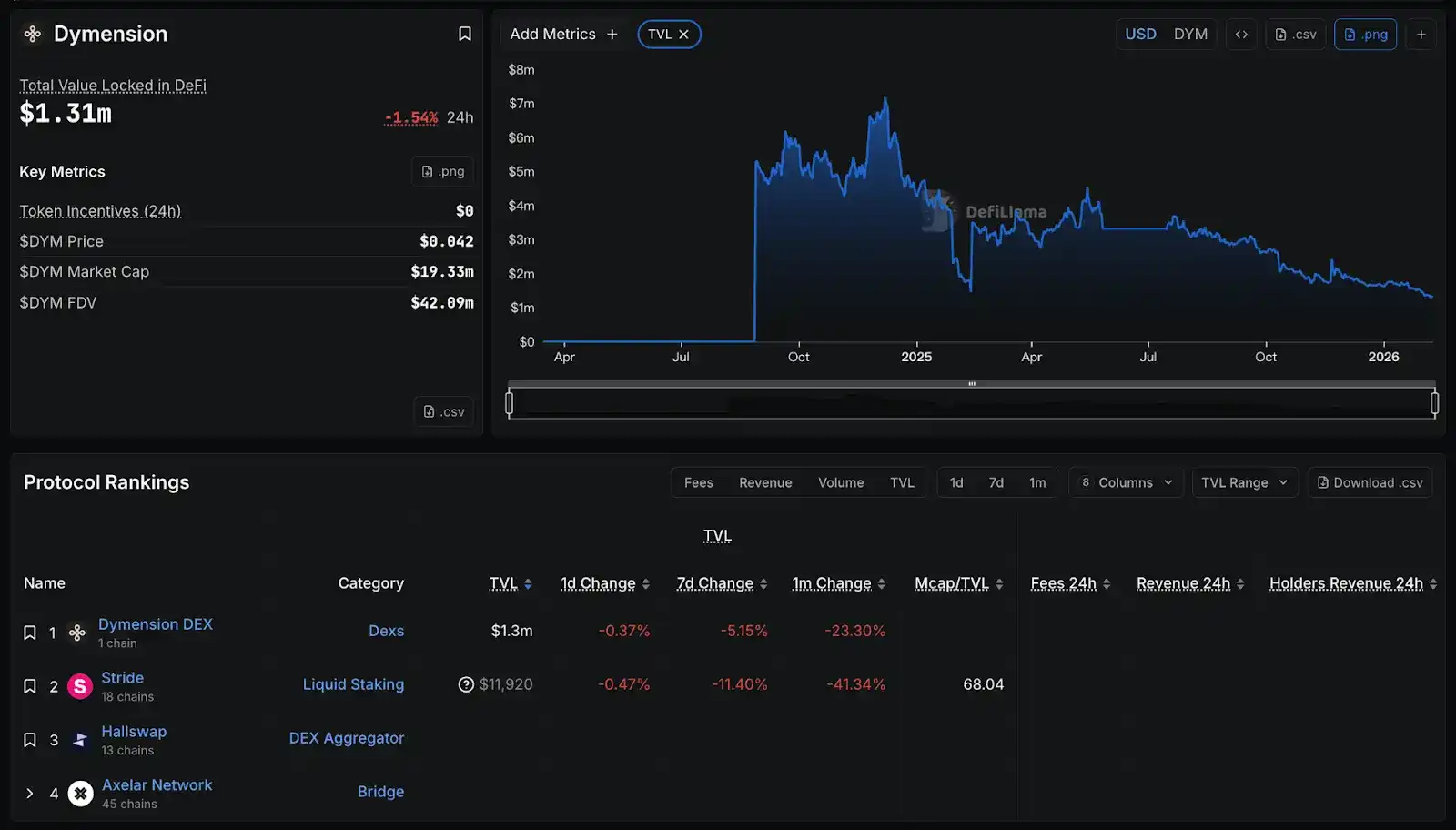
2. Dysfunctional Economic Function of Infrastructure: When Launchpad and development kits fail to transform into a thriving digital economy, the infrastructure itself falls into value exhaustion. Dymension's main DEX projects and ecosystem TVL performance are both unsatisfactory. The current overall TVL is only $1.3M, forming a stark contrast with the market's initial expectation of it being a "modular leader" at token launch.
极

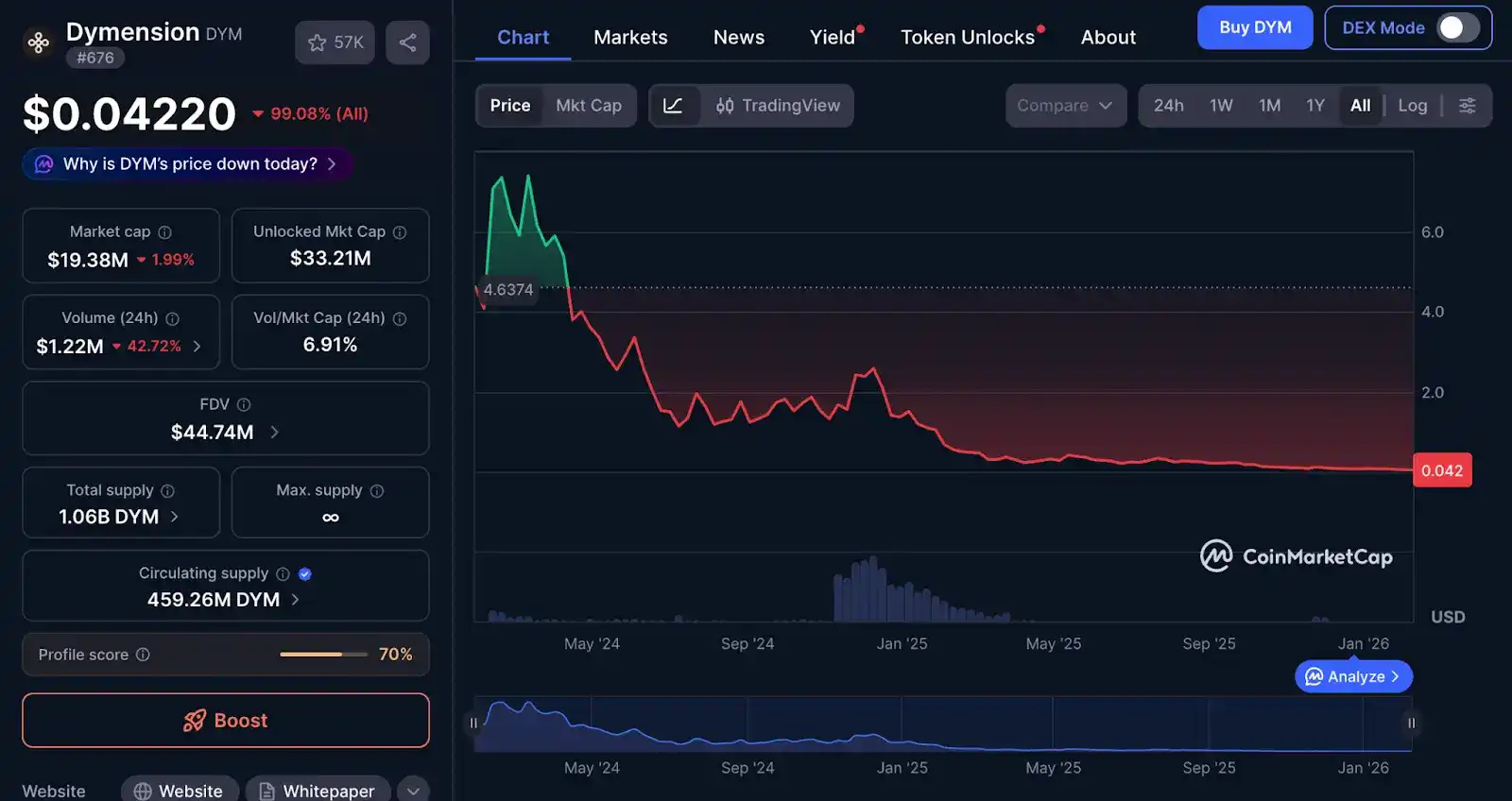
When the infrastructure primarily runs zombie applications and the overall ecosystem performance is拉垮 (lacking), the native token DYM price is inevitably corrected by the market. The current FDV is $45M, and the token price has fallen 99% from its high of $6, now只剩 (only remaining at) $0.042.
Why Are "Zombie" Projects Proliferating?

The reason these projects can maintain a superficial "vitality" stems from deep-seated structural issues within the Web3 industry.

1. Capitalized Listing Power Structure: In recent years, the listing path for many projects has not originated from substantial technological breakthroughs but has highly relied on "capital, vested interests, and narrative packaging." Pushed forward by the combined force of VCs and internal executives, these projects enter top exchanges through精美 packaging and刷出来的 (fabricated) testnet data. Once the token unlock is complete, teams often lose motivation for further development.

2.模糊的团队背景 (Ambiguous Team Backgrounds): A common characteristic among some zombie projects is that the background of the core operators and technical leaders is extremely模糊 (ambiguous). This "black box" operational model not only allows the project team to avoid credible accountability when encountering technical bottlenecks or security vulnerabilities but also provides them with very low exit costs. It enables the operating team to quickly rebrand, discreetly reposition in a new narrative after one project stalls, and repeatedly消耗 (consume) market credit.

3. Narrative Parasitism Capability: Zombie projects often possess a strong ability for "narrative parasitism." Whenever market热点 (hot topics) shift, these projects with little substantive progress often conduct "announcement-style pivots" to align with the new narrative. This not only increases the identification cost for investors but also分散 (disperses) scarce liquidity into unproductive shells, from which they can蹭热度 (ride the hype) and attract speculative capital.

Conclusion: Investors Should Seek the True Bottom Line of Value in 2026

Facing a prosperous market woven from twenty million token-launching projects, investors' core logic must change. In 2026, identifying zombie projects is no longer just a bonus skill but a defensive necessity. Below are three core indicators to help readers identify them:

First, the verifiability of the team and technical delivery: Avoid projects with unclear team information, no GitHub commit history, low roadmap fulfillment rates, and slow product distribution. Second, the substance of the data: Distinguish between "subsidy-driven activity" and "organic demand." Check if users show retention willingness after token subsidies are removed. Finally, be wary of projects that change their core focus every three months. Genuine innovation requires deep cultivation; frequent narrative switches usually掩盖 (mask) the failure of the old business.

As the crypto market matures, the industry needs projects that consistently deliver both before and after token launches, genuinely bring value to the industry, and solve market pain points.


Связанные с этим вопросы

QWhat is the main contradiction observed in the 2025 crypto market according to the article?

AThe main contradiction is that while the total number of token issuance projects exceeded 20 million, over 57% of them failed, and a more insidious type of 'zombie project' is emerging, which has backing from top-tier capital and major exchanges but shows near stagnation in actual product delivery, technology development, and ecosystem building.

QWhat are the three key indicators the article suggests for investors to identify zombie projects in 2026?

AThe three key indicators are: 1. Verifiability of the team and technical delivery—avoid projects with unclear team backgrounds, no GitHub commit history, low roadmap fulfillment, and slow product distribution. 2. The substance—distinguish between 'subsidy-driven activity' and 'native demand' by checking if retention persists after token incentives end. 3. Be wary of projects that frequently change their core narrative every few months, as this often masks the failure of previous ventures.

QWhy did Sleepless AI's market performance decline significantly, as per the analysis?

ASleepless AI's market performance declined by 99% from its all-time high due to a lack of technical transparency and development progress (e.g., no trackable code updates or delayed Web Dapp launch), inefficient execution of its mobile strategy (failure to launch on major app stores), and market skepticism about its narrative, with allegations that it was a repackaged Web2 project leveraging AI hype for capital and exchange benefits.

QWhat core challenge does Hooked Protocol's situation reveal about Web3 application projects?

AHooked Protocol's situation reveals the core challenge that if a project's viability relies solely on token incentives rather than transforming into a business with resilient native demand, it is likely to suffer from token price collapse and zombification once subsidies diminish, as seen with its 99% price drop and potentially shrinking ecosystem activity.

QWhat structural problems in the Web3 industry contribute to the proliferation of zombie projects?

AThe proliferation of zombie projects is fueled by structural problems such as: 1. Capital-driven listing power structures, where projects rely on VC backing and narrative packaging rather than technical merit to get listed on exchanges. 2. Opaque team backgrounds, allowing low exit costs and rebranding opportunities. 3. Narrative parasitism, where projects frequently pivot to new hot topics without substantive progress, increasing investor identification costs and dispersing liquidity.

Похожее

После трёх кварталов падения: получится ли у крипторынка стабилизироваться в третьем квартале?

Криптовалютный рынок пережил худший квартал с 2022 года, общая капитализация упала на 12,6% до $2,1 трлн, а дневные объемы торгов снизились на 20,9%. Впервые за три года сократилась и капитализация стейблкоинов. Основные факторы спада — отток средств из биткоин-ETF, распродажа биткоинов корпоративным казначейством Strategy и ужесточение монетарной политики ФРС. Второй квартал завершился чистым оттоком $46,7 млрд из ETF, при этом в июне отток достиг рекордных $45 млрд. Ключевым событием третьего квартала станет заседание ФРС 28–29 июля. Мягкий сигнал может поддержать биткоин в диапазоне $68 000–84 000 и вернуть приток в ETF, тогда как жесткая риторика способна сместить торговый диапазон к $50 000–56 000. Законодательная неопределенность также давит на рынок: прогресс по закону CLARITY Act, определяющему регуляторные границы, замедлился, и вероятность его принятия в 2026 году упала до 40–45%. Несмотря на общий спад, два сегмента показали рост: объемы на рынках предсказаний выросли на 48,7%, а торговля токенизированными коллекционными предметами увеличилась на 143%. Сектор RWA продолжает стабильно развиваться, достигнув $28,1 млрд. Рынок, вероятно, миновал фазу острой распродажи, но для устойчивого восстановления необходимы ясность от ФРС и регуляторный прогресс.

marsbit1 ч. назад

После трёх кварталов падения: получится ли у крипторынка стабилизироваться в третьем квартале?

marsbit1 ч. назад

BIT Торговые часы: BTC по-прежнему под давлением 200 EMA на недельном графике, после отскока возможен перезапуск нисходящего движения; секторы хранения данных и полупроводников, выросшие ночью, начали падение в вечерней сессии

**Краткий обзор рынка: BTC под давлением, коррекция на рынке акций, внимание к данным и событиям** Рынок криптовалют демонстрирует осторожное восстановление. Bitcoin торгуется около $66 000, сталкиваясь со значительным сопротивлением в районе $68 000, где сосредоточены объемные "застрявшие" позиции. Ключевые технические уровни — 200-недельная скользящая средняя (~$63 333) и 200-недельная EMA (~$68 328). Аналитики отмечают низкую ликвидность, характерную для летнего периода. На фондовом рынке после сильного роста во вторник наблюдается коррекция. Фьючерсы на основные индексы США снижаются. Акции полупроводниковой и памяти, которые резко выросли накануне, падают в ночных торгах. Исключением стал SMCI, который вырос более чем на 15% после оптимистичного прогноза. На общий настрой негативно влияют рост цен на нефть (более $91 за баррель Brent) и доходности государственных облигаций США (10-летние — около 4,64%), что возрождает инфляционные опасения. Азиатские рынки показали нестабильную динамику. Индекс KOSPI в Корее вырос на 0,74%, а японский Nikkei 225 снизился на 0,18%. Основной риск для региона — ослабление японской иены до минимумов с 1986 года, что повышает вероятность вмешательства властей. **Ключевые события для наблюдения:** * **24 июля:** Финансовые отчеты Alphabet (Google), Tesla, IBM. Событие AMD, посвященное ИИ. * **25 июля:** Решение по процентной ставке ЕЦБ и пресс-конференция Кристин Лагард. Финансовые отчеты Intel, American Airlines, Honeywell и других. Данные по числу первичных заявок на пособие по безработице в США.

marsbit1 ч. назад

BIT Торговые часы: BTC по-прежнему под давлением 200 EMA на недельном графике, после отскока возможен перезапуск нисходящего движения; секторы хранения данных и полупроводников, выросшие ночью, начали падение в вечерней сессии

marsbit1 ч. назад

Бывший глава CFTC и президент Circle Тарберт: призывает к долгосрочной стратегии, но сам выводит $30 млн

Бывший председатель CFTC и президент Circle Хит Тарберт, публично пропагандируя долгосрочное видение компании для инвесторов на фоне падения акций на 70% с пиковых значений, сам активно распродавал свои акции CRCL. С момента IPO Circle он по плану 10b5-1 продал более 360 тысяч акций, выручив около 30 миллионов долларов, и при этом ни разу не докупал акции на открытом рынке. Эта разница между его публичными заявлениями и личными действиями вызвала критику. Карьера Тарберта демонстрирует классическое использование «вращающейся двери» между регулирующими органами и частным сектором. Уйдя с поста председателя CFTC в 2021 году, через 27 дней он занял должность главного юрисконсульта в маркет-мейкере Citadel Securities, который в тот момент находился под пристальным вниманием из-за скандала с акциями GameStop. Позже, уже работая в Citadel, Тарберт выступал за расширение полномочий CFTC на крипторынок, в то время как его работодатель планировал выход на этот рынок. В 2023 году Тарберт присоединился к Circle, где его опыт и связи сыграли ключевую роль в успешном проведении IPO компании в 2025 году. Однако его последующие массовые продажи акций, совпавшие с падением котировок и его же призывами к долгосрочным инвестициям, ставят под сомнение искренность его уверенности в будущем компании. Критики видят в его карьере образец превращения регуляторного опыта и политических связей в личную выгоду, в то время как риски несут обычные инвесторы, верящие его нарративам.

marsbit1 ч. назад

Бывший глава CFTC и президент Circle Тарберт: призывает к долгосрочной стратегии, но сам выводит $30 млн

marsbit1 ч. назад

Gate Research: Взлет «уолл-стритизации» криптофинансовых продуктов — это конкуренция или интеграция?

**Аналитический обзор Gate Research Institute: Волна "уолл-стритизации" криптофинансовых продуктов — конкуренция или интеграция?** Создание биткоина в 2009 году было ответом на финансовый кризис и стремлением построить децентрализованную систему без доверенных посредников. Однако к 2026 году значительная часть биткоинов (около 7,14%) хранится через ETF таких гигантов, как BlackRock. Это символизирует глубокую интеграцию традиционных финансов (TradFi) и крипторынка. С появлением биткоин-ETF, фьючерсов, RWA (токенизированных реальных активов) и государственных облигаций на блокчейне, традиционные институты получают всё больше влияния на выпуск, ценообразование, кастодию и дистрибуцию криптоактивов. Однако это не одностороннее поглощение, а взаимодополняющая конвергенция. Криптосфера приносит TradFi глобальную 24/7 ликвидность и программируемость, а TradFi предоставляет криптосфере регулируемые каналы, институциональное доверие и массовый доступ. Яркий пример — две противоположные, но ведущие к одной цели траектории: * **Путь А:** Криптобиржи, такие как Gate, начинают с токенизированных акций и CFD, а затем напрямую подключаются к инфраструктуре традиционных брокеров, предлагая реальную торговлю акциями США, Гонконга и Кореи за стейблкоины. * **Путь Б:** Традиционные брокеры, такие как Robinhood, интегрируют криптоактивы, а затем создают собственные Layer 2 для токенизации своих акций, стремясь к круглосуточной торговле. Обе стратегии нацелены на создание **универсального финансового аккаунта будущего** — единой точки доступа к акциям, криптовалютам, ETF, токенизированным облигациям и другим активам. Ключевой конкурентной борьбой становится не между CEX и брокерами, а между этими "супераккаунтами". Параллельно, слой RWA и токенизированных гособлигаций растёт даже на медвежьем рынке, становясь "прослойкой" для объединения капиталов. Хотя этот рынок (около $150 млрд токенизированных казначейских облигаций) ещё мал по сравнению с традиционным ($30 трлн), он демонстрирует устойчивый структурный тренд, привлекающий крупнейшие финансовые институты (JPMorgan, DTCC и др.). **Вывод:** "Уолл-стритизация" — это не поражение идеалов децентрализации, а формирование новой гибридной модели. Децентрализованные протоколы продолжают работать на базовом уровне, в то время как на уровне приложений и пользовательского опыта формируется более эффективный, глобальный и свободный объединённый рынок капитала, где активы TradFi и DeFi торгуются бок о бок в одном интерфейсе. Уолл-стрит не завоевала криптосферу, а криптосфера не обошла Уолл-стрит — они совместно строят новые финансовые рельсы.

marsbit2 ч. назад

Gate Research: Взлет «уолл-стритизации» криптофинансовых продуктов — это конкуренция или интеграция?

marsbit2 ч. назад

S&P Dow Jones и Pantera выпускают криптоиндекс, биткоин оставлен за бортом из-за «отсутствия прибыли»

Стандард энд Пурс (S&P Dow Jones Indices) совместно с Pantera Capital запускает индекс S&P Pantera Digital Asset Index. Новый индекс включает 18 токенов, но исключает биткоин, XRP и мем-токены. Критерием отбора послужила «финансовая жизнеспособность», по аналогии с S&P 500: протокол должен демонстрировать положительный доход в течение нескольких кварталов и распределять стоимость среди держателей токенов. Это первое применение фундаментального подхода к оценке криптоактивов со стороны крупнейшего в мире провайдера индексов. В первую пятерку активов вошли Ethereum (ETH), BNB, Solana (SOL), TRON (TRX) и Hyperliquid (HYPE). Pantera отмечает, что совокупный годовой доход всех протоколов индекса превышает $30 млрд. Биткоин был исключен по трем причинам: он рассматривается как монетарный актив, доступный через отдельные ETF; он не генерирует доход протокола; а смешивание его в индексе с доходными активами затрудняет фундаментальный анализ для институциональных инвесторов. Пока индекс является эталонным, но Pantera ведет переговоры о создании на его основе ETF и других инвестиционных продуктов. Компания также отмечает значительный разрыв на рынке: многие институциональные инвесторы готовы к аллокации в криптоактивы, но им не хватает структурированных продуктов, фокусирующихся на активах с реальной экономической деятельностью.

marsbit2 ч. назад

S&P Dow Jones и Pantera выпускают криптоиндекс, биткоин оставлен за бортом из-за «отсутствия прибыли»

marsbit2 ч. назад

Торговля

Спот
活动图片




