Standard Chartered, AirAsia parent to test ringgit stablecoin in Malaysia

cointelegraphОпубликовано 2025-12-12Обновлено 2025-12-12

Введение

Standard Chartered Bank Malaysia and Capital A, the parent company of AirAsia, have signed a letter of intent to jointly explore a ringgit-pegged stablecoin. The initiative falls under Malaysia’s Digital Asset Innovation Hub, a regulatory framework introduced by the central bank. Standard Chartered will serve as the issuer, while Capital A and its ecosystem partners will develop and pilot wholesale use cases. This move aligns with Malaysia’s broader effort to modernize its financial system with digital assets, supported by recent regulatory developments including a central bank roadmap for asset tokenization and the formation of an industry working group.

Standard Chartered Bank Malaysia and Capital A, the parent company of AirAsia, plan to jointly explore a stablecoin pegged to Malaysia’s local currency, the ringgit.

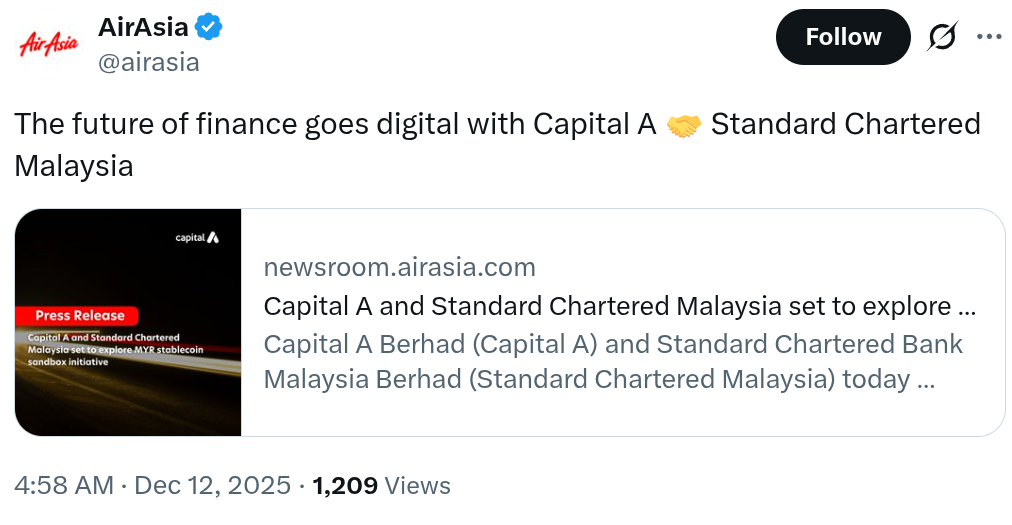
In a statement Friday, the bank’s Malaysian arm and Capital A said they signed a letter of intent to explore a ringgit-pegged stablecoin under the country’s Digital Asset Innovation Hub, an initiative announced by Bank Negara Malaysia (BNM) in June.

This is Capital A’s first interaction with the regulated digital asset space. The initiative will rely on Standard Chartered’s infrastructure and financial expertise, as well as Capital A’s ecosystem, to pilot the stablecoin in a wholesale fashion, rather than focusing on the retail market.

Standard Chartered Malaysia will serve as the issuer of the stablecoin, while Capital A and companies within its ecosystem will be tasked with developing, testing, and piloting wholesale use cases.

Source: Air Asia

Related: Malaysian regulator proposes easing crypto asset listing process

Malaysia is not getting left behind

Malaysia is moving to ensure it is not left behind as more countries weave crypto and stablecoins into mainstream finance. Capital A’s announcement said the effort “supports the aspirations of Malaysia,” positioning the stablecoin work as part of a broader national push to modernize payments and capital markets with digital asset technology.

That direction appears to have backing at the highest levels. The eldest son of Malaysia’s billionaire king recently launched a stablecoin pegged to the national currency. The Digital Asset Innovation Hub allows fintech and digital asset firms to test new technologies under BNM oversight.

Related: Illegal crypto mining surges in Malaysia amid unclear policies

Last month, BNM also unveiled a three-year roadmap to explore and test asset tokenization across the financial sector while building on the regulatory sandbox framework. The roadmap anticipates that the institution will launch proof-of-concept projects and conduct live pilots.

The central bank also decided to create an Asset Tokenization Industry Working Group to coordinate industry-wide exploration, share knowledge and identify regulatory and legal challenges in the country.

Malaysia has been considering a change in its approach to the digital asset industry since the beginning of 2025. In mid-January, the local government reportedly began exploring the possibility of establishing a cryptocurrency policy that could recognize the industry and modernize the nation’s financial system.

Похожее

Arbitrum Pretends to Be the Hacker, 'Steals' Back the Money Lost by KelpDAO

Title: Arbitrum Poses as Hacker to Recover Stolen Funds from KelpDAO Last week, KelpDAO suffered a hack resulting in nearly $300 million in losses, marking the largest DeFi security incident this year. Approximately 30,765 ETH (worth over $70 million) remained on an Arbitrum address controlled by the attacker. In an unprecedented move, Arbitrum’s Security Council utilized its emergency authority to upgrade the Inbox bridge contract, adding a function that allowed them to impersonate the hacker’s address and initiate a transfer without access to its private key. The council’s action, approved by 9 of its 12 members, moved the stolen ETH to a frozen address in a single transaction before reverting the contract to its original state. The operation was coordinated with law enforcement, which attributed the attack to North Korea’s Lazarus Group. Community reactions are divided: some praise the recovery of funds, while others question the centralization of power, as the council can upgrade core contracts without governance votes. However, such emergency mechanisms are common among major L2s. Despite the partial recovery, over $292 million was stolen in total, with more than $100 million in bad debt on Aave and remaining funds scattered across other chains. The incident highlights escalating security challenges in DeFi, with state-sponsored hackers employing advanced tactics and L2s responding with elevated countermeasures.

marsbit10 мин. назад

Arbitrum Pretends to Be the Hacker, 'Steals' Back the Money Lost by KelpDAO

marsbit10 мин. назад

iQiyi Is Too Impatient

The article "iQiyi Is Too Impatient" discusses the controversy surrounding the Chinese streaming platform IQiyi's recent announcement of an "AI Actor Library" during its 2026 World Conference. IQiyi claimed over 100 actors, including well-known names like Zhang Ruoyun and Yu Hewei, had joined the initiative. CEO Gong Yu suggested AI could enable actors to "star in 14 dramas a year instead of 4" and that "live-action filming might become a world cultural heritage." The announcement quickly sparked backlash. Multiple actors named in the list issued urgent statements denying they had signed any AI-related authorization agreements. This forced IQiyi to clarify that inclusion in the library only indicated a willingness to *consider* AI projects, with separate negotiations required for any specific role. The incident, which trended on social media with hashtags like "IQiyi is crazy," is presented as a sign of the company's growing desperation. Facing intense competition from short-video platforms like Douyin and Kuaishou, as well as Bilibili and Xiaohongshu, IQiyi's financial performance has weakened, with revenues declining for two consecutive years. The author argues that IQiyi is "too impatient" to tell a compelling AI story to reassure the market, especially as it pursues a listing on the Hong Kong stock exchange. The piece concludes by outlining three key "AI questions" IQiyi must answer: defining its role as a tool provider versus a content creator, balancing the "coldness" of AI with the human element audiences desire, and properly managing the interests of platforms, actors, and viewers. The core dilemma is that while AI can reduce costs and increase efficiency, it risks creating homogenized, formulaic content and devaluing human performers.

marsbit1 ч. назад

iQiyi Is Too Impatient

marsbit1 ч. назад

Торговля

Спот
Фьючерсы
活动图片