Stablecoin giant Tether makes $1B bid to buy Juventus FC

cointelegraphОпубликовано 2025-12-13Обновлено 2025-12-13

Введение

Stablecoin issuer Tether has made a binding all-cash offer to acquire a controlling 65.4% stake in Italian soccer club Juventus FC from the Agnelli family's holding company, Exor. The bid, which would value the publicly traded club at approximately $1.1 billion, has reportedly been rejected, with a source stating "Juventus is not for sale." Tether CEO Paolo Ardoino, a lifelong fan, expressed the company's commitment to investing 1 billion euros into the club's development. Tether, which already owns over 10% of Juventus and recently secured a board seat, has been expanding its investments beyond crypto into AI, robotics, and health.

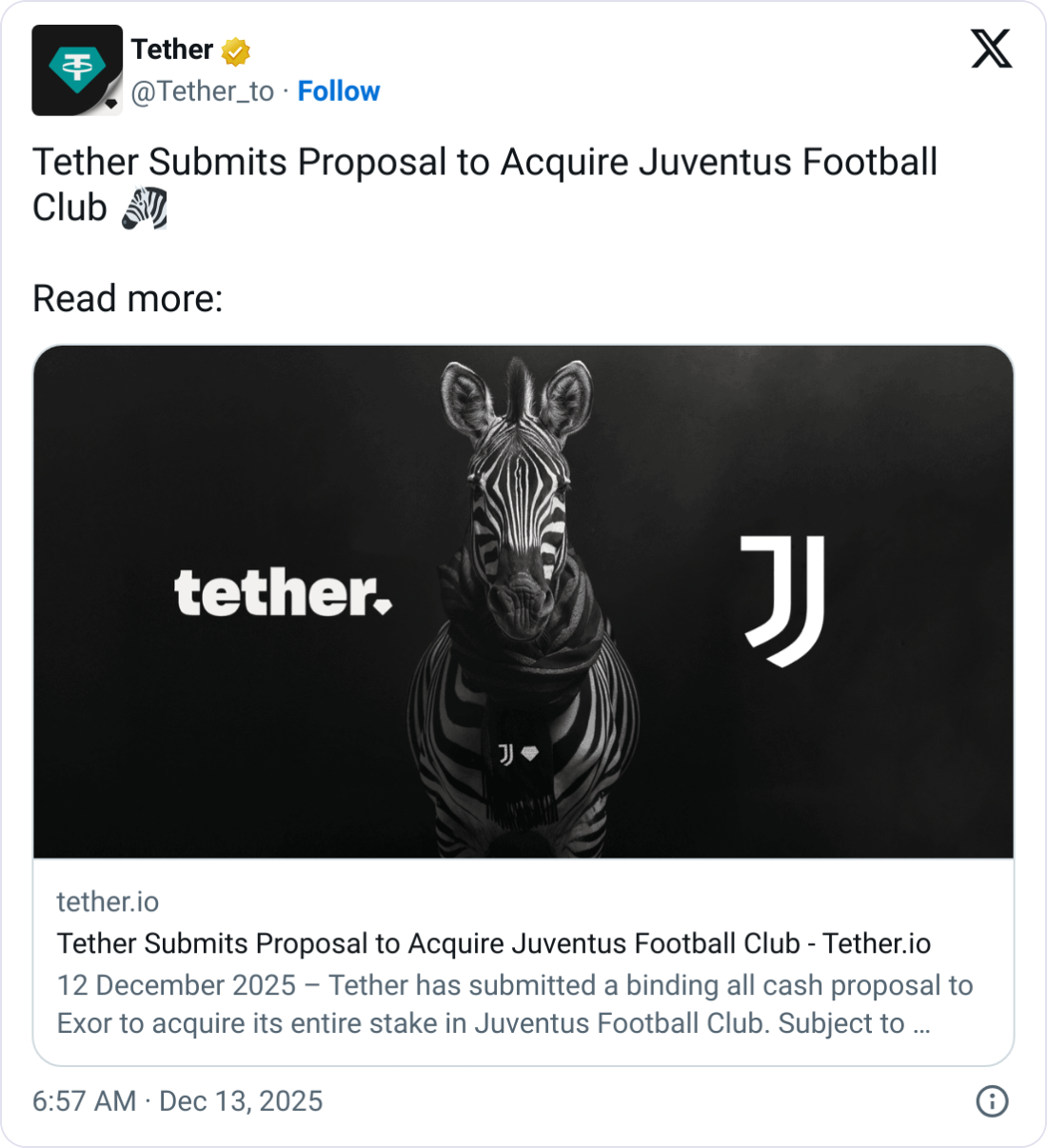
Crypto stablecoin issuer Tether says it has launched a bid to fully acquire the Italian professional soccer club, Juventus Football Club, which has reportedly already been shot down.

Tether said on Friday that it submitted a binding all-cash proposal to Exor, the holding company of the Agnelli family, for its 65.4% controlling stake in Juventus that it has held for over 100 years.

If Exor agrees, then Tether will make a “public offer for the remaining shares at the same price.” Juventus is a public company with a market capitalization of 944.49 million euros ($1.1 billion), having closed trading on Friday up 2.3% to 2.23 euros ($2.62).

However, AFP reported that Tether’s bid has already been rebuffed, with a source close to Exor saying that “Juventus is not for sale.” Exor and Tether did not immediately respond to Cointelegraph’s request for comment.

Tether promises $1.1 billion investment

Tether said it’s prepared to invest 1 billion euros ($1.1 billion) in the support and development of Juventus if the transaction completes.

“Tether is in a position of strong financial health and intends to support Juventus with stable capital and a long horizon,” said Tether CEO Paolo Ardoino.

Source: Tether

“For me, Juventus has always been part of my life,” Ardoino added. “I grew up with this team. As a boy, I learned what commitment, resilience, and responsibility meant by watching Juventus face success and adversity with dignity.”

Related: Major fantasy sports operator enters prediction markets with Polymarket

Tether, which issues the self-named stablecoin Tether (USDT), has looked to expand its business beyond the token and has taken up investing in artificial intelligence, robotics and a health platform.

The company first bought a stake in Juventus in February and boosted its stake to over 10% in April.

It has since looked to boost its influence on the club and, in October, nominated its deputy investment chief, Zachary Lyons, along with Francesco Garino, to the football club’s board of directors.

The bids have paid off, as Juventus shareholders approved Garino’s appointment to the board of directors last month.

Magazine: Peter McCormack’s Real Bedford Football Club puts Bitcoin on the map

Похожее

The Billionaires Behind the Most Expensive Midterm Election in History

"The Most Expensive Midterm Elections and Their Billionaire Backers" This analysis details the unprecedented scale of spending in the 2026 midterm elections, highlighting the key billionaire donors shaping the political landscape. Jeff Yass, founder of Susquehanna International Group, has contributed over $81 million, ranking third among individual donors behind George Soros ($102.6M) and Elon Musk ($84.8M). Yass is a major donor to Trump's MAGA Inc. and supports school choice and various candidates. Overall, federal committees have raised over $4.7 billion this cycle, with political ad spending projected to reach $10.8 billion. Republican-aligned groups are significantly out-raising their Democratic counterparts. "Dark money" from undisclosed sources continues to grow. The core stakes involve control of Congress and policy direction for Trump's final term. Donors are also motivated by specific issues: Sergey Brin and Chris Larsen are funding opposition to a proposed California wealth tax and supporting crypto-friendly policies. Other top donors include OpenAI's Greg Brockman and his wife Anna ($50M total to MAGA Inc. and an AI-focused PAC), Richard Uihlein ($45.3M to conservative causes), venture capitalists Marc Andreessen and Ben Horowitz (each over $44M to crypto/AI PACs and MAGA Inc.), Miriam Adelson ($42.6M to GOP leadership PACs), Paul Singer ($33.9M), and Diane Hendricks ($25.8M to MAGA Inc.). The article notes that the peak fundraising period is still ahead, with major primaries approaching.

marsbitТолько что

The Billionaires Behind the Most Expensive Midterm Election in History

marsbitТолько что

The Largest IPO in History Is Approaching, Surpassing SpaceX, 28 Years of AI Self-Iteration, Countdown to Intelligence Explosion

"Anthropic Nears Trillion-Dollar IPO, Fueled by Explosive Growth and 2028 'Intelligence Explosion' Warning Anthropic is considering a deal valuing the AI company near $1 trillion, potentially leading to one of the largest IPOs ever and surpassing SpaceX. Its revenue has skyrocketed, with Annual Recurring Revenue (ARR) reaching $45 billion in May 2026—a 500% increase in just five months. This vertical growth curve is attributed to its key products, Claude Code and Cowork, dominating AI coding and enterprise collaboration. Beyond commercial success, co-founder Jack Clark issued a pivotal warning in an interview: there is a greater than 50% chance that by the end of 2028, AI systems will achieve recursive self-improvement—the ability to autonomously build a 'better version' of themselves, initiating an 'intelligence explosion.' This prophecy underpins the company's astronomical valuation, as the market prices in the potential for transformative and disruptive AI. Further signaling its ambition, Anthropic formed a $1.5 billion joint venture with Goldman Sachs and Blackstone, aiming to disrupt traditional consulting firms like McKinsey by deploying Claude AI for complex strategic work. This move tests AI's capacity to replace high-level cognitive labor, a precursor to its predicted autonomous evolution. The narrative presents a dual future: unprecedented economic opportunity alongside significant risks like economic restructuring and security threats. Anthropic's meteoric rise and Clark's 2028 prediction frame the coming years as a countdown to a potential technological singularity."

marsbit12 мин. назад

The Largest IPO in History Is Approaching, Surpassing SpaceX, 28 Years of AI Self-Iteration, Countdown to Intelligence Explosion

marsbit12 мин. назад

Has Hook Summer Really Arrived? sato, Lo0p, FLOOD Ignite the New Narrative of Uniswap v4

"Hook Summer" Arrives? Sato, Lo0p, FLOOD Ignite Uniswap v4 Narrative Amidst a slight market recovery, attention within the Ethereum ecosystem has shifted to Meme coins built on Uniswap v4's Hook protocol. Following ASTEROID, tokens like sato, sat1, Lo0p, and FLOOD have become market focal points, with market caps ranging from millions to tens of millions, bringing concentrated liquidity to a narrative-dry market. Uniswap v4 Hooks are "plugin smart contracts" that allow developers to inject custom logic at key points in a liquidity pool's lifecycle (initialization, adding/removing liquidity, swaps, etc.), making the AMM programmable. Recent representative projects include: * **sato**: Market cap peaked over $38M; uses a v4 curve mechanism for minting/burning, locking ETH as reserve. * **sat1**: Market cap briefly exceeded $10M, positioning as an "optimized sato," but later declined significantly. * **Lo0p**: Market cap neared $6.6M; a "lending AMM protocol" allowing users to borrow ETH against deposited LO0P tokens without immediate selling pressure. * **FLOOD**: Market cap approached $6M; channels trading reserves into Aave v3 to generate yield, which is retained in the pool. The emergence of these Hook-based tokens could drive long-term growth for the Uniswap ecosystem by attracting users and liquidity to v4 pools. Combined with Uniswap's activated fee switch (partially used to burn UNI), the long-term outlook for UNI appears positive. However, short-term UNI price appreciation is not directly guaranteed. Factors include the sustainability and lifecycle of these new tokens, their price volatility, overall market conditions, and regulatory pressures. Currently, Uniswap v4's TVL ($595M) lags behind v3 and v2, indicating Hook adoption still requires time to mature. In summary, the Hook ecosystem serves as "long-term nourishment" for UNI, but acts more as a "catalyst" than a direct "booster" in the short term. Note: These are early-stage experimental tokens and may carry unknown risks.

marsbit37 мин. назад

Has Hook Summer Really Arrived? sato, Lo0p, FLOOD Ignite the New Narrative of Uniswap v4

marsbit37 мин. назад

Торговля

Спот
Фьючерсы
活动图片