South Korean Youth Trading Stocks Overnight, Diving Headfirst into Samsung and SK Hynix

marsbitОпубликовано 2026-02-27Обновлено 2026-02-27

Введение

The article details a significant shift in South Korea's investment landscape, where young retail investors are moving from volatile cryptocurrencies to the booming semiconductor stocks, particularly Samsung Electronics and SK Hynix. This transition is driven by the explosive demand for AI-related chips, specifically High Bandwidth Memory (HBM), where these two Korean giants hold a near-oligopoly alongside Micron. Due to unprecedented demand from cloud providers, AI firms, and electronics manufacturers, HBM supply is critically low, with SK Hynix's inventory at a historic low of just four weeks. This scarcity has led to massive price increases for HBM and DRAM chips, fueling a dramatic surge in the companies' stock prices—SK Hynix's stock is up sixfold and Samsung's has quadrupled since early 2025. This rally has propelled the Korean KOSPI index past 6000 points, making it a top-performing global market. The piece explains that the AI era has inverted the traditional tech profit structure. HBM, now a critical and irreplaceable component for advanced GPUs, has given upstream memory suppliers unprecedented pricing power over downstream customers like NVIDIA. This has led to a fundamental "re-rating" of these semiconductor stocks. Consequently, online forums once dominated by crypto talk are now focused on "AI semiconductor concept stocks." Trading volume on crypto exchanges has plummeted, while stock market activity has soared. This shift is further encouraged by government ...

"This year, not a single customer's demand can be fully met."

South Korean chip giant SK Hynix stated that the company's overall inventory of DRAM and NAND is only about 4 weeks, at a historically low level. From cloud providers like Google and Microsoft to AI companies like OpenAI, and then to consumer electronics terminal manufacturers, all customers are unable to receive full supply.

Price increases are inevitable. Starting from the third quarter of 2025, SK Hynix raised HBM3E prices by 15%-20%, with the price of DDR5 16Gb颗粒 (chips) surging by 102% in a single month. Starting in November, prices for all categories of DRAM increased, and NAND contract prices were also raised. In January 2026, another significant price hike occurred, with increases ranging from 20% to 60%.

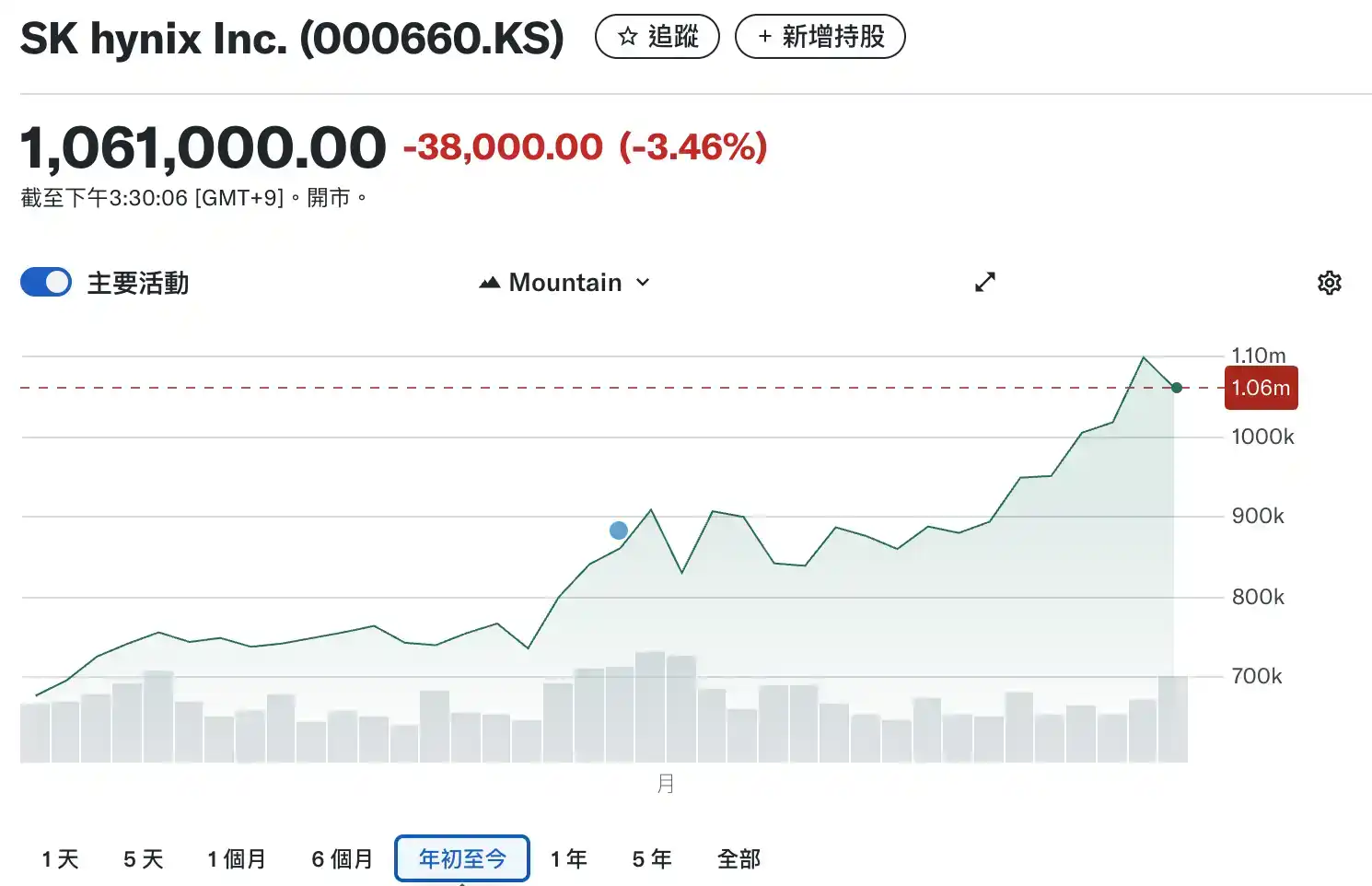
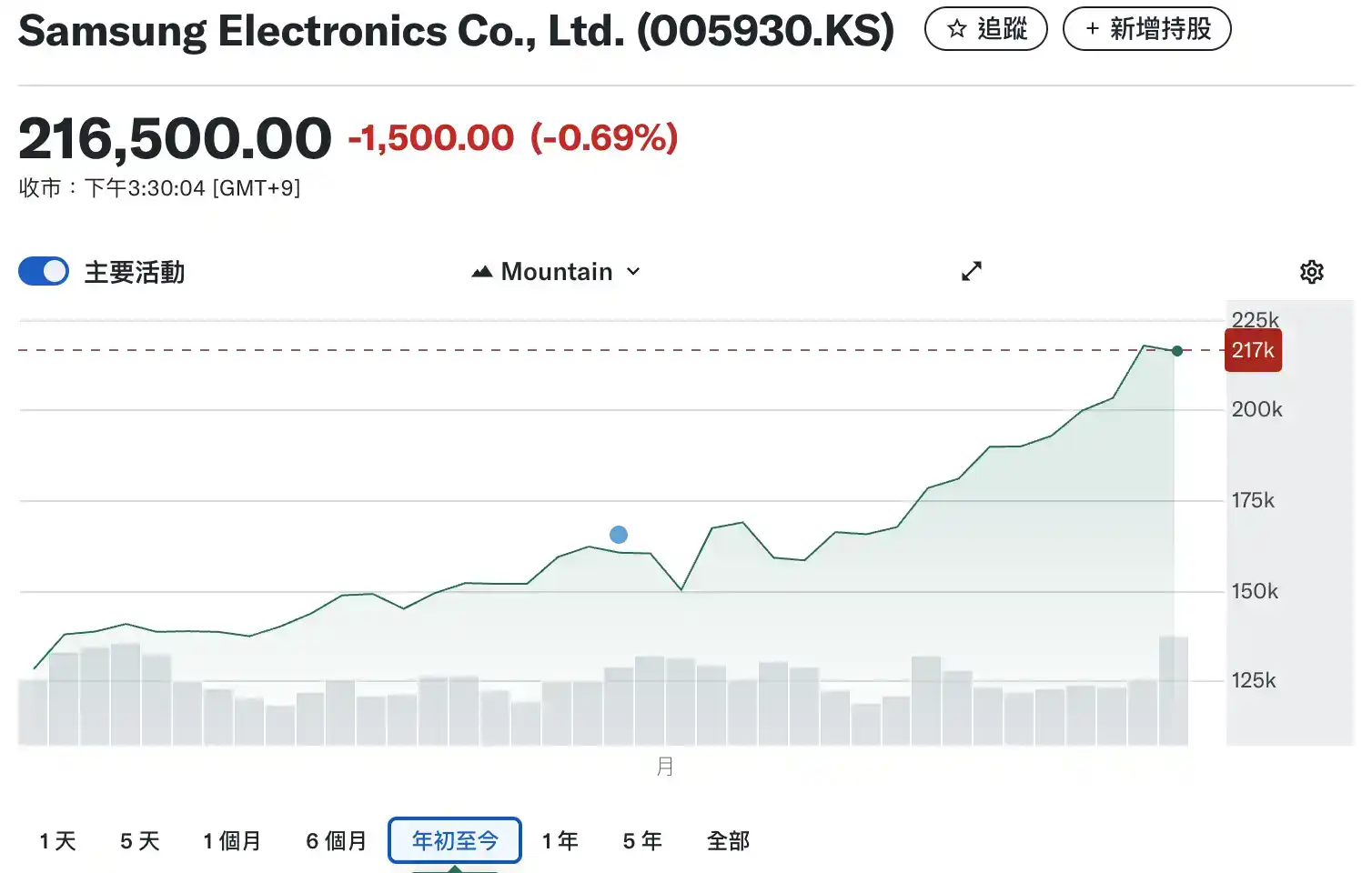
And the rise in stock prices is also inevitable. Since the beginning of 2025, SK Hynix's stock price has skyrocketed about sixfold, while the stock price of another South Korean chip giant, Samsung Electronics, has accumulated an increase of nearly four times.

This has also led the South Korean stock market KOSPI index to break through the 6000-point mark for the first time. The total market capitalization of the South Korean stock market exceeded $3.76 trillion, increasing by about $2.23 trillion since the beginning of 2025, surpassing the stock markets of Germany and France and historically entering the global top ten, rising to the ninth position globally. Since 2026, the index has accumulated a gain of nearly 45%, becoming one of the best-performing major stock markets in the world.

South Korea, this tiny territory, whose stock market was long neglected by overseas funds due to low valuations, has now become the focus of the global capital markets. It has also captured the attention of South Korea's youth, who were originally疯狂 (crazy) about crypto.

Repricing Samsung and SK Hynix

In the consumer electronics era, the industrial paradigm represented by Apple Inc. dominated for twenty years.

As Apple's largest contract manufacturer, Foxconn employs over 1.4 million workers in China, located at the bottom of the "Smiling Curve." Design, brand, and sales occupy the two ends of the curve, where profits curve upwards. Profit distribution thus presents a stable structure: downstream (finished products/platforms) get the meat, upstream gets the soup. After all, there are numerous upstream suppliers, they are highly replaceable; product definition power lies with the brand manufacturers; demand is concentrated at the terminal; switching costs are low.

Many Chinese manufacturers take pride in being "Apple accessory manufacturers," but from an investment perspective, the consensus is: if you can buy Apple, don't buy Foxconn.

But when high technological concentration, slow capacity expansion speed, strong downstream dependence, and no alternative path in the short term these four conditions appear simultaneously, the upstream shifts from being "component suppliers" to becoming "system bottlenecks." The upstream反而 (instead) gains pricing power.

This is exactly what is happening in the current AI industry, in the HBM (High Bandwidth Memory)赛道 (track/field).

For over a decade, the semiconductor industry assumed a premise: the computing power bottleneck lies in the computing chip itself. But large model training shattered this perception. When the parameter scale moves from billions to trillions, GPUs face a more practical problem: no matter how fast they compute, they need data fed into them. HBM (High Bandwidth Memory) determines whether the GPU can run at full capacity; whether cluster efficiency is maximized; whether the unit computing power cost can decrease. It has become the "vascular system" of AI chips.

The more advanced the GPU, the deeper the dependence on memory. Taking NVIDIA as an example, from A100 to H100, then to H200 and subsequent roadmaps, the HBM capacity and bandwidth bound to each generation of GPU are increasing step by step. Computing power doubles, HBM usage almost doubles simultaneously. The proportion of HBM cost in the entire card's BOM (Bill of Materials) is getting higher and higher.

And the number of players globally with true large-scale mass production capabilities is very few: Samsung Electronics, SK Hynix, and (relatively smaller scale) Micron Technology. Apple needs Samsung, NVIDIA needs SK Hynix.

When demand grows exponentially and supply cannot be released quickly, price elasticity is amplified infinitely. In the traditional PC era, CPU/GPU took the lion's share of profits, while memory had strong cycles and weak bargaining power. In the AI server era, HBM has become an irreplaceable component. When a component simultaneously possesses irreplaceability and supply constraints, it means it has absolute pricing power, and it almost inevitably gains超额利润 (supernormal profits).

Repricing Samsung and SK Hynix has become the main theme in most financial markets, including South Korea. The allure of this theme has even surpassed that of crypto.

South Korean Retail Investors Dive Headfirst into Semiconductors

If you opened the chat windows of South Korean young people late at night in 2023 or 2024, Bitcoin was definitely a frequently discussed topic. For a long time, South Korea has been one of the most retail-driven cryptocurrency markets globally, playing a pivotal role.

And 2026 is the fourth year after the LUNA crash. The last person who brought巨大注意力 (huge attention) to South Korea from the financial industry, Do Kwon, has already been sentenced to 15 years in prison. This year, the丙午 (Bingwu) Fire Horse year, is a year of strong fire. The AI industry is still exploding, and South Korea, whose geographical location is associated with fire (in五行, Five Elements theory),显然火气过旺 (obviously has excessive fire energy).

When律动 (Lydian, likely a media name) editors recently opened Naver's investment forum贴吧 (tieba, forum), most posts were about "Samsung Electronics" (삼성전자) and "SK Hynix" (SK하이닉스). Samsung and SK Hynix.

South Korean investors, who were keen on highly volatile altcoins, are now reallocating funds to domestic and foreign stocks, particularly those related to artificial intelligence and robotics.

According to Bloomberg statistics, the trading volume on local South Korean cryptocurrency trading platforms in January decreased by approximately 65% year-on-year. In stark contrast, the trading volume of the KOSPI, the core benchmark of the South Korean stock market, surged by 221% during the same period. The margin balance at securities firms has exceeded 30 trillion won (approximately $208 billion).

The speculative nature of South Korean youth has not changed, but they have shifted their阵地 (battlefield/position).

This sign was already apparent at the end of 2025.

In 2025, Upbit's trading volume fell by 80% compared to the same period in 2024; the activity of the Bitcoin-KRW trading pair was far less than in previous years. Instead, the South Korean stock market was booming, with the KOSPI index surging over 70% during the year, continuously hitting historical highs. On Kakao Talk and Naver forums, retail investors who used to discuss altcoins every day are now talking about "AI semiconductor concept stocks."

This migration also resonates微妙地 (subtly) with the political atmosphere. The current President, Lee Jae-myung, prominently proposed the "KOSPI 5000" target during his campaign. It is rumored that he repeatedly lost money in the stock market when he was young, and this experience of "being harvested like leeks" became his motivation for promoting financial reform.

Furthermore, Lee Jae-myung很清楚一件事 (understands one thing very clearly): whether the stock market can reach 5000 ultimately depends on whether corporate profits can reach a new level. And the South Korean stock market's weight is highly concentrated in technology and semiconductor leaders, so he押 (bets) heavily on these industries.

After taking office, he quickly released strong capital market-friendly signals: establishing a "KOSPI 5000 Special Committee"; promoting amendments to the Commercial Act; strengthening rules for equalization of shareholder rights; enhancing board accountability. On the eighth day of his term, he specially visited the Korea Exchange. The goal is singular: to keep South Korean residents' money in the stock market for the long term.

As for how much the South Korean stock market can rise, some analysis also suggests that besides the impact of the AI sector, political circles would also希望 (hope) the upward trend continues until the local elections in June this year.

This atmosphere has also deeply affected the liquidity still in the crypto circle.

On February 11, 2026, the Lighter exchange launched the world's first batch of on-chain perpetual contracts for South Korean stocks, including Samsung Electronics, SK Hynix, Hyundai Motor, and the KOSPI index, with leverage up to 10x. A few days later, Trade XYZ listed Samsung and Hynix, also with tenfold leverage.

This is also a highly symbolic scene: trading platforms that once hosted the altcoin狂欢 (carnival) are now hosting South Korean stocks.

After all, in this era where AI is reshaping the world, semiconductors are sexier than altcoins.

Связанные с этим вопросы

QWhy are SK Hynix and Samsung Electronics experiencing a surge in stock prices?

ADue to extremely low inventory levels of DRAM and NAND (around 4 weeks) and massive, unmet demand from AI companies, cloud providers, and consumer electronics manufacturers. This supply-demand imbalance has led to significant price increases for their memory products, driving investor optimism and stock price appreciation.

QWhat role does HBM play in the AI industry, and why is it so critical?

AHBM (High Bandwidth Memory) acts as the 'vascular system' for AI chips like GPUs. It is crucial because it determines whether a GPU can run at full capacity, maximizes cluster efficiency, and lowers the cost per unit of computing power. As AI models grow larger, the demand for HBM increases exponentially, making it a bottleneck component with significant pricing power.

QHow has the investment behavior of South Korean youth shifted recently?

ASouth Korean youth, who were previously heavily invested in volatile cryptocurrencies, are now reallocating their funds to stocks, particularly in AI and semiconductor-related companies like Samsung and SK Hynix. This is evidenced by a sharp decline in crypto exchange trading volumes and a massive increase in stock market trading volume and margin balances.

QWhat political factors are contributing to the boom in the South Korean stock market?

APresident Lee Myung-bak's administration has implemented policies friendly to capital markets, including forming a 'KOSPI 5000 Special Committee,' pushing for commercial law amendments, and strengthening shareholder rights. The government's focus on boosting the profitability of key tech and semiconductor companies, which dominate the market index, aims to encourage long-term domestic investment in the stock market.

QWhat is the significance of crypto exchanges like Lighter offering perpetual contracts for Korean stocks?

AIt symbolizes a major shift in speculative investment trends. Platforms that were once hubs for trading altcoins are now catering to the demand for leveraged trading of traditional equities like Samsung and SK Hynix, reflecting how semiconductor stocks have captured the attention and speculative interest that was previously directed toward cryptocurrencies.

Похожее

Those Pre-Bitcoin PoW Protocols Have Recently Been Reimplemented

This article details a recent surge in replicating pre-Bitcoin Proof-of-Work (PoW) protocols, specifically focusing on Hal Finney's 2004 RPOW (Reusable Proofs of Work). Within five days in May 2026, multiple independent builders in the Bitcoin/cypherpunk community launched projects inspired by this early electronic cash proposal. The initiative began with Fred Krueger's `rpow2.com`, a centralized but auditable system that replaced RPOW's original IBM 4758 hardware with Ed25519 signatures. Initially a faithful replica, it later adopted Bitcoin-like features (21M supply cap, difficulty adjustment) and a controversial 5.24% founder allocation. This sparked rapid forks, including `rpow4.com` which incorporated full Bitcoin parameters, a prediction market (`rpowmarket.com`), and a DEX (`rpow2swap.com`). Concurrently, Mike In Space created a prototype of Wei Dai's 1998 b-money proposal (`b-money.replit.app`), pushing the historical exploration even further back. The article contrasts these centralized, server-dependent experiments with Bitcoin's core innovation of decentralized, trustless consensus. It also highlights a parallel development: the `HASH` project on Ethereum, which uses smart contract hooks to enable a purely fair-launch, browser-mineable PoW token with 0% allocations to team or VCs. The collective activity is framed as a meme-driven, educational exploration of cypherpunk history rather than a serious financial movement, with all projects heavily disclaiming any investment value.

marsbit3 мин. назад

Those Pre-Bitcoin PoW Protocols Have Recently Been Reimplemented

marsbit3 мин. назад

South Korean Exchanges 'Battle' Regulators, Challenging the Boundaries of Enforcement and Legislation

South Korea's cryptocurrency industry is engaged in a rare, direct confrontation with regulators. The Financial Intelligence Unit (FIU), the primary anti-money laundering (AML) watchdog, has recently imposed heavy penalties on major exchanges like Upbit and Bithumb for alleged violations involving unregistered overseas VASPs and AML procedures. However, exchanges are now actively challenging these actions in court and through industry associations. In a significant shift, the Seoul Administrative Court ruled in favor of Upbit's operator, Dunamu, overturning part of an FIU-ordered business suspension. The court found the FIU's penalty criteria and justification insufficiently clear. Similarly, the court suspended the enforcement of a six-month business suspension against Bithumb pending a final ruling, citing potential irreversible harm to the exchange. Beyond legal battles, the industry is contesting proposed legislative amendments. The Digital Asset eXchange Alliance (DAXA) strongly opposes a draft rule that would mandate Suspicious Transaction Reports (STRs) for all crypto transfers over 10 million KRW (~$6,800). DAXA argues this "poison pill" clause violates legal principles and would overwhelm the STR system, increasing reports from 63,000 to an estimated 5.45 million annually for major exchanges, thereby crippling effective AML monitoring. This conflict highlights a structural tension in South Korea's crypto governance: comprehensive digital asset laws are still developing, while regulators rely heavily on AML enforcement. The industry's move from passive compliance to active legal and legislative challenges signifies a new phase, pressing for clearer rules and more proportionate enforcement. While short-term disputes may intensify, this clash could ultimately lead to a more mature and sustainable regulatory framework for South Korea's vibrant crypto market.

marsbit56 мин. назад

South Korean Exchanges 'Battle' Regulators, Challenging the Boundaries of Enforcement and Legislation

marsbit56 мин. назад

After 50x Storage Surge, Justin Sun Always Looks to the Next Decade

Sun Yuchen, known for his controversial stunts like a $30 million lunch with Warren Buffett (canceled due to a kidney stone) and eating a $6.2 million duct-taped banana, is often overshadowed by a significant fact: his decade-long track record of spotting major investment trends. In 2016, he famously advised young people to invest in Bitcoin, Nvidia, Tesla, and Tencent instead of buying property. A hypothetical $20,000 investment in Nvidia and Tesla from that list would now be worth over 50 million RMB. His latest major call was on November 6, 2025, predicting a "50x storage opportunity" tied to the AI boom, which materialized with Sandisk's stock surging nearly 50-fold by 2026. Looking ahead, Sun now focuses on the next frontier: Physical AI. He identifies four key areas: 1. **Embodied AI/Robotics**: He sees this reaching its "iPhone moment," with companies like UBTech and Galaxy General leading in commercialization. 2. **Drones**: Viewed as the first commercially viable form of Physical AI, revolutionizing sectors from warfare (e.g., AeroVironment's Switchblade) to logistics. 3. **Spatial Computing**: Beyond VR, it's about AI understanding physical space, a foundational technology for robotics and autonomous systems, exemplified by Apple's Vision Pro. 4. **Space Exploration**: After a 2025 suborbital flight with Blue Origin, Sun advocates for space as the ultimate frontier, discussing blockchain's potential role in space asset management and data transactions. His investment philosophy involves betting on entire, inevitable trends rather than single companies. For robotics, he sees Tesla (the body/manufacturer) and Nvidia (the brain/AI platform) as complementary plays. In defense drones, he highlights companies making tanks obsolete (AeroVironment) and those augmenting fighter jets (Kratos). For space, he participated in Blue Origin's flight and anticipates SpaceX's potential IPO to redefine the sector's valuation. Sun Yuchen's vision frames the next two decades not as a revolution in information flow (like the internet), but in the fundamental operation of the physical world through AI-powered robots, autonomous systems, and spatial intelligence, ultimately extending human and AI activity into space. While many still focus on conventional assets, he continues to look toward the next technological horizon.

marsbit1 ч. назад

After 50x Storage Surge, Justin Sun Always Looks to the Next Decade

marsbit1 ч. назад

The Billionaires Behind the Most Expensive Midterm Election in History

"The Most Expensive Midterm Elections and Their Billionaire Backers" This analysis details the unprecedented scale of spending in the 2026 midterm elections, highlighting the key billionaire donors shaping the political landscape. Jeff Yass, founder of Susquehanna International Group, has contributed over $81 million, ranking third among individual donors behind George Soros ($102.6M) and Elon Musk ($84.8M). Yass is a major donor to Trump's MAGA Inc. and supports school choice and various candidates. Overall, federal committees have raised over $4.7 billion this cycle, with political ad spending projected to reach $10.8 billion. Republican-aligned groups are significantly out-raising their Democratic counterparts. "Dark money" from undisclosed sources continues to grow. The core stakes involve control of Congress and policy direction for Trump's final term. Donors are also motivated by specific issues: Sergey Brin and Chris Larsen are funding opposition to a proposed California wealth tax and supporting crypto-friendly policies. Other top donors include OpenAI's Greg Brockman and his wife Anna ($50M total to MAGA Inc. and an AI-focused PAC), Richard Uihlein ($45.3M to conservative causes), venture capitalists Marc Andreessen and Ben Horowitz (each over $44M to crypto/AI PACs and MAGA Inc.), Miriam Adelson ($42.6M to GOP leadership PACs), Paul Singer ($33.9M), and Diane Hendricks ($25.8M to MAGA Inc.). The article notes that the peak fundraising period is still ahead, with major primaries approaching.

marsbit1 ч. назад

The Billionaires Behind the Most Expensive Midterm Election in History

marsbit1 ч. назад

Торговля

Спот
Фьючерсы

Популярные статьи

Как купить S

Добро пожаловать на HTX.com! Мы сделали приобретение Sonic (S) простым и удобным. Следуйте нашему пошаговому руководству и отправляйтесь в свое крипто-путешествие.Шаг 1: Создайте аккаунт на HTXИспользуйте свой адрес электронной почты или номер телефона, чтобы зарегистрироваться и бесплатно создать аккаунт на HTX. Пройдите удобную регистрацию и откройте для себя весь функционал.Создать аккаунтШаг 2: Перейдите в Купить криптовалюту и выберите свой способ оплатыКредитная/Дебетовая Карта: Используйте свою карту Visa или Mastercard для мгновенной покупки Sonic (S).Баланс: Используйте средства с баланса вашего аккаунта HTX для простой торговли.Третьи Лица: Мы добавили популярные способы оплаты, такие как Google Pay и Apple Pay, для повышения удобства.P2P: Торгуйте напрямую с другими пользователями на HTX.Внебиржевая Торговля (OTC): Мы предлагаем индивидуальные услуги и конкурентоспособные обменные курсы для трейдеров.Шаг 3: Хранение Sonic (S)После приобретения вами Sonic (S) храните их в своем аккаунте на HTX. В качестве альтернативы вы можете отправить их куда-либо с помощью перевода в блокчейне или использовать для торговли с другими криптовалютами.Шаг 4: Торговля Sonic (S)С легкостью торгуйте Sonic (S) на спотовом рынке HTX. Просто зайдите в свой аккаунт, выберите торговую пару, совершайте сделки и следите за ними в режиме реального времени. Мы предлагаем удобный интерфейс как для начинающих, так и для опытных трейдеров.

1.3k просмотров всегоОпубликовано 2025.01.15Обновлено 2025.03.21

Как купить S

Sonic: Обновления под руководством Андре Кронье – новая звезда Layer-1 на фоне спада рынка

Он решает проблемы масштабируемости, совместимости между блокчейнами и стимулов для разработчиков с помощью технологических инноваций.

2.2k просмотров всегоОпубликовано 2025.04.09Обновлено 2025.04.09

Sonic: Обновления под руководством Андре Кронье – новая звезда Layer-1 на фоне спада рынка

HTX Learn: Пройдите обучение по "Sonic" и разделите 1000 USDT

HTX Learn — ваш проводник в мир перспективных проектов, и мы запускаем специальное мероприятие "Учитесь и Зарабатывайте", посвящённое этим проектам. Наше новое направление .

1.8k просмотров всегоОпубликовано 2025.04.10Обновлено 2025.04.10

HTX Learn: Пройдите обучение по "Sonic" и разделите 1000 USDT

Обсуждения

Добро пожаловать в Сообщество HTX. Здесь вы сможете быть в курсе последних новостей о развитии платформы и получить доступ к профессиональной аналитической информации о рынке. Мнения пользователей о цене на S (S) представлены ниже.

活动图片