Solana Gets A Big Infra Signal As Alibaba Demos High-Performance RPCs

bitcoinistОпубликовано 2026-02-11Обновлено 2026-02-11

Введение

Alibaba Cloud demonstrated high-performance Solana RPC connectivity during a keynote, showcasing a significant infrastructure development for the blockchain. The demo highlighted a migration of a Solana archive node to Alibaba's in-house database, completed in just two days with the aid of AI-assisted coding. Key improvements included a reduction in RPC call latency; a "get slot" call dropped from 25ms to 10ms, while a "get block" call for a 4MB payload saw latency fall to under 200ms. This was achieved by routing traffic through Alibaba's private backbone network instead of the public internet, emphasizing stability and suitability for low-latency, trading-heavy applications. The company also highlighted its global data center footprint as a perfect match for Solana's needs. Although not a formal product announcement, the public benchmarking by a major cloud provider is a notable vote of confidence for the Solana ecosystem.

Solana picked up an infrastructure vote of confidence on Wednesday after Alibaba Cloud used a Hong Kong keynote to demo “high-performance” Solana RPC connectivity, framing the work as part of its broader push to fuse AI tooling with Web3 developer workflows.

In a clip shared by Solana’s official X account, the demo came during an Accelerate APAC 2026 keynote titled “Fueling Web3 Innovation with AI on Cloud,” delivered by Zhao Qingyuan of Alibaba Cloud Intelligence Group. The pitch was straightforward: reduce latency and operational overhead for builders who rely on fast, reliable RPC access, especially in trading-heavy use cases where milliseconds can matter.

Alibaba Flexes Solana RPC Throughput

Zhao framed the talk as a practical example of how large language models can compress development cycles. In the keynote, he said he recently migrated a archive node away from a Google Bigtable setup to an Alibaba Cloud in-house database implementation over a weekend, leaning on AI-assisted coding despite limited prior familiarity with Solana’s usual developer stack.

“Just this weekend, I spent two days — I migrated the Solana archive node from a Google Bigtable implementation to Alibaba Cloud’s in-house database implementation,” Zhao said. “I haven’t even learned Rust before, and I just used web coding to do this in two days. And it will download the data from Hugging Face for the historical slots, and it will synchronize the data with the mainnet, and it can provide the RPC service.”

The remarks landed alongside Alibaba Cloud’s broader messaging around its Qwen family of models, positioned by the company as a general-purpose LLM stack that can be used for coding, assistants, and multimodal workflows.

The more market-relevant part of the demo was the latency claim. Zhao described a setup where users connect to RPC nodes through Alibaba Cloud’s backbone network rather than via general public internet routes.

In a table shown during the talk, he said a “get slot” RPC call latency was reduced from roughly 25 milliseconds to about 10 milliseconds under the backbone-network approach, calling it “a huge reduction.” For “get block,” described as a 4MB block payload, he said latency fell from “more than 200 milliseconds” to “less than 200 milliseconds,” while emphasizing stability and suitability for low-latency workloads.

Alibaba Cloud also leaned into geography. Zhao pointed to the firm’s global footprint, highlighting regions such as Frankfurt, the US, and multiple Asia-Pacific hubs including Tokyo, Singapore, and Hong Kong, as a “perfect match” for Solana’s builder base and latency-sensitive applications.

While the clip stops short of announcing a formal partnership or a productized Solana RPC offering with pricing or SLAs, the optics are notable: a major cloud provider using a Solana ecosystem stage to publicly benchmark RPC latency improvements, and explicitly tying that to trading and “co-location for the high frequency calls.”

At press time, SOL traded at $81.
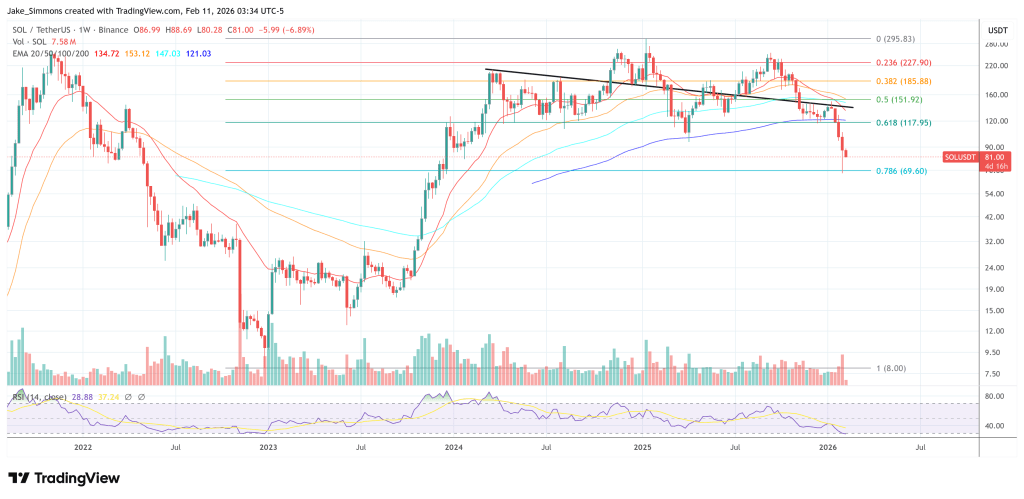
SOL stays above the 0.786 Fib, 1-week chart | Source: SOLUSDT on TradingView.com

Связанные с этим вопросы

QWhat did Alibaba Cloud demonstrate regarding Solana at the Accelerate APAC 2026 keynote?

AAlibaba Cloud demonstrated 'high-performance' Solana RPC connectivity, showcasing reduced latency and operational overhead for developers, particularly in trading-heavy use cases.

QHow did Zhao Qingyuan from Alibaba Cloud migrate the Solana archive node, and what was notable about his approach?

AZhao Qingyuan migrated a Solana archive node from a Google Bigtable implementation to Alibaba Cloud's in-house database over a weekend using AI-assisted coding, despite having limited prior familiarity with Rust or Solana's developer stack.

QWhat latency improvements did Alibaba Cloud claim for Solana RPC calls using their backbone network?

AFor a 'get slot' RPC call, latency was reduced from roughly 25 milliseconds to about 10 milliseconds. For a 'get block' call with a 4MB payload, latency fell from 'more than 200 milliseconds' to 'less than 200 milliseconds'.

QHow did Alibaba Cloud position its Qwen family of models in relation to this demonstration?

AAlibaba Cloud positioned its Qwen family of models as a general-purpose LLM stack that can be used for coding, assistants, and multimodal workflows, using the demo as a practical example of how AI can compress development cycles.

QWhat was the market context for SOL at the time of the article's publication?

AAt press time, SOL was trading at $81.

Похожее

The Value Distribution of Stablecoins

**Summary: The Value Distribution of Stablecoins** The article argues that stablecoins are evolving from mere trading tools into broader channels for dollar access. It divides the stablecoin ecosystem into four layers to analyze how value is distributed: 1. **Issuance Layer:** Mints stablecoins, holds reserve assets, and captures the spread between reserve yield and user costs (e.g., Tether, Circle). This layer currently earns the largest profit margin. 2. **Infrastructure Layer:** Connects stablecoins to the traditional financial system, handling fiat on/off-ramps, banking integration, compliance (KYC/AML), and asset management (e.g., Bridge, BVNK). This is the "unglamorous" but critical work, building the essential bridges between crypto and real-world finance. 3. **Acquiring/Distribution Layer:** Integrates stablecoins into merchant systems, manages payment flows, and provides enterprise financial software (e.g., Stripe, Coinbase). They act as the access point for businesses. 4. **Application Layer:** The end-users and businesses that ultimately use stablecoins for payments, settlements, or as a store of value. They benefit from convenience but have little pricing power. The core thesis is that while the issuance layer currently dominates profits, the often-overlooked **infrastructure layer holds significant long-term potential**. The real challenge and barrier to mass adoption is not the on-chain transfer of stablecoins (which is simple), but the complex "last mile" integration into existing business workflows, banking systems, and regulatory frameworks across different countries. Companies in this layer are currently in a "land grab" phase, investing heavily to build networks, secure bank partnerships, and establish compliance pathways. While their position is currently pressured by the profitable issuers above and distribution platforms below, the article suggests that if stablecoins become a default financial rail for businesses, the infrastructure providers who have done the hard work of integration will ultimately gain strong pricing power and become entrenched, essential players.

marsbit5 ч. назад

The Value Distribution of Stablecoins

marsbit5 ч. назад

The Value Distribution of Stablecoins

The Value Distribution of Stablecoins The article argues that stablecoins are evolving from a mere trading tool into a broad "dollar channel." It analyzes the industry's value chain through four layers: 1. **Issuance Layer (e.g., Tether, Circle):** The top layer that mints stablecoins, holds reserve assets, and captures the thickest interest rate spread. 2. **Infrastructure Layer (e.g., Bridge, BVNK):** Connects stablecoins to the traditional financial system, handling critical but complex "dirty work" like fiat on/off-ramps, banking integration, compliance (KYC/AML), and cross-border settlement. 3. **Acquiring/Distribution Layer (e.g., Stripe, Coinbase):** Embeds stablecoins into merchant systems, manages payment flows, and integrates with enterprise software. 4. **Application Layer:** End-users and businesses that ultimately use stablecoins for payments, settlement, or storing value. The author posits that while the issuance layer currently captures the most profit, the most overlooked and potentially critical layer is infrastructure. The core challenge for stablecoin adoption isn't the on-chain transfer (which is simple), but bridging the gap between blockchain and the real-world financial system. This involves solving practical problems for businesses: fiat conversion, reconciliation, tax handling, and user onboarding. Infrastructure companies are currently in a difficult "land-grab" phase—building networks, securing banking relationships, and achieving compliance country-by-country. They face pressure from both the profitable issuance layer above and distribution platforms below. However, the author suggests this layer is building a crucial moat. Once stablecoins become a default business rail, the infrastructure players who have done the hard work of integration may gain significant, durable value and pricing power.

链捕手5 ч. назад

The Value Distribution of Stablecoins

链捕手5 ч. назад

How to Do Research Well: Deliberately Practice the Real Skills That Matter

No one truly teaches you how to do research. You're often given a desk, a pre-selected problem, and vague instructions to "create something new." Consequently, many people reverse-engineer the job based on visible outputs—papers, posts, announcements—learning only how to *appear* like a researcher rather than how to *become* one. True research capability is built from stacking small, trainable skills, nearly all of which can be developed through deliberate practice. **Pick Your Own Problem:** Most researchers absorb problems from advisors or trends, lacking the underlying reasoning. Choosing a problem you genuinely care about, as John Schulman advises, leads to original work. Develop "taste" like a muscle: predict experiment outcomes, guess paper results from methods, and track which findings remain important over time. **Upgrade Your Inputs:** Relying on shared reading lists (arXiv hot lists, filtered group chats) leads to unoriginal conclusions. Undervalued old literature often holds crucial insights (e.g., MoE, LSTM, backpropagation). Richard Sutton's "The Bitter Lesson" or Claude Shannon's 1952 talk on creative thinking are more predictive than lengthy modern surveys. Breadth matters as much as depth: draw from neuroscience, mechanism design, hardware knowledge, and honest statistics. Read papers directly, especially appendices and limitations sections. **Write Everything Down:** As Paul Graham noted, writing exposes flaws in seemingly mature ideas. Writing is the cheapest defense against self-deception. Following Feynman's principle, Darwin programmatically wrote down facts contradicting his theory to combat memory bias. Maintain a detailed log of hypotheses, setups, predictions, results, and updated understandings. Reviewing past logs fosters essential humility.

marsbit7 ч. назад

How to Do Research Well: Deliberately Practice the Real Skills That Matter

marsbit7 ч. назад

Торговля

Спот
Фьючерсы

Популярные статьи

Обсуждения

Добро пожаловать в Сообщество HTX. Здесь вы сможете быть в курсе последних новостей о развитии платформы и получить доступ к профессиональной аналитической информации о рынке. Мнения пользователей о цене на SOL (SOL) представлены ниже.

活动图片