SOL struggles as Solana TVL slides and memecoin demand fades

cointelegraphОпубликовано 2025-12-12Обновлено 2025-12-12

Введение

SOL, the native token of the Solana blockchain, has struggled to maintain prices above $145 amid declining network activity and reduced demand for decentralized applications. The total value locked (TVL) on Solana has dropped by over $10 billion from its September peak, while weekly DApp revenues fell from $37 million to $26 million. Memecoin demand, a key driver for Solana, has weakened significantly since October’s market crash, contributing to a 67% drop in decentralized exchange volumes. Although Solana’s transaction count increased by 6%, network fees declined by 21%. SOL’s funding rates indicate low bullish leverage demand, reflecting weakened trader confidence after a 46% price decline over three months. Despite positive developments like the Firedancer mainnet launch and new products from Kamino, a sustained recovery to previous highs remains uncertain.

Key takeaways:

  • SOL funding rates signal low bullish conviction after a 46% price drop, despite Firedancer’s launch and rising Solana network transactions.

  • Solana DApp revenues and DEX activity have weakened sharply, suggesting broader market fatigue even as Solana’s ecosystem grows.

Solana’s native token, SOL (SOL), has failed to sustain prices above $145 for the past four weeks. A decline in network activity amid reduced demand for decentralized applications has negatively impacted SOL’s outlook.

With Solana’s TVL now down more than $10 billion from its September peak, onchain metrics are flashing signs that user participation is cooling faster than expected.

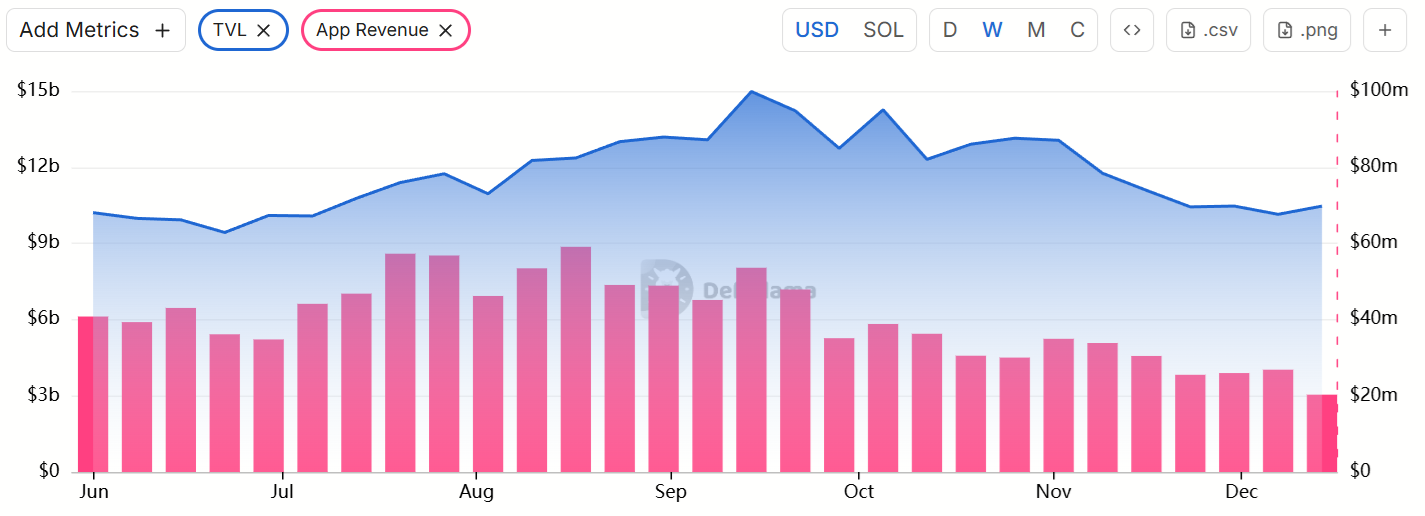
Solana TVL (left) vs. 7-day DApp revenues (right), USD. Source: DefiLlama

The total value locked (TVL) on Solana has been in decline since reaching its all-time high of $15 billion in September. Falling smart contract deposits increase the immediately available SOL supply for sale. Meanwhile, revenues from decentralized applications (DApps) on Solana dropped to $26 million per week, down from $37 million two months earlier.

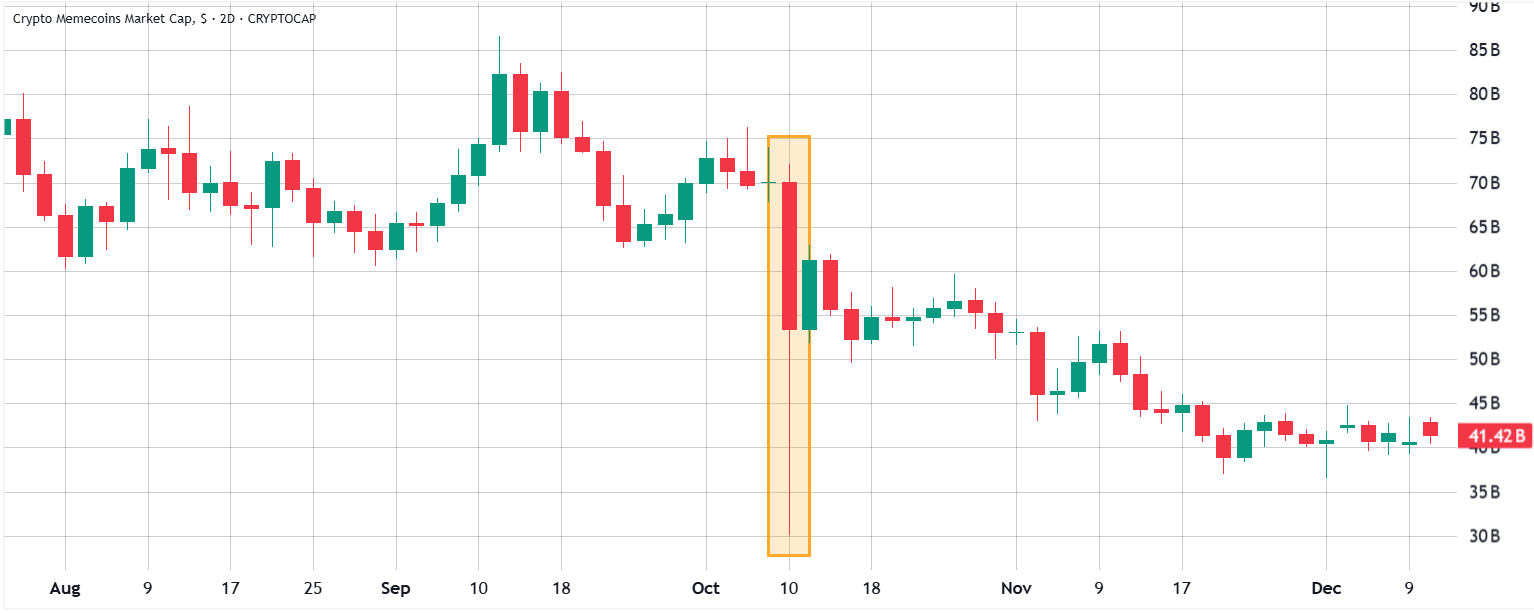
Traders’ appetite for memecoins has also weakened since the cryptocurrency market flash crash on Oct. 10, an event that exposed critical flaws in leveraged positions and the overall liquidity of smaller altcoins. Regardless of whether derivatives markets amplified the move, traders became less comfortable with DEX platforms following the $19 billion liquidation event.

Memecoin market capitalization, USD. Source: TradingView

Memecoins have been a major driver for SOL, especially after the Official Trump (TRUMP) launch in January, which pushed decentralized exchange (DEX) volumes on Solana to $313.3 billion that month. According to DefiLlama data, this activity has since dropped by 67%, partly explaining the softer revenue trends across Solana DApps.

Still, the reduced demand for blockchain-based applications may reflect a broader market slowdown rather than a specific weakness in Solana.

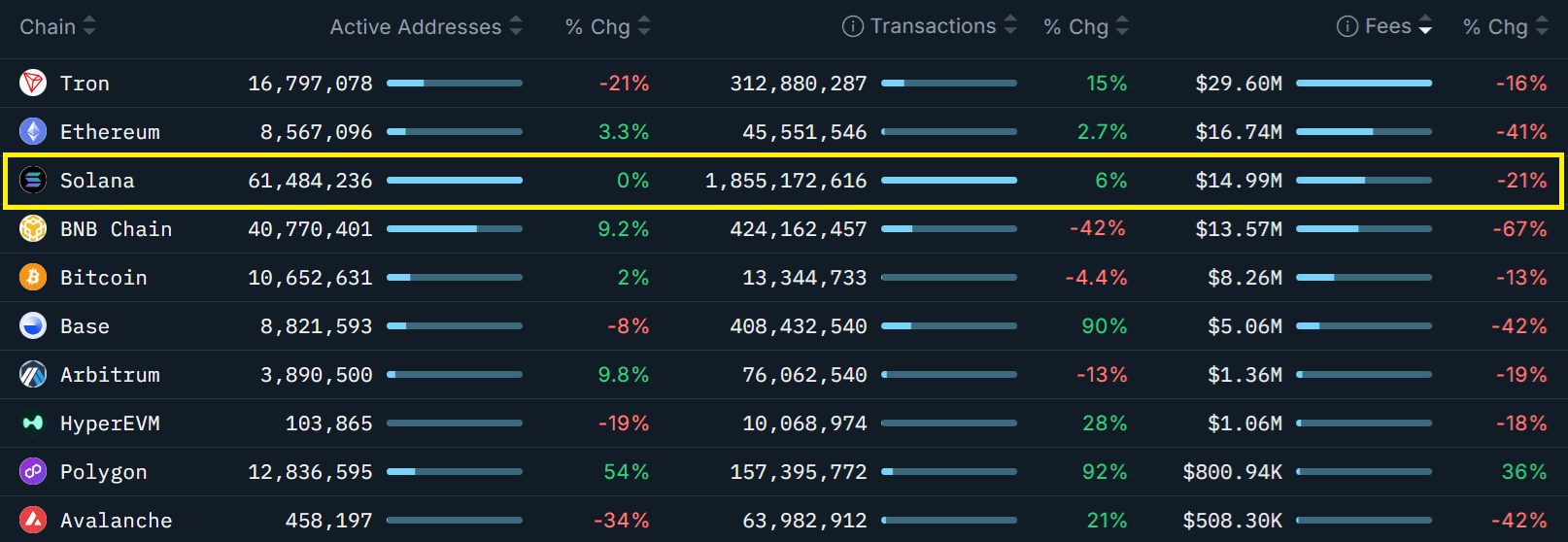
Blockchains ranked by 30-day network fees. Source: Nansen

Solana network fees fell by 21% over the past 30 days, yet competing blockchains experienced steeper declines. Fees on the BNB Chain dropped 67%, while Ethereum saw a 41% decrease over the same period, according to Nansen data. Additionally, the number of transactions on Solana increased by 6%, while activity on the BNB Chain decreased by 42%.

SOL long leverage demand vanishes

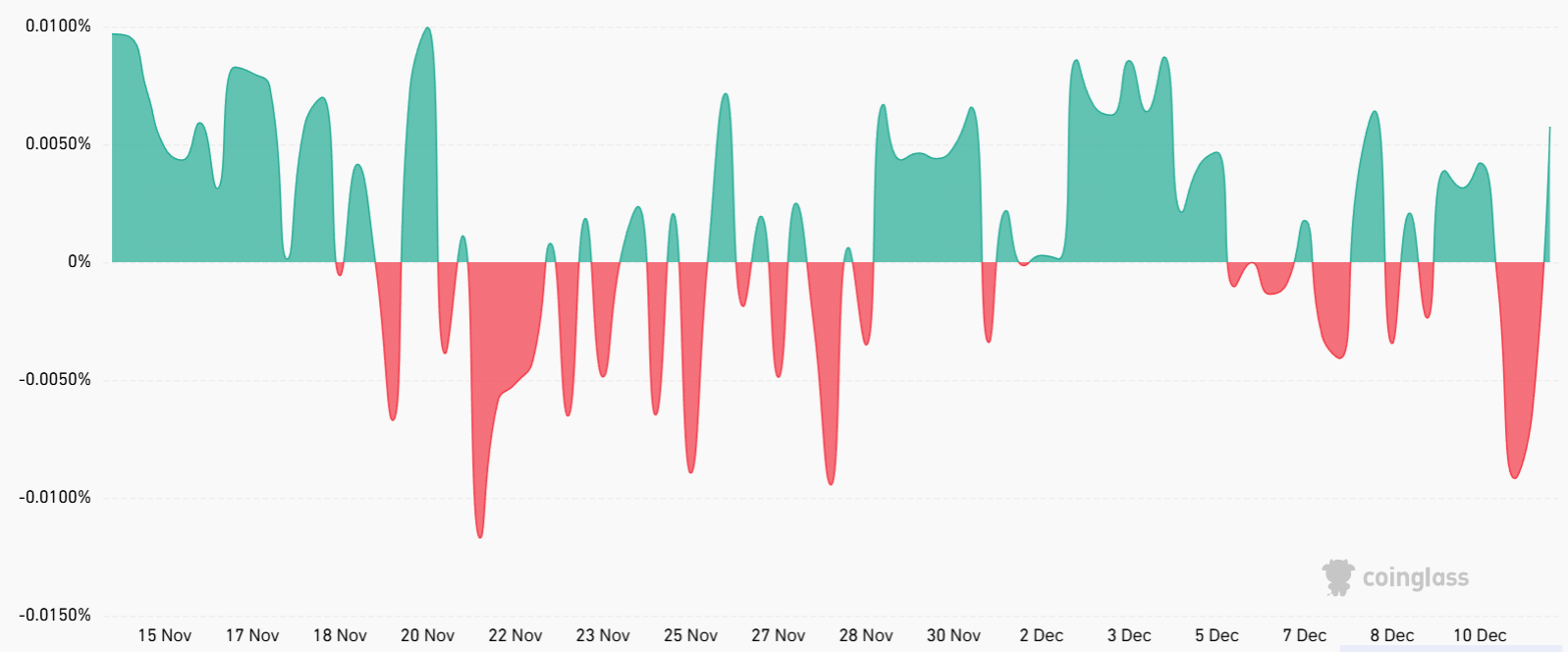
SOL perpetual futures can provide a useful gauge of traders’ sentiment, as exchanges charge either buyers (longs) or sellers (shorts) based on leverage demand. In neutral conditions, the funding rate typically ranges between 6% and 12% per year, with longs paying to keep their positions open given the cost of capital. Conversely, a negative funding rate signals broader bearish sentiment.

SOL perpetual futures 8-hour funding rate. Source: CoinGlass

SOL’s annualized funding rate stood at 6% on Friday, showing weak demand for bullish leverage. The unusual 11% negative reading on Thursday should not be interpreted as heavy demand for bearish positions, as market makers moved quickly to stabilize imbalances. Still, it may take time for bulls to rebuild conviction after SOL’s 46% price decline over three months.

Several recent developments in the Solana ecosystem are expected to draw renewed investor interest, including Friday’s mainnet launch of Firedancer, a new validator client designed to expand processing capacity. The project took more than three years to build under the guidance of Jump Trading, one of the industry’s top market makers. Developers reported a strong response after the validator node re-synced in under two minutes.

Related: J.P. Morgan taps Solana for Galaxy’s tokenized corporate bond issuance

Kamino, the second-largest Solana DApp by TVL, also announced new products on Friday, including fixed-rate and fixed-term borrowing, offchain collateral, private credit and an onchain Bitcoin-backed institutional credit line. Kamino’s $69 million in annualized fees and an average 10% annualized yield on deposits offer a clear indication of the ecosystem’s expansion.

Whether SOL can reclaim the $190 level last seen two months ago remains uncertain, and it is unlikely that improved validation software or expanded DApp offerings alone will restore the confidence needed to support a sustainable bullish trend.

This article is for general information purposes and is not intended to be and should not be taken as, legal, tax, investment, financial, or other advice. The views, thoughts, and opinions expressed here are the author’s alone and do not necessarily reflect or represent the views and opinions of Cointelegraph. While we strive to provide accurate and timely information, Cointelegraph does not guarantee the accuracy, completeness, or reliability of any information in this article. This article may contain forward-looking statements that are subject to risks and uncertainties. Cointelegraph will not be liable for any loss or damage arising from your reliance on this information.

Похожее

The AI Agent Era Accelerates Its Arrival: Questflow Defines a New Paradigm of Financial Intelligence with On-Chain AI Brokerage

The AI Agent era is accelerating, with the CB Insights AI 100 list highlighting global investment confidence. The focus has shifted from whether AI works to its speed of deployment and ability to manage complex workflows, with autonomous AI Agents driving this transformation. At the forefront is Questflow, a Singapore-based startup redefining financial intelligence through its on-chain AI brokerage. Unlike tools that merely provide data dashboards, Questflow deploys AI Agents that proactively scan markets, form judgments, and execute trades via a conversational interface—operating 24/7 without requiring manual confirmation for each decision. This embodies the new AI paradigm of agents capable of executing multi-step workflows autonomously. Questflow's mission is to democratize institutional-grade trading intelligence. Historically reserved for the ultra-wealthy, this capability is now accessible starting from just $1 through Questflow's "AI Clone + Copy Trade" model. The platform charges only a 1% execution fee, aligning its incentives directly with users and eliminating traditional management or performance fees. The timing is opportune, aligning with key trends identified by CB Insights: the scalable deployment of AI Agents, accelerated AI adoption in financial services, and the maturation of on-chain infrastructure. With robust liquidity on platforms like Hyperliquid and Polymarket, alongside advancements in AI reasoning and non-custodial wallet security, Questflow is positioned to merge the roles of broker, fund, and exchange into a single, accessible platform for millions.

链捕手11 мин. назад

The AI Agent Era Accelerates Its Arrival: Questflow Defines a New Paradigm of Financial Intelligence with On-Chain AI Brokerage

链捕手11 мин. назад

Why Pricing Social Interactions is Doomed to Fail?

Titled "Why Putting a Price on Social Interaction Is Doomed to Fail," this article critiques attempts to monetize social networks directly through SocialFi models, arguing their inevitable failure stems from a fundamental misunderstanding of media dynamics. Using Marshall McLuhan's theory of "hot" and "cold" media, the author posits that social networks are inherently "cold" media. Their value isn't contained in individual posts but is co-created through user participation, interpretation, and fragmented, ongoing interaction (e.g., replies, shares). This ambiguity and need for user involvement are core to their function. The article asserts that SocialFi projects like Friend.tech failed because introducing real-time, tradable financial pricing (a definitive "hot" signal) into this "cold" environment doesn't add a layer—it replaces the medium's essence. The unambiguous price signal overshadows and nullifies the nuanced, participatory social signal. Users become traders, not participants, and when speculative profits vanish, the underlying social ecosystem—never genuinely cultivated—collapses entirely. This principle extends beyond crypto. The author argues platforms like Twitter have gradually "heated up" through metrics (likes, retweets counts, algorithmically defined value), shifting users from participants to performers and eroding organic engagement. The solution isn't to abandon capital but to manage its entry point. Successful models like Substack, Patreon, or Bandcamp allow capital to "condense" at specific, isolated nodes (e.g., subscriptions, one-time payments) without permeating and "heating" every social interaction. They preserve the core "cold," participatory medium while enabling monetization at designated boundaries. The NFT boom and bust serves as a stark parallel: the ancient "cold" medium of collecting (valued for story, community, gradual accumulation) was rapidly destroyed by platforms that introduced real-time floor prices, rarity scores, and trading dashboards, transforming collectors into speculators and vaporizing cultural value when prices fell. The core lesson: "Liquidity equals heat." Injecting high liquidity and definitive pricing into a "cold" participatory medium doesn't optimize it; it fundamentally alters and destroys its value-creating mechanism. The future lies not in pricing every social gesture but in finding precise, non-invasive points for capital to condense without overheating the entire ecosystem.

marsbit19 мин. назад

Why Pricing Social Interactions is Doomed to Fail?

marsbit19 мин. назад

Jensen Huang's CMU Speech: In the AI Era, Don't Just Watch, Build

Jensen Huang, CEO of NVIDIA and a first-generation immigrant, delivered the commencement address to Carnegie Mellon University's class of 2026. He shared his personal journey from a humble background to founding NVIDIA, emphasizing resilience, learning from failure, and the responsibility that comes with leadership. Huang framed the present moment as the dawn of the AI revolution, a shift he believes is more profound than previous computing waves. He described AI as fundamentally resetting computing—moving from human-written software to machines that understand, reason, and use tools. This will create a new industry for generating intelligence and transform every sector. While acknowledging AI's potential to automate tasks and displace some jobs, Huang distinguished between the *tasks* of a job and its core *purpose*. He argued AI will augment human capability, not replace humans. The real risk, he stated, is not AI itself, but people being left behind by those who effectively use AI. He presented AI as a generational opportunity for massive infrastructure investment—in chip factories, data centers, energy grids, and advanced manufacturing—that could re-industrialize nations like the U.S. and bridge the digital divide by making computing and intelligent tools accessible to all. Huang called for a balanced approach: advancing AI safely and responsibly, establishing prudent policies, ensuring broad access, and encouraging universal participation. He urged the graduates not to fear the future but to engage with optimism and ambition, reminding them of CMU's motto, "My heart is in the work." His core message was clear: this is their moment to actively build and shape the AI-powered future, not merely observe it.

marsbit1 ч. назад

Jensen Huang's CMU Speech: In the AI Era, Don't Just Watch, Build

marsbit1 ч. назад

Торговля

Спот
Фьючерсы

Популярные статьи

Обсуждения

Добро пожаловать в Сообщество HTX. Здесь вы сможете быть в курсе последних новостей о развитии платформы и получить доступ к профессиональной аналитической информации о рынке. Мнения пользователей о цене на SOL (SOL) представлены ниже.

活动图片