Original|Odaily Planet Daily (@OdailyChina)
Author|Wenser(@wenser 2010 )
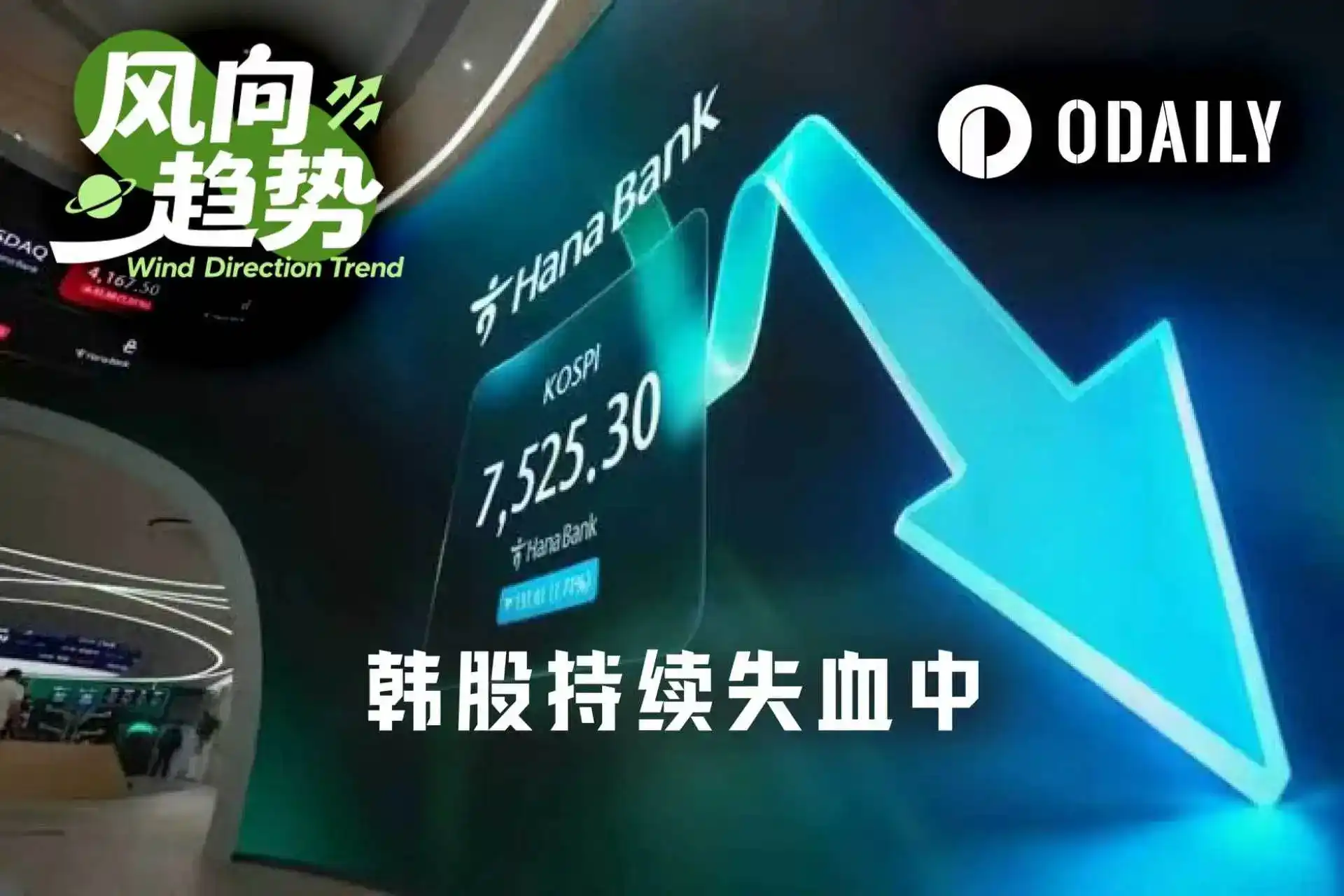
After experiencing a violent rebound of about 20% last Friday, South Korea's KOSPI index closed down 5% today, temporarily reported at 6257 points.
At the same time, various changes in the Korean stock market are gradually emerging: on one hand, a record-breaking 500,000 leveraged retail accounts have been liquidated; on the other hand, over 24 trillion Korean Won has flowed back into banks as a safe-haven operation. Against the backdrop of South Korean President Lee Jae-myung's approval rating hitting a new low and frequent interventions by Korean financial regulators, the next direction of the Korean stock market has become a focus of attention for Korean investors and even the global capital market. After all, South Korea is home to 2 giants in the semiconductor industry amid the AI boom.
Will the stock market continue to bleed and decline, or will regulators step in with favorable stimulus?At least for now, the downturn in the Korean stock market is far from over.
The Miserable State of the Korean Stock Market: Over 500,000 Leveraged Retail Investors Liquidated, Investment Deposit Size Shrinks by Over 35 Trillion Korean Won
In a previous article, "7 Circuit Breakers for Korean Stocks This Year: The Summer Destroyed by Leverage for Young People," we used the real stories of several Korean investors as an entry point to reveal the brutal truth behind the market sell-off this summer.
After nearly half a month of continuous decline and occasional rebounds, various data indicate that the Korean stock market is currently experiencing sustained bloodletting: on one hand, retail investors (the "small fish") are being liquidated due to insufficient capital; on the other hand, the scale of investment deposit funds is shrinking while bank savings funds are expanding.
Goldman Sachs Data: Over 500,000 Korean Leveraged Retail Investor Accounts May Have Been Completely Liquidated
On July 30th, the well-known financial account The Kobeissi Letter on platform X posted, citing Goldman Sachs data, that as of July 13th, over 1.2 million leveraged retail trading accounts in South Korea had triggered margin calls, with an estimated 320,000 to 360,000 accounts already completely liquidated, accounting for about 3.4% of the adult population in South Korea (Odaily Planet Daily Note: equivalent to 1 in every 30 Korean adults potentially facing liquidation). As the Korea Composite Stock Price Index (KOSPI) hasaccumulatively fallen about 18% since July 13th, it is estimated that the number of accounts completely liquidated by that time has now exceeded 500,000.
Although the KOSPI index and stock prices of companies like Samsung and SK Hynix rebounded violently on July 31st, countless liquidated accounts have already become dust in the history of the Korean stock market forever.
Korean Stock Market "Capital Flowing Back to Banks": Over 24 Trillion Korean Won Flows into Term Deposits of the Five Major Banks
Due to adjustments in the semiconductor sector and tightening regulations on leveraged investments, capital awaiting investment in the Korean stock market rapidly withdrew, leading to a phenomenon of "reverse capital migration."
Data shows that as of the end of July, theterm deposit balance of South Korea's five major banks (KB Kookmin, Shinhan, Hana, Woori, NH Nonghyup) reached 973.49 trillion Korean Won, an increase of 24.09 trillion Korean Won compared to the end of last month, setting the largest monthly increase this year.
Capital surrounding the stock market also showed a significant contraction. Data from the Korea Financial Investment Association shows that investor securities account deposits (capital awaiting investment for stock trading) reached a historical high of 139.69 trillion Korean Won on June 4th, butas of July 28th, it had fallen to 107.20 trillion Korean Won, a decrease of over 32 trillion Korean Won in less than two months. Meanwhile, the credit trading margin balance, representing the scale of market margin trading, fell to 33.19 trillion Korean Won in the same period, down about 4.5 trillion Korean Won from the peak of 37.72 trillion Korean Won reached on July 2nd, a decrease of about 12%.
Korean Stock Market Volatility Scares Off Investors: Investor Deposits Plunge Over 35 Trillion Korean Won in 2 Months
Affected by significant volatility in the Korean stock indices, the average daily deposit size of investors in July (Odaily Planet Daily Note: Investor deposits refer to funds deposited by investors into securities company accounts for purchasing stocks; this is a daily average statistic) plunged by nearly 20 trillion Korean Won compared to the previous month. This level was about 10 trillion Korean Won less than in March this year (Odaily Note: At that time, the KOSPI index experienced a significant correction due to US-Iran conflict impact).
According to data released by the Korea Financial Investment Association on August 3rd, as of the 30th of last month, the day the KOSPI index hit a stage low, investor deposit size was 104.6584 trillion Korean Won. Compared to the historical high of 139.6948 trillion Korean Won set on June 4th, it decreased by over 35 trillion Korean Won in just about two months.
Combined with previously mentioned news about 85% of household loan limits being used in the first half of the year and interest rate hikes by the Bank of Korea, the liquidity in the Korean stock market is expected to face another wave of tightening in the short term.
Korean Stock Market Regulators Step In: Individual Stock Leveraged ETF Trading Margin Tripled, Plans to Use "Emergency Intervention Power"
The "Bloody July" of the Korean stock market has forced financial regulators to seek various measures to minimize high volatility and excessive leverage pressure. Specifically, the Financial Services Commission (FSC) and the Financial Supervisory Service (FSS) in Korea are joining forces to influence the market through legislation and restrictions on margin requirements for leveraged trading.
Korean FSC May Be Granted "Emergency Intervention Power": Restricting Leveraged ETF Multiples and Setting Investment Limits
The Korean Financial Services Commission (FSC) has initiated amendments to the Capital Markets Act in conjunction with the Financial Supervisory Service (FSS), focusing on single-stock leveraged ETF products deemed to amplify volatility during the recent stock market crash.The proposed measures include adjusting leverage multiples, setting investment limits, and using "emergency intervention power."
Currently, some single-stock leveraged ETFs in the Korean market use up to 2x leverage.Regulators are discussing whether to allow temporary reductions in leverage multiples during periods of abnormal market volatility to reduce risks from concentrated trading.(This proposal references recent regulatory measures in Hong Kong, where the Securities and Futures Commission previously allowed institutions meeting asset management capabilities, risk control standards, and disclosure requirements to adjust multiples for listed leveraged and inverse products, providing space for dynamic market regulation.
Korean regulators believe that under the current system, matters involving changes to the profit structure may require approval from fund holder meetings, making it difficult to respond quickly in extreme market environments. Therefore,they plan to establish an emergency regulatory mechanism that can be activated without complex procedures.
Additionally, Korean financial regulators are also considering:setting individual investment limits for single-stock leveraged ETFs, uniformly controlling investment limits at around 20% to prevent excessive concentration of funds, and introducing a practical trading simulation system to improve investor understanding of leveraged product risks.
Korean regulators stated thatraising the initial margin primarily increases the investment threshold, while investment limit restrictions are equivalent to setting a "ceiling" on fund inflows; the two will form a complementary risk control system.
Previously, South Korea had Already Data shows that on the first day of the new rule's implementation, the trading volume of 16 related leveraged ETFs was about 3 trillion Korean Won, only about a quarter of the previous trading day's 12.4 trillion Korean Won, and down about 80% from the level of 15 trillion Korean Won on July 29th.
First Day of Korea Tightening Leveraged ETF Trading: Trading Volume Plummets 75%
According to Korean media reports, on the first day of Korean financial regulators implementing restrictive measures on individual stock leveraged ETFs (raising the minimum margin requirement for investors in single-stock leveraged ETFs from 10 million Korean Won to 30 million Korean Won effective July 31st), the total trading volume of 16 individual stock leveraged and inverse ETFs was 3.3071 trillion Korean Won. This figure represents a significant drop of 75.3% compared to the July 30th data (12.4485 trillion Korean Won).Compared to the average daily trading volume of 12.27 trillion Korean Won in July, the powerful control measures by financial regulators have also obviously yielded immediate results in curbing capital flows.
Excluding inverse products, the trading volume of the 14 main individual stock leveraged ETFs also fell by 64.4%, from 6.9354 trillion Korean Won on July 30th to 2.4686 trillion Korean Won.
It is worth mentioning that the current Korean stock market generally views individual stock leveraged ETF funds as the "culprit" behind the cascading effects of this crash,with many believing these funds (e.g., SK Hynix) exacerbated market volatility and caused investors to suffer losses of tens of billions of dollars.
Kim Yong-pan, the Chief of the Office for Government Policy Coordination in the President's Office, has been formally charged with related criminal accusations of abuse of power, coercion, and obstruction of business by Lee Jong-pae, a conservative former Seoul city councilor supported by the opposition People Power Party. This is the official who previously allegedly promoted the listing of leveraged ETFs linked to single semiconductor stocks and was accused of related misconduct. This is the same official who earlier declared, "We should prevent the listing of single-stock leveraged ETFs, they will have to step over my corpse," and was previously involved in a "Korean version of common prosperity rumor" incident for "suggesting distributing AI profit dividends to all Korean citizens," which was eventually settled only after clarification by South Korean President Lee Jae-myung. For details, see "South Korea's Financial Chaos: Samsung Strike, AI Communism, and Massive Crypto Bloodletting."
Stock Market Affects Presidential Standing: Lee Jae-myung's Approval Rating Hits Lowest Point During Term
Affected by the above market turmoil, South Korean President Lee Jae-myung, who has always encouraged people to "stay away from property speculation and invest in the stock market," has also suffered negative impacts.
A poll released today shows that due to controversies such as the stock market crash, South Korean President Lee Jae-myung's approval rating has fallen to its lowest level since taking office in June last year. This poll, conducted by Realmeter and commissioned by media EKN, shows thatthe positive evaluation of Lee Jae-myung by the Korean public fell 0.4 percentage points to 45.9% compared to the previous week, marking the third consecutive week of decline; the negative evaluation of Lee Jae-myung by the Korean public rose 1 percentage point to 50.5%, breaking the 50% key level for the first time.
Another poll by the same agency shows that the ruling Democratic Party of Korea's approval rating is 45.1%, up 3.8 percentage points from the previous week; while the main opposition People Power Party's approval rating fell 2.9 percentage points to 37.7%.
It can only be said thatwhen the market is rising, the president encouraging stock trading is highly praised like a god of wealth; but when the market falls, the president also becomes the biggest scapegoat.
Perspectives on the Direction of the Korean Stock Market: After Foreign Capital Bottom Fishing, Morgan Stanley Gives "Overweight" Rating
After experiencing sustained weakness throughout July, the South Korean KOSPI index surged over 17% intraday on July 31st, setting a record for the largest single-day gain in history. Although some investors optimistically believe this rebound is a "signal flare" for a market trend reversal, some market experts believe thatthe fragile structure of the Korean stock market, which is susceptible to foreign capital flows and prone to sharp volatility, has been verified once again, and this rebound may ultimately just be a "dead cat bounce."
Data shows thatwithin just over two minutes after the market opened that day, the scale of net foreign buying of Korean stocks reached 1.6 trillion Korean Won; by the close, foreign capital had accumulated a net purchase of 7.18 trillion Korean Won for the day, setting a historical record. Meanwhile, Korean individual investors net sold 8.2 trillion Korean Won, also setting a historical record for the highest single-day net selling.
In other words,last Friday, Korean retail investors and foreign investors briefly had a moment of "calling each other fools."
Morgan Stanley Upgrades Korean Stock Market Rating to Overweight, Potential for 36% Upside
Today, Morgan Stanley upgraded its rating on South Korean stocks from equal-weight to overweight, citing recent "leverage unwinding," providing a better entry opportunity for investors to participate in the AI trade and industrial supercycle themes.
Strategists including Daniel K. Blake believe that with the significant unwinding of crowded trades and leveraged positions, the South Korean KOSPI index still has about 36% upside potential compared to its target level of 9000 points.
In terms of details, analysts believe the recent sell-off was "mainly driven by technical factors" and stated that "the deleveraging process for leveraged ETFs, hedge fund leverage, and retail margin trading is already more than halfway through." Morgan Stanley expectsthe KOSPI index to fluctuate in the short term within a range of 5500 to 10500 points, and believes Samsung Electronics and SK Hynix will provide valuation support for the market; stocks in industries such as industrials, defense, and finance are expected to benefit from favorable factors.