Small-Cap Tokens Hit Four-Year Low, Is the 'Altcoin Bull Run' Completely Hopeless?

marsbitОпубликовано 2025-12-16Обновлено 2025-12-16

Введение

Small-cap cryptocurrency tokens have plummeted to multi-year lows, with indices tracking altcoins significantly underperforming both major cryptocurrencies and traditional equities. In 2024–2025, while the S&P 500 and Nasdaq 100 delivered strong double-digit returns with limited drawdowns, altcoin indices like the CoinDesk 80 and MarketVector Small-Cap Index fell sharply—by nearly 40% and to November 2020 lows, respectively. These altcoin indices showed high correlation (0.9) with large-cap crypto assets like Bitcoin and Ethereum but delivered deeply negative returns, higher volatility, and worse risk-adjusted performance (negative Sharpe ratios). Liquidity is increasingly concentrated in high-value, institutionally supported assets such as Bitcoin, Ethereum, SOL, and XRP, indicating a structural shift away from speculative small-cap tokens. The data suggests that altcoins offered no diversification benefits and instead magnified losses during a period of broader market growth.

Author: Gino Matos

Compiled by: Luffy, Foresight News

Since January 2024, the performance comparison between cryptocurrencies and stocks indicates that the so-called new "altcoin trading" is essentially just a substitute for stock trading.

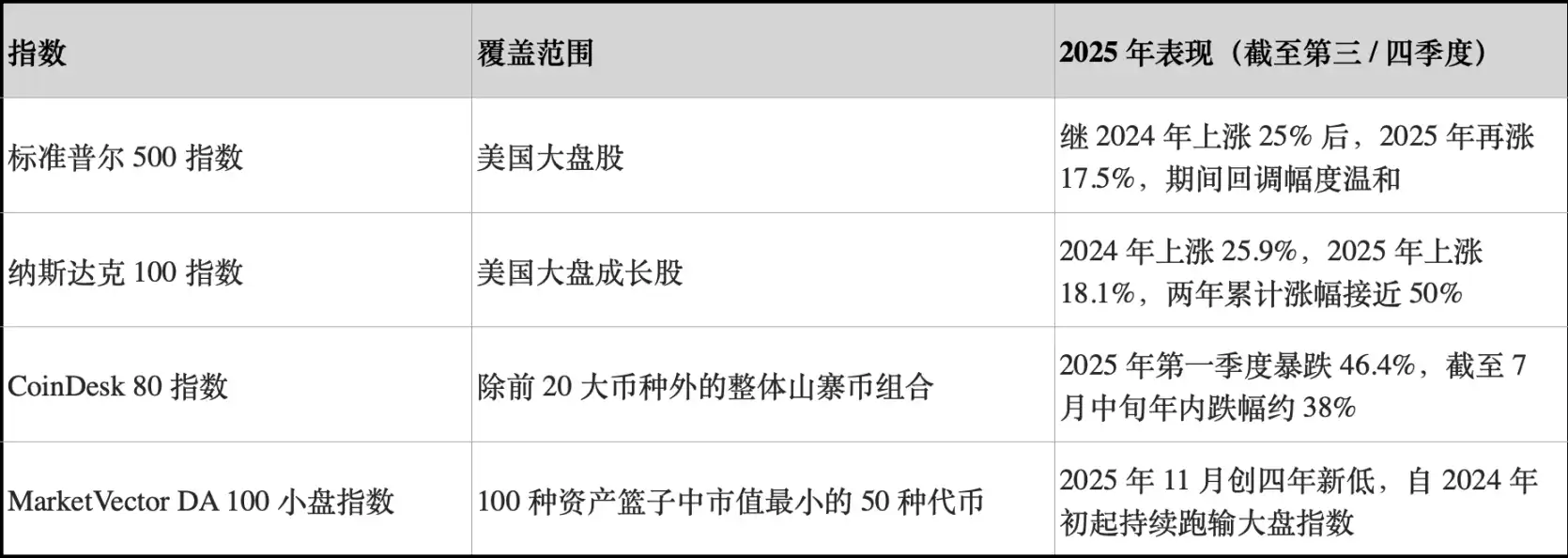
In 2024, the S&P 500 index had a return of approximately 25%, and in 2025 it reached 17.5%, with a cumulative two-year increase of about 47%. During the same period, the Nasdaq 100 index rose by 25.9% and 18.1% respectively, with a cumulative increase of nearly 49%.

The CoinDesk 80 Index, which tracks 80 assets outside the top 20 cryptocurrencies by market capitalization, plummeted 46.4% in the first quarter of 2025 alone, and by mid-July, its year-to-date decline was about 38%.

By the end of 2025, the MarketVector Digital Assets 100 Small-Cap Index fell to its lowest level since November 2020, wiping out over $1 trillion in total cryptocurrency market capitalization.

This divergence in performance is by no means a statistical error. Not only did the overall altcoin portfolio have a negative return, but its volatility was comparable to or even higher than that of stocks; in contrast, major U.S. stock indices achieved double-digit growth with controllable drawdowns.

For Bitcoin investors, the core question is: Can allocating to small-cap tokens deliver risk-adjusted returns? Or is such an allocation merely taking on exposure to a negative Sharpe ratio while maintaining similar correlations to stocks? (Note: The Sharpe ratio is a core metric for measuring the risk-adjusted return of an investment portfolio. Its calculation formula is: Annualized portfolio return - Annualized risk-free rate / Annualized volatility of the portfolio.)

Choosing a Reliable Altcoin Index

For analysis, CryptoSlate tracked three altcoin indices.

The first is the CoinDesk 80 Index, launched in January 2025. This index covers 80 assets outside the CoinDesk 20 Index, providing a portfolio of diversified assets beyond Bitcoin, Ethereum, and other major tokens.

The second is the MarketVector Digital Assets 100 Small-Cap Index. This index selects the 50 smallest tokens by market cap from a basket of 100 assets, serving as a barometer for the market's "junk assets."

The third is a small-cap index launched by Kaiko. This is a research product, not a tradable benchmark, offering a clear sell-side quantitative perspective for analyzing the small-cap asset group.

These three depict the market landscape from different dimensions: the overall altcoin portfolio, high-beta small-cap tokens, and a quantitative research perspective. Yet, the conclusions they point to are highly consistent.

In contrast, the benchmark performance of the stock market shows a completely opposite trend.

In 2024, major U.S. indices achieved gains of around 25%, and in 2025, they also saw double-digit increases, with relatively limited drawdowns during the period. During this time, the maximum intra-year drawdown of the S&P 500 index was only in the mid-to-high single digits, while the Nasdaq 100 index maintained a strong upward trend throughout.

Both major indices achieved compounded annual growth without significant givebacks of gains.

The trend of the overall altcoin indices, however, is vastly different. Reports from CoinDesk Indices show that the CoinDesk 80 Index plummeted 46.4% in the first quarter alone, while the large-cap tracking CoinDesk 20 Index fell 23.2% during the same period.

By mid-July 2025, the CoinDesk 80 Index was down 38% year-to-date, whereas the CoinDesk 5 Index, which tracks Bitcoin, Ethereum, and three other major tokens, achieved a gain of 12% to 13% during the same period.

Andrew Baehr of CoinDesk Indices, in an interview with ETF.com, described this phenomenon as "identical correlation, vastly different profit and loss performance."

The correlation between the CoinDesk 5 Index and the CoinDesk 80 Index is as high as 0.9, meaning their price movements are completely aligned in direction, but the former achieved a slight double-digit growth while the latter plunged nearly 40%.

It turns out that the diversification benefits of holding small-cap altcoins are minimal, while the performance cost is extremely heavy.

The performance of the small-cap asset sector is even worse. According to Bloomberg, by November 2025, the MarketVector Digital Assets 100 Small-Cap Index had fallen to its lowest level since November 2020.

Over the past five years, the return of this small-cap index has been approximately -8%, while the corresponding large-cap index has surged about 380%. Institutional funds clearly favor large-cap assets and avoid tail risks.

Looking at the performance of altcoins in 2024, the Kaiko small-cap index fell over 30% for the year, and mid-cap tokens also struggled to keep up with Bitcoin's gains.

Market winners were highly concentrated in a few top tokens, such as SOL and Ripple. Although the share of altcoin trading volume once rebounded to the 2021 high in 2024, 64% of the trading volume was concentrated in the top ten altcoins.

Liquidity in the cryptocurrency market has not disappeared but has shifted towards higher-value assets.

Sharpe Ratio and Drawdown Magnitude

If compared from the perspective of risk-adjusted returns, the gap widens further. The CoinDesk 80 Index and various small-cap altcoin indices not only have returns deep in negative territory but also have volatility comparable to or even higher than stocks.

The CoinDesk 80 Index plummeted 46.4% in a single quarter; the MarketVector small-cap index fell to pandemic-era lows in November after another round of declines.

The overall altcoin index experienced multiple index-level halving drawdowns: the Kaiko small-cap index fell over 30% in 2024, the CoinDesk 80 Index crashed 46% in Q1 2025, and the small-cap index fell again to 2020 lows by the end of 2025.

In contrast, the S&P 500 and Nasdaq 100 indices achieved cumulative returns of 25% and 17% over two years, with maximum drawdowns only in the mid-to-high single digits. The U.S. stock market had fluctuations, but they were overall controllable; the volatility of cryptocurrency indices, however, was highly destructive.

Even if the high volatility of altcoins is considered a structural feature, their unit risk return from 2024 to 2025 was still far lower than that of holding major U.S. stock indices.

From 2024 to 2025, the overall altcoin index had a negative Sharpe ratio; meanwhile, the S&P and Nasdaq indices had strong Sharpe ratios even without volatility adjustment. After volatility adjustment, the gap between them further widened.
Bitcoin Investors and Cryptocurrency Liquidity

The first insight from the above data is the trend of liquidity concentration and migration towards high-value assets. Reports from Bloomberg and Whalebook on the MarketVector small-cap index both pointed out that since early 2024, small-cap altcoins have consistently underperformed, and institutional funds have instead flowed into Bitcoin and Ethereum ETFs.

Combined with Kaiko's observations, although the share of altcoin trading volume rebounded to 2021 levels, funds were concentrated in the top ten altcoins. The market trend is already clear: liquidity has not completely left the cryptocurrency market but has shifted towards higher-value assets.

The previous altcoin bull market was essentially just a basis trade strategy, not a structural outperformance of assets. In December 2024, the CryptoRank Altcoin Bull Index once soared to 88 points, then plummeted to 16 points in April 2025, completely giving back all gains.

The 2024 altcoin bull market ultimately turned into a typical bubble burst; by mid-2025, the overall altcoin portfolio had almost given back all its gains, while the S&P and Nasdaq indices continued to compound growth.

For wealth advisors and asset allocators considering diversification beyond Bitcoin and Ethereum, the data from CoinDesk provides a clear case reference.

As of mid-July 2025, the large-cap tracking CoinDesk 5 Index achieved a slight double-digit growth year-to-date, while the diversified altcoin index CoinDesk 80 plummeted nearly 40%, yet their correlation was as high as 0.9.

Investors allocating to small-cap altcoins did not obtain substantial diversification benefits but instead suffered far higher return losses and drawdown risks compared to Bitcoin, Ethereum, and U.S. stocks, while still being exposed to the same macro drivers.

Current capital views most altcoins as tactical trading targets, not strategic allocation assets. From 2024 to 2025, Bitcoin and Ethereum spot ETFs had significantly better risk-adjusted returns, and U.S. stocks also performed brilliantly.

Liquidity in the altcoin market is increasingly concentrating towards a few "institutional-grade coins," such as SOL, Ripple, and other tokens with independent positive factors or clear regulatory prospects. Asset diversity at the index level is being squeezed by the market.
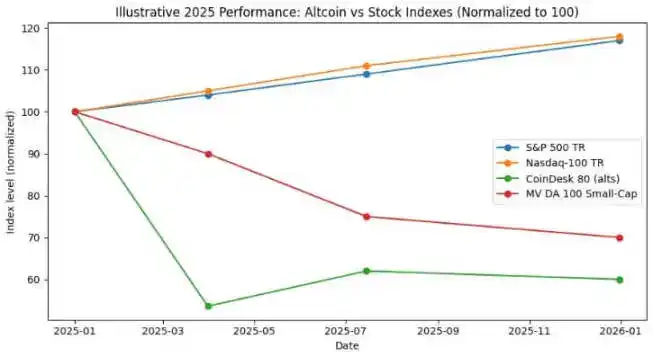
In 2025, the S&P 500 and Nasdaq 100 indices rose about 17%, while the CoinDesk 80 cryptocurrency index fell 40%, and small-cap cryptocurrencies fell 30%

What Does This Mean for Liquidity in the Next Market Cycle?

The market performance from 2024 to 2025 tested whether altcoins could achieve diversification value or outperform in an environment of rising macro risk appetite. During this period, U.S. stocks achieved double-digit growth for two consecutive years with controllable drawdowns.

Bitcoin and Ethereum gained institutional recognition through spot ETFs and benefited from a moderating regulatory environment.

In contrast, the overall altcoin index not only had negative returns and larger drawdowns but also maintained high correlations with major crypto tokens and stocks, yet failed to provide corresponding compensation for the additional risks investors undertook.

Institutional capital always chases performance. The five-year return of the MarketVector small-cap index is -8%, while the corresponding large-cap index surged 380%. This gap reflects the migration of capital towards assets with clear regulation, sufficient derivatives market liquidity, and well-developed custody infrastructure.

The CoinDesk 80 Index's 46% plunge in the first quarter and its 38% year-to-date decline by mid-July indicate that the trend of capital migration towards high-value assets is not reversing but accelerating.

For Bitcoin and Ethereum investors evaluating whether to allocate to small-cap crypto tokens, the data from 2024 to 2025 provides a clear answer: the absolute returns of the overall altcoin portfolio underperformed U.S. stocks, and the risk-adjusted returns were inferior to Bitcoin and Ethereum; despite a correlation as high as 0.9 with major crypto tokens, it provided no diversification value.


Связанные с этим вопросы

QWhat was the performance difference between the S&P 500 and the CoinDesk 80 Index in 2025?

AIn 2025, the S&P 500 index rose by approximately 17.5%, while the CoinDesk 80 Index plummeted by 40%.

QAccording to the article, what is the main reason for the poor performance of small-cap altcoins?

AThe main reason is that institutional capital is migrating towards high-value assets like Bitcoin and Ethereum ETFs, which are seen as having clearer regulatory prospects and better infrastructure, leaving small-cap altcoins with negative returns and high volatility.

QWhat was the correlation between the CoinDesk 5 Index and the CoinDesk 80 Index, and what does this imply?

AThe correlation between the CoinDesk 5 Index and the CoinDesk 80 Index was as high as 0.9. This implies that their price directions moved almost identically, yet the performance was drastically different, with the former achieving double-digit gains while the latter fell nearly 40%, offering no meaningful diversification benefit.

QTo what level did the MarketVector Digital Assets 100 Small-Cap Index fall by the end of 2025?

ABy the end of 2025, the MarketVector Digital Assets 100 Small-Cap Index fell to its lowest level since November 2020.

QWhat does the article conclude about allocating to small-cap tokens for Bitcoin investors?

AThe article concludes that allocating to small-cap tokens did not provide a risk-adjusted return benefit. Instead, it resulted in significantly worse returns and higher drawdown risks compared to holding Bitcoin, Ethereum, or U.S. stocks, while still being exposed to the same macroeconomic factors.

Похожее

Бывший глава CFTC и президент Circle Тарберт: призывает к долгосрочной стратегии, но сам выводит $30 млн

Бывший председатель CFTC и президент Circle Хит Тарберт, публично пропагандируя долгосрочное видение компании для инвесторов на фоне падения акций на 70% с пиковых значений, сам активно распродавал свои акции CRCL. С момента IPO Circle он по плану 10b5-1 продал более 360 тысяч акций, выручив около 30 миллионов долларов, и при этом ни разу не докупал акции на открытом рынке. Эта разница между его публичными заявлениями и личными действиями вызвала критику. Карьера Тарберта демонстрирует классическое использование «вращающейся двери» между регулирующими органами и частным сектором. Уйдя с поста председателя CFTC в 2021 году, через 27 дней он занял должность главного юрисконсульта в маркет-мейкере Citadel Securities, который в тот момент находился под пристальным вниманием из-за скандала с акциями GameStop. Позже, уже работая в Citadel, Тарберт выступал за расширение полномочий CFTC на крипторынок, в то время как его работодатель планировал выход на этот рынок. В 2023 году Тарберт присоединился к Circle, где его опыт и связи сыграли ключевую роль в успешном проведении IPO компании в 2025 году. Однако его последующие массовые продажи акций, совпавшие с падением котировок и его же призывами к долгосрочным инвестициям, ставят под сомнение искренность его уверенности в будущем компании. Критики видят в его карьере образец превращения регуляторного опыта и политических связей в личную выгоду, в то время как риски несут обычные инвесторы, верящие его нарративам.

marsbit8 мин. назад

Бывший глава CFTC и президент Circle Тарберт: призывает к долгосрочной стратегии, но сам выводит $30 млн

marsbit8 мин. назад

Gate Research: Взлет «уолл-стритизации» криптофинансовых продуктов — это конкуренция или интеграция?

**Аналитический обзор Gate Research Institute: Волна "уолл-стритизации" криптофинансовых продуктов — конкуренция или интеграция?** Создание биткоина в 2009 году было ответом на финансовый кризис и стремлением построить децентрализованную систему без доверенных посредников. Однако к 2026 году значительная часть биткоинов (около 7,14%) хранится через ETF таких гигантов, как BlackRock. Это символизирует глубокую интеграцию традиционных финансов (TradFi) и крипторынка. С появлением биткоин-ETF, фьючерсов, RWA (токенизированных реальных активов) и государственных облигаций на блокчейне, традиционные институты получают всё больше влияния на выпуск, ценообразование, кастодию и дистрибуцию криптоактивов. Однако это не одностороннее поглощение, а взаимодополняющая конвергенция. Криптосфера приносит TradFi глобальную 24/7 ликвидность и программируемость, а TradFi предоставляет криптосфере регулируемые каналы, институциональное доверие и массовый доступ. Яркий пример — две противоположные, но ведущие к одной цели траектории: * **Путь А:** Криптобиржи, такие как Gate, начинают с токенизированных акций и CFD, а затем напрямую подключаются к инфраструктуре традиционных брокеров, предлагая реальную торговлю акциями США, Гонконга и Кореи за стейблкоины. * **Путь Б:** Традиционные брокеры, такие как Robinhood, интегрируют криптоактивы, а затем создают собственные Layer 2 для токенизации своих акций, стремясь к круглосуточной торговле. Обе стратегии нацелены на создание **универсального финансового аккаунта будущего** — единой точки доступа к акциям, криптовалютам, ETF, токенизированным облигациям и другим активам. Ключевой конкурентной борьбой становится не между CEX и брокерами, а между этими "супераккаунтами". Параллельно, слой RWA и токенизированных гособлигаций растёт даже на медвежьем рынке, становясь "прослойкой" для объединения капиталов. Хотя этот рынок (около $150 млрд токенизированных казначейских облигаций) ещё мал по сравнению с традиционным ($30 трлн), он демонстрирует устойчивый структурный тренд, привлекающий крупнейшие финансовые институты (JPMorgan, DTCC и др.). **Вывод:** "Уолл-стритизация" — это не поражение идеалов децентрализации, а формирование новой гибридной модели. Децентрализованные протоколы продолжают работать на базовом уровне, в то время как на уровне приложений и пользовательского опыта формируется более эффективный, глобальный и свободный объединённый рынок капитала, где активы TradFi и DeFi торгуются бок о бок в одном интерфейсе. Уолл-стрит не завоевала криптосферу, а криптосфера не обошла Уолл-стрит — они совместно строят новые финансовые рельсы.

marsbit11 мин. назад

Gate Research: Взлет «уолл-стритизации» криптофинансовых продуктов — это конкуренция или интеграция?

marsbit11 мин. назад

S&P Dow Jones и Pantera выпускают криптоиндекс, биткоин оставлен за бортом из-за «отсутствия прибыли»

Стандард энд Пурс (S&P Dow Jones Indices) совместно с Pantera Capital запускает индекс S&P Pantera Digital Asset Index. Новый индекс включает 18 токенов, но исключает биткоин, XRP и мем-токены. Критерием отбора послужила «финансовая жизнеспособность», по аналогии с S&P 500: протокол должен демонстрировать положительный доход в течение нескольких кварталов и распределять стоимость среди держателей токенов. Это первое применение фундаментального подхода к оценке криптоактивов со стороны крупнейшего в мире провайдера индексов. В первую пятерку активов вошли Ethereum (ETH), BNB, Solana (SOL), TRON (TRX) и Hyperliquid (HYPE). Pantera отмечает, что совокупный годовой доход всех протоколов индекса превышает $30 млрд. Биткоин был исключен по трем причинам: он рассматривается как монетарный актив, доступный через отдельные ETF; он не генерирует доход протокола; а смешивание его в индексе с доходными активами затрудняет фундаментальный анализ для институциональных инвесторов. Пока индекс является эталонным, но Pantera ведет переговоры о создании на его основе ETF и других инвестиционных продуктов. Компания также отмечает значительный разрыв на рынке: многие институциональные инвесторы готовы к аллокации в криптоактивы, но им не хватает структурированных продуктов, фокусирующихся на активах с реальной экономической деятельностью.

marsbit13 мин. назад

S&P Dow Jones и Pantera выпускают криптоиндекс, биткоин оставлен за бортом из-за «отсутствия прибыли»

marsbit13 мин. назад

Claude представляет мощное обновление: запись экрана + голос, одним кликом дистиллируйте навык для работы за вас

Claude представил новую функцию «Record a Skill» (Записать навык) в десктопном приложении Cowork. Теперь пользователи Pro, Max и Team могут создавать автоматизированные рабочие процессы, просто записывая свои действия на экране и сопровождая их голосовыми комментариями. Система автоматически анализирует запись, извлекает логику и шаги, а затем преобразует их в готовый к использованию Skill (навык). Это устраняет необходимость вручную писать инструкции в формате Markdown, значительно снижая порог входа для нетехнических специалистов. Функция фиксирует не только явные действия, но и скрытую логику, контекст и условия, о которых пользователь рассказывает в процессе записи. Статья отмечает, что такая технология меняет подход к управлению знаниями в компаниях, облегчая документирование и передачу экспертизы. С другой стороны, упоминается случай, когда фрилансер автоматизировал свою работу для клиента с помощью Claude, что в итоге привело к прекращению сотрудничества. Это подчеркивает двойственное влияние технологии: она повышает эффективность, но одновременно снижает зависимость от конкретного исполнителя, перенося конкурентное преимущество работника в область уникальных, сложно автоматизируемых задач. Функция доступна с 21 июля для пользователей соответствующих подписок.

marsbit17 мин. назад

Claude представляет мощное обновление: запись экрана + голос, одним кликом дистиллируйте навык для работы за вас

marsbit17 мин. назад

Кормление ИИ "шумом" тоже повышает точность: это исследование позволяет шуму осуществить позитивный перенос

В статье представлен новый метод полуконтролируемого обучения под названием **Semi-Supervised Noise Adaptation (SSNA)**. Вместо использования реальных данных (например, изображений или текста) в качестве исходного домена, подход использует синтетические **шумовые векторы**, сгенерированные из простого гауссовского распределения. Эти шумовые данные не несут семантического содержания, но им присваиваются искусственные метки классов, соответствующие целевым классам. Основная идея заключается в том, чтобы обучить модель формировать **дискриминативную классовую структуру** в общем пространстве представлений сначала на шумовых данных, а затем адаптировать (выровнять) эту структуру к данным целевого домена с помощью небольшого количества размеченных примеров. Для этого используется **Noise Adaptation Framework (NAF)**, который минимизирует три компонента потерь: классификацию на размеченных целевых данных, классификацию на шумовых данных и расстояние между распределениями шумового и целевого доменов. Эксперименты на наборах данных CIFAR-10, CIFAR-100, DTD-47 и других показали значительное улучшение точности по сравнению с базовым методом ERM при использовании всего 4 размеченных примера на класс. Например, на CIFAR-10 точность выросла на 12.35%. Метод также совместим с существующими полуконтролируемыми алгоритмами (UDA, FixMatch), дополнительно улучшая их результаты. Ключевой вывод исследования: для положительного переноса знаний в задачах трансферного обучения **не обязательно наличие семантически богатых исходных данных**. Достаточно сформировать в пространстве признаков четкую, разделимую классовую структуру, даже на искусственном шуме, и успешно перенести её на реальные данные. Это открывает новые возможности для сценариев, где доступ к реальным исходным данным ограничен из-за проблем конфиденциальности, авторских прав или их отсутствия.

marsbit18 мин. назад

Кормление ИИ "шумом" тоже повышает точность: это исследование позволяет шуму осуществить позитивный перенос

marsbit18 мин. назад

Торговля

Спот
活动图片