SIREN crashes 66%: Is $0.46 support about to be tested?

ambcryptoОпубликовано 2026-03-25Обновлено 2026-03-25

Введение

SIREN has experienced a sharp decline of 66.43% in 24 hours, dropping to $0.9994 at the time of writing. Trading volume also fell by 55.18%, indicating a lack of buyer interest and confidence. The price has broken below the key $0.9015 support level, with the next major support at $0.4645. The RSI has dropped to around 53.12, confirming weakening momentum. On Binance, top traders maintain a bearish stance with short positions dominating at 55.61%. Funding rates have turned negative, reflecting strong conviction among short sellers. Overall, market structure, derivatives positioning, and weak demand suggest continued downside pressure with no signs of immediate recovery.

Siren [SIREN] has dropped sharply to $0.9994 after losing 66.43% in 24 hours, at press time, and the move reflected clear deterioration in participation across the market.

At the same time, volume has fallen by 55.18% to $93.34 million, and this decline suggests traders have not stepped in to absorb the sell-off. Instead, reduced activity signals hesitation and lack of confidence during the drop.

As a result, the structure does not show signs of demand returning, and the absence of strong buying interest continues to expose SIREN to further downside pressure.

SIREN breakdown accelerates as RSI confirms weakness

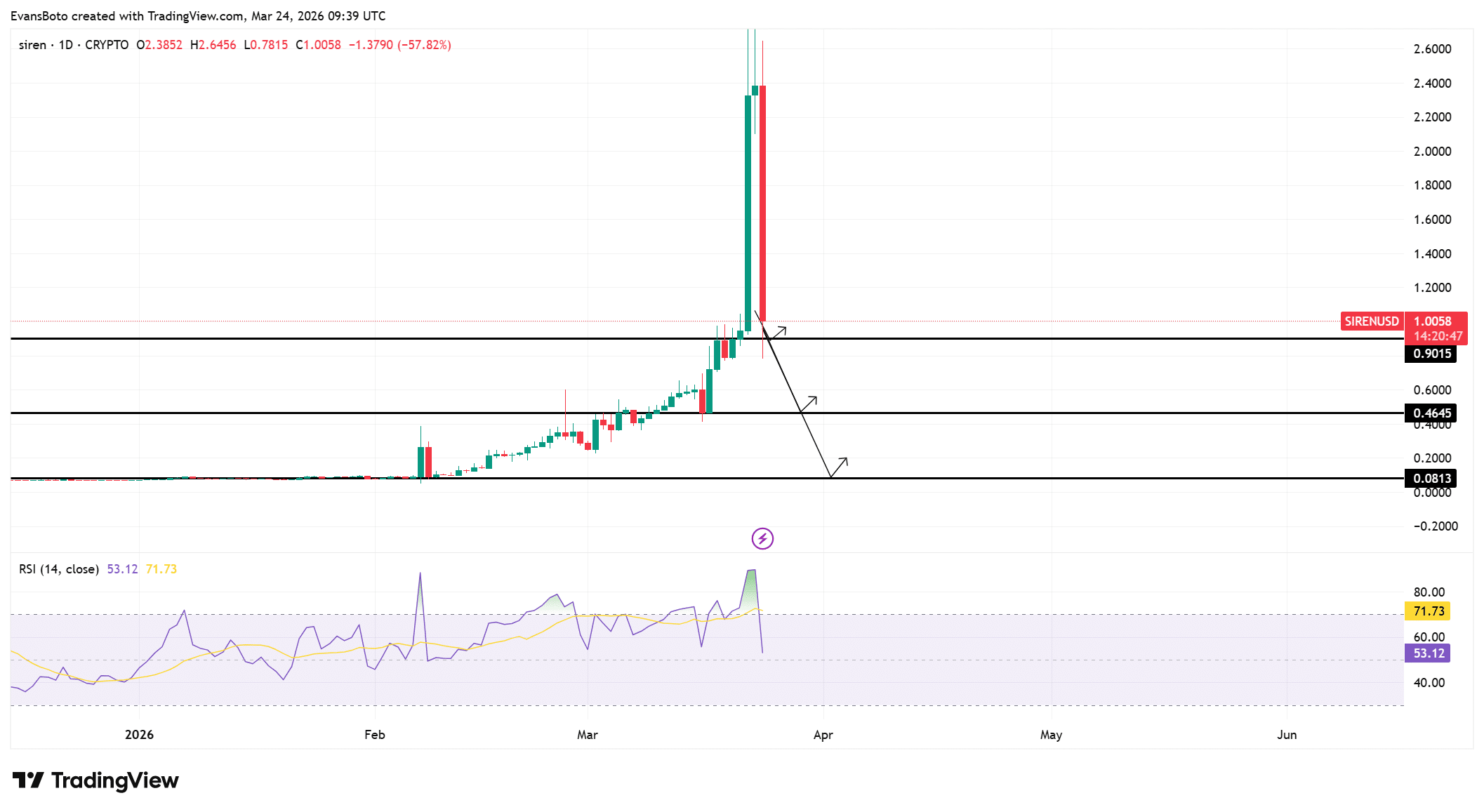
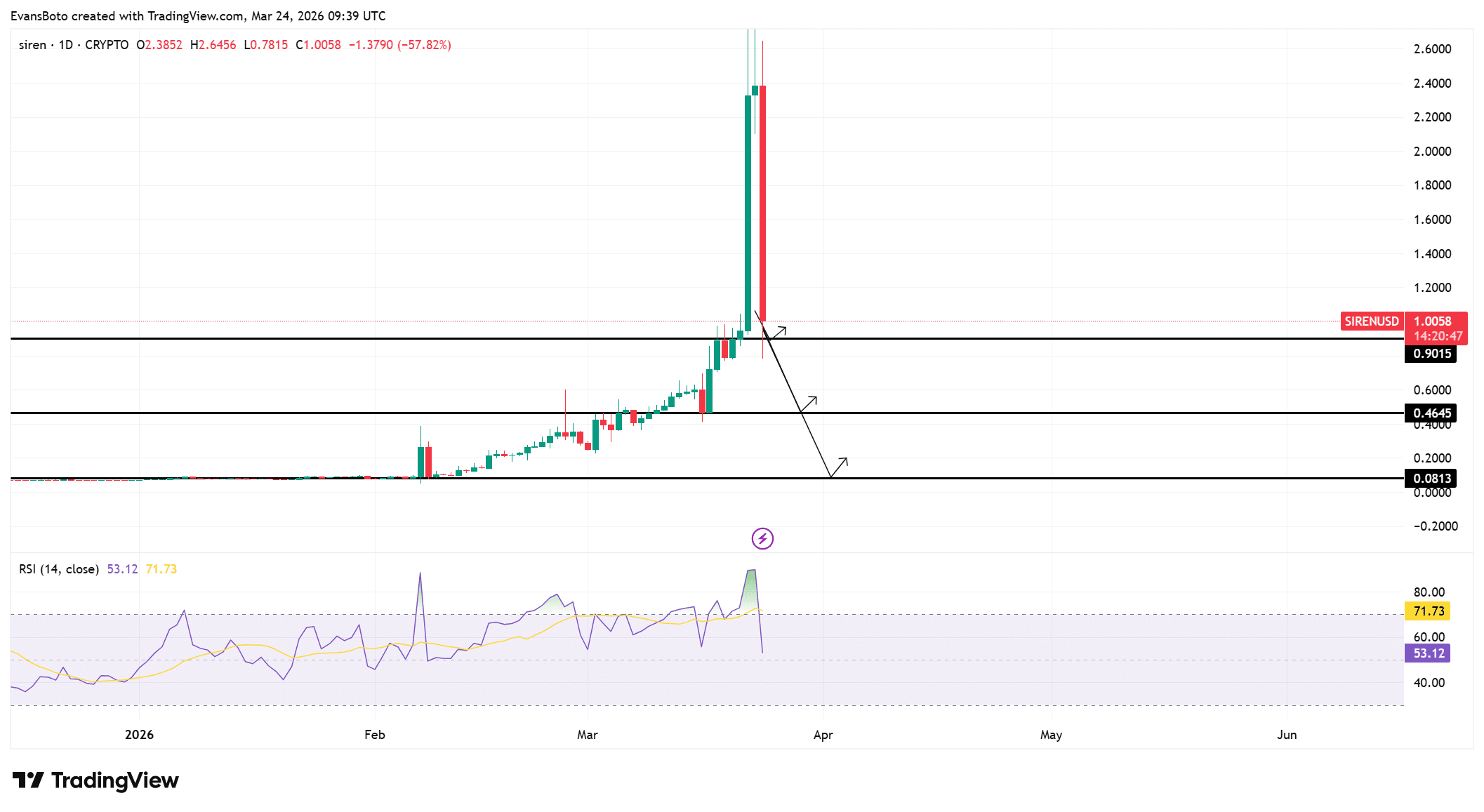
Price has rejected sharply after a vertical expansion phase, and the structure now reflects a clear breakdown from recent highs.

SIREN has already lost the $0.9015 support level, which previously acted as a key reaction zone during the rally. This shift now places $0.4645 as the next major support, while a failure there could expose $0.0813 as the lower historical base.

However, price continues to trade below the breakdown zone without signs of stabilization. On the other hand, the RSI has dropped to around 53.12 as of writing, reflecting a rapid loss of buyer strength after the peak.

Although RSI has not reached oversold levels, it continues trending lower alongside price, which reinforces the ongoing weakness and supports the broader shift toward sustained downside pressure.

Source: TradingView

SIREN short dominance persists across Binance positioning

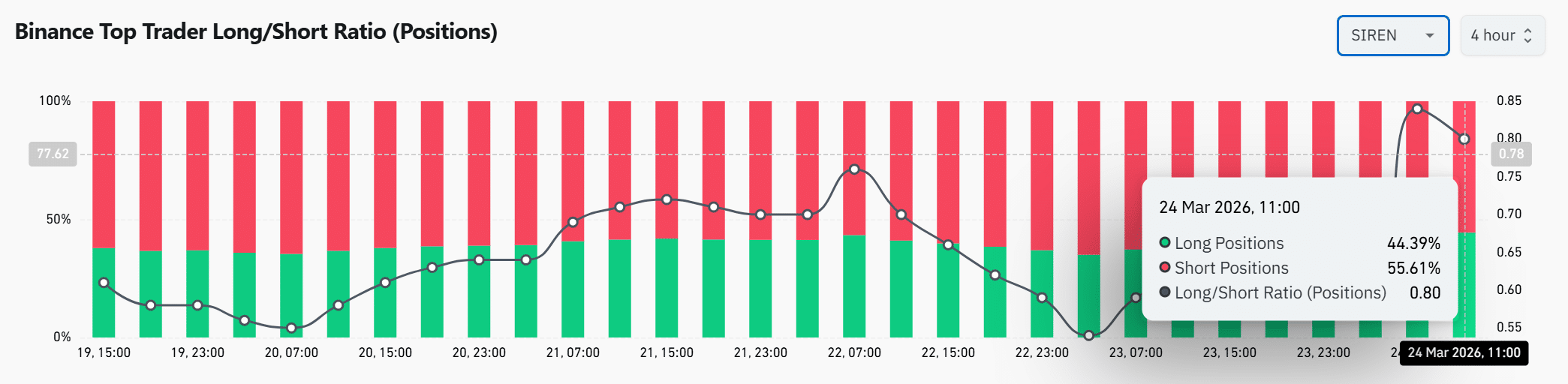
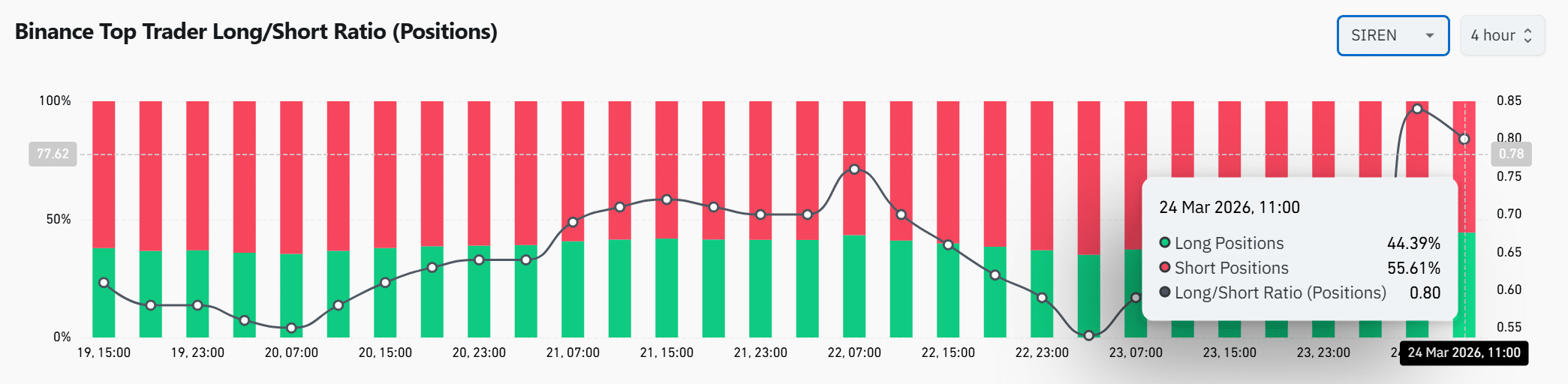
Binance top trader positioning continues to favor shorts, and this alignment strengthens the bearish outlook. At the time of writing, short positions accounted for 55.61% of total positions, while longs stood at 44.39%, leaving the Long/Short ratio at 0.80.

This imbalance shows that experienced traders continue to position for further downside even after the steep decline. In addition, the persistence of this short bias suggests that market participants do not expect immediate recovery.

As price struggles to reclaim lost levels, trader positioning remains aligned with the ongoing bearish structure, reinforcing continued downside pressure across the market.

Source: CoinGlass

Negative funding highlights rising bearish conviction

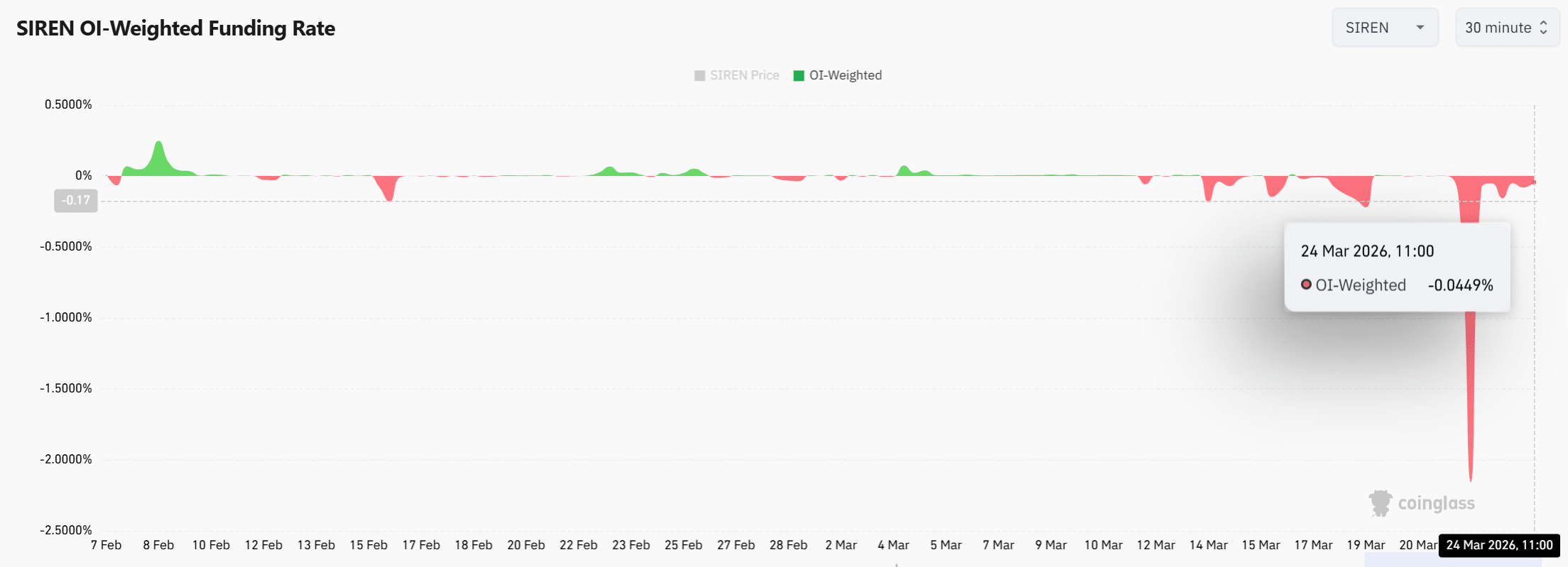
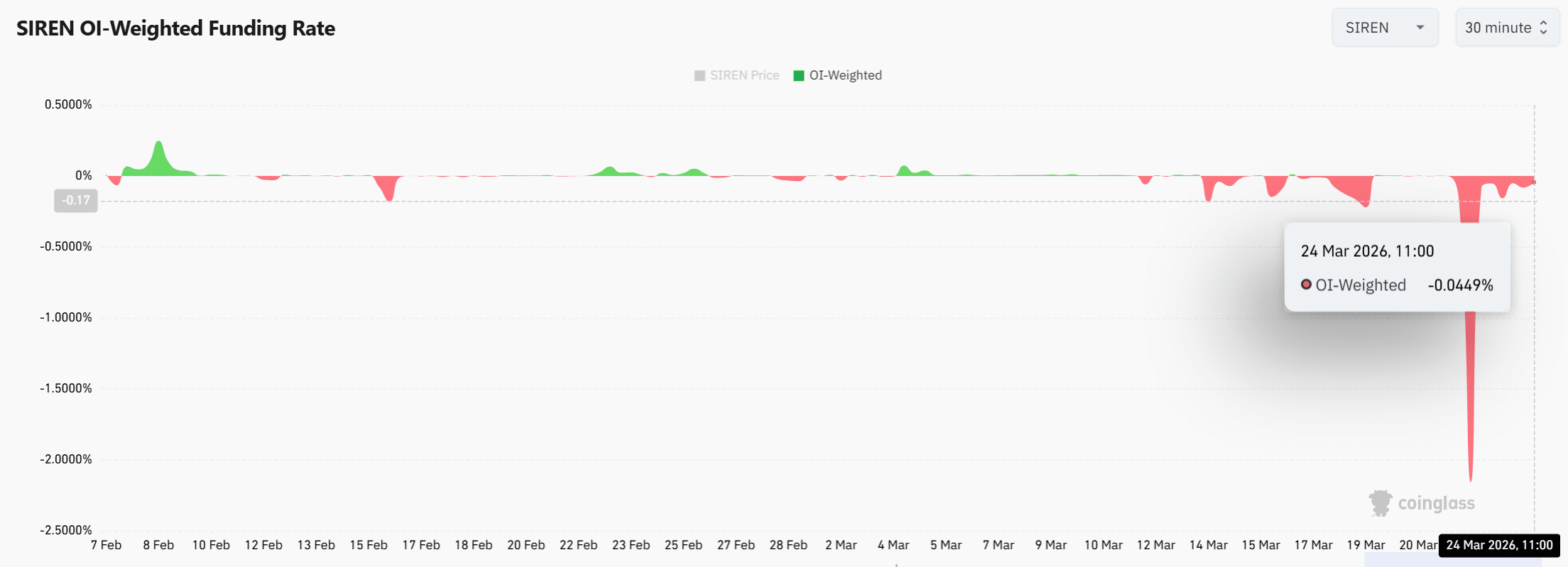
Funding Rates have turned negative, and the OI-Weighted Funding Rate was at -0.0449% as of writing, reflecting strong short-side conviction. This shift shows that short traders continue to pay to maintain their positions, which confirms sustained bearish sentiment in the derivatives market.

Earlier periods showed mixed funding, but the current persistent negative trend signals growing confidence in downside continuation.

Besides, this imbalance does not yet indicate exhaustion, as no sharp reversal in funding appears. As a result, derivatives positioning continues to support the broader bearish structure seen across price and market participation.

Source: CoinGlass

SIREN remains firmly under bearish control as weak demand, declining RSI, and dominant short positioning continue to align with downside pressure.

Price has already lost key support and shows no signs of stabilization, while funding rates and trader positioning reinforce continued selling interest. Given this structure, the current trend favors further downside toward lower support levels rather than recovery.


Final Summary

  • Persistent weakness in demand and structure suggests sellers remain firmly controlling SIREN’s direction ahead.
  • Continued short dominance across derivatives and spot behavior indicates downside pressure could extend before any meaningful recovery attempt.

Связанные с этим вопросы

QWhat is the current price of SIREN and how much has it dropped in the last 24 hours?

ASIREN is currently trading at $0.9994 after a sharp drop of 66.43% in the last 24 hours.

QWhat is the next major support level for SIREN after it lost the $0.9015 level?

AThe next major support level for SIREN is $0.4645.

QWhat does the negative funding rate of -0.0449% indicate about market sentiment?

AThe negative OI-Weighted Funding Rate of -0.0449% indicates strong bearish conviction, as short traders are paying to maintain their positions, confirming sustained selling pressure in the derivatives market.

QAccording to Binance data, what percentage of top trader positions are short on SIREN?

AAccording to Binance data, short positions account for 55.61% of top trader positions.

QWhat does the RSI level of 53.12 suggest about the current market strength for SIREN?

AAn RSI level of 53.12, while not yet in oversold territory, shows a rapid loss of buyer strength and is trending lower, reinforcing the ongoing weakness and supporting the broader shift toward sustained downside pressure.

Похожее

Cryptocurrency & Stock Market Indicator丨SpaceX Discloses Holding 18,712 Bitcoins Worth $1.18 Billion; Strategy Spends $100 Million Two Weeks in a Row to Scoop Up BTC at Low Levels (June 16)

"Coin-Stock Barometer: SpaceX discloses holding 18,712 Bitcoin worth $1.18B; Strategy spends another $100M accumulating BTC (June 16) SpaceX has officially disclosed holding 18,712 Bitcoin in its S-1 filing, valued at ~$1.18B, becoming the 8th largest public company Bitcoin holder. Its average cost is ~$35,000 per BTC. In weekly BTC treasury news, Strategy (formerly MicroStrategy) purchased another 1,587 BTC (~$100M) last week, increasing its total to 846,842 BTC. Mara Holdings added 1,000 BTC. However, Metaplanet and others made no purchases. Nakamoto sold ~600 BTC to repay ~$45M in debt. Global public companies (excluding miners) now hold 1,121,341 BTC. In other crypto treasury developments: - Metaplanet acquired Siiibo Securities to build a Bitcoin-focused financial ecosystem in Japan. - Bitmine increased its ETH holdings by 76,881 last week. - SharpLink's cumulative ETH staking rewards surpassed 21,119 ETH. - Forward Industries' acquisition offers for two SOL treasury companies, including Brera Holdings (holding 2.1M SOL), were rejected. - Tron Inc.'s TRX holdings surpassed 700 million. - Avalanche Treasury Co. (AVAT) begins trading on Nasdaq. - AIFC detailed plans to use WLFI tokens for collateral/loans. Market perspectives on U.S. stocks vary. 'White-Haired Stock God' Serenity sees the current cycle as retail-to-institution transfers, where negative reports may signal institutional accumulation. Morgan Stanley suggests a rotation from tech to cyclical stocks could occur. Citrini believes the U.S. stock market hasn't peaked but expects frequent 10-15% pullbacks in the coming months."

marsbit4 мин. назад

Cryptocurrency & Stock Market Indicator丨SpaceX Discloses Holding 18,712 Bitcoins Worth $1.18 Billion; Strategy Spends $100 Million Two Weeks in a Row to Scoop Up BTC at Low Levels (June 16)

marsbit4 мин. назад

Do Robots Also Need Encrypted Wallets? Stablecoin Giant Tether Bets on German Company NEURA Robotics

Do Robots Need Crypto Wallets? Stablecoin Giant Tether Bets on German Firm NEURA Robotics German robotics company NEURA Robotics has secured up to $1.4 billion in what is claimed to be the largest-ever funding round in the full-stack robotics industry, valuing the company at $7 billion. The Series C round attracted major investors like Tether, Qualcomm, Amazon, NVIDIA, Bosch, and the European Investment Bank. NEURA, founded in 2019, initially focused on AI-powered collaborative robots (cobots) for industrial automation, later expanding to autonomous mobile robots, service robots, and humanoid robots. Its core strategy is evolving from a hardware manufacturer to the operator of "Neuraverse," a platform designed to enable different robots to share learned experiences and data, creating network effects. A key, crypto-focused aspect of this investment is Tether's involvement. Tether plans to integrate its open-source Wallet Development Kit (WDK) into NEURA's robot platforms. This would embed self-custody wallet functionality, allowing robots to autonomously handle payments and settlements for tasks under pre-set rules—envisioning use cases in logistics or Robotics-as-a-Service (RaaS) models. This move could position stablecoins and crypto wallets as potential "machine payment infrastructure." Additionally, the partnership will see Tether's QVAC (QuantumVerse Automatic Computer) edge-AI framework tested and deployed within Neuraverse. This aims to enable low-latency, offline-capable AI decision-making directly on robots, reducing reliance on cloud computing for critical, time-sensitive operations. The investment underscores Tether's broader ambition to expand beyond being just a stablecoin issuer into AI, energy, and digital infrastructure, with NEURA's robotics network serving as a testbed for merging crypto-based financial layers with edge-based intelligence for the future of automation.

marsbit22 мин. назад

Do Robots Also Need Encrypted Wallets? Stablecoin Giant Tether Bets on German Company NEURA Robotics

marsbit22 мин. назад

AMD Launches Compact AI Host, Directly Challenging NVIDIA DGX Spark

In June 2026, AMD announced the Ryzen AI Halo, a compact AI developer desktop to rival NVIDIA's DGX Spark. Both feature 128GB unified memory for running 200B+ parameter models locally. Priced from $2,949 to $3,999, AMD undercuts NVIDIA's $3,999+ DGX Spark. The core divergence lies in architecture and philosophy. Ryzen AI Halo uses an x86-based Ryzen AI Max+ 395 APU (CPU+GPU+NPU), runs standard Windows/Linux, and emphasizes general-purpose PC flexibility. DGX Spark uses an ARM-based Grace Blackwell Superchip, runs a custom DGX OS, and includes a high-speed ConnectX-7 NIC for cluster prototyping, anchoring it to NVIDIA's full-stack CUDA ecosystem. AMD's ROCm software has improved, with simpler installation and support for major frameworks, but still lags behind CUDA's 17-year maturity in community support and cutting-edge library availability. AMD's broader strategy focuses on becoming a viable second-source supplier. Key moves include acquiring design capabilities via ZT Systems (while outsourcing manufacturing) and securing two major 6GW GPU supply deals with OpenAI and Meta in late 2025/early 2026. These contracts validate AMD's role in diversifying the AI supply chain, rather than outright beating NVIDIA. NVIDIA counters with a tightly integrated stack from desktop (DGX Spark) to data center, emphasizing seamless scalability and enterprise software subscriptions (AI Enterprise). In summary, Ryzen AI Halo represents AMD's pragmatic path: offering a cost-effective, open-ecosystem alternative for developers wary of vendor lock-in, while its large data center contracts aim to capture share from customers seeking a second GPU supplier. The choice boils down to a familiar, flexible PC environment with potential software gaps (AMD) versus a premium, optimized, but locked-in ecosystem (NVIDIA).

marsbit22 мин. назад

AMD Launches Compact AI Host, Directly Challenging NVIDIA DGX Spark

marsbit22 мин. назад

Sharplink CEO: One Million Ethereum Developers, Who Can Compete?

Etherean Ecosystem: One Million Developers and a Formidable Moat The Ethereum network has surpassed a significant milestone: over one million unique lifetime developers, with approximately 232,000 active in the past year. This vast and growing talent pool is Ethereum's core advantage, far more critical than transient metrics like speed or transaction fees. The central question is not which blockchain is fastest, but where the best builders choose to build long-term. Ethereum's answer lies in a decade-long accumulation of infrastructure, standards, tools, liquidity, and collaborative culture that is exceptionally difficult to replicate. It has become the default operating system for programmable finance. This massive developer base is actively working on complex, high-risk challenges that deepen Ethereum's strategic moat: * **Glamsterdam Upgrade (2026):** Focused on core protocol scalability (ePBS, parallel execution) while preserving core values like credible neutrality. * **Synchronous Composability:** Aims to make numerous Rollups interoperate like a single chain, directly addressing fragmentation concerns. * **Quantum Resistance:** Ethereum leads mainstream ecosystems in coordinated preparation for post-quantum cryptography, with a targeted migration plan around 2029. This developer advantage is self-reinforcing, fueled by: * **Deep Composability:** Applications interact like interoperable financial Lego bricks via shared standards (e.g., EVM, Solidity). * **Credible Neutrality:** Secured by over 900,000 validators, making it trusted by major institutions. * **Modularity:** Rollups (Base, Arbitrium, etc.) expand, rather than fracture, the ecosystem into a tightly connected modular internet economy. * **Culture:** Attracts top-tier researchers and standard-setters who guide the entire industry. In essence, while other chains generate activity, Ethereum is consolidating as the trusted, long-term coordination layer for internet-native finance. Its future is being built now by the architects of the next-generation financial infrastructure.

Odaily星球日报1 ч. назад

Sharplink CEO: One Million Ethereum Developers, Who Can Compete?

Odaily星球日报1 ч. назад

Торговля

Спот
Фьючерсы
活动图片