Short Positions Have Been Squeezed Out: Will the Next Leg of the U.S. Stock AI Rally Continue in Seoul?

marsbitОпубликовано 2026-05-12Обновлено 2026-05-12

Введение

"Short Squeeze Exhausted: Will the Next Leg of the AI Rally Continue in Seoul?" A Nomura report suggests the US AI stock rally, which saw the S&P 500 rise ~16.6% in 28 days largely driven by 10 key stocks, may be pausing. The fuel from short covering, CTA fund positioning, and volatility-control strategies is nearing its limit. For the rally to continue, new momentum from retail and sentiment-driven FOMO (Fear Of Missing Out) is needed. South Korea's market provided a potential answer on the very day the report was published. The KOSPI index surged 4.32%, triggering a buy-side circuit breaker, led by massive gains in chip giants SK Hynix (+11.98%) and Samsung. This surge is characterized by retail "hynix FOMO" and overseas funds precisely buying into AI themes via chip-focused ETFs, shifting from broad Korean market ETFs. The Korean rally is a high-beta extension of the US AI capital expenditure story, as major cloud providers plan massive infrastructure spending, directly benefiting memory chip leaders. However, this linkage also implies vulnerability. The sustainability of this next leg depends on whether US tech stocks correct, the trajectory of US inflation (with upcoming CPI data key), and geopolitical tensions around the Strait of Hormuz. Seoul has emerged as the new epicenter of the AI trade, but its fate remains tied to these broader macro and market dynamics.

Author: Claude, Deep Tide TechFlow

Deep Tide Introduction: A key judgment in Nomura's May 11th research report stated: "At least for U.S. stocks, the AI rally may be taking a breather." On the very same day, the KOSPI surged 4.32% in a single day to 7822.24 points, triggering a buy-side sidecar during the session. SK Hynix soared 11.98%, with its market cap surpassing Eli Lilly for the first time, becoming the 14th largest globally. The report's call that "the next leg depends on Korean FOMO" occurred almost simultaneously with the Korean stock surge. The driving force behind the U.S. stock AI trade is shifting from a "short squeeze" to "retail FOMO."

The U.S. stock AI rally is not over. The S&P 500 accumulated gains of about 16.6% over 28 trading days. However, the source of the funds lifting the index and the remaining fuel for the rally are undergoing subtle changes. Nomura's assessment is that the phase driven by short covering and institutional positioning is nearing its end. For the AI trade to continue, a new wave of capital must take the baton. The Korean market provided a sample case on the very day the report was released, with the KOSPI crossing the 7000, 7400, and 7800 levels within a week, retail investors falling into "hynix FOMO," and foreign capital concentrating on chip stocks via DRAM ETFs. The narrative is shifting from the Nasdaq to the KOSPI.

U.S. Stocks Appear Normal, But the Anomalous "Spot Up/Volatility Also Up" Combo is Flashing

The surface readings of the U.S. stock AI trade remain strong. Saxo's options briefing on May 11th showed the VIX closing at 17.19, up 0.64% for the day. This level is below its historical average, but the VIX rising while the index hits record highs is itself an anomalous signal. The CBOE SKEW Index rose to 138.21 (+1.54%), the VVIX (measuring VIX volatility) rose to 96.78 (+3.39%). The simultaneous rise of these three indicators suggests institutional investors have not abandoned hedging even as the index hits new highs.

Nomura's May 11th report described this combination as an "anomalous state" for U.S. tech stocks. The report noted the Nasdaq exhibited a pattern of "spot prices rising, but volatility also rising," with the VIX continuing its decline while the VXN (Nasdaq volatility) rebounded noticeably. The option skew for U.S. tech stocks (the difference between the implied volatility of 1-month 25-delta puts and 25-delta calls) has rapidly fallen to near historical lows, back to levels around October 2025. A declining skew means the premium for put protection relative to calls has been compressed, indicating more crowded pricing for tech stock upside.

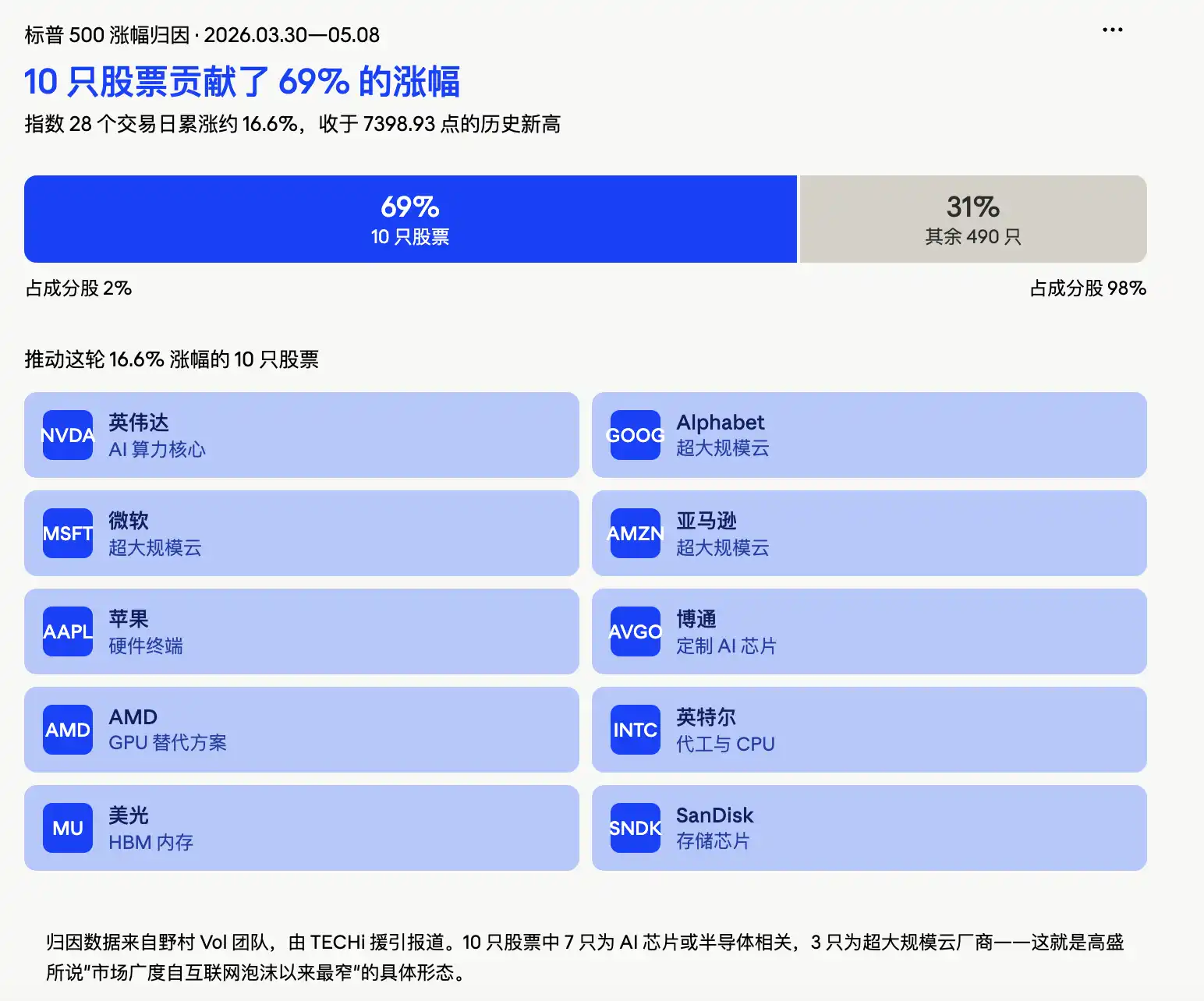
More concerning is the structure of this rally. According to a return attribution chart from Nomura's Vol team cited by TECHi, of the S&P 500's roughly 16% gain since March 30th, 10 stocks contributed 69%: Alphabet, Nvidia, Amazon, Broadcom, Intel, Micron, Apple, AMD, Microsoft, SanDisk. The remaining 490 constituents contributed only 31%. Goldman Sachs' U.S. equity strategy chief Ben Snider also pointed out that current market breadth has fallen to one of the narrowest levels since the dot-com bubble era. Goldman lists "AI Megaprojects" and "Iran Conflict" as the two clearest stock market risks for the coming weeks.

The Shorts Have Been Squeezed Out, Who Will Push the Next Leg?

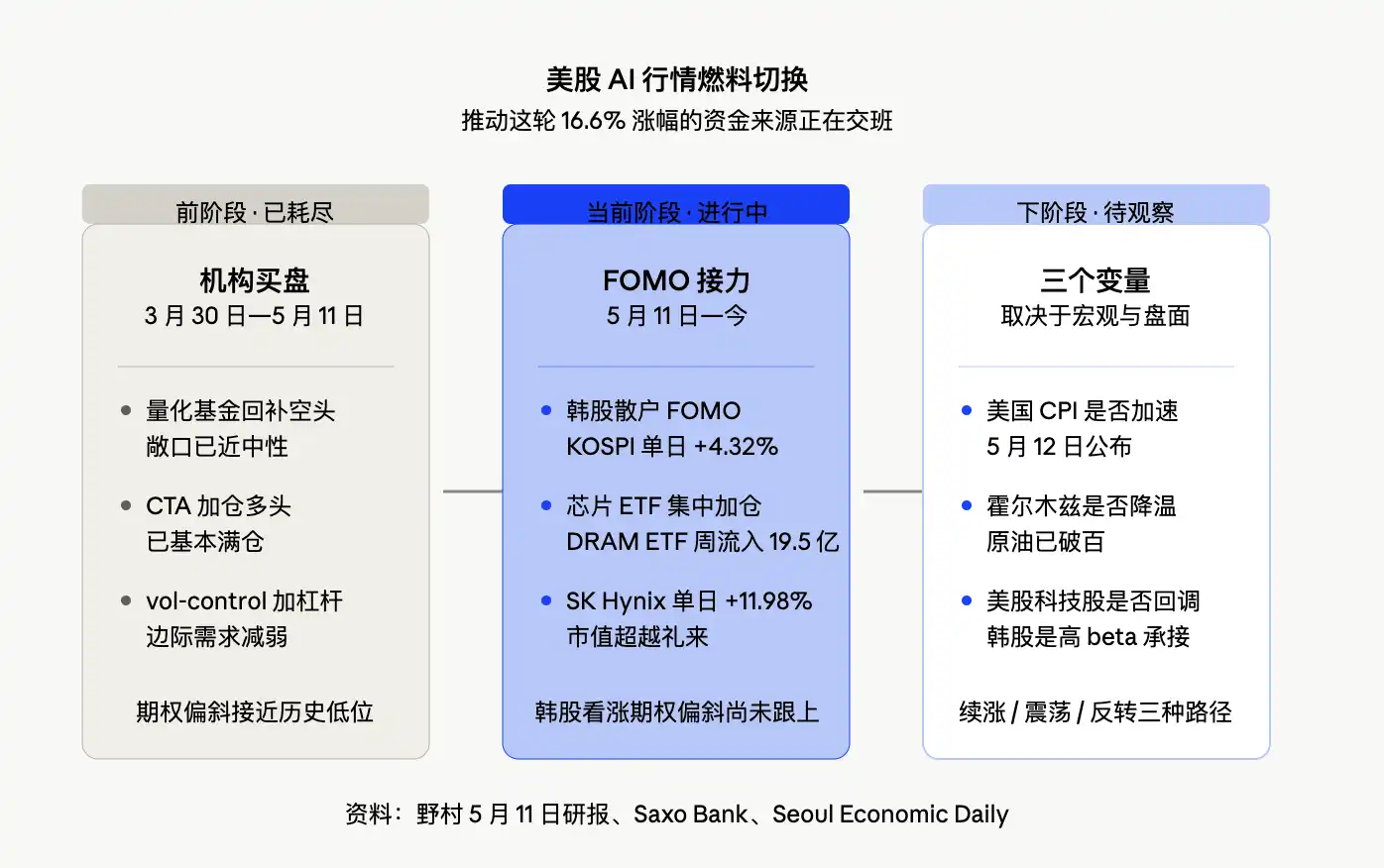
The real killer judgment in Nomura's report isn't the "anomalous combo" itself, but its dissection of fund flows: Quant funds' equity exposure has recovered to near neutral, and the process of forced buying and short covering is largely complete. CTA (Commodity Trading Advisor) funds have largely returned to full long positions, and the marginal incremental demand from volatility control strategies is also waning.

In other words, the three main buying forces that drove AI stocks higher in recent weeks—shorts being squeezed, CTAs adding positions, and declining volatility prompting vol-control funds to add leverage—are all nearing their limits. If AI stocks are to continue rising, they can no longer primarily rely on the "short squeeze" buying force.

It's important to note that Nomura's estimates of quant fund, CTA, and macro fund positioning are based on model calculations, not actual measured holdings. This makes them better suited as a temperature gauge for marginal changes rather than a precise positioning table. Even so, the direction is clear: Programmatic buying from the institutional side is nearing its limits, and subsequent upward momentum must rely more on retail and sentiment-driven capital.

Goldman's trading desk largely agrees with Nomura's assessment. Goldman's One-Delta trading desk head Rich Privorotsky recently described the current pace as "semi-irrational chasing," drawing a comparison to 1999, when overflowing telecom equipment orders provided a "physical bottleneck narrative," similar to the current logic of AI compute scarcity. Goldman's volatility trading desk characterized recent dynamics as "spot up, volatility up," which limits the space for systematic strategies to add further positions.

This assessment means the U.S. stock AI trade isn't breaking, but the script of "pushing higher by squeezing shorts" is nearing its end.

Korean Stocks Provide the Answer: On the Day of Nomura's Report, KOSPI Surges 4.32%, Triggering Buy-Side Sidecar

Another judgment in Nomura's report was: For the AI trade to have another leg, the true signal for continuation would be to watch for a resurgence of FOMO in Korea.

The Korean market responded with an extreme outburst on the very day the report was released. The KOSPI closed at 7822.24 points, up 4.32% for the day, touching 7899.32 points during the session, which triggered a buy-side sidecar. SK Hynix surged 11.98% to 1.888 million KRW, with its market cap surpassing Eli Lilly for the first time to become the 14th largest globally. Samsung Electronics rose 6.33% to 285,500 KRW. The combined market cap of the two companies exceeded 3,000 trillion KRW, accounting for nearly half of the KOSPI's total market cap. The combined market cap of the Korean stock market (KOSPI and KOSDAQ) exceeded 7,000 trillion KRW for the first time, just 8 trading days after breaking 6,000 trillion KRW on October 27th.

During the May 12th session, the KOSPI further broke above 3900 points (the 7900-point level), setting another new all-time high. However, data from the same day revealed the other side of FOMO: Of the 948 stocks on the KOSPI, only 186 rose while 696 fell; approximately 30% of the index constituents have fallen year-to-date. Gains were entirely concentrated in the two semiconductor heavyweights, Samsung and SK Hynix.

A retail FOMO has already spawned new market vocabulary. Korean financial media uses "hynix FOMO" to describe the psychological divide among retail investors: on one side, the regret of missing out ("I should have bought at 800,000 KRW"), and on the other, the anxiety of "should I jump in now?" and "a correction is coming soon." Retail communities are flooded with discussions about "Samjeon-nix" (a portmanteau of Samsung + Hynix). This is a typical retail-driven chasing pattern, highly consistent with the "FOMO signal" Nomura defined.

The flow of foreign capital is even more telling. According to a Seoul Economic Daily report on May 10th, the iShares MSCI Korea ETF (EWY) saw net outflows of $1.0145 billion between May 1st and 7th, a signal of passive fund withdrawal from the Korean market. However, during the same period, the Roundhill Active DRAM ETF saw net inflows of $1.9538 billion. This ETF has a 25.94% weighting in SK Hynix and 21.62% in Samsung Electronics, totaling about 48%. Foreign capital isn't selling Korea, they are selling broad-based ETFs and buying chips, a precise overweighting of the AI theme.

One detail warrants caution. Nomura's May 11th report pointed out that the KOSPI 200 also showed "spot up, volatility up," but the call skew didn't rise alongside it. This doesn't look like volatility expansion driven by call-buying chase demand. In other words, as of the report's release, the Korean market had not yet entered a typical "fear of missing out, scrambling for calls" state. Whether this signal reverses quickly after the KOSPI's surge that day will be key to judging the sustainability of the FOMO.

Korean Stocks are an Extension of the U.S. AI Capex Chain; How Long the Next Leg Lasts Depends on the "Pyramid's Apex"

The Korean FOMO is not an isolated event; it's essentially a high-beta extension of the U.S. stock AI capital expenditure story.

Data directly anchors this transmission chain. According to Bridgewater estimates, Alphabet, Amazon, Meta, and Microsoft are projected to collectively invest around $650 billion in AI-related infrastructure in 2026. Goldman Sachs cites data showing that the consensus estimate for the largest cloud infrastructure companies' 2026 capex jumped by $130 billion last quarter to $670 billion, equivalent to over 90% of these companies' projected operating cash flow. Microsoft's Q3 capex reached $31.9 billion, Alphabet's Q1 property and equipment purchases were $35.7 billion, and Meta raised its 2026 capex guidance to a range of $125-145 billion.

This money flows into data centers, GPUs, memory, networking, power systems, and cloud capacity. SK Hynix and Samsung sit at the core of this money flow, with HBM4 memory and high-bandwidth memory being snapped up by hyperscale cloud providers. According to a Reuters report, SK Hynix recently received "unprecedented" order proposals from major tech companies, with some customers proactively offering to help finance new production lines and ASML lithography machines. Chip capacity is essentially sold out. This is why the KOSPI's single-day 4.32% surge is narratively coherent—Korean stocks are essentially the "second derivative" of the U.S. AI story.

But this linkage also implies vulnerability. If U.S. tech stocks experience a full-scale reversal, Korean stocks would be the most direct high-beta asset to bear the selling pressure. Another risk path mentioned by Nomura is a resurgence of inflation forcing global central banks to be more hawkish. This week's (May 12th) U.S. CPI is a key event, yet the premium in options markets for this event remains low; the market hasn't paid a high insurance premium for this risk yet.

There's one more variable in the macro backdrop: The Strait of Hormuz. WTI crude closed at $100.09 on May 8th (+4.89%), Brent crude at $105.66 (+4.31%). Conflict near the Strait of Hormuz continues to escalate. Nomura's judgment is: As long as the Strait remains obstructed and the U.S. and Iran remain divided on ceasefire terms, the AI-dominated market environment may last longer than expected. Energy price shocks will lift inflation expectations but could also make the market even more reluctant to leave "the AI story that's making money."

Layering these clues together: The phase of the U.S. stock AI rally driven by "squeezing shorts" is nearing its end. Korean FOMO has been ignited, with retail and foreign chip ETFs adding positions in sync, but the option skew hasn't caught up yet. How long the next leg lasts depends on whether U.S. tech stocks correct, whether U.S. CPI signals accelerating inflation, and whether the Strait of Hormuz ultimately cools down. Nomura's report's judgment framework is being validated one by one by market action. Seoul is becoming the latest epicenter of this AI trade.

Связанные с этим вопросы

QAccording to Nomura's report, what are the three main forces behind the recent AI stock rally in the US market, and why is their influence now considered to be nearing its limit?

AThe three main forces identified are: 1) Short covering (shorts being squeezed), 2) CTA (Commodity Trading Advisors) funds adding long positions, and 3) Volatility-control strategies increasing leverage as volatility receded. Their influence is nearing its limit because quantitative fund equity exposure is back near neutral, CTAs are mostly back to full long positions, and the 'spot up, VIX up' dynamic has limited the room for further systematic buying from these strategies.

QWhy does the article suggest South Korea's stock market (KOSPI) has become a focal point for the next phase of the AI trade, and what evidence supports this?

AThe article suggests South Korea is the next focal point because its market exhibited classic FOMO (Fear Of Missing Out) behavior driven by retail investors, precisely as predicted by Nomura's report. Evidence includes: KOSPI's 4.32% single-day surge triggering a buy-side circuit breaker; SK Hynix rising nearly 12% and Samsung Electronics rising over 6%; massive inflows into the Roundhill Active DRAM ETF concentrated on chip stocks; and the emergence of 'hynix FOMO' sentiment among Korean retail investors.

QWhat does the 'spot up, volatility up' dynamic observed in US indices like the Nasdaq indicate, and why is it considered an 'abnormal signal'?

AThe 'spot up, volatility up' dynamic means that while stock indices are hitting record highs, the CBOE Volatility Index (VIX) and Nasdaq Volatility Index (VXN) are also rising. This is considered an abnormal or contrary signal because typically, when markets rally to new highs, investor fear subsides, leading to lower volatility (VIX down). The concurrent rise suggests institutional investors are still hedging against potential downside even as prices climb, indicating underlying caution and crowded positioning.

QHow is the Korean stock market's AI rally fundamentally linked to the AI capital expenditure story in the US?

AThe Korean stock market's AI rally is a high-beta extension of the US AI capital expenditure story. Massive AI infrastructure spending by US tech giants like Alphabet, Amazon, Meta, and Microsoft (estimated at hundreds of billions annually) flows directly into data center components, including high-bandwidth memory (HBM) and DRAM chips. South Korean firms SK Hynix and Samsung Electronics are dominant suppliers in this critical segment. Therefore, the surge in their stock prices reflects the intense demand and 'scarcity narrative' downstream from US tech capital spending.

QAccording to the article, what are the key risks that could determine how long the current phase of the AI trade, centered on Korea, can last?

AThe key risks are: 1) A significant correction or reversal in US tech stocks, which would directly pressure high-beta Korean chip stocks. 2) US CPI data showing accelerating inflation, which could force central banks into more hawkish policies and disrupt the low-rate environment favorable for growth stocks. 3) Escalation of conflict around the Strait of Hormuz, which could spike oil prices, increase inflation fears, and create broader market instability.

Похожее

GitHub, Transfixed by AI

On the night of February 9th, GitHub suffered a major outage caused by a simple configuration change—reducing a cache refresh interval from 12 to 2 hours—that triggered a cascade of failures. This was not an isolated event, but part of a broader pattern. In early 2026, GitHub experienced at least 8 major incidents, failing to meet its promised 99.9% availability. These outages stemmed from structural issues: explosive growth in load, tight service coupling, and insufficient protection against abnormal traffic. This unprecedented load is driven by AI Agents. In 2025, GitHub handled ~1 billion commits. By 2026, weekly commits reached 275 million, projecting to ~14 billion for the year—a 14x increase. AI tools like Claude Code now contribute 4.5% of all public repository commits, with weekly submissions surging 25x in just three months. AI-generated pull requests jumped from 4 million to 17 million per month in half a year. Unlike human developers, AI Agents work continuously, generating commits at a scale that overwhelms infrastructure designed for human rhythms. The surge also shattered GitHub's business model. Copilot's flat-rate pricing, based on assisting human developers, became unsustainable as Agentic AI sessions consumed resources worth hundreds of dollars for a few dollars in fees. In response, GitHub imposed usage limits and, by June 1st, shifted to a pay-per-use "AI Credits" system. Facing this new reality, GitHub realized a 10x scaling plan was insufficient. It announced a need to *redesign* its architecture for 30x current scale—decoupling services, adding fault isolation, and improving change management to prevent cascading failures. Other platforms like Stripe and AWS are facing similar challenges with AI Agents. Fundamentally, GitHub is transitioning from a human collaboration platform to an "exhaust pipe" for automated AI workflows. Its detailed post-mortem reports aim to maintain trust during this turbulent rebuild. The February outage was not just a technical glitch, but a signal of the software industry's entry into a new, AI-driven era.

marsbit16 мин. назад

GitHub, Transfixed by AI

marsbit16 мин. назад

Both Suffer Massive Losses Exceeding $90 Billion, Which Is in Greater Peril: Strategy or Bitmine?

Facing massive paper losses exceeding $90 billion each amidst a sharp market downturn, "Digital Asset Treasury" (DAT) giants Strategy and Bitmine find themselves in a precarious position, but with different underlying risks. Strategy, heavily invested in Bitcoin (BTC), faces significant financial strain. Its strategy relies heavily on debt, including convertible notes and preferred stock (STRC) requiring substantial dividend payments. With its cash reserves dwindling and BTC offering no staking yield for cash flow, Strategy's high leverage makes it vulnerable. A continued price decline could force asset sales to meet obligations, potentially creating a negative feedback loop. Its market value has already fallen sharply. In contrast, Bitmine, an Ethereum (ETH) holder, appears on firmer financial ground. It primarily funds its purchases through equity offerings (like ATM programs), avoiding debt pressure. It also generates income by staking a large portion of its ETH holdings. While not immune to market drops and shareholder dilution concerns, Bitmine maintains more flexibility, recently announcing a new preferred share offering to raise further capital. The core divergence lies in their financing: Bitmine uses equity (investor money), while Strategy uses debt (borrowed money). Consequently, Bitmine currently faces less immediate liquidity pressure than Strategy, which must navigate the dual challenge of servicing debt/dividends and a declining core asset (BTC) price.

marsbit23 мин. назад

Both Suffer Massive Losses Exceeding $90 Billion, Which Is in Greater Peril: Strategy or Bitmine?

marsbit23 мин. назад

Where the AI Bubble Really Is: Which Layer of Players Are Naked

AI Bubble: Where It Really Is and Who's Swimming Naked This analysis dissects the AI industry not as a single entity but as a five-layer pyramid, arguing that bubbles are concentrated in specific tiers, not uniformly distributed. **Key Distinction from the 2000 Dot-com Bubble:** Unlike 2000, where companies had stock prices before revenue, today's leading AI players have massive, contract-backed revenue driving their valuations. Core infrastructure demand is real, with every GPU running at full capacity for paying customers. **The Five-Layer Pyramid & Bubble Assessment:** * **L0 (Fab/Manufacturing) & Top L4 (Leading AI Apps): NO BUBBLE.** Companies like TSMC, NVIDIA, major cloud providers (Microsoft, Google, Meta, Amazon), and top AI labs have real revenues and orders. Supply is tightly constrained by TSMC's disciplined capacity control and physical limits like power/land for data centers, preventing a supply glut. * **L1 (Memory): BATTLEGROUND.** Sky-high HBM margins could signal a new structural cycle or a classic "boom before bust." The oligopoly of three major players may enforce supply discipline, making this a high-stakes bet. * **L2 (Interconnect/Optical Modules): BUBBLE TERRITORY.** Companies like Lumentum and AAOI have seen stock surges (4-10x) far outpacing revenue growth. This hardware segment has lower physical barriers to expansion than fabs, allowing speculation. It mirrors the 2000 bubble's epicenter—optics. * **L3 (Infrastructure/"GPU Landlords"): VULNERABLE.** GPU leasing companies profit from the current compute shortage but own no long-term moat. Their business model relies on a temporary bottleneck that will ease as big tech expands and new tech (e.g., potential space-based data centers) emerges. * **L4 Long Tail (VC-backed Startups): STRONG BUBBLE SIGNALS.** VC funding concentration in AI is twice that of the 1999 peak. Many startups with little revenue use the valuation logic of successful giants to justify their own, creating high risk of a "valuation crunch" when funding dries up. **Critical Risks to Monitor:** 1. **GPU Depreciation & Accounting:** Companies extending the assumed useful life of GPUs artificially boost profits. The true economic life depends on future generational leaps from NVIDIA. 2. **"GPU Credit" & Off-Balance-Sheet Leverage:** Emerging structures where shell companies borrow to buy GPUs and lease them out (with chipmakers sometimes investing) move debt off major balance sheets. This echoes the "vendor financing" of 2000 and the securitization risks of 2008, though currently small-scale. 3. **TSMC Abandoning Caution:** If the primary supply bottleneck (TSMC's conservative capacity planning) breaks, runaway supply could trigger a bust. 4. **Algorithmic Efficiency Breakthrough:** A major leap in software efficiency could drastically reduce the need for raw compute hardware, undermining the investment thesis. **Conclusion:** The AI boom is expensive and has frothy areas, but its core is underpinned by real demand and physical supply constraints. The bubble risk is layered: most present in optical components, GPU leasing, and the long-tail startup ecosystem, while the foundational chip manufacturing and leading application layers remain relatively solid—for now.

marsbit36 мин. назад

Where the AI Bubble Really Is: Which Layer of Players Are Naked

marsbit36 мин. назад

Торговля

Спот
Фьючерсы

Популярные статьи

Как купить NOM

Добро пожаловать на HTX.com! Мы сделали приобретение Nomina (NOM) простым и удобным. Следуйте нашему пошаговому руководству и отправляйтесь в свое крипто-путешествие.Шаг 1: Создайте аккаунт на HTXИспользуйте свой адрес электронной почты или номер телефона, чтобы зарегистрироваться и бесплатно создать аккаунт на HTX. Пройдите удобную регистрацию и откройте для себя весь функционал.Создать аккаунтШаг 2: Перейдите в Купить криптовалюту и выберите свой способ оплатыКредитная/Дебетовая Карта: Используйте свою карту Visa или Mastercard для мгновенной покупки Nomina (NOM).Баланс: Используйте средства с баланса вашего аккаунта HTX для простой торговли.Третьи Лица: Мы добавили популярные способы оплаты, такие как Google Pay и Apple Pay, для повышения удобства.P2P: Торгуйте напрямую с другими пользователями на HTX.Внебиржевая Торговля (OTC): Мы предлагаем индивидуальные услуги и конкурентоспособные обменные курсы для трейдеров.Шаг 3: Хранение Nomina (NOM)После приобретения вами Nomina (NOM) храните их в своем аккаунте на HTX. В качестве альтернативы вы можете отправить их куда-либо с помощью перевода в блокчейне или использовать для торговли с другими криптовалютами.Шаг 4: Торговля Nomina (NOM)С легкостью торгуйте Nomina (NOM) на спотовом рынке HTX. Просто зайдите в свой аккаунт, выберите торговую пару, совершайте сделки и следите за ними в режиме реального времени. Мы предлагаем удобный интерфейс как для начинающих, так и для опытных трейдеров.

466 просмотров всегоОпубликовано 2025.09.30Обновлено 2026.06.02

Как купить NOM

Обсуждения

Добро пожаловать в Сообщество HTX. Здесь вы сможете быть в курсе последних новостей о развитии платформы и получить доступ к профессиональной аналитической информации о рынке. Мнения пользователей о цене на NOM (NOM) представлены ниже.

活动图片