Shiba Inu SOU Recovery System Goes Live After Shibarium Hack

bitcoinistОпубликовано 2026-02-17Обновлено 2026-02-17

Введение

Shiba Inu has launched its SOU (Shib Owes You) recovery system to compensate users affected by the 2025 Shibarium bridge exploit. The on-chain NFT-based framework allows users to claim verifiable records of their losses, which are tradable, mergeable, and splittable on Ethereum. The system distinguishes between principal repayments and bonus rewards, funded through ecosystem revenues and community donations. It aims to provide transparency and liquidity options, enabling affected participants to either wait for full reimbursement or sell their claims on secondary markets.

Shiba Inu has put its long-trailed SOU recovery framework into production, opening claims for users affected by last year’s Shibarium bridge exploit and turning those claims into transferable, on-chain NFTs on Ethereum. The launch matters because it moves the project’s compensation effort from a promised structure into a live system with visible balances, payout mechanics, and a secondary-market option for anyone who wants liquidity now.

The SOU concept itself isn’t new. In a year-end letter dated Dec. 29, 2025, Shibarium developer Kaal Dhairya introduced “SOU: Shib Owes You” while stressing it was “Not live yet, beware of scammers,” describing it as a system where “every affected user has an SOU NFT — an on-chain, verifiable record of exactly what the ecosystem owes them.”

Shiba Inu ‘Shib Owes You’ Goes Live

That warning is now being replaced by a go-live announcement. Via X, the official Shiba Inu account wrote:

“SOU is live. Introducing SOU (Shib Owes You) an onchain NFT built as a good-faith effort to support impacted users with payouts, donations, and occasional rewards. Transparent. Tradable. On-chain. You can transfer it, split it, merge it, or trade it on marketplaces. Claim your SOUs: https://shib.io/sou”

In Shib’s documentation, the system is framed as an attempt to make the recovery ledger public, auditable, and mechanically enforced rather than tracked in private databases. “SOU (Shib Owes You) is more than just a name; it is a commitment,” the docs say.“It represents the Shib ecosystem’s dedication to making users whole through a transparent, audited, and on-chain recovery system. Activity Notifications: The system provides a real-time activity feed, notifying the community whenever a new donation is received or a payout is distributed, ensuring complete visibility into the recovery progress.”

The mechanism hinges on two balances: “Original Principal,” the immutable historical record of what a user lost, and “Current Principal,” which declines as payouts are claimed or contributions flow in. The docs also draw a hard distinction between debt repayment and incentives. “Payout” reduces principal as compensation, while a “Reward” is additive and “No Change” to the owed balance, positioning rewards as bonuses on top of repayment rather than substitutes.

SOU is also designed to be a financial instrument, not just a receipt. Claims can be merged or split to manage position sizing, transferred between wallets, or sold on marketplaces, effectively enabling a market in discounted claims for users who don’t want to wait for recovery flows.

Shib’s docs also describe a funding model that routes ecosystem revenues and community donations into a common pool, with donations applied proportionally across affected claims, and optional creator fees on secondary sales directed back to payouts or rewards.

The backdrop is the September 2025 Shibarium bridge incident, where Shib’s own security update said “unauthorized validator signing power” was used to push a malicious exit through the PoS bridge, enabling withdrawals of multiple assets.

At press time, Shiba Inu traded at $0.00000656.
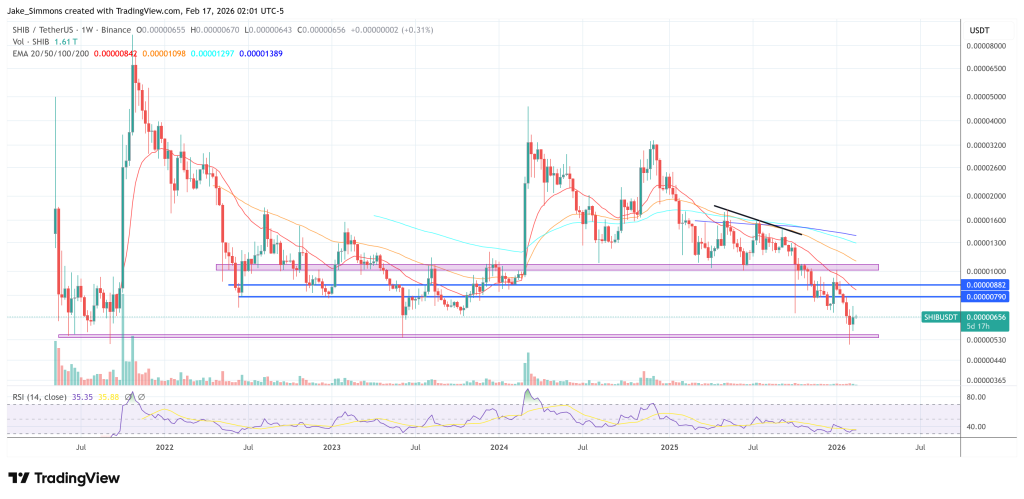
Shiba Inu trades near historical lows, 1-week chart | Source: SHIBUSDT on TradingView.com

Похожее

Who Funds the Agents?

**Summary: Who Funds AI Agents?** OpenAI recently shut down a feature allowing AI agents to shop for users, highlighting the challenge of creating a secure and regulated environment for agent-driven transactions. While payment infrastructure exists, a crucial governance layer—defining spending limits, fraud detection, tax handling, and return policies—is largely missing. The potential is enormous: AI agents already processed $73M across 176M transactions last year, with McKinsey forecasting this could grow to $3-5T in global consumer commerce by 2030. The core competition isn't just about processing payments, which can be very cheap (especially with crypto-based settlement), but about controlling the rules that govern agent spending. Key players like Stripe and Coinbase are racing to dominate this governance layer. Stripe's acquisition of wallet provider Privy allows it to set spending policies, identity checks, and human-in-the-loop approvals directly at the wallet level. Similarly, Coinbase's stack, including its x402 protocol and AgentKit, embeds governance rules. This vertical integration across settlement, wallet, and governance layers is becoming the dominant strategy. Control over the governance layer is where significant future value lies. If agents handle trillions in transactions, even a small fee for managing compliance, fraud prevention, and policy enforcement could generate billions in annual revenue. The companies that successfully integrate across the payment stack will capture value from idle agent balances, transaction fees, and governance services, positioning themselves as the foundational banks of the AI agent economy.

marsbit20 мин. назад

Who Funds the Agents?

marsbit20 мин. назад

A Nation Blocks Chips, a Giant Buys a Nuclear Power Plant: Why It's Time to Seriously Consider DeAI

**Title: Great Powers Blockade Chips, Giants Buy Nuclear Plants: Why It's Time to Seriously Consider DeAI** In May 2026, the US closed loopholes for Chinese firms to acquire advanced NVIDIA chips via overseas subsidiaries. That same month, Kenya halted a $1B geothermal data center project involving Microsoft, fearing its immense energy consumption. Meanwhile, Huawei announced mass production of its Ascend AI chip. These disparate events underscore a new reality: the competition for computing power ("compute") has escalated beyond the tech industry, becoming a geopolitical and infrastructural battleground. A new era of oligopoly is forming, with control over the AI stack—from GPU chips (NVIDIA) and cloud platforms (AWS, Azure, Google Cloud) to foundational models (OpenAI, Anthropic)—concentrating in a few Western "AI Octopus" corporations. This centralization creates systemic risks: pricing power and platform lock-in for users, infrastructure fragility, and a widening "compute divide" that threatens to marginalize nations without independent AI capacity. An "AI Iron Curtain" is deepening through export controls. In response, some nations like Saudi Arabia and the UAE are investing heavily to buy compute power, aiming to transition from oil to AI economies. The EU seeks to triple its compute capacity by 2030 to reduce dependency. However, the spending gap is vast, with four US tech giants alone planning ~$750B in AI capex for 2026. The race is increasingly constrained by energy, with AI tasks consuming up to 1000x more power than web searches, pushing firms to even acquire nuclear plants. This landscape is fueling interest in Decentralized AI (DeAI). It proposes a third way: using open protocols to coordinate a global network of idle GPUs, independent developers, and data centers, creating an AI infrastructure without a single controlling entity. Leveraging blockchain and cryptographic verification, DeAI aims to break market concentration, disperse energy demands, reduce geopolitical dependencies, and enhance transparency. While still nascent in performance and stability, DeAI's core promise is not immediate superiority but providing a crucial alternative architecture to resist monopoly, censorship, and centralized power. As specialized AI hardware costs fall and open-source models flourish, the window to build this foundation is open. The very existence of such competition serves as a vital check against the inevitable abuse of concentrated power.

marsbit1 ч. назад

A Nation Blocks Chips, a Giant Buys a Nuclear Power Plant: Why It's Time to Seriously Consider DeAI

marsbit1 ч. назад

Торговля

Спот
Фьючерсы
活动图片