Senator Urges Banking Regulator To Block Crypto Charter Linked To Trump

bitcoinistОпубликовано 2026-01-14Обновлено 2026-01-14

Введение

Senator Elizabeth Warren has urged the Office of the Comptroller of the Currency (OCC) to halt the review of a national trust bank charter application from World Liberty Financial, a crypto firm linked to former President Donald Trump. Warren argues that approving the charter while Trump retains financial ties could create serious ethical conflicts and undermine public trust in regulators. The firm aims to use the charter to issue and manage its dollar-pegged stablecoin, USD1, which has grown to over $3.3 billion in circulation since its launch. Other Democrats have expressed similar concerns, emphasizing the need for regulatory independence when reviewing politically connected applicants.

United States President Donald Trump’s family-backed crypto firm has applied for a national trust bank charter, and one of the Senate’s most vocal financial critics wants regulators to stop the process until the President severs his financial ties to the venture.

According to filings and public statements, the firm aims to use the charter to issue and manage a dollar-pegged stablecoin called USD1, which has grown quickly since launch.

Warren Raises Conflict Concerns With The OCC

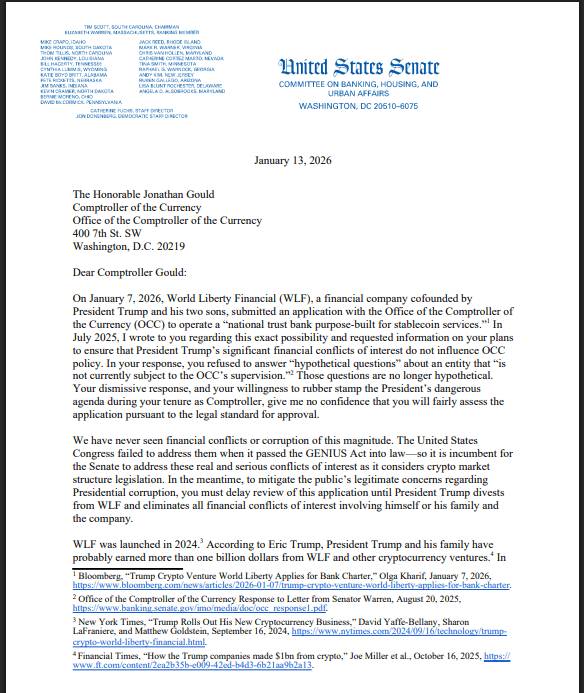
US Senator Elizabeth Warren sent a formal letter to Comptroller Jonathan Gould asking the Office of the Comptroller of the Currency (OCC) to pause its review of the application until Trump divests and fully eliminates financial links to World Liberty Financial, reports say.

The senator wrote that approving a federally chartered bank while the sitting President retains ties to the business could create serious government ethics problems.

Warren's letter to Comptroller of the Currency, Jonathan Gould.

The Company’s Plan And Its Scale

World Liberty Financial wants a national trust bank that would offer stablecoin issuance, custody and conversion services.

The stablecoin USD1 has reached more than $3.3 billion in circulation since its launch, a figure regulators and lawmakers are watching closely as the firm seeks federal oversight.

The move would place certain crypto activities under the same kind of supervision given to traditional trust banks.

Pushback And Political Risk

Reports note that Warren’s demand is rooted in a concern about the public’s trust in regulators. She asked the OCC for a written reply by January 20, highlighting the urgency of the matter for lawmakers who oversee banking rules.

Other Democrats have signaled similar worries about the optics and legal questions that could follow if a regulator reviews a bank linked to the incumbent President.

Total crypto market cap currently at $3.19 trillion. Chart: TradingView

Industry Context And Reaction

Several crypto firms have recently sought national charters or conditional approvals, prompting a broader debate over how stablecoins should be regulated. Supporters of bank charters say federal oversight can protect customers and bring clarity.

Critics argue that when a highly political figure is connected to an applicant, extra caution is required so that regulatory independence is preserved. Reporting on this case has focused on both the bank application and the potential effect on trust in federal agencies.

Other Developments Around The Firm

World Liberty and related affiliates have been active on multiple fronts, including new product launches and international talks. Some outlets noted a newly announced partnership with external parties to explore broader payment uses for USD1, an effort that underlines how quickly the stablecoin has spread.

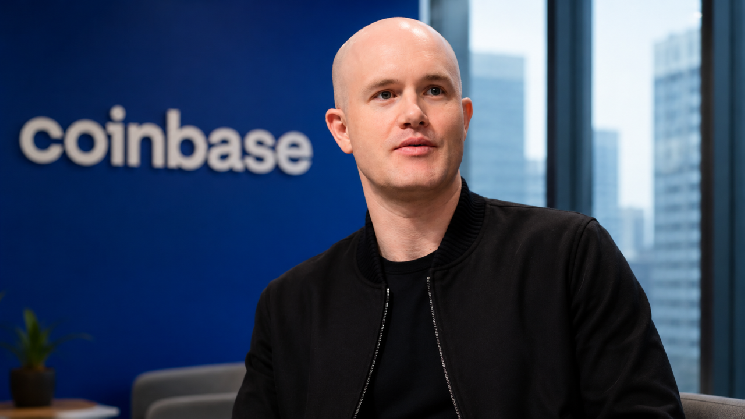
Featured image from Inc/Getty Images, chart from TradingView

Связанные с этим вопросы

QWhat is urging the banking regulator to block the crypto charter linked to former President Trump?

AUS Senator Elizabeth Warren is urging the banking regulator to block the crypto charter.

QWhat is the name of the crypto firm backed by Trump's family that applied for the charter?

AThe firm is called World Liberty Financial.

QWhat specific product does World Liberty Financial want to issue and manage with this charter?

AThe firm wants to issue and manage a dollar-pegged stablecoin called USD1.

QWhat major concern did Senator Warren raise in her letter to the Comptroller of the Currency?

AShe raised concerns about a serious conflict of interest and government ethics problems if the charter is approved while the former President retains financial ties to the venture.

QHow much circulation has the USD1 stablecoin reached since its launch?

AThe USD1 stablecoin has reached more than $3.3 billion in circulation.

Похожее

The Value Distribution of Stablecoins

**Summary: The Value Distribution of Stablecoins** The article argues that stablecoins are evolving from mere trading tools into broader channels for dollar access. It divides the stablecoin ecosystem into four layers to analyze how value is distributed: 1. **Issuance Layer:** Mints stablecoins, holds reserve assets, and captures the spread between reserve yield and user costs (e.g., Tether, Circle). This layer currently earns the largest profit margin. 2. **Infrastructure Layer:** Connects stablecoins to the traditional financial system, handling fiat on/off-ramps, banking integration, compliance (KYC/AML), and asset management (e.g., Bridge, BVNK). This is the "unglamorous" but critical work, building the essential bridges between crypto and real-world finance. 3. **Acquiring/Distribution Layer:** Integrates stablecoins into merchant systems, manages payment flows, and provides enterprise financial software (e.g., Stripe, Coinbase). They act as the access point for businesses. 4. **Application Layer:** The end-users and businesses that ultimately use stablecoins for payments, settlements, or as a store of value. They benefit from convenience but have little pricing power. The core thesis is that while the issuance layer currently dominates profits, the often-overlooked **infrastructure layer holds significant long-term potential**. The real challenge and barrier to mass adoption is not the on-chain transfer of stablecoins (which is simple), but the complex "last mile" integration into existing business workflows, banking systems, and regulatory frameworks across different countries. Companies in this layer are currently in a "land grab" phase, investing heavily to build networks, secure bank partnerships, and establish compliance pathways. While their position is currently pressured by the profitable issuers above and distribution platforms below, the article suggests that if stablecoins become a default financial rail for businesses, the infrastructure providers who have done the hard work of integration will ultimately gain strong pricing power and become entrenched, essential players.

marsbit1 ч. назад

The Value Distribution of Stablecoins

marsbit1 ч. назад

The Value Distribution of Stablecoins

The Value Distribution of Stablecoins The article argues that stablecoins are evolving from a mere trading tool into a broad "dollar channel." It analyzes the industry's value chain through four layers: 1. **Issuance Layer (e.g., Tether, Circle):** The top layer that mints stablecoins, holds reserve assets, and captures the thickest interest rate spread. 2. **Infrastructure Layer (e.g., Bridge, BVNK):** Connects stablecoins to the traditional financial system, handling critical but complex "dirty work" like fiat on/off-ramps, banking integration, compliance (KYC/AML), and cross-border settlement. 3. **Acquiring/Distribution Layer (e.g., Stripe, Coinbase):** Embeds stablecoins into merchant systems, manages payment flows, and integrates with enterprise software. 4. **Application Layer:** End-users and businesses that ultimately use stablecoins for payments, settlement, or storing value. The author posits that while the issuance layer currently captures the most profit, the most overlooked and potentially critical layer is infrastructure. The core challenge for stablecoin adoption isn't the on-chain transfer (which is simple), but bridging the gap between blockchain and the real-world financial system. This involves solving practical problems for businesses: fiat conversion, reconciliation, tax handling, and user onboarding. Infrastructure companies are currently in a difficult "land-grab" phase—building networks, securing banking relationships, and achieving compliance country-by-country. They face pressure from both the profitable issuance layer above and distribution platforms below. However, the author suggests this layer is building a crucial moat. Once stablecoins become a default business rail, the infrastructure players who have done the hard work of integration may gain significant, durable value and pricing power.

链捕手1 ч. назад

The Value Distribution of Stablecoins

链捕手1 ч. назад

How to Do Research Well: Deliberately Practice the Real Skills That Matter

No one truly teaches you how to do research. You're often given a desk, a pre-selected problem, and vague instructions to "create something new." Consequently, many people reverse-engineer the job based on visible outputs—papers, posts, announcements—learning only how to *appear* like a researcher rather than how to *become* one. True research capability is built from stacking small, trainable skills, nearly all of which can be developed through deliberate practice. **Pick Your Own Problem:** Most researchers absorb problems from advisors or trends, lacking the underlying reasoning. Choosing a problem you genuinely care about, as John Schulman advises, leads to original work. Develop "taste" like a muscle: predict experiment outcomes, guess paper results from methods, and track which findings remain important over time. **Upgrade Your Inputs:** Relying on shared reading lists (arXiv hot lists, filtered group chats) leads to unoriginal conclusions. Undervalued old literature often holds crucial insights (e.g., MoE, LSTM, backpropagation). Richard Sutton's "The Bitter Lesson" or Claude Shannon's 1952 talk on creative thinking are more predictive than lengthy modern surveys. Breadth matters as much as depth: draw from neuroscience, mechanism design, hardware knowledge, and honest statistics. Read papers directly, especially appendices and limitations sections. **Write Everything Down:** As Paul Graham noted, writing exposes flaws in seemingly mature ideas. Writing is the cheapest defense against self-deception. Following Feynman's principle, Darwin programmatically wrote down facts contradicting his theory to combat memory bias. Maintain a detailed log of hypotheses, setups, predictions, results, and updated understandings. Reviewing past logs fosters essential humility.

marsbit3 ч. назад

How to Do Research Well: Deliberately Practice the Real Skills That Matter

marsbit3 ч. назад

Торговля

Спот
Фьючерсы
活动图片